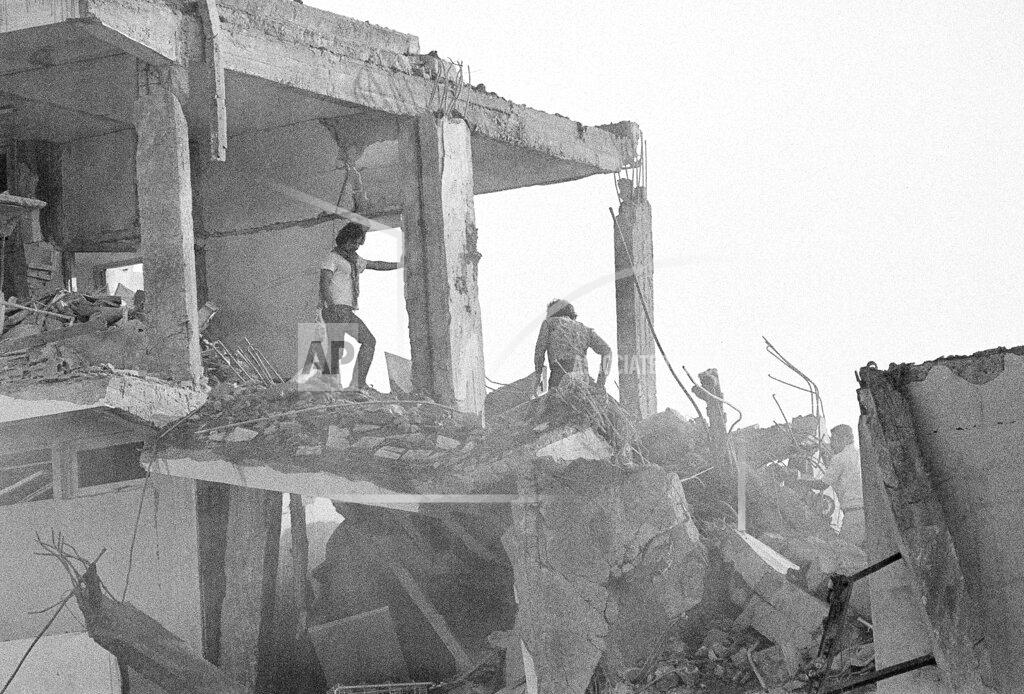
In swift reprisal for Maalot, Israeli planes bombed and strafed Palestinian refugee camps and suspected guerrilla hideouts in Lebanon, reportedly killing more than 20 persons and wounding more than 130. It was the heaviest Israeli attack ever carried out against Lebanon, and reports from the attack zone, where bomb targets were said to include roads and bridges, indicated Israel was making good the threat to render southern Lebanon uninhabitable if Lebanon did not repress local guerrilla forces.
The death toll of Israelis killed at Maalot rose to 24 as a numbed and grief-stricken nation continued to cry for revenge. Despite the intensity of the air raid against Lebanon, some felt it might be only the first step in what Premier Golda Meir vowed would be an effort to “cut off the hands that want to harm a child, an adult, a settlement, a town or a village.”
Several hundred angry mourners shouting, “Revenge! revenge!” disrupted a state funeral in Safad for 18 of the Maalot victims and drove the President and Deputy Premier of Israel out of the cemetery. As the crowd, enraged by the government’s failure to curb terrorists, forced President Ephrim Katzir and Deputy Premier Yigal Allon to their cars, the ceremonies were cut short.
The leader of the Palestinian group that claims responsibility for the attack at Maalot said the mission had been designed to prevent Secretary of State Kissinger from achieving an Arab-Israel settlement that would mean “the surrender of the Palestinian people.” Flanked by armed guerrillas, Nayef Hawatmeh, the leader of the Popular Democratic Front for the Liberation of Palestine, said at a Beirut news conference that the group wanted to demonstrate its rejection of Mr. Kissinger’s mission.
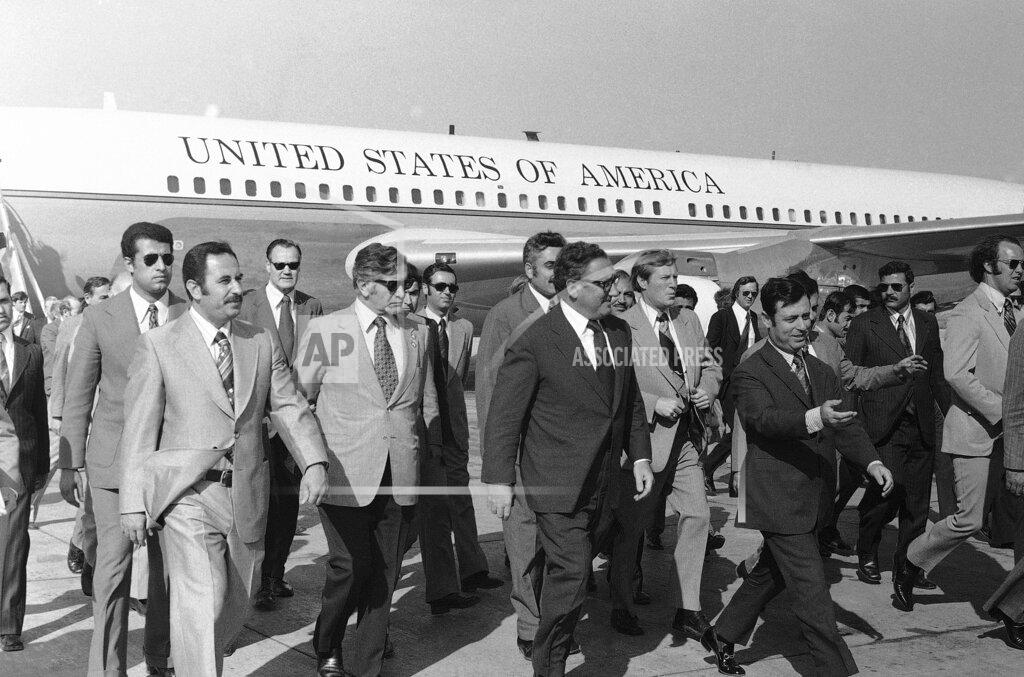
Secretary of State Kissinger flew to Syria with “new approaches” on a disengagement agreement and then returned to Israel, reporting “some progress,” He said he would go back to Syria on Saturday and should know then whether his current mission could produce an agreement.
Terrorist kidnappings of Americans abroad will be met with a U.S. policy of refusal to pay ransom or release political prisoners in answer to ransom demands, a State Department official reaffirmed. Lewis Hoffacker told the House Internal Security Committee, which has been holding hearings on terrorism, that the department advises other governments, individuals and companies to adopt a similar position, which he said was intended to save the most lives in the long run. He said 27 U.S. officials abroad had been kidnaped in the last five years and 10 of them murdered.
Syrian gunners shelled Israeli positions and one settlement on the Golan Heights today, mainly around the salient captured by Israel in the October war, a military spokesman said here. Israel suffered no casualties, he added. The spokesman said the Syrians shelled Israeli positions in the northern and southern sectors of the salient during the morning hours, and later fired on the Israeli settlement of Ein Zivan, three miles south of El Quneitra.
Syria reported that fighting flared up on the Golan Heights today as officials here awaited the arrival of Secretary of State Kissinger. A military spokesman said clashes that had been going on throughout the night on Mount Hermon later extended to other sectors.
In South Vietnam, the Battle of the Iron Triangle began in the Bình Dương Province to repel an invasion by North Vietnam, and would last more than six months. Although the South Vietnamese repelled the invasion and thousands of soldiers of North Vietnam’s People’s Army of Viet Nam (PAVN) were killed, the South’s Army of the Republic of Viet Nam (ARVN) lost hundreds of soldiers. The counterattack came on the same day 5,000 North Vietnamese troops overran the Đắk Pék Camp and its 369-member South Vietnamese Rangers battalion. Spokesmen said half of the 369 men in a ranger battalion defending the isolated Đắk Pék border camp, 300 miles north of Saigon and 12 miles from the Laotian border, were either killed, wounded or missing after all-night assaults. Many of the defenders and 90 percent of the civilians in the town are mountain tribesmen.
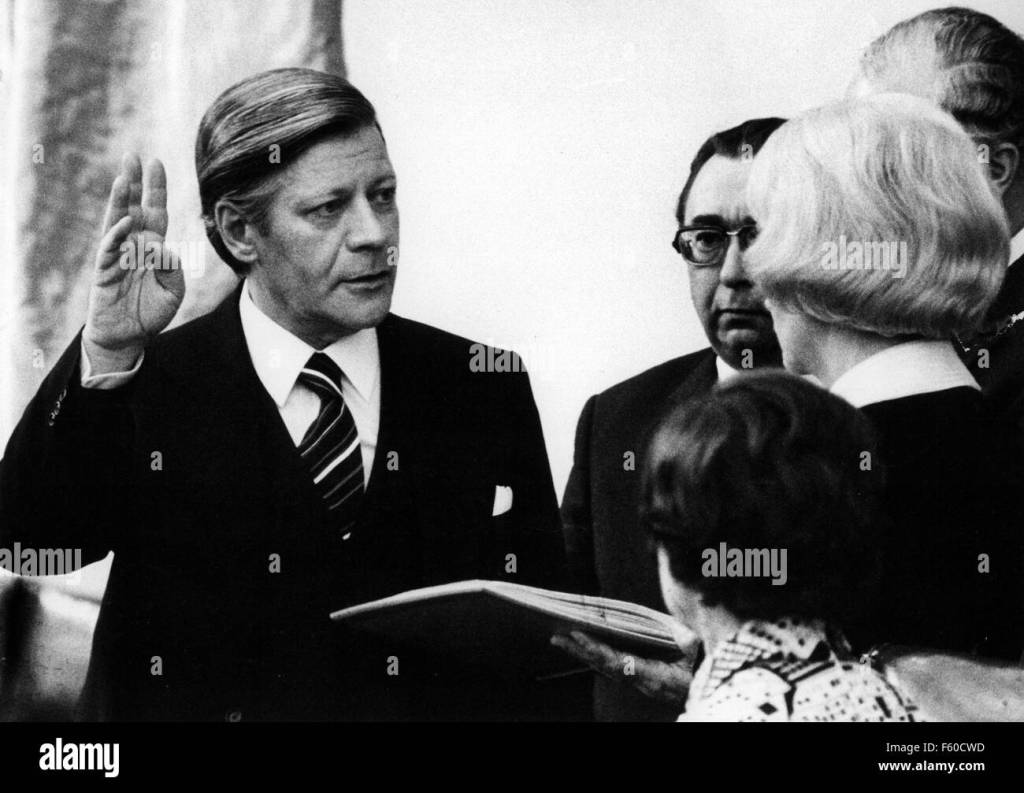
Helmut Schmidt was elected as the new Chancellor of West Germany by the Bundestag by a vote of 267 to 225 along party lines. Helmut Schmidt, elected and sworn in today as West Germany’s fifth postwar chancellor, said that he would “continue the foreign policy conceived and begun” by Willy Brandt, who resigned 10 days ago in an espionage scandal. Mr. Schmidt noted, however, that “at the moment we have to concentrate more strongly on domestic political problems, in the broadest sense.” The new Chancellor spoke short television interviews. He will formally present his Cabinet and deliver a policy speech tomorrow. Mr. Schmidt, who served as Defense Minister and later as Finance Minister in Mr. Brandt’s cabinets from 1969 to this year, took his oath of office at 4 PM in the Bundestag, the lower house of Parliament. Following the ceremony, the 15 members of his Cabinet were given their certificates of appointment by the outgoing President, Dr. Gustav Heinemann.
Danish workers walked off their jobs by the thousands to protest sales tax increases rammed through parliament by the minority government and a temporary group of parliamentary allies. Typographers shut down major newspapers within hours after the Folketing voted to boost taxes on household goods, cars, cigarettes, beer and wine. Bakery and brewery workers struck during the night and 15,000 shipyard and steel workers later joined in the walkout. The taxes are designed to soak up buying power, curb imports and slow the drain on Denmark’s currency reserves.
Portuguese African guerrilla leaders were invited to Portugal to discuss peace with President Antonio de Spinola’s new government. Spinola, swearing in his left-of-center regime, promised the rebel chiefs free movement in and out of the country during preparations for “an uncontrolled and popular referendum” for Angola, Mozambique and Portuguese Guinea on self-determination. Spinola added that the referendum should cover a wide range of possibilities between total independence and continued reliance on Portugal.
Sicilian Mafia figure Luciano Liggio, head of the Corleone “family.” was captured in a Milan apartment in the company of two bodyguards. Though Liggio, 49, had undergone plastic surgery, police identified him through fingerprints. He had fled a Rome hospital in 1970 after receiving a life prison term for two murders and was to undergo questioning in connection with a wave of kidnappings in northern Italy. His arrest was seen as a major setback for a “new Mafia” operating there.
In Belgrade, Marshal Josip Broz Tito was unanimously re-elected by the 300-member Chamber of Deputies as the President of Yugoslavia and, at the age of 81, given an unlimited term to effectively make him president for life. The Communist nation’s parliament also unanimously approved the selection of the first eight members of the new, nine-member “collective presidency” which would rotate to a new member each year after Tito’s death. Petar Stambolic of the Socialist Republic of Serbia was the first person selected to the new office of Vice President of Yugoslavia for one year, after which the job would rotate to another member of the collective presidency.
A high government source in Venezuela said the country’s foreign-owned oil industry could be nationalized by the end of this year. President Carlos Andres Perez, who was inaugurated March 12, promised during his campaign to nationalize the industry and had said at the time he expected that the machinery for the conversion would be completed within two years. Although not giving a timetable, Perez has now announced the government’s decision to nationalize the industry, and named a 30-member commission of representatives of all political parties, labor, business and the military to make recommendations for the takeover.
Chile’s military junta has tortured political prisoners on at least 134 occasions and 12 prisoners have died from the treatment, according to a report released by the Catholic bishop of Santiago and the Lutheran bishop of Chile. The report, published in Excelsior newspaper of Mexico, said the torture methods included the use of acid, lighted cigarettes, and electric shock.
In voting in the Dominican Republic, Joaquín Balaguer was re-elected President with more than 84% of the vote against his challenger, Luis Lajara Burgos. Balaguer’s Partido Reformista won 75 of the 91 seats in the House of Deputies, and 23 of the 27 seats in the Senate.
Jamaica, the world’s leading exporter of bauxite, the raw material for aluminum, outlined plans to almost triple the taxes and royalties paid by foreign companies.
The USSR performs a nuclear test at the Semipalatinsk Test Site in northeast Kazakhstan.
Former Attorney General Richard Kleindienst pleaded guilty to a minor charge for failing to give full and accurate answers in testifying before a Senate committee investigating the International Telephone and Telegraph Corporation case. Mr. Kleindienst, who was apparently allowed to plead guilty to the lesser offense rather than perjury because of his cooperation with the Watergate prosecutor, was Acting Attorney General at the time of his testimony in 1972.
The House Judiciary Committee met in secret session to hear evidence on how funds. from President Nixon’s 1972 re-election campaign were allegedly used in an effort to buy the silence of the Watergate burglars. The chairman, Representative Peter Rodino, said the hearings would probably continue in private through next week despite a request by President Nixon’s attorney, James St. Clair, that they be conducted in public.
In by far the largest settlement ever made under the Age Discrimination in Employment Act, the Standard Oil Company of California agreed to pay $2 million to 160 former employees and to rehire 12 of them. The employees maintained that their dismissals violated the 1967 law, which prohibits discrimination against employees between the ages of 40 and 65.
The Senate voted to designate the Admiral’s House on the Naval Observatory grounds as the official residence of the U.S. Vice President. The three-story house, built in 1893, has been the home of the chief of naval operations for 40 years. The resolution goes to the House, where bills are pending to construct a vice presidential residence. Sen. Harry F. Byrd Jr. (Ind.-Virginia) estimated that the Admiral’s House could be made “habitable” for the Vice President for $15,000, plus a minimum of $33,000 in Secret Service security equipment.
The wife of a Waverly, Minnesota, banker was abducted from her home and held for 35 hours before her husband paid $50,000 ransom for her safe return, the FBI said. Authorities said they had arrested and filed charges against Charles W. Ward, 28, of Golden Valley, a Minneapolis suburb. A family spokesman said Daniel Graham, 55, president of Citizens State Bank, paid the ransom for his wife, Ardis, 47, who was forced from their home by a lone abductor. Authorities said the ransom was found in Ward’s apartment. The FBI said law enforcement agencies did not learn of the kidnaping until an hour after Mrs. Graham was reunited with her husband.
The Food and Drug Administration announced that up to 200,000 recently approved copper intrauterine contraceptive devices (IUDs) are being withdrawn from the market because of a risk of infections. The FDA said the recall did not apply to another 100,000 of the devices which the manufacturer, G. D. Searle & Co., said may already be in use. The agency said the firm reported that it was recalling all of its new CU-7 devices.
John C. Sawhill, head of the Federal Energy Office, said new regulations just proposed on costs and pricing will be used to test oil companies’ actions since the Arab oil embargo last October. Sawhill earlier had charged that consumers might have been gouged out of more than $100 million by accounting methods that artificially inflated prices during the energy crisis. A $46 million price rollback case has already been started against Gulf Oil Co. The FEO audit will not be completed before the end of the month but sources say the estimated $100 million stemming from overcharges alone, which is part of a larger FEO investigation of oil companies, might be “conservative.”
Chicago’s buses and elevated and subway trains ceased operations as a negotiating session between the Chicago Transit Authority and the Amalgamated Transit Union failed to avert a midnight strike by 11,000 union employees. The strike is the first in 55 years against the CTA, which serves more than a million persons in the Chicago area. Leonard Beatty, president of District 308 of the ATU, said that negotiators for the CTA and the union would continue their talks.
The Senate narrowly approved today a weakened version of provision aimed at barring the long‐distance busing of children to end school segregation but leaving the final decision on school busing cases to the courts. The compromise, drafted by the Senate’s two top leaders, Hugh Scott of Pennsylvania, the minority leader, and Mike Mansfield of Montana, the majority leader, was approved, 47 to 46, during a series of seesaw votes that indicated that neither the civil rights bloc or the antibusing bloc in the Senate had a decisive majority. The final product was a much milder version of an antibusing amendment previously passed by the House and supported by the White House but tabled by the Senate yesterday by a one‐vote margin. It would allow school children to attend the school “closest or next closest” to their homes but specifies that the provisions “are not intended to modify or diminish the authority of the courts of the United States to enforce fully” the United States Constitution.
Twenty years ago, Chief Justice Earl Warren, writing for all of his colleagues on the United States Supreme Court, asked the following key question: “Does segregation of children in public schools solely on the basis of race, even though the physical facilities and other ‘tangible’ factors may be equal, deprive the children of the minority group of equal educational opportunities?”
In its answer to this question, the Brown v. Board of Education of Topeka decision established its claim to historic compassion and revealed fundamental concern with the quality and requirements of humanity, not frequently found in legal discourses and decisions, by a simple, eloquent answer. It was: “To separate them from others of similar age and qualifications solely because of their race generates a feeling of inferiority as to their status in the community that may affect their hearts and minds in a way unlikely ever to be undone.”
Chief Justice Warren then quoted from the findings in the Kansas case: “Segregation of white and colored children in public schools has a detrimental effect upon the colored children. . . the policy of separating the races is usually interpreted as denoting the inferiority of the Negro group. A sense of inferiority affects the motivation of a child to learn.” The decision then concludes: “Separate educational facilities are inherently unequal.”
These findings are as true today as they were in May, 1954. They will remain true as long as American children are required to attend racially segregated schools anywhere in this nation—the rural or urban South or the urban and suburban North — wherever there exists a recognizable proportion of children of different racial, ethnic or nationality backgrounds who are required to attend public schools.
United States District Judge Alfonso J. Zirpoli ordered two persons jailed today who had refused to testify before a Federal grand jury investigating the Patricia Hearst kidnapping in San Francisco. Judge Zirpoli held Cynthia Garvey, 23 years old, and Paul Halverson, 29, in contempt of court for refusing to testify after they were granted partial immunity last week. The sentence is for the remainder of the term of the grand jury, which is 16 months. This could be extended 18 months more. Judge Zirpoli refused to grant either of the two bail pending appeal. Miss Garvey was asked eight questions and Mr. Halverson five. They each refused to testify one the ground that partial immunity did not guarantee their Fifth Amendment right against self‐incrimination and that they and their attorney had been illegally wiretapped. Judge Zirpoli ruled against the contention yesterday.
“Dybbuk,” a ballet by Jerome Robbins with music by Leonard Bernstein, premiered in New York City at the Lincoln Center.
Behind the pitching of Carl Morton, the Braves defrock the host Padres, 11–1. Davey Johnson has a pair of homers and Marty Perez drives in 6 runs on a single, double and homer.
Dow Jones Industrial Average: 835.34 (-10.72, -1.27%).
Born:
Adam Richman, American TV personality (“Man v Food”), in Brooklyn, New York, New York.
Keith Thibodeaux, NFL cornerback (Washington Redskins, Atlanta Falcons, Minnesota Vikings, Green Bay Packers), in Opelousas, Louisiana.
Jerrod Riggan, MLB pitcher (New York Mets, Cleveland Indians), in Brewster, Washington.
Sonny Sandoval, American metal singer-songwriter, and rapper (P.O.D. – “Youth of the Nation”), in San Diego, California.
Laura Pausini, Italian pop music singer (“Tra te e il mare”; “Surrender”); in Faenza, Province of Ravenna, Emilia-Romagna, Italy.
Died:
Ruth McGinnis, 64, American straight pool player, and women’s champion in 1946, died of cancer.
Billy Welu, 41, American professional bowler and commentator, winner of the American Bowling Congress Masters championship in 1964 and 1965


 History Diaries