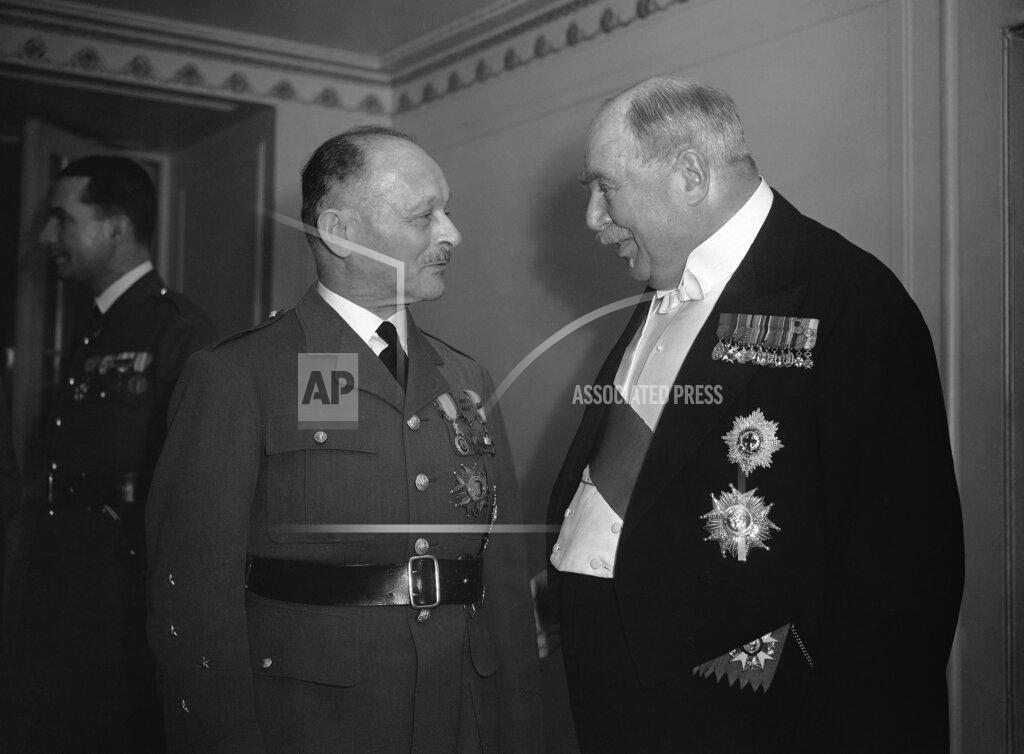
German Chancellor Adolph Hitler and his generals, on inspection tour of Western fortifications, pronounced Germany’s western frontier a “wall of steel” that was perfect and impregnable. Hitler and his generals have been joined by approximately 40 Nazi leaders of German districts. Every leader was expected to return to his own region ready to assure their constituents that Germany was safe from invasion.
Germany’s “West Wall,” the double and triple line of fortifications guarding her border from the Netherlands frontier to Switzerland, was undergoing its first test today before Chancellor Adolf Hitler, who continued the tour that he started yesterday at Aachen. The German press, meanwhile, printed more details of the “invincible line” than ever before. Construction of the forts and bunkers hidden in the fields and mountains of the variegated Rhineland country was started in the Summer of 1936, immediately after the military occupation of the Rhineland. For the protection of the important industrial centers about Cologne the Germans built 118 forts that year.
Extension of the fortified area in the region between the Rhine and the Moselle as well as in the upper Rhineland district was decided on in 1937. In that year 500 more forts were added to the existing defenses. But the real “West Wall” to which Germany is pointing with such emphasis today was not erected until 1938. After the first Czech crisis, in May of last year, Herr Hitler ostentatiously issued orders to “extend and strengthen the entire line so that Germany’s western border will be invincible.”
For more than a year now as many as 300,000 workers, including labor service conscripts and divisions of infantry and pioneers, have been working at top speed on the line of fortifications, which is more than 400 miles long and, in places, as much as thirty miles deep. The Germans now assert that their rear is covered in the event of a war in the east, and military experts agree that a conflict between Germany and France in this region would be at worst, as far as Germany is concerned, a standstill fight.
25,000 enthusiastic Nazi advocates of a restoration of Germany’s colonial empire began meeting at a four-day convention in Vienna, Austria. General Franz Ritter von Epp, leader of the German Colonial Society, said before leaving Munich for the convention, that “Germany’s weapon in its fight for colonial rights is the weapon of justice.”
German official announced in Berlin that Germany would take further reprisals concerning the expulsion of Germans from Britain. He declared that the Germans abroad were regarded as scapegoats, and hatred was felt against the right. “Nevertheless, we do not want expulsion or war, as the Germans abroad are merely ambassadors of goodwill.”
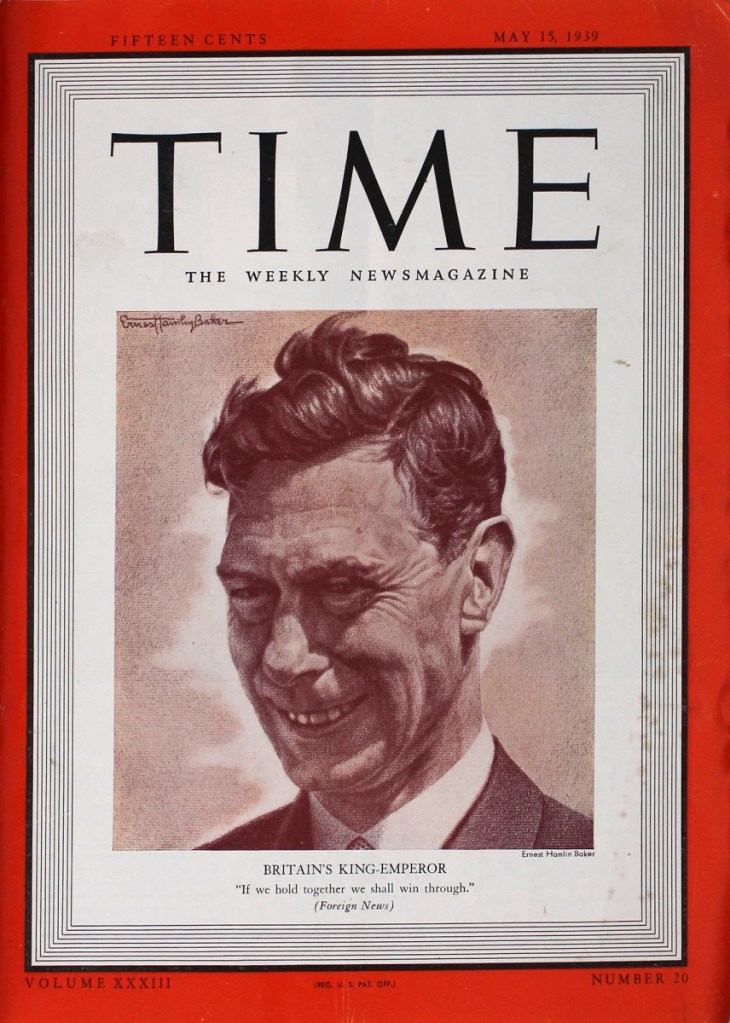
Eva Braun began being mentioned in the international press. In an article in Time speculating about the love lives of Hitler and Mussolini, Braun was identified as someone that Hitler always came to visit whenever he was in Munich.
Ravensbrück Concentration Camp for women was established in Germany. The SS transferred almost 900 women prisoners from the Lichtenburg concentration camp for women to Ravensbrück. Upon this transfer, Ravensbrück replaced Lichtenburg as the main camp for women prisoners in Germany.
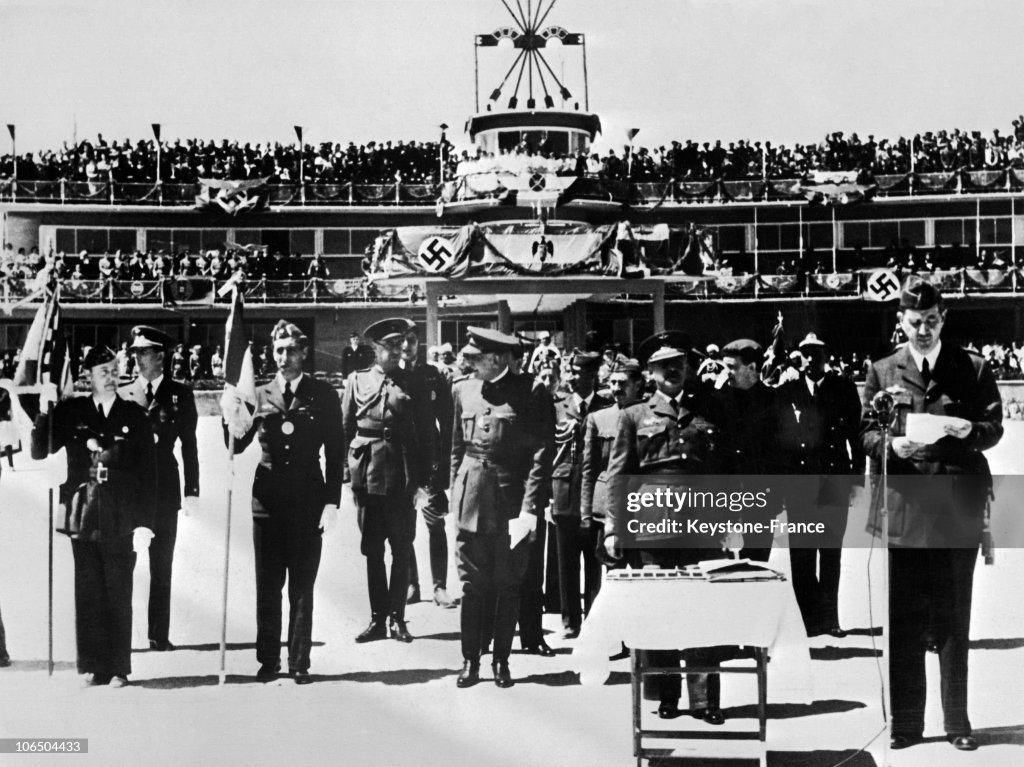
Benito Mussolini attended the inauguration of a new military airfield in Caselle Torinese, barely 25 air miles from the French border.
Italian Premier Benito Mussolini reiterated his desire for peace today before 5,000 Fiat automobile workers at a vast new factory being built just outside Turin in the Mirafiore district. He referred his listeners to yesterday’s speech but again said “certain questions must be settled before they become chronic and a danger for all.” Italy’s automobile owners all hoped he would announce the oft-heralded reduction in the price of gasoline, but all he said was, “We have abolished the circulation tax and would have done more if the international situation had been safer.”
The factory, which will start producing at the end of this year, will be Italy’s largest industrial plant. Conceived in 1936 by Senator Giovanni Agnelli, a Fiat director, it will be a city in itself. It will give work to 60,000 persons and will provide recreational and educational facilities for workers. Premier Mussolini saw the first models of a new economical four-passenger car which will be placed on the market next year.
The French see Italian Premier Benito Mussolini trapped by errors of aggression in Ethiopia, Spain, and Albania.
The Soviet Union refused in a note to London to join the British-French front on Britain’s terms. British officials were said to be still confident of eventually winning the Soviets support. British Foreign Secretary Viscount Halifax would try to iron out the differences in conversations the next week with the French Foreign Minister Georges Bonnet and Vladimir P. Potemkin, the Soviets first assistant foreign commissar in Geneva, Switzerland.
Russia’s reply to the latest British proposals for an agreement in opposition to Axis aggression was received here today. Officials had nothing to say about it, but apparently it did not advance matters very much. From all that could be learned tonight, the Soviet Government feels its desire for complete reciprocity in military liabilities is not met by the British proposals and that British assurances that Russia is not expected to go to the aid of Poland, Rumania or Greece unless Great Britain and France already are involved do not suffice.
Apparently, Russia is still sticking to the idea of an alliance of three or four powers with no strings as the best method of meeting the present German threat. The Russians apparently believe that the British idea of a piecemeal agreement leaves considerable loopholes through which Soviet territory could be attacked, either directly or through the Baltic States. Therefore, British hopes of an early agreement with Russia took a distinct setback tonight. The British had to take what comfort they could from the fact that the Russian reply was handed over in a most cordial atmosphere.
The British attitude tonight was that the original Russian proposals had been restated but phrased in slightly less uncompromising terms. As a result, there still existed a belief that the two nations would eventually get together. With that belief, however, went one that Britain would have to give way and approach to some extent the Russian idea of a military alliance, although there is, at present at least, no apparent chance of Britain’s acceding to the Russian idea of a firm military alliance.
Objections to making security as collective as that which Britain held for a long time still hold good; and, while they may be partly based on conservative distrust of Communists, they are based more — for publication at least — on the distrust that other States of Europe are said to manifest against communism.
On 15 May 1939, the liner MS St. Louis stops in Cherbourg, France, to take on more passengers. The total number of passengers reaches 937. The ship sails for Havana, Cuba. What the captain and the passengers do not know, however, is that the Cuban government has invalidated all landing permits.
Jewish leaders ask British Prime Minister Neville Chamberlain to permit the House of Commons to vote independently on the Palestine issue, and not be bound by a party vote.
The Damascus government formed on April 6 to attempt a reconciliation of differences between France and Syrian Nationalists resigned today with the statement that it could not adapt its policy to that of France. The government was headed by Premier Nasoubi el Bokhari, independent leader, who organized a Cabinet after French troops had taken over police powers and occupied Damascus to quell Nationalist rioting.
The previous Nationalist Cabinet resigned March 14 after France, which holds a League of Nations mandate over this Near Eastern republic, refused to accept demands for greater autonomy. Observers linked the resignation of the latest Cabinet with French plans to hand over Hatay, the former Syrian Sanjak (district) of Alexandretta, to Turkey in exchange for Turkish participation in the British-French anti-aggression bloc in Europe.
In Washington, President Roosevelt was told today that he could expect repeal of the remaining stump of the undistributed profits levy and other more substantial amendments of the corporation tax laws designed to help business at this session of Congress, with or without White House aid. The bearer of this message was understood to have been Senator Harrison of Mississippi, chairman of the Senate Finance Committee, who submitted to the President a plan of his own which he said would bring about business-encouraging revisions without sacrificing any revenue or opening the law further to tax avoidance.
The Harrison plan was said to contain about 80 percent of the proposals for corporation tax revision worked up by Secretary Morgenthau. and Under Secretary Hanes, but which the President insisted again today would not be submitted to Congress as an Administration program. The statement of the determination on Capitol Hill to revamp the corporation division of business taxes marked a two-hour White House conference, which was attended by Senator Harrison, Representative Doughton of North Carolina, chairman of the Ways and Means Committee; Representative Cooper of Tennessee, chairman of the Ways and Means subcommittee on taxation, and Messrs.” Morgenthau and Hanes.
Chairman Doughton, who made the official announcement of what transpired at the conference, said that some changes in the present corporation tax structure probably would be made at this session, but added that no conclusions were. reached in the long talk with the President. The only definite decision, he said, was that substitutes providing the same amount of revenues would have to be found for such “business deterrents” as are removed. “We are just as anxious to help business as business is to be helped,” Mr. Doughton said. “But everyone agrees that we cannot cut down our total Federal revenues now. I hear a lot of talk about elimination of business deterrents in taxes, but no one has come forward to suggest what taxes we can substitute for them.”
Back of Mr. Doughton’s remarks was one of the frankest discussions of the tax situation to occur in many months. Senator Harrison was understood to have told the President that the minds of himself and members of his committee were made up on the proposition of aiding business through changes in the corporation tax structure, particularly repeal of the undistributed profits levy. And that decision, he told the conferees, represented, in his mind, the preponderant view of the Senate and a growing feeling among the members of the House. The President was said to have left little doubt that he disliked intensely the idea of repealing, or rather permitting to lapse on December 31, the undistributed profits tax policy which he announced in 1936 and had fought consistently since to preserve.
The Senate was in recess today. The Education and Labor Committee resumed hearings on the Wagner Act amendments, an Appropriations subcommittee studied the Argentine beef question in connection with the navy supply bill for next year, and a Commerce subcommittee heard endorsements of a bill to embargo exports of certain types of logs.
The House of Representatives passed a $305,188,514 rivers and harbors and flood-control bill, heard several speeches opposing the Argentine beef purchase for the navy, passed a bill to bar re-entry of draft dodgers, heard other speeches, and adjourned at 3:10 PM until noon tomorrow. An Appropriations subcommittee resumed an investigation of the Works Progress Administration.
Georgia Democrats see a third-term move being made by Roosevelt.
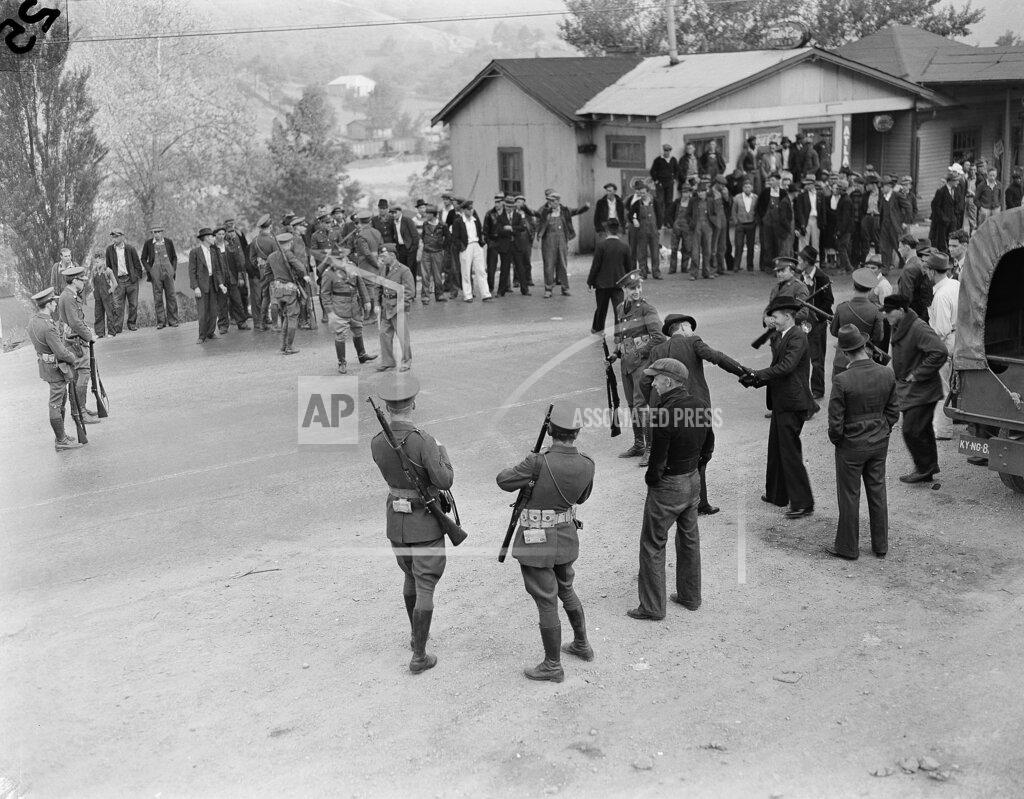
A definite break in the phalanx of Harlan, Kentucky soft coal operators opposing a new contract with John L. Lewis’s United Mine Workers came tonight as more National Guard troops arrived to patrol additional mines expected to open tomorrow. E. J. Asbury, superintendent of the Black Mountain Coal Corporation at Kenvir, a subsidiary of the Peabody Coal Corporation of Chicago, one of the largest mines in the county, said he would open separate negotiations with the union tomorrow. The corporation normally employs about 600 men.
“You’ll know when we sign,” he said, adding that his company did not object to a union shop, the issue that caused representatives of the Harlan Coal Operators Association to walk out of the New York conference on Saturday when fifteen other districts approved. “We had a union shop under the old contract,” Asbury pointed out. The Black Mountain Corporation is not a member of the county association, but observers said that the large number of men employed returning to work without National Guard troops would weaken the position of the other operators.
The U.S. federal deficit crossed the $3,000,000,000 mark today with a month and a half of the fiscal year remaining. However, officials said they did not expect the year-end shortage on June 30 to reach the $4,000,000,000 estimated in the budget because receipts today of $4,908,867,056 were somewhat higher than expected and expenditures totaling $7,912,202,156 were less than forecasts. The deficit, however, will be more than double that of last year. At this time a year ago the excess of expenditures over receipts was $1,134,220,550, compared with $3,003,335,099 now. The federal debt, which sets a new record almost daily, was at a peak of $40,203,666,919, or about $2,800,000,000 more than a year ago.
The U.S. Supreme Court decided United States v. Miller, a landmark decision of the Supreme Court of the United States that involved a Second Amendment to the United States Constitution challenge to the National Firearms Act of 1934 (NFA). The case is often cited in the ongoing American gun politics debate, as both sides claim that it supports their position. Writing for the unanimous Court, Justice James Clark McReynolds reasoned that because possessing a sawed-off double barrel shotgun does not have a reasonable relationship to the preservation or efficiency of a well-regulated militia, the Second Amendment does not protect the possession of such an instrument.
Twenty thousand soldiers deployed through tropical showers today in Hawaii’s most spectacular army maneuvers. Complete civilian participation was planned for Thursday night when a blackout of Oahu Island will simulate wartime conditions under an enemy attack. All lights, except lighthouses, which will guide army fliers, were ordered turned off for 20 minutes. Even exit lights inside theaters must be shaded.
The primary problem of the maneuvers, which began today, is swift mobilization and rapid movement of troops to repel a sudden enemy thrust at this keystone of America’s Pacific defenses. Soldiers, trucks and guns moved during the night to beaches and foothills, where they received consolidation commands. Scouting planes soared aloft at daybreak in an attempt to find a theoretical “red fleet, which is assumed to be a well-balanced force composed of modern ships with adequate attached aviation.” Well trained “enemy” troops were assumed to be transported by the red merchant marine. This fleet was “considered capable of transporting an extremely large force of men for an initial overseas expedition.”
The romantic drama film “Goodbye, Mr. Chips” premiered in the United Kingdom.
Argentine President Roberto M. Ortiz issued a decree today making mandatory the dissolution of the German Nazi party and all other political organizations in Argentina that are directed from abroad. Besides the Nazi party, the most prominent organizations affected included the Fascist and Dopolavoro workmen’s group, both Italian-directed, and the Spanish Falangist (Fascist) party.
These parties, however, received ninety days in which to subscribe to “democratic principles,” which the decree said must govern their by-laws. All foreign organizations must register with the Interior Ministry and the police. The Presidential decree followed an inquiry into Nazi activities in Argentina, ordered by President Ortiz after the publication of an alleged Nazi plan to annex Patagonia, southern section of Argentina.
The police authorities in Santiago, Chile arrested Hans Voigt Schmidt, chief in Chile of the propaganda bureau of the German State Railways, placed him on the Argentine border, and told him he could no longer reside in this country, it was announced this afternoon. Police investigations had proved that Herr Schmidt had personally paid for and ordered the printing of more than 100,000 leaflets with arguments against the establishment of Jews in Chile. These were designed to create racial conflict, it was affirmed.
Japanese troops in Hubei Province, China began to falter from the Chinese counteroffensive which began a week prior.
The United States Embassy has been advised of the bombing by Japanese planes of American mission properties in two cities in Southwest Honan. A telegram from Tungpeh said the American Lutheran Brethren Mission there was bombed on May 2 and the residence school was hit at the same mission’s station at Tangho, northwest of Tungpeh on May 4. The 3-year-old baby daughter of the Rev. Arthur Nyhus was killed when the Japanese bombed the Lutheran Mission at Tungpeh last October.
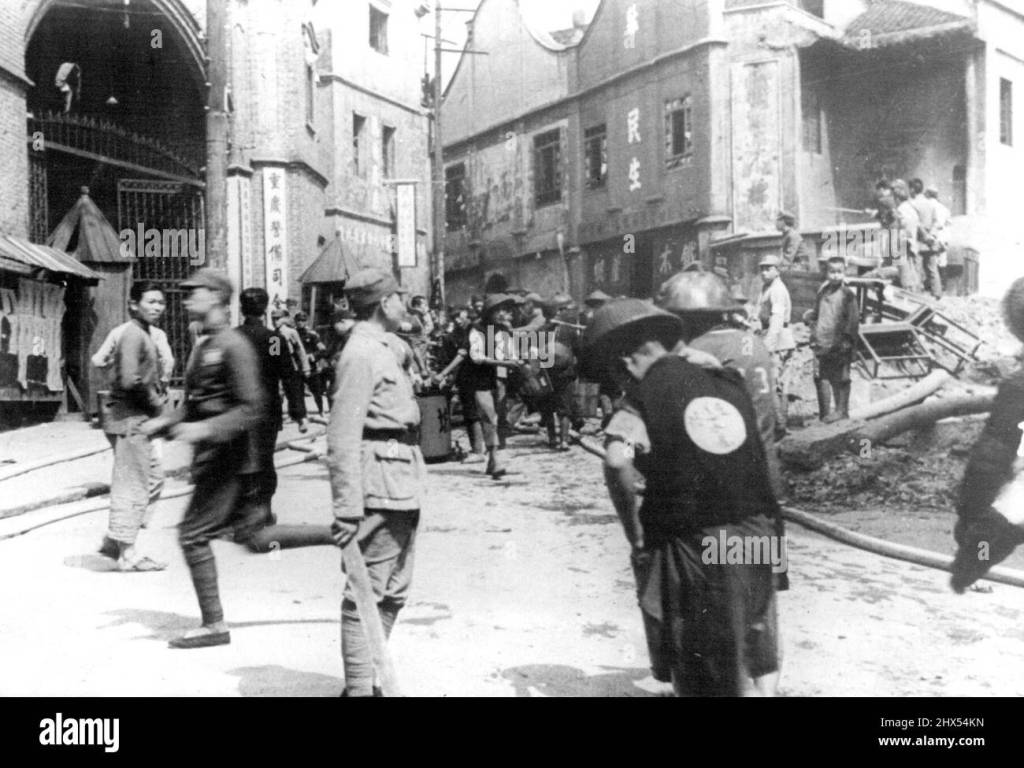
The number of identified cases of cholera in the last few days has roused fears of an epidemic in Chungking. With normal health precautions impossible because of the destitution resulting from recent Japanese bombings, the authorities are apprehensive over the spread of disease. It is fortunate that the health administration has a plentiful supply of anti-cholera serum but there. is an acute lack of a number of doctors.
Secretary of State Cordell Hull announced today that Japan had promised that her aviators would exercise all the caution possible in China to avoid injuring the unarmed population. This reply was made, he said, to Ambassador Joseph C. Grew’s recent representation against the aerial bombardment of Chungking, provisional capital of China.
Mr. Hull said that the Japanese Foreign Office had told Mr. Grew that Japanese aviators had been instructed to exercise all the caution possible in bombing what they would consider military points to avoid injury to those who were not armed or were not a part of the military system in any way. The Foreign Office also promised to pass on to its military authorities in China the American Government’s representations.
Dow Jones Industrial Average: 132.65 (+0.25).
Born:
Michael Gerson, American journalist and speechwriter, served as President George W. Bush’s chief speechwriter from 2001 until June 2006, as a senior policy advisor from 2000 through June 2006, in Belmar, New Jersey.
Walt Suggs, NFL and AFL tackle and center (AFL All-Star, 1967, 1968; Houston Oilers), in Hattiesburg, Mississippi.
Dudley Wysong, American golfer (PGA Championship 1966 runner-up), in McKinney, Texas (d. 1998).
Naval Construction:
The Royal Australian Navy Grimsby-class sloop HMAS Warrego (L 73; later U 73) is laid down by the Cockatoo Docks and Engineering Co. Ltd. (Sydney, New South Wales, Australia).
 History Diaries