Defense Secretary McNamara reports to the National Security Council on the situation in Vietnam; President Johnson informs Congressional leaders attending the session that he will probably seek more aid for South Vietnam. President Johnson alerted the Congressional leaders of both parties today to the probability that he would seek increased economic and military assistance for South Vietnam. The alert came at a meeting of the National Security Council, which was attended by important Democratic and Republican members of Congress. They also heard a report by Secretary of Defense Robert S. McNamara, who has returned from his fifth inspection trip to South Vietnam. Some of those who attended said Mr. McNamara had painted a grim picture of a deteriorating situation in the guerrilla warfare between the Vietcong and the United States‐supported Government troops. Senator Leverett Saltonstall of Massachusetts, the senior Republican on the Senate Armed Services and Appropriations Committees, said that “it looks like a long and tough pull” in South Vietnam.
Secretary of State Dean Rusk also reported on the meeting of the Foreign Ministers of the member nations of the North Atlantic Treaty Organization, which he attended at The Hague this week. George E. Reedy, the White House press secretary, said the Congressional leaders had been invited to hear Mr. McNamara to become acquainted with the situation. He said it was “rather obvious there well may be need for additional funds and appropriate recommendations will be made at an early date.” Members of Congress who attended the session in the White House Cabinet Room said no definite figures or programs had been mentioned.
The first evidence of plans for increased assistance to South Vietnam came from the Pentagon. Informed officials said the United States would add 25 or more Skyraider dive bombers to the 75 additional Skyraiders it earlier announced it would send to South Vietnam. In addition, the officials said, United States training personnel would fry to double the present force of 400 South Vietnamese pilots, training the best of them to fly attack planes. Mr. McNamara said yesterday that it was desirable to increase South Vietnamese flying personnel by 100 percent and to strengthen the South Vietnamese air force.
As for what the President had in mind, Mr. Reedy several times referred questioners to yesterday’s remarks by Mr. McNamara. The Secretary said at a news conference that more United States training personnel might be needed in South Vietnam. He also said it was vital “that we consider ways and means through increased economic assistance, increased military support to assist the Government of Vietnam.” Since the sending of additional training forces to South Vietnam would not necessarily require Congressional action, the probable recommendations from Mr. Johnson would be for economic and military assistance. An important Democratic committee chairman said the report by Mr. McNamara had not made clear the amounts to be required. But he said the Administration had apparently decided recommendations for increased assistance would be made.
South Vietnamese Premier Khánh signs a decree that abolishes restrictions imposed by the Diệm regime on Buddhists and grants them the same rights as Catholics. The decree erased legislation in force under the deposed Ngô Đình Diệm regime and put the Buddhists on the same level as Roman Catholics and other religious groups. The Buddhists will now be free to accept money from private sources and to acquire land and buildings when needed to further their religious aims. Previously the Buddhists had a legal status similar to that of a club or lodge.
The Laotian Defense Ministry reported today that Tha Thom, an important town about 90 miles northeast of Vientiane, fell to the pro‐Communist Pathet Lao yesterday. It said an attack on the defense perimeter of Paksane was imminent. A communiqué said an assault on Sala Dene Dinh, advance outpost of the Paksane garrison. was expected. Tha Thom is linked by road to Paksane, a Mekong River town. on the Thailand border. Yesterday the Laotian neutralist Premier, Prince Souvanna Phouma, said he did not know when he would fly to Khang Khay in central Laos to meet Prince Souphanouvong, the Pathet Lao leader.
The Pathet Lao leaders have rejected an appeal by Prince Souvanna Phouma to come to Vientiane and join his coalition Government. They say Vientiane, which has been controlled by the rightists, is not safe. Troops of two right‐wing generals took over Vientiane in a coup d’état last month. Since then, the neutralists and rightists have merged politically under Premier Souvanna Phouma, who has tried unsuccessfully to put a three‐faction coalition into operation. The Pathet Lao has insisted that the right‐wing leaders of the coup be withdrawn from Vientiane. Two days ago, the armies of the neutralists and the rightists were reported to have merged, apparently tightening the deadlock.
As the report of the fall of Tha Thom came, a right‐wing tribal chief reported that about 1,000 refugees harassed by Pathet Lao forces had died during a 15‐day march from their villages to their camp in Muong Cha, 60 miles northeast of Vientiane. The tribal leader, Lieutenant Vang Chou, said the refugees had come from two villages near the Vietnamese frontier, which he said had been attacked by Pathet Lao and North Vietnamese troops. He said the Pathet Lao had ambushed the refugees at least six times as they trekked through narrow hill paths for 15 days. An army officer said the refugees had struggled into the Muong Cha camp bedraggled and dirty. Many mothers. carried babies on their backs. They carried few possessions. They were given food, clothes and knives by United States foreign aid personnel.
It was from Tha Thom that a strong right‐wing striking force set out on deep raids into Pathet Lao territory two months ago. Western sources said yesterday that the rightist force of 1,200 men had suffered 25 per cent casualties in pulling back toward Tha Thom after the raids. This was described as the worst loss in a single operation in the Laotian conflict. The Defense Ministry’s communique today said that two companies of Chinese Communist troops coming from Nam Tha in northeast Laos and five companies of North Vietnamese troops coming directly from Điện Biên Phủ in North Vietnam had been “exterminating” right‐wing guerrillas near Muong Sai in northern Laos.
Meanwhile, at Khang Khay, Prince Souphanouvong gave his first interview to Western reporters since last month’s coup. He said the coup had violated the agreement of 1960 making Laos neutral. But he said the Pathet Lao would not start a war. The pro‐Communist leader stated his opposition to the merger of the right‐wing and neutralist armies, saying he would only agree to unification of all three armies — neutralist, rightist and Pathet Lao. He added that there could be no changes in the Government unless this was agreed upon by the three factions.
The Security Council has called a meeting for Tuesday morning on Cambodia’s complaint that the United States was taking part in raids by South Vietnamese forces into Cambodian territory. The 11‐nation council deadlocked, however, on when and how to wind up its current debate on the Indian‐Pakistani dispute over the border state of Kashmir.
Archbishop Makarios, President of Cyprus, and Greek and Turkish Cypriote officials heard some blunt talk here today from the commander of the United Nations peace force. The abrupt manner employed in public by the usually affable and courteous commander tended to confirm a growing im‐ pression among observers that the United Nations was adopting a tougher attitude in its dealings with the leaders of the warring communities. The archbishop and the commander, Lieutenant General Prem Singh Gyani of India, went to this east coast port town to see what could be done to reduce the tension that had built up since Monday’s killing of two Greek Army officers and a Greek Cypriote policeman and the abduction of 10 Turkish Cypriotes in the town. Since then, 22 more Turkish Cypriotes have been seized by Greek Cypriotes in retaliation for the killing by Turkish Cypriotes in the old walled Turkish quarter. Fearing further retaliation, Turkish Cypriote dockworkers have not gone to the port, which adjoins one side of the walled quarter.
To the applause of Greek Cypriote dockworkers and the hooting of ships’ sirens, the Archbishop, General Gyani and Greek Cypriote officials walked through the dock area as Irish troops of the United Nations force patrolled the walls overlooking the port. Among the Greek Cypriote officials were George Georghipades, police chief of Famagusta, and Demetrios Pararalikis, Famagusta’s district officer. They and the Archbishop gave their view of the situation and blamed the Turkish Cypriotes for the trouble. At one-point General Gyani turned to Mr. Pararalikis and said in a loud, angry voice: “Don’t you complain to me about the Turks when a Turkish Cypriote is not safe in the Greek sector after you seized eight Turks in the Naafi store.” The Naafi is the British equivalent of the American PX.
Then turning again to Mr. Pararalikis, General Gyani said bluntly: “If you were a fair man, I would work with you.” Clearly taken aback, the district officer blurted: “I’m astonished you have to say that.”
Further along, the party observed a Greek Cypriote sandbagged fortification manned by helmeted soldiers with automatic weapons pointed at the top pf the walls and into the Turkish quarter. The Greek Cypriote officials said the position was necessary to protect the port from Turkish Cypriote fire. In reply General Gyani barked: “Those guns are pointing at my soldiers. Only my soldiers are on the walls.”
The guided missile destroyer USS Biddle, soon to be renamed the USS Claude V. Ricketts, became the first U.S. Navy ship to engage in the “mixed-manning experiment”, with a crew of 17 officers and 305 enlisted men from the navies of seven NATO members. The international crew was the first effort toward the American proposal of a Multilateral Force (MLF), an idea that never reached fruition.
Yugoslavia has advised Cuba to stop trying to export revolution by violent means in Latin America, informed sources disclosed today. The counsel, offered recently, is consistent with Yugoslavia’s declared policy of “active peaceful coexistence.” This policy holds that Socialism can best be promoted by setting a good example and cultivating normal exchanges with other countries. It is understood that relations between the two Communist countries have deteriorated sharply in the last few months, and that differences over policy toward Latin‐American countries has been one cause.
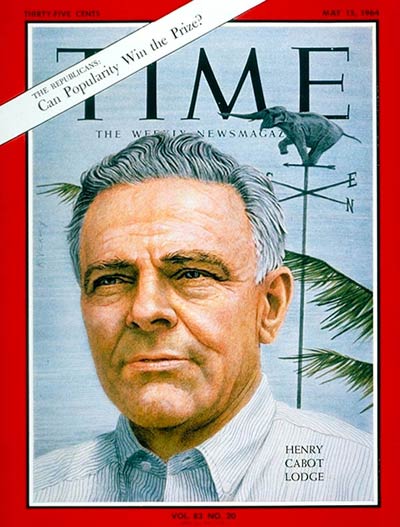
Governor Nelson A. Rockefeller won a dramatic upset victory tonight in Oregon’s Republican Presidential preferential primary election. His “Lone Ranger” campaign to capture the state’s 18‐vote delegation to the Republican National Convention carried him into first place over Henry Cabot Lodge, who was favored, and four other rivals in the incomplete ballot count. A tabulation by the Columbia Broadcasting System of 90 percent of the state’s total ballots gave Mr. Rockefeller 83,365 votes; Mr. Lodge, Ambassador to South Vietnam, 66,300; Richard M. Nixon, 47,430; Senator Barry Goldwater of Arizona, 45,859; Senator Margaret Chase Smith of Maine, 6,353, and Gov. William W. Scranton of Pennsylvania, 4,171.
President Johnson, as the only Democrat on the Presidential preference ballot, polled 92,338 votes in 1,899 of the 3,251 precincts, The Associated Press reported. There were also more than 500 write‐in votes for Gov. George C. Wallace of Alabama, who had not carried his segregationist primary campaign into the state.
Paul Grindle of Cambridge, Massachusetts, national campaign director of the “Draft Lodge” movement, conceded victory to Mr. Rockefeller an hour after the polls closed. He said of Mr. Rockefeller’s uphill battle: “There is not the slightest question that Oregon voters have seen one of the greatest finishes in political history. They have seen an incredible fighter with lots of guts, who has gone on slugging since New Hampshire. I think the Oregon voters have gone along with us in expressing their admiration for Nelson A. Rockefeller.” The Governor carried three of the state’s four Congressional districts, losing to Mr. Lodge only the Second District of Eastern and Southern Oregon, which is represented in Congress by Al Ullman, a Democrat. Democrats are in possession of two of the three other Congressional District seats.
Senator Goldwater said tonight that the Oregon primary victory by Governor Rockefeller was less important than his own lead in delegate votes for the Republican National Convention. “I still have 325 delegates,” said Mr. Goldwater. “I am glad he has some — it makes a better race of it.”
Governor Rockefeller made it to the White House today. His stay at 1600 Pennsylvania Avenue was short, however. In a matter of 10 minutes, he was ushered into President Johnson’s office, had his picture taken there, talked with Mr. Johnson, held a brief news conference in the lobby and left. The President had invited the New York Governor to drop by after finishing his intelligence briefing on foreign policy and defense at the State Department. He was the first Republican Presidential candidate to take advantage of Mr. Johnson’s offer of such information. Mr. Rockefeller described his few moments with the President as “just a friendly chat.” He declined to disclose the subject of their conversation but reported they had touched on politics “only lightly.”
Civil rights leaders and police officials in New York City expressed confidence yesterday that Monday’s March for Democratic Schools would be peaceful and non‐obstructive. “An honorable agreement has been reached and we expect no untoward problems,” Chief Inspector Lawrence J. McKearney said. Bayard Rustin, director of the march, said it would include an “orderly meeting, demonstration, rally — there will be no attempt to sit‐in or tie up traffic or anything like that.” Mr. Rustin said that the march was designed to gather support from “good citizens” for the state’s new plan for recasting the city school system, and to urge Governor Rockefeller to call a special session of the Legislature to get money for the plan.
Industrial production in the United States registered its sharpest gain in almost a year in April, paced by record production of automobiles and continued increases in the output of steel and machinery. Factory employment also rose during the month by considerably more than is normally expected in April. The Federal Reserve Board announced today that its index of industrial, production rose one full point in April, to 129.2 percent of its 1957‐59 average. The index had risen by half a point, or less, in each of the three earlier months of this year and had recorded a total gain of only four‐tenths of a point for the final six months of 1963. Nearly 500,000 new jobs other than farm jobs — came into being in April, according to the Labor Department’s monthly survey of employers’ payrolls. The normal rise for April is about 300,000 jobs.
The increase in the number of available jobs was centered in the metal‐producing and metal‐using industries, including the automobile and steel industries and the electrical equipment industry, in which employment has, until lately, been falling. Employment in retail stores and wholesale companies also increased in April, although it would normally have been expected to drop following Easter. Since the beginning of 1964, the total number of available jobs has increased by 700,000, with about 160,000 of them in manufacturing.
This is a large gain, Labor Department officials said, but they noted that it was not much larger than the rise recorded during the corresponding period of 1963 and a little smaller than the gain recorded during the comparable period of 1962. In both of those years, there was relatively little increase in total employment in the second half of the year and unemployment failed to decline.
The House Ways and Means Committee has devised a complete substitute for the Administration’s program of health care for the aged, and may approve it next week. Committee sources said that a bipartisan majority of the 25-member panel was in apparent agreement on the substance of the new plan and that only a few details remained to be settled. Favorable committee action by the end of next week was predicted by several members. The committee chairman, Representative Wilbur D. Mills, Democrat of Arkansas, was identified as the chief author of the proposed substitute, which is in two parts. It calls for:
- Expansion and liberalization of the present Federal‐state program of aid to aged persons who are “medically indigent” This program was established in 1960 under legislation sponsored by Mr. Mills and the late Senator Robert S. Kerr, Democrat of Oklahoma.
- A general increase of either 5 or 6 percent in cash retirement benefits under the Social Security insurance program. The additional costs would be financed by higher Social Security taxes.
An entirely new approach to the enforcement of the antitrust laws is about to be attempted by the Federal Trade Commission. Under the new program, the commission will conduct studies of the competitive situation in specific industries and, upon completion of its inquiries, issue broad rules that will indicate to business, in advance, whether or not certain types of mergers would be prosecuted by the federal agency. The first such industrywide study was ordered by the F.T.C. today. It will involve the development of standards for the approval or disapproval of mergers of cement producers with their, customers and suppliers ‐so‐called vertical mergers, The commission’s decision to order the cement industry study was an outgrowth of a merger case involving the Permanente Cement Company of Oakland, California.
Deactivation of the Atlas D and Atlas E series of the American SM-65 Atlas intercontinental ballistic missiles began, with their replacement on bases and in silos by the newer LGM-30 Minuteman missiles. The process of Atlas deactivation would be completed by February 17, 1965.
The U.S. performs a nuclear test at the Nevada Test Site.
Filling in for Bill White, whose consecutive-game streak ends at 284 because of a muscle strain, Jeoff Long hits a towering drive that bounces off the top of the scoreboard in left field, over 400 feet away to snap a 6-6 tie between the Cards and Braves. The two-run shot, Long’s only major league homer, comes off knuckleballer Bobby Tiefenauer. St. Louis wins, 10–6, over the visiting Braves. Julian Javier hits a grand slam in the 1st inning off Denny Lemaster.
Diego Segui scatters 9 hits and walks two as the Kansas City cutie shuts out the Yankees, 11–0.
Dow Jones Industrial Average: 826.23 (+1.78).
Born:
Lars Løkke Rasmussen, Danish politician, Prime Minister of Denmark (2015–2019), in Vejle, Denmark.
Dave Reid, Canadian NHL left wing (NHL Champions, Stanley Cup, Dallas-1999, Colorado-2001; Boston Bruins, Toronto Maple Leafs, Dallas Stars, Colorado Avalanche), in Toronto, Ontario, Canada.
Miles Turpin, NFL linebacker (Green Bay Packers, Tampa Bay Buccaneers), in Minneapolis, Minnesota.
Kent Sullivan, NFL punter (Houston Oilers, Kansas City Chiefs, San Diego Chargers), in Plymouth, Indiana.
John O’Callaghan, English NFL tight end (Seattle Seahawks), in London, England, United Kingdom.
Pierre Trentin, French 1K time trials cyclist (Olympic gold medal, 1968), in Créteil, France.
Died:
Vladko Maček, 84, Kingdom of Yugoslavia deputy prime minister (1939-1941).


 History Diaries