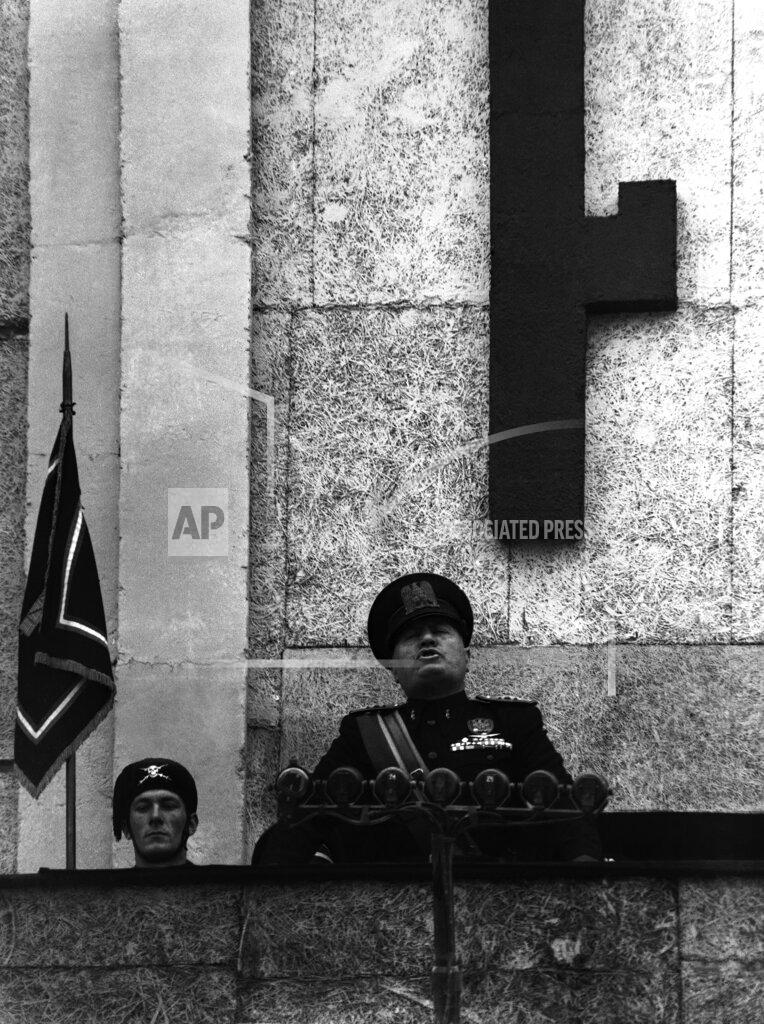
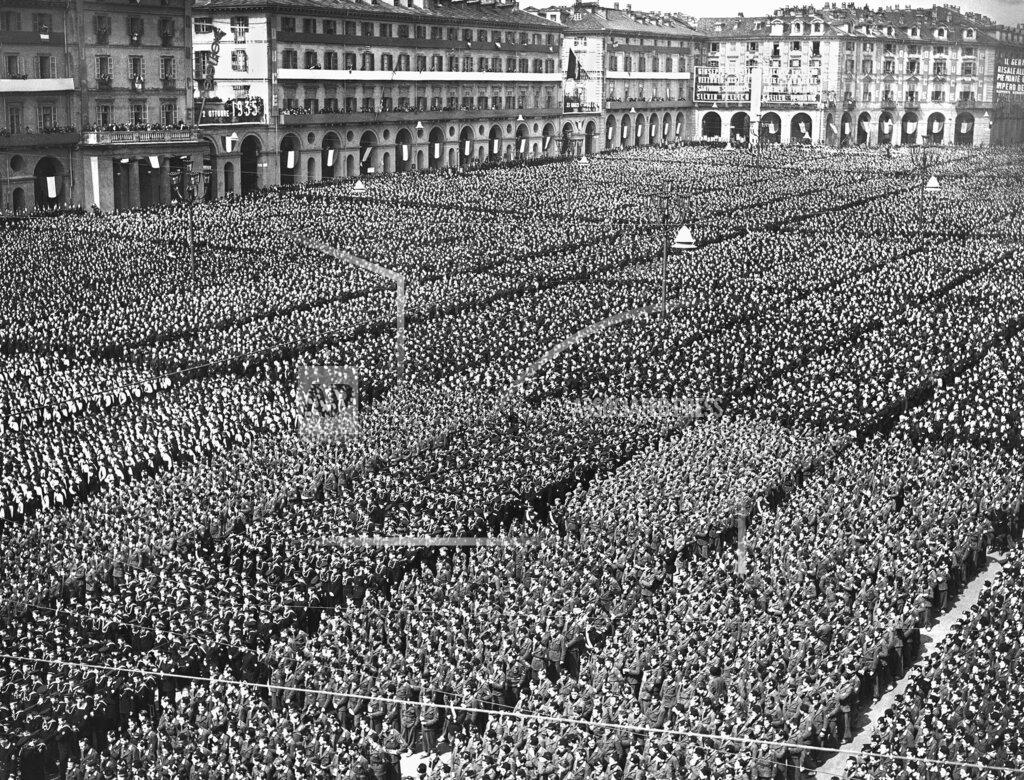
Italian Premier Mussolini gives a speech in Turin. He declares war unnecessary. An attack on France is the likely subject. Before more than 50,000 uniformed men and women packed in the huge Piazza Vittorio Veneto here this morning, Premier Mussolini announced his conviction that there were no reasons for war in Europe. Only the women massed together in the center of the square cheered when he said that, and the cry went traveling back through the side streets into the distance. In every respect it was a moderate speech with the violence coming not from Signor Mussolini, but from the crowd which shouted for Tunisia and Savoia and jeered the democracies, particularly France. Here in Turin, which is so close to the French frontier, feeling against France apparently is stronger than in other parts of Italy.
There was firmness, sarcasm and pride in Signor Mussolini’s speech, but no bones were broken and the general tone was reassuring. His audience responded like a sensitive instrument. With that phenomenal luck that so often has characterized his great speeches, the weather, which had been rainy for several days without a break in the clouds, suddenly cleared about an hour before his appearance to remain bright and sunny until after he had finished.
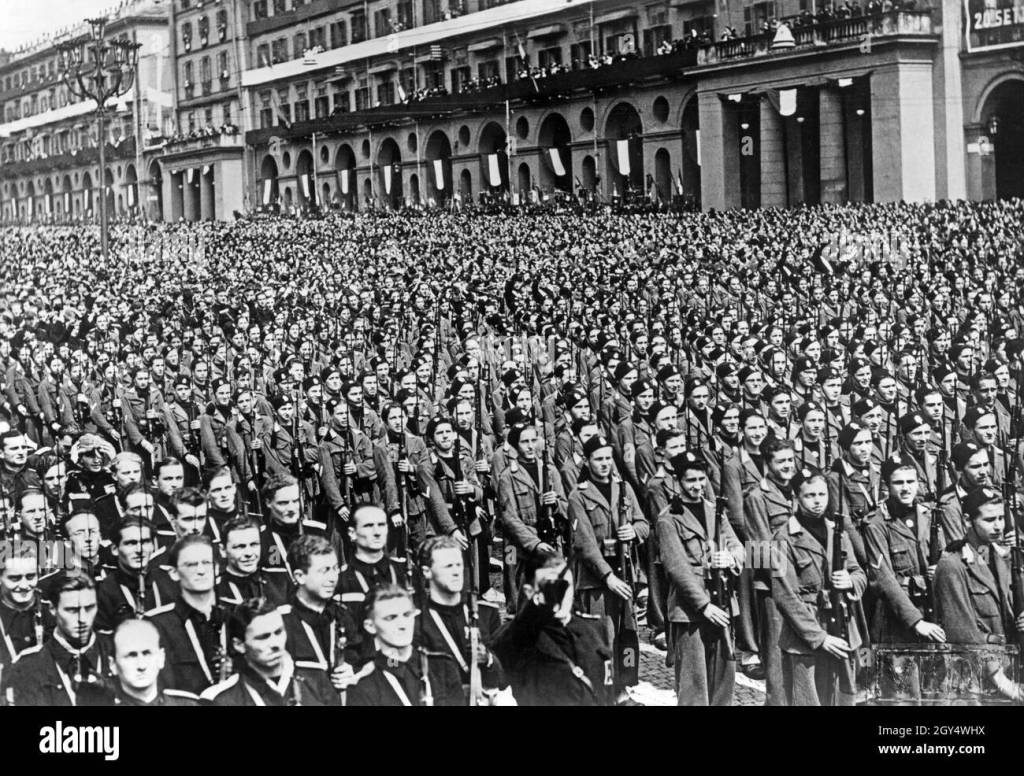
From 4:30 am this morning the city of Turin was kept awake by the tramp of marching men, brass bands and good-natured cheering as the great mass of humanity flowed into the square and took their places. No one who did not belong to some organization of the regime was allowed except a small group of foreign correspondents, who alone were without uniforms and who were incidentally hooted and jeered constantly on the theory that they were at best representatives of the democracies and, at worst, Frenchmen.
From the foot of the vast podium built in the shape of an M the crowd seemed like a solid black mass with one large burst of color in the center foreground where the various student groups stood. But gradually the color seemed to come out-the white sleeves of the peasant women, the gray green of the militiamen, the blue of the sailors and, in the foreground, the red and yellow sashes of the Squadristi, the Fascist veterans of the early days. In a place of honor just left of the stand was a small group of legionnaires, who had recently returned from Spain, in their khaki field uniforms. Red, white and green streamers ran all around the buildings, the windows and balconies of which were crowded with people.
At 10:30, the boom of cannon announced that Signor Mussolini was near and the crowd’s excitement became almost visible. At 10:53, his standard bearer marched on the platform, and when Signor Mussolini stepped out the crowd seemed to lift itself up as bayonets, daggers, caps and handkerchiefs were waved in the air amid deafening shouts. Signor Mussolini looked happy and healthy and his voice was singularly clear. As always, he worked on the crowd, bringing out its enthusiasms and making it, by its responses, play an important role.
He reminded his hearers of his visit seven years ago, and he recalled what had happened since, how Italy had fought and conquered in Africa against sanctions (the crowd hooted the League of Nations), and in Spain (cheers for General Franco) against a “democratic coalition” (more hoots and jeers).
“While I am speaking,” he continued, “millions of men, perhaps hundreds of millions of men in all parts of the world, through the heights and depths of optimism and pessimism, are asking: ‘Will there be war or peace?’ A serious question for all, but especially for those who at a given moment must take the responsibility of deciding. I answer this question by declaring that, according to a cold, objective examination of the situation, there are not at present in Europe problems big enough or acute enough to justify a war that, by logical development, would spread from Europe and become a universal event.”
Two features of Premier Mussolini’s Turin speech today were noted in Paris with satisfaction: First, the women’s applause for his statement that war is not inevitable or necessary; second, with the exception of a few sentences, there was considerable moderation in his tone and attitude. While his Black Shirts continued to shout for Tunisia and Savoy, it was evident from what their leader said that he was quite conscious that the shouting for these places and the adding of them to the Italian Empire are two different matters.
Premier Mussolini knows that the French Army in North Africa is ready for any attempt to take Tunisia and that a war would be likely to result in Italy’s loss of Libya. He also knows that against his 300,000 tons of war vessels of all categories France and Britain have 600,000 tons in the Mediterranean. He had to mobilize 100,000 men to overawe the few hundred gendarmes of Albania, and to take Tunisia or Savoy from France — aware of the danger and prepared for it — is something he cannot even contemplate.
Adolf Hitler arrived in Aachen to conduct an inspection of the Siegfried Line. Premier Mussolini’s Turin speech today is accepted by the Berlin press as “renewed proof of the solidarity of the Axis” and a warning to the democratic powers that a “united bloc of 150,000,000 people representing the Axis is the power with which the democracies will have to reckon someday.”
Chancellor Hitler, meanwhile, began his tour of the western fortifications. He arrived at Aachen this morning. He was accompanied by his personal adjutants as well as Heinrich Himmler, head of all German police, and Dr. Otto Dietrich, Reich press chief. On his arrival he was received by Colonel General Wilhelm Keitel, head of the supreme command, and local army leaders.
The press comment on the Mussolini speech ignores the statement that there is no problem in Europe today that justifies war. The Montag stresses Signor Mussolini’s statements regarding the totalitarian States’ unity of aim and method and adds: “Furthermore, there exists absolute unity of opinion regarding every move made by the enemies of the totalitarian States. This unity is supported by 150,000,000 people and is a power to be reckoned with.
General Tadeusz Kasprzycki, the Polish War Minister, left for Paris today on what was described officially as “private business,” but it was believed he would have important consultations with French military and political leaders. General Kasprzycki not only holds the War portfolio, but he has continued in active service as one of Poland’s most prominent military leaders.
Observers said that they believed his trip to France was connected closely with Poland’s alignment in the British-French front and that he would discuss details of the military assistance that has been guaranteed to Poland in the event that she found it necessary to resort to war in defense of her independence and territorial integrity.
His trip marks the first time since 1936 that a high Polish military official has visited France. Three years ago, visits were exchanged by General Marie Gustave Gamelin, French Chief of the General Staff of National Defense, and Marshal Edward Smigly-Rydz, Inspector General of the Polish Army.
Prime Minister Neville Chamberlain’s position weakens as the House of Commons suspects he still favors appeasement.
London completes evacuation plans.
The first flight of the four-engine Short Stirling bomber is made. In early 1941, the Stirling entered squadron service. During its use as a bomber, pilots praised the type for its ability to out-turn enemy night fighters and its favorable handling characteristics, whereas the altitude ceiling was often a subject of criticism. The Stirling had a relatively brief operational career as a bomber before being relegated to second-line duties from late 1943, due to the increasing availability of the more capable Handley Page Halifax and Avro Lancaster, which took over the strategic bombing of Germany. Decisions by the Air Ministry on certain performance requirements (most significantly to restrict the wingspan of the aircraft to 100 feet [30 m]) had played a role in limiting the Stirling’s performance; the 100 ft limit also affected earlier models of the Halifax (Mk I and Mk II) though the Lancaster never adhered to it. During its later service, the Stirling was used for mining German ports; new and converted aircraft also flew as glider tugs and supply aircraft during the Allied invasion of Europe in 1944–1945. In the aftermath of the Second World War, the type was rapidly withdrawn from RAF service, having been replaced in the transport role by the Avro York, a derivative of the Lancaster that had previously displaced it from the bomber role. Several ex-military Stirlings were rebuilt for the civilian market.
The Bulgarian Government today ordered its Minister to Rumania to protest vigorously against what it called the “willful slaughter” of twenty-two Bulgarians by Rumanian gendarmes in Dobruja last Wednesday. There were violent anti-Rumanian demonstrations in Varna, Ruse and other towns over the alleged incident. Angry crowds called for the return of Dobruja, the border region which Rumania took from Bulgaria as a war prize. The Bulgarian official news agency charged that the Bulgarians were executed as punishment for the flight of sixty men from the Rumanian border town of Belitza during the recent Rumanian mobilization.
The Rumanian Foreign Office issued a communiqué tonight denying Bulgarian charges of persecution in the Dobruja border region. The communiqué reiterated an earlier statement that “22 bandits” were slain in the village of Belitza last Wednesday. The Bulgarian Foreign Office said in Sofia they were “innocent Bulgarian villagers.” The slain men, the communiqué said, had been arrested for holding up an auto caravan two weeks ago and stealing 200,000 lei. While being taken to Constanta for trial, the prisoners were said to have attempted to escape and were killed after shooting at escorting officers.
A Zionist leader warns Britain that its Palestine plan would create ghettos for Jews, and thinks bloodshed would be likely. When the British Government publishes its White Paper containing a statement of the policy to be enforced in Palestine it will find both the Arabs and the Jews dissatisfied. The Arabs threaten to continue violence in Palestine until all their demands are satisfied, while the Jews are preparing the most vehement protests in the form of noncooperation with the Palestine Government and they will continue immigration of the kind that the government terms illegal.
President Roosevelt is prepared to issue another appeal for European peace by suggesting, at an opportune moment or if another critical situation develops in Europe, a conference to settle economic problems by means other than territorial aggrandizement, according to a State Department official who had a part in the President’s last action in this connection.
The matter is largely one of “timing,” this official explained, and the moment and circumstances of the contemplated move hinge upon developments in Europe. Asked recently at a press conference whether further action of this kind by the United States was contemplated, Secretary of State Cordell Hull was careful not to deny the possibility. He remarked simply that there was nothing new at the moment.
In this connection, the speech of Premier Benito Mussolini today at Turin, Italy, in which he asserted that the great democracies already had begun “a war on economic ground” was viewed in this capital with considerable interest. Particular attention was given also to Signor Mussolini’s remark that the problems of Europe are not “big enough to justify a war.”
These points were seen in official circles here as at variance with Signor Mussolini’s earlier speech characterizing President Roosevelt’s proposal last month for an economic conference as “absurd” and also as putting the Italian leader in an embarrassing position with regard to refusing another proposal.
It is considered unlikely here that Signor Mussolini’s speech today will in itself provide the best opportunity for another proposal from Washington. Moreover, the view was expressed clearly in President Roosevelt’s. last message to Premier Mussolini and Chancellor Adolf Hitler that the solving of economic problems could be based only upon an agreement against further aggressions. The inclusion of Poland and Turkey in the non-aggression bloc, however, is felt in Washington to have had an at least temporarily deterrent effect upon Herr Hitler.
Kentucky state troops came into “Bloody Harlan” late today to face a tense labor situation as coal mines prepared to reopen with soldier protection over strongly voiced opposition of officials of the United Mine Workers of America. A short time before the first contingent of troops moved through the streets the miners gathered in a mass meeting at Lenarue and were told by William Turnblazer, U.M.W.A. district president, “You can’t dig coal with bayonets or with tin soldiers.”
As the first detachment of forty-five men, commanded by Brigadier General Ellerbee W. Carter of Louisville, passed in four trucks along the quiet street of a small town on the Sabbath, people stared, but there was no audible comment. One miner was killed tonight at Yancey and a man shot on one of the main streets of Harlan. Although county and military officials said the shootings had no connection with labor troubles, General Carter issued an order for 200 additional troops to move into the county immediately. About 550 National Guardsmen were already in the county or on the way here under the previous orders.
Illinois women win the right to serve jury duty.
The American Labor Party discusses purging all Communists from membership.
The U.S. Army and Navy plan to spend $30 million to fortify Puerto Rico, planning to create the “Hawaii of the Atlantic.” The rapid strides in military aviation. have brought Puerto Rico into new importance in national defense strategy comparable to her position in the sixteenth century when Spain was defending the New World possessions with sailing ships. This was emphasized today during the visit of Brigadier General George C. Marshall, army chief of staff-designate, who is en route to Brazil on a hemisphere defense mission. He stopped for a day to view the proposed sites for the army air base and to inspect the existing military establishment.
General Marshall’s visit came two days after President Roosevelt announced that Admiral William D. Leahy would become Governor of Puerto Rico when he retires as Chief of Naval Operations in a few weeks. General Marshall, who will become Chief of Staff in August, said the army and navy planned Puerto Rican air bases to guard the Panama Canal and the Atlantic Coast.
Making his first appearance since elbow surgery in August 1938, Carl Hubbell pitches New York to a 2–1 win over the Phillies. Catcher Ken O’Dea hits a 10th inning home run to win it for King Carl.
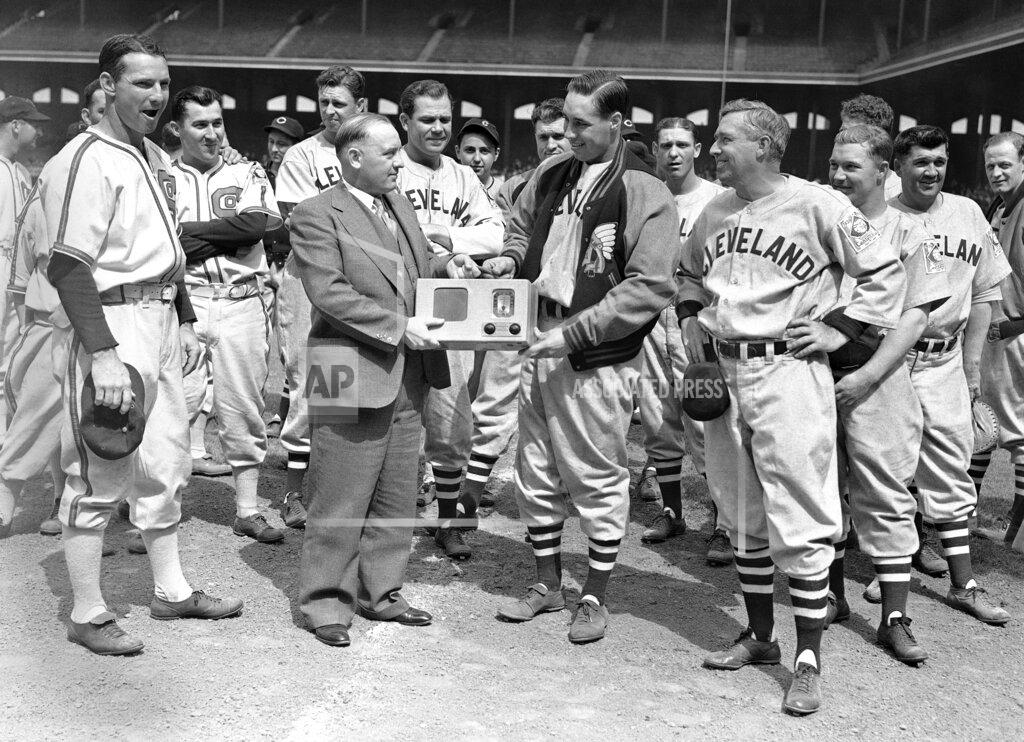
Next time, say it with flowers. At Comiskey Park, Mrs. William Feller smiled through a swat of bandages today her appreciation of a Mother’s Day gift from her son Bob Feller, 20-year-old Cleveland Indian’s pitching ace, which resulted in near tragedy. The bandages covered lacerations over her left eye suffered when she was struck by a foul tip from one of her son’s pitches.
There were 28,000 spectators in the Chicago White Sox park yesterday in celebration of “Feller Day.” Mrs. Feller, her husband and daughter, Marguerite, 10, had accompanied a delegation from Van Meter, Iowa, to pay tribute to the hometown fireballer. Bob Feller’s mother travels from Iowa to watch her son pitch against the White Sox. It was the first time she had seen him play in the majors, and she was given a box along the first base line. The family occupied front row seats and over 700 locals had made the trip to present Feller with a gift of a transistor radio. Bob promised his mother he would win the game as a Mother’s Day present. He was fulfilling his promise easily when the game reached the last half of the third inning with the Indians leading 6 to 0.
Marv Owen, Chicago third baseman, tipped a fastball into the stands. The ball struck Mrs. Feller above the left eye, shattering the lenses of her glasses. The glass lacerated her nose and eye. She was treated by the Indians trainer Max Weisman before being rushed to a hospital. Bob stood stunned for a moment, then resumed pitching. Chicago scored three runs before he regained his composure but he stayed in to win 9 to 4. Then he rushed to the hospital. His mother, with six stitches closing the wounds, already was recovering. Physicians said she probably would be released tomorrow after an x-ray examination. Baseball Commissioner, Mountain Landis also joined them in the room to check on the ace’s mother.
In St. Louis, the Tigers sweep a pair, winning 14–4 and 7–4. Rudy York has a grand slam for Detroit.
With considerable chagrin, officials of the Canadian Pacific Railroad conceded today that its ship, the Empress of Australia, had been delayed so greatly by fog and ice on its trip here with King George VI and Queen Elizabeth that it could not possibly arrive in time for a reception Tuesday. It was announced that if all now went well the first visit of a reigning sovereign to any of Britain’s dominions would begin formally Wednesday and that the reception here, originally planned for Monday, would be carried out in full.
By the time news came that the arrival of the royal visitors would be delayed another day, plans had been made to compress Ottawa’s four-day celebration into three. Further telescoping of the Dominion capital’s festivities was believed impossible and, as it is unlikely that Dominion officials would dare risk affronting the sensitive French by curtailing the brief visits of the sovereigns to Quebec and Montreal, it was suggested that the scheduled stop at Kingston, Ontario, next Sunday might be eliminated. This would give the King and Queen another day in Ottawa and still permit them to arrive in Toronto on schedule without traveling at night.
Lina Medina of Peru becomes the world’s youngest confirmed mother in medical history at the age of five.
Farther south the Chinese reported the recapture of Wamiaochi, an important point on the Hankow-Ichang highway, severing the Japanese line in this region.
Chinese planes bombed Japanese positions in the North Kiangsi Province and the airfield at Canton. On the Yangtze River east of Hankow Chinese guerrillas were reported to have briefly occupied Ocheng and Kuotien.
Hundreds of cases of cholera were reported today among Chinese refugees and soldiers following the series of air raids launched by the Japanese on Chungking May 5. Free inoculations were given in the crowded refugee quarter of the provisional capital, exhausting the supply of serum at several hospitals. So far, the disease was said to be taking a mild form. Its prevalence, however, caused Chinese officials to redouble efforts to remove civilians from the city. In an effort to facilitate the exodus the government offered free transportation and free food, but most of the population was unwilling to leave.
The United States Embassy received a belated report today that the American Lutheran Mission at Tangho, Honan Province, was damaged by Japanese bombs May 3. Americans at the mission escaped injury.
The Japanese Army in Central China claimed to have routed 26 Chinese divisions as a result of its May offensive against the main body of the Chinese (Hupeh) War Zone. The Chinese at Chungking admitted the Japanese advance but denied the Japanese encirclement. Japanese Army Headquarters at Hankow reports that between twenty-six and thirty Chinese divisions were defeated and scattered during a series of battles in Northern Hupeh and Southern Honan. The army air force reported that from May 3 to Saturday more than 250 raids had been made and that 250 tons of bombs had killed 13,700 Chinese, had sunk 700 junks and destroyed 130 motor trucks and 300 horse-drawn supply wagons.
A Japanese air raid at Swatow yesterday afternoon showered shrapnel and machine-gun bullets on property of the British Jardine, Matheson & Co. Several Chinese coolies were killed. The British naval sloop HMS Folkestone and a British freighter narrowly escaped.
The Amoy situation remains tense, the Japanese charging that Chinese trenches on the mainland, where troops are firing at Kulangsu, the seized International area, are on properties of the Standard Oil and Shell companies.
The Hailar region in Western Manchukuo reports three new forays across the border by Mongol troops. The reports say two regiments of Mongols are massing across the border.
Japanese Army Lieutenant Colonel Yaozo Azuma leads the reconnaissance regiment of 23rd Infantry Division, supported by the 64th Infantry Regiment of the same division, under Colonel Takemitsu Yamagata, into the disputed territory at Nomonhan and the Mongolians withdrew. Soviet and Mongolian troops later return to the disputed region, however, and Azuma’s force again moves to evict them. This time things turn out differently, as the Soviet-Mongolian forces surrounded Azuma’s force on 28 May and destroy it.
Born:
Troy Shondell, American singer (“This Time (We’re Really Breaking Up)”), in Fort Wayne, Indiana (d. 2016).
Veruschka von Lehndorff, model, actress and artist, in Königsberg, East Prussia.
Naval Construction:
The Regia Marina (Royal Italian Navy) Marcello-class submarine Comandante Cappellini is launched by Odero Terni Orlando (O.T.O.), Muggiano, Italy.
The Royal Navy Maidstone-class submarine depot ship HMS Forth (F 04) is commissioned. Her first commander was Captain William Derek Stephens, RN.
 History Diaries