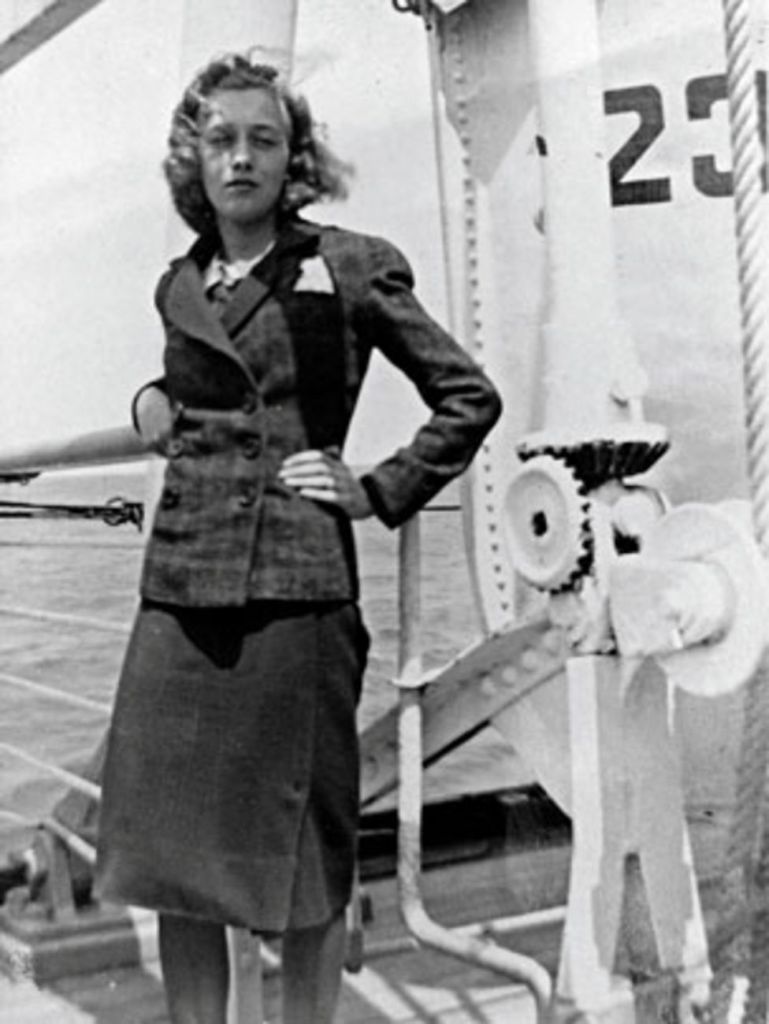
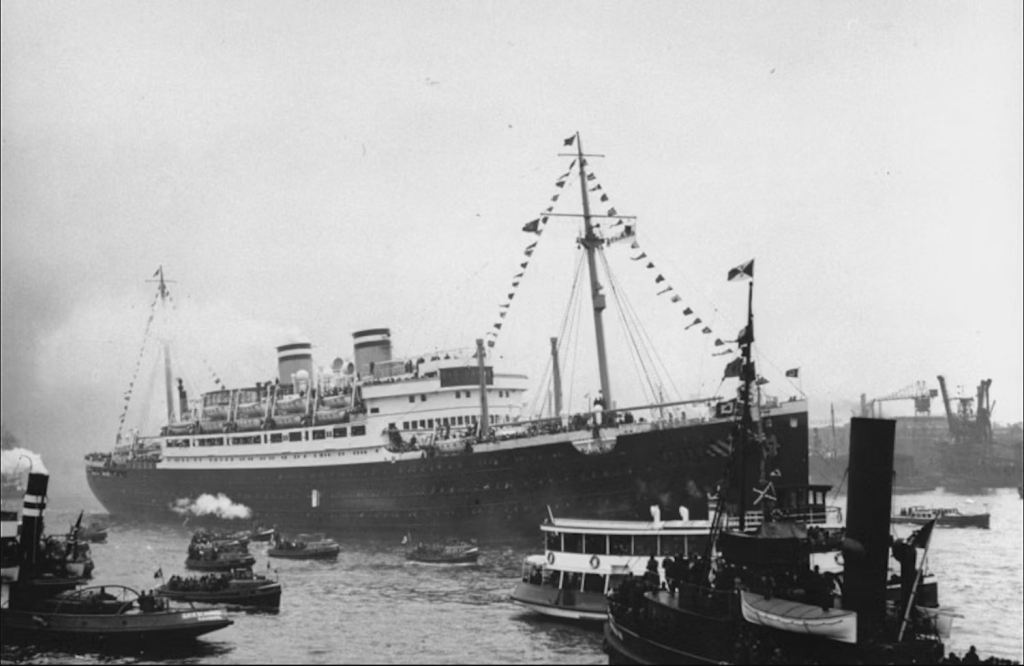
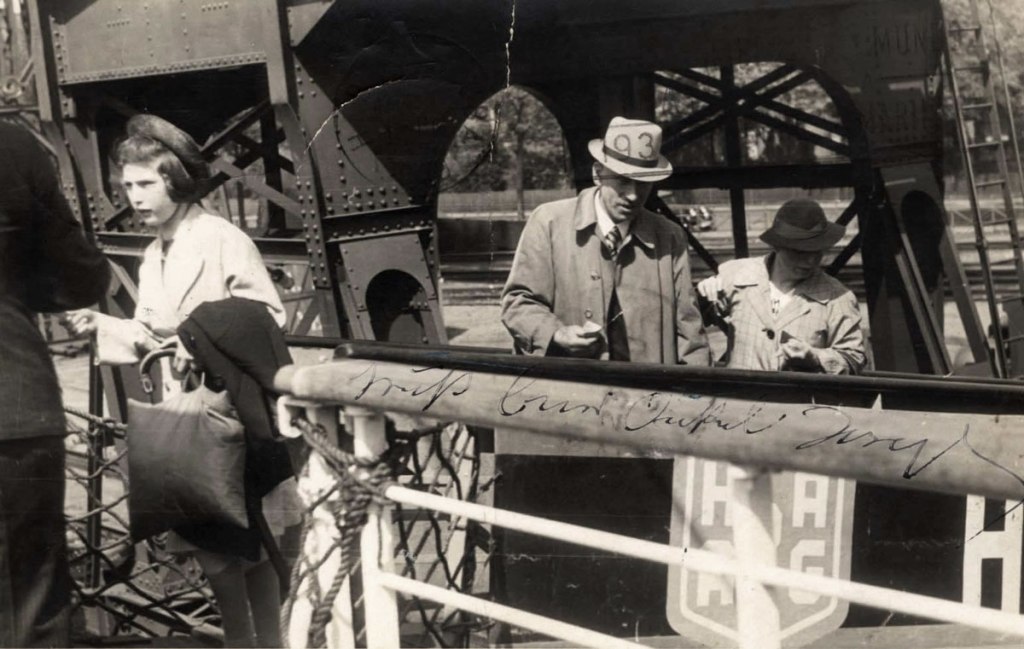
The German ocean liner MS St. Louis departed Hamburg for Cuba with 936 passengers, mostly Jewish refugees. The Cuban government had already canceled their landing certificates, but many passengers boarded the ship anyway hoping the Cubans would honor the certificates they had already obtained. They hoped to reach Cuba and then travel to the U.S. — but were turned away in Havana and forced to return to Europe. In the end, the ship’s passengers did not have to go back to Nazi Germany. Instead, Belgium, France, Holland and the UK agreed to take the refugees. The American Jewish Joint Distribution Committee (JDC) posted a cash guarantee of $500,000 — or $8 million (£4.7m) in today’s money — as part of an agreement to cover any associated costs. But many were swept up in the collapse of western Europe to Nazi invaders in 1940. Two-hundred-and-fifty-four passengers from the St Louis were killed in the Holocaust.
A spectacular welcome awaits Premier Benito Mussolini upon his arrival in Turin tomorrow morning for the first of a series of speeches in Piedmontese cities. Those speeches are expected to set the tone of Italian foreign policy in this period of tension. No one knows whether these addresses will be warlike or peaceful or indeed what Signor Mussolini will talk about, for there has rarely been such advance secrecy. Even the newspapers today show that they have received no cue, and Virginio Gayda, most authoritative Fascist editor, merely writes a few generalities about Italy’s wanting nothing better than to work in peace and to have the means to live independently.
All guesses are that Signor Mussolini’s tone, in substance, will be moderate but that there will be a round denunciation of the alleged encirclement policy, with especially harsh words for France. That seems a safe enough prediction but if so, the speeches would contain nothing new. Some people feel, however, that, having drawn the eyes of the world to Turin tomorrow, Signor Mussolini will not allow the occasion to pass without some sensation.
The city is beflagged in every street; there are pictures of Signor Mussolini in all the windows; Fascist mottoes and quotations from Signor Mussolini’s speeches are in evidence, as is all the paraphernalia accompanying events like these. Any one arriving from Rome sees nothing but these enthusiastic expressions of adoration. Needless to say, the station, the streets and, indeed, the entire city are thoroughly guarded and this morning 120 musketeers from Signor Mussolini’s private bodyguard arrived. The address will begin at 10:45 AM from a huge special podium built in the Piazza Vittorio Veneto.
France again became the target of fascist press attacks today as Premier Benito Mussolini departed for Turin to make an address tomorrow. which some sources expected might decide future relations between France and Italy. In some diplomatic quarters It was thought that Signor Mussolini, in his speech before a Turin mass meeting, might give France a “last chance” to settle Italy’s claims against her peaceably. In recent days the Italian press has been calling on both France. and Britain to take steps toward settling Europe’s “open problems” — in which it includes Italian colonial aspirations — before it is “too late.”
France held her military forces ready on land and sea tonight in preparation for what diplomatic circles considered likely to be a weekend of heightened international tension. Her army was on the alert in the Maginot zone along the eastern frontier across from German fortifications which Chancellor Adolf Hitler and high Nazi officers were reported to have decided suddenly to inspect early next week.
A strong detachment of the Mediterranean Fleet moved late today into Tunisian waters on the eve of the speech Premier Benito Mussolini of Italy is to deliver at Turin tomorrow. The fleet movement coincided with the arrival of reports here. that Il Duce would speak violently on the strained Italian-French relations. During the two hours required for the French warships to take up their positions in the Bay of Sebra at France’s great naval base at Bizerte, Tunisia, Premier Edouard Daladier was conferring with Navy Minister César Campinchi and Vice Admiral Jean Darlan, Commander in Chief of the Navy.
Admiral Darlan had just returned to Paris from an inspection of the French Atlantic fleet, which was being held to its base at Brest. The German fleet, returning from its maneuvers in Spanish waters near Gibraltar at the entrance to the Mediterranean, was believed to be steaming up the Atlantic coast.
The French squadron which was shifted to Tunisia, one of the French-ruled territories in which Signor Mussolini has asked for increased Italian rights, had been on a quiet patrol mission in the Western Mediterranean during the visit of the German fleet. The squadron was led by four of France’s newest cruisers, sister ships built specifically to offset new German warships. They are the Galissonnière, the Jean de Vienne, the Marseillaise, and the Emile Bertin. There were also eight destroyers which are ordinarily based at Toulon.
German Chancellor Adolph Hitler left Munich for Nuremberg to inspect the building being erected there for use of the Nazi Party conferences. He was accompanying by his personal architect Albert Speer. Hitler is also reportedly planning to inspect the western fortifications along the French border.
General Alois Elias, Premier of the German protectorate of Bohemia-Moravia, announced to its Czechs today that they would be required to conform to German ways of living and working. The Premier said far-reaching restrictions on personal liberty had become necessary and that he would announce government decrees regulating prices, wages, hours of work and the status of Jews.
“We Czechs must in our new situation develop greater speed in our work and must perfect the quality and precision of our output,” he said, adding that “exportation is the main artery of our economic life.” Announcing that the government was “thinking of introducing compulsory labor service,” the Premier said civil service officials and officers and men of the army of the Czecho-Slovak Republic, which vanished when Germany absorbed Bohemia and Moravia two months ago, must first get jobs.
The Premier did not divulge the measures to be adopted concerning Jews. He said only that “a solution will be found for the Jewish problem which will correspond to the interests of public life and to the demands of unhampered economic development of the protectorate.”
The Hungarian Union of Jewish Communities, in response to a massive surge in conversions to Christianity, implores Jews not to abandon the faith of their fathers and the Jewish people.
French Foreign Minister Georges Bonnet declared today that Britain and France would “keep their word and honor their signature” to pledges holding together the British-French line-up. M. Bonnet flew from Paris to address a luncheon here of the British federation of the Alliance Française.
He strongly emphasized British-French unity and said that Premier Edouard Daladier had stated their common policy “perfectly” in declaring they refused to submit to domination but did not bar cooperation with anyone. M. Bonnet dealt at length with what he called France’s “speedy awakening” to the responsibilities of rearmament after the Munich conference last September. He referred to the lengthened work-week in French factories, to the willing response of those called to the colors and asserted that among all France’s millions of workers, only twenty-seven were on strike.
Hitler’s Elite Guards swoop in and arrest 21 Czech police. Some attempt suicide.
Nazis free banker Louis Rothschild after 13 months as a Gestapo prisoner. Friends say Rothschild will sue to regain his confiscated fortune.
Britain offers the interior of British Guinea for Jewish settlements. Prime Minister Neville Chamberlain promises the establishment of facilities for a refugee colony.
The first of a series of plans calculated to assure the United States a position as the first air power of the world was submitted to President Roosevelt today by an interdepartmental committee headed by Oswald Ryan of the Civil Aeronautics Authority. The committee recommended immediately more than doubling the mechanical employees in the American aircraft industry, and outlined plans for cooperation of the industry, vocational schools, and government agencies to make about 500,000 aviation mechanics quickly available for war purposes.
This report, on means of preparing behind the scenes for vast expansion of the aircraft industry it war should develop, is expected to be followed soon by one from another interdepartmental committee on plans for strengthening “continental” defense by further development of civilian airlines in Latin America with United States Government aid, thereby widening the market for American planes and offsetting penetration by the totalitarian powers. Today’s report, noting that only 40,000 factory workers are now employed in the aircraft industry, states that “the maximum requirement for factory labor to meet the authorized air expansion program will necessitate 60,000 additional factory workers.”
“The number of aircraft factory workers in time of war will be at least four to six times that needed, in the present approved air expansion program,” it continued. “The greatly increased output of aircraft will make production line methods possible, thereby reducing the proportion of skilled workers. The existing facilities for the training of skilled workers should, therefore, be expanded to the limit of peacetime practicability. Your committee has discovered that one of the principal limitations in such peacetime training is the objection made to any training of a group who would never find any use for their skill except in time of war.
“In view of this and other limiting factors, it is not anticipated that this expansion of existing training facilities can avert entirely deficiency of skilled personnel for aircraft work in time of war. As a last resort in time of war, the remaining deficiency of skilled workers must be met by the emergency method of breaking down skilled jobs into semi-skilled operations, which can be performed by available semi-skilled workers or by beginners who can be trained in a relatively short time. It is important, therefore, that appropriate steps be taken immediately to develop plans to insure the most effective cooperation in time of war of all groups concerned with the training and recruiting of the needed personnel.”
Kentucky National Guardsmen were ordered to mobilize in Harlan County today after six associations of Southern soft coal operators had refused to sign a “union shop” agreement with the United Mine Workers, headed by John L. Lewis. Fifteen associations of operators in the North and South, representing 80 per cent of the coal production in the Appalachian district, signed contracts restricting employment to members of Mr. Lewis’s union at a meeting yesterday in the Hotel Biltmore.
The formal ratification of the new two-year agreement by the employers of 260,000 bituminous miners will make possible the reopening of 3,000 Appalachian mines tomorrow and ensures replenishment of fuel reserves that were reaching the vanishing point after forty-five days of idleness in the coal fields. The operators who withdrew from the Appalachian Joint Wage Conference because of their opposition to the union shop employ between 50,000 and 70,000 men.
Little difficulty was anticipated by officials of the CIO union in signing up most of the dissident mine owners, but they made no effort to minimize the gravity of the situation in Harlan County, long known for the bloodiness of its disputes between miners and operators.
Warning that miners could not be “shot back” into the mines, Mr. Lewis asserted at the Biltmore conference that “sound public policy” required that the mines that did not sign remain closed. In Frankfort, Kentucky, Governor A. B. Chandler retorted that “no one can tell our people to work or not to work and no one can come into this state and cause trouble.” He instructed Adjutant General E. Lee McClain to send 557 National Guardsmen into Harlan County today to protect miners returning to work.
As representative of the Federal Government, Dr. John R. Steelman, chief of the United States Conciliation Service, served notice upon the Southern bolters at the Biltmore that “the time has passed when we expect the settlement of labor disputes by fighting or by warfare.” He appealed to the dissenting operators to continue negotiations with the union in an effort to reach a peaceful settlement.
George Palmer Putnam, husband of the late Amelia Earhart, was resting in safety at his North Hollywood home today after two men who he believes, he told police, were Nazi sympathizers kidnapped him last night, drove him 100 miles north to Bakersfield, and left him bound and gagged in an abandoned house. The publisher walked into the Bakersfield sheriff’s office early this morning and said that he had been left in the vacant house with his mouth taped and his legs and arms bound. He said that he had managed to work off the gag after several hours and that his cries had attracted the attention of Mr. and Mrs. Roy Walker, who lived nearby.
Bakersfield deputy sheriffs searched the vacant house and confirmed Mr. Putnam’s version of how he was found, through statements from the Walkers. Another angle to the case came when it was learned that agents of the Federal Bureau of Investigation were acting unofficially on orders from Washington in connection with the kidnapping.
President Roosevelt recommends the Chief of Naval Operations, Admiral William Leahy, to serve as Governor of Puerto Rico. The announcement takes the Navy by surprise.
This month’s edition of Detective Comics (#27) features a new hero: “Batman,” by Bob Kane.
64th Preakness: George Seabo aboard Challedon wins in 1:59.8. Racing over a slow track at Pimlico, W. L. Brann’s Challedon won the forty-ninth running of the Preakness Stakes as Johnstown, victor in the Kentucky Derby, finished next to last in a field of six. Gilded Knight, coupled in the betting with Johnstown, was second, a length and a half behind Challedon, and Volitant was third.
In a 10-player deal, Bobo Newsom goes from the St. Louis Browns, along with Beau Bell, Red Kress, and Jim Walkup, to Detroit for Vern Kennedy, Bob Harris, George Gill, Roxie Lawson, Chet Laabs, and Mark Christman. It is one of the biggest trades of the 1930s. Newsom will rack up 17 wins this year as a Tiger to finish at 20–11. Stephens will be the reverse, finishing at 9–20, while Gill, 0-1 after two fine seasons with the Tigers, will be 1–12 with the Browns.
Admiral Harry E. Yarnell, commander in chief of the United States Asiatic Fleet, today sent a destroyer to obtain information of the situation at Amoy, where the International Settlement on Kulangsu Island was occupied yesterday by Japanese naval forces. The Bulmer, carrying Captain J. T. G. Stapler, commander of the South China patrol, is speeding to Amoy from Foochow, where the ship has been looking after American interests. Americans share in the administration of Kulangsu. Seven live there and one is a member of its international council.
In Shanghai authoritative quarters interpreted the Kulangsu occupation as a Japanese “trial balloon” to test the reaction of foreign governments.
A checkup of Friday’s bombing of Chungking revealed the casualties were 200 to 300. The toll was lower than the first estimate because most residents had fled to the hills when the raid warnings were sounded. A loss of approximately 500,000 Chinese dollars was caused when bombs and fire destroyed the warehouse of William Hunt & Co., an American concern, on the south bank of the Yangtze River. Chinese and American interests had just completed installing a tobacco factory and storing tobacco worth 300,000 Chinese dollars in the warehouse. Chinese authorities announced that anti-aircraft guns had brought down three Japanese planes in Friday’s raid.
The Chinese admit the seriousness of the Japanese threat to Slangyang, North Hupeh city and historical gateway to Hanchung and. Sian, the capital of Shensi Province, up the Han River valley. The Japanese are attacking Siangyang from Sinyang to the east, from Yingahan on the southeast and from Chunghalang to the south. The column from Sianyang has reached Tungpeh, while the force from Chunghsiang has swept northward and occupied Huanglungtang, thirty miles east of Siangyang.
Denying Japanese reports that they had trapped nearly 200,000 Chinese troops between Yingshan and Siangyang, the Chinese maintained they defeated Japanese who were advancing from Yingshan toward Suihsien, causing 1,000 enemy casualties. Cutting in from the west between Chunghsiang and Huanglungtang the Chinese are said to be threatening the annihilation of the Japanese vanguards at Huanglungtang.
A report from Shanghai said seven Japanese planes made direct hits on over 100 buildings in the treaty port of Ningpo. Ten people were reported to have been killed.
United States Ambassador Joseph C. Grew conferred today with Foreign Minister Hachiro Arita. It was reported unofficially that they discussed the status of the Shanghai International Settlement, in the administration of which Japan seeks more authority, and the probable United States reaction should Japanese troops occupy the area. The zone is governed by a council of five Britons, two Americans, two Japanese and five Chinese, all elected by International Settlement taxpayers.
Dow Jones Industrial Average: 132.40 (+0.24).
Born:
Harvey Keitel, actor (“Taxi Driver”, “Pulp Fiction”, “Reservoir Dogs”) and producer, in Brooklyn, New York, New York.
Bill Cobey, American politician (Rep-R-North Carolina, 1985-1987), in Washington, District of Columbia.
Died:
Stanisław Leśniewski, 53, Polish mathematician, philosopher and logician.
Wilhelm Normann, 69, German chemist (hydrogenated liquid fat creating trans fat).

 History Diaries