
The Pentagon insisted today that propeller‐driven aircraft used in South Vietnam had been “carefully tested” and were “performing outstandingly.” It had been charged that the planes — T‐28 trainers and B‐26 fighter‐bombers, which were recently grounded — had caused the death of two pilots. The Secretary of the Air Force, Eugene M. Zuckert, replied that one and possibly two of 72 airplanes specially modified for use in Vietnam might have failed structurally in noncombat incidents. He contrasted this with the completion of 4,500 sorties in 1962 and 9,000 sorties in 1963 in South Vietnam.
Information Given Vinson Mr. Zuckert discussed the quality of the Air Force planes in a five‐page letter to Representative Carl Vinson, Democrat of Georgia, who is chairman of the House Armed Services Committee. The letter was in answer to an inquiry, originally addressed to Secretary of Defense Robert S. McNamara, concerning charges of obsolescence in the planes being flown by United States pilots in their role as advisers and teachers in the antiguerrilla war. The House committee, Representative Vinson pointed out yesterday following a meeting of the panel, had been disturbed by reports that two pilots had lost their lives when the wings of their T‐28 planes had fallen off.
The State Department said today that The Associated Press, in a report from Los Angeles Tuesday, had not accurately described what a department spokesman said about the overthrow of the Ngô Đình Diệm regime in South Vietnam last year. The spokesman, Richard I. Phillips, was quoted as having said that there had been no religious persecution under the Diệm regime and that widespread belief to the contrary might have been the result of Buddhist public relations.
“We are well aware that there was discrimination in certain areas against the Buddhists under Diệm and that they had justified complaints,” Robert McCloskey, Mr. Phillips’s deputy, said in Washington today. Mr. Phillips was quoted further as having said that the Buddhists had had the support of Communist China. The Buddhists of Ceylon and Burma complained about the Diệm regime’s attitude, Mr. McCloskey said, and Communist China exploited this situation in other Buddhist countries. This was what Mr. Phillips said, Mr. McCloskey asserted.
Cambodia called today for a meeting of the Security Council “as soon as possible” to consider “repeated acts of aggression by United States-South Vietnamese forces against the territory and civilian population of Cambodia.” The complaint charged that United States officers had taken part in the invasions. South Vietnam has acknowledged entering Cambodian territory in pursuit of Communist guerrillas. The Cambodian Government’s note asked that a United Nations investigating group be sent to Cambodia to investigate United States charges that Cambodia had sheltered “rebels opposing the Saigon Government.” It also charged that the United States had “steadily refused to consider” a proposal by Cambodia for international inspection of her frontiers. The proposal fully demonstrates the sincerity of Cambodian neutrality, it said.
Communist China declared today that the situation in Laos was “explosive” and charged that the United States was responsible. It demanded the dissolution of what it called the “coup d’état clique.” Alternatively, Peking proposed that consideration be given to the holding of a new Geneva conference. Relating the situation in Laos to alleged United States “plans for extending its aggressive war in South Vietnam,” Peking said that a new Geneva conference should discuss not only the Laotian question but also the “entire Indochina question.”
“Laos is now faced with the danger of all‐out civil war as a result of provocations of United States imperialists and the Laotian right wing,” Jenmin Jih Pao, the Chinese Communist party newspaper, asserted. “This is against the national interests of Laos and seriously threatens the peace in Indochina and the rest of Southeast Asia.” Right‐wing forces staged a coup in Laos April 19 against the coalition regime set up in the country on the basis of the 1962 Geneva conference. The neutralist, rightist and pro-Communist coalition has been beset by dispute and rivalries since its formation.
Secretary of State Dean Rusk declared today that any war between Greece and Turkey was unthinkable. The two countries, important units in the North Atlantic Treaty Organization’s defense system, must exert all possible influence on Greek and Turkish Cypriotes to end the fighting on Cyprus, Mr. Rusk said. He spoke at a session of NATO’s Ministerial Council. Greece rejected a Turkish proposal for ending the Cyprus conflict by dividing the island into separate communities of the Turkish and Greek communities. The proposal was advanced by foreign minister Feridun Cemal Erkin of Turkey. Foreign Minister Stavros Costopoulos of Greece in effect rejected mediation by the North Atlantic Alliance.
Zenon Rossides, representative of Cyprus called today for United Nations action over the killing of two Greek Army officer and a Greek Cypriote policeman Monday by Turkish Cypriotes. Mr. Rossides sent a letter to Roger Seydoux of France, this month’s President of the Security Council, and asked that it be circulated to all member countries.
Premier Khrushchev and President Gamal Abdel Nasser threw two pieces of granite into the Nile today in a gesture symbolic of their cooperation toward the harnessing of the historic river for the benefit of Egypt’s millions. Standing on the deck of the steamer Ramses, President Nasser gave his square of rock a quick underhand flip. But Premier Khrushchev dramatically clutched his rock firmly between his hands and swung it high and far for a big splash. President Abdullah al‐Salal of Yemen also took part in the ceremony. The granite thrown ceremonially this morning represented the first of a series of steps ending the first phase of the construction of the Aswan High Dam.
A Cuban exile organization said tonight that it began its war against Premier Fidel Castro’s regime today with the temporary capture of a port in eastern Cuba and the demolition of a sugar mill after a pitched battle with Castro forces. The organization, the Revolutionary Recovery Movement, issued its “first war communiqué.” It said that guerrilla forces already in Cuba had joined “commandos, frogmen, combat engineers, signal corps units and torpedo units” and had taken Pilon, on the southern coast of Oriente Province, by force. The Cuban radio confirmed that anti‐Castro forces had attacked a sugar mill at Pilon. However, the broadcast, monitored here, said the attackers had shelled the mill from a ship offshore.
Premier Fidel Castro called the attack a “new and criminal vandalistic act by the United States.” At Rio de Janeiro, Brazil accused Dr. Castro of “interfering in Brazil’s internal affairs” and severed relations with Cuba.
Brazil broke diplomatic and consular relations with Cuba today, charging Premier Fidel Castro’s regime with “interfering in Brazil’s internal affairs.” A Foreign Ministry official advised the Cuban charge d’affaires here, Francisco Cazadilla, of the break in relations and an official Brazilian note was presented in Havana. President Humberto Castelo Branco’s Government said the break was in “consonance with the Brazilian Government’s position of not permitting Communist action within its national territory.”
The Brazilian Government accused Premier Castro of “taking advantage of every opportunity to continue exporting his subversive doctrines through intense ideological propaganda.” It specifically accused the Cuban regime of bypassing normal diplomatic channels in its relations with Brazil and entering into “inadmissible understandings with minority groups dedicated to proselytizing incompatible with Brazil’s traditional democratic and Christian convictions.”
The Brazilian decision set the stage for the inter‐American foreign ministers’ conference requested by Venezuela under the Inter‐American Mutual Defense Treaty to consider Cuban aggression in the hemisphere. Only four Latin ‐ American countries now maintain diplomatic relations with Cuba. They are Mexico, Chile, Uruguay and Bolivia.
The Foreign Ministers of France and Belgium clashed today over the future of the North Atlantic Treaty Organization when a long‐smoldering dispute reached the highest Western defense council. Paul‐Henri Spaak of Belgium challenged the French to say exactly what they wanted changed in the alliance. He suggested that President de Gaulle’s Government look forward, rather than backward to bilateral alliances of 1914 and 1939.
Maurice Couve de Murville of France conceded that France opposed the system of integrated military command in NATO. Political consultation and support do not invariably work well within the alliance, he said.
Secretary of State Dean Rusk intervened briefly in the debate before the Ministerial Council this afternoon. The United States, he said, will listen to all suggestions for change and is doing its best, through the proposal for a nuclear fleet, to widen allied management of nuclear weapons.
Salah al-Din al-Bitar was named as the Prime Minister of Syria for the second time, having served from for eight months in 1963. He would step down on October 4 after less than five months. He would serve a final time for two months in 1966, before President Amin al-Hafiz was overthrown, and live in exile until his assassination on July 21, 1980.
Attorney General Robert F. Kennedy, Senator Everett McKinley Dirksen of Illinois and others in a bipartisan group of Senators reached final agreement today on amendments to the civil rights bill aimed at easing the task of breaking the Southern filibuster. At the end of the all‐day session in his office, Mr. Dirksen, the Senate Republican leader, said, “We have a good agreement.” Mr. Kennedy said, “This bill is perfectly satisfactory to me.” “And it is to me,” said Senator Hubert H. Humphrey of Minnesota, the Democratic floor manager for the bill. “We have done nothing to injure the objectives of this bill,” Mr. Humphrey declared. The Attorney General agreed with Mr. Humphrey that the proposed amendments “would not weaken the bill.”
Senators Dirksen and Humphrey both emphasized that the agreement was not binding on other Senators. In the next few days, the amendments will be circulated among all Senators in both parties except the 19 Southerners opposing the bill. At 9 AM next Tuesday the amendments will be discussed at a Senate Republican conference. The Democratic caucus, without the Southern members, will probably discuss them the same morning at 10:30. If, as expected, the amendments win the general approval of both parties, they will then be submitted to the Senate either by Mr. Dirksen alone or under joint sponsorship with the Democratic leader, Mike Mansfield of Montana, and possibly with Mr. Humphrey and Senator Thomas H. Kuchel of California, the Republican floor manager. Before the amendments are called up, either singly or in one package, the leaders must also decide whether to seek closure of debate on the whole bill or title by title. The votes of two‐thirds of the members present and voting are required to curb debate — 67, if all 100 are present. To achieve this, the affirmative vote of 25 of the 33 Republicans will be needed.
President Johnson called in Democratic members of the House Rules Committee last night for what was described as a pep talk on his legislative program. Word of the secret meeting leaked out at the Capitol today, but the White House would not acknowledge that it had taken place. Congressional sources said the President’s apparent aim had been to emphasize his determination to get action on a sizable part of his program this year, even if legislators had to return after the national political conventions. They said he had mentioned about a dozen bills on which he wanted action and had asked the Rules Committee Democrats to help him. All 10 of the committee Democrats were invited and seven attended. Also present were Representatives John W. McCormack of Massachusetts, Speaker of the House, and Carl Albert of Oklahoma, the majority leader.
President Johnson scored a double victory for his foreign aid policy in the House of Representatives today. The major triumph came as the House reversed its earlier stand and shouted through a $312 million United States contribution to the International Development Association. Moments before the voice vote sent the measure to the White House, a Republican motion to return it a second time to committee was rejected, 247 — 132. A second, if temporary, victory for the President came from the House Foreign Affairs Committee. Responding to his direct appeal, the group beat off repeated attempts to cut his request for $3.4 billion for economic and military foreign aid in the fiscal year beginning July 1.
The authorizing legislation faces an uphill fight on the House floor. It is almost certain to be cut when taken up later by the Appropriations Committee. But the President appealed only last night to key members of the foreign policy group to “hold the line” on his asking figure and it sustained his position on four tests today. House action on the development fund contribution assured the World Bank affiliate of a $750 million replenishment of its loan capital from the United States and 16 other industrially advanced nations over a three‐year period beginning July 1, 1965. The House voted, 208 — 188, late in February to send a similar measure to its Banking and Currency Committee for further study.
Republican efforts to expand the Robert G. Baker investigation to include members of the Senate ran into Democratic opposition today. Senator John J. Williams, Republican of Delaware, who was responsible for the investigation’s getting started last October, proposed in a Senate speech to broaden his original resolution to include “illegal, immoral or improper activities” of any member or former member of the Senate. He also offered language that would empower the Rules Committee, which has conducted the investigation, to include in its jurisdiction the giving and receiving of campaign funds “under questionable circumstances.” Both the conduct of individual Senators and matters relating to political contributions have been regarded by the Rules Committee majority as out of bounds in the inquiry.
Mr. Williams’s proposal was challenged on the floor by the Rules Committee chairman, Senator B. Everett Jordan, Democrat of North Carolina; by Senator Warren Magnuson, Democrat of Washington, and others. Although Mr. Jordan said at one point that he would have no objection to the resolution if it were adopted, he disagreed sharply with Mr. Williams on the necessity for such a new grant of authority. Mr. Magnuson was more vehement in his disapproval, and accused the Delaware Republican of trying to make “a blanket indictment of the whole Senate.”
Attorney General Robert F. Kennedy is exploring the idea of running for the Senate from New York State this fall. The move has been suggested by members of his family and by Democrats in both Washington and New York. It is one of a series of political alternatives he is weighing. Mr. Kennedy has been sufficiently interested in the possibility to send a representative to New York to sound out sentiment of some carefully chosen Democrats. The fact that the Attorney General is not a resident of New York and has not been one for many years would probably not interfere if he chooses to run. authorities in both parties agree that a Senate nominee must be living in the state from which he is running only at the time he is elected.
The Federal Constitution provides that “no person shall be a Senator who shall not have attained the age of 30 years and been nine years a citizen of the United States and who shall not, when elected, be an inhabitant of that state for which he shall be chosen.” Generally, the courts have held that states may not add to these qualifications but may only regulate the time, place and manner in which Senators are chosen. If he received the nomination, Mr. Kennedy would oppose Senator Kenneth B. Keating, the Rochester Republican who will seek a second term in the election this fall. Republicans have been increasingly confident in recent months that Senator Keating’s relentless and effective campaigning for the last five years has made him a favorite to win re‐election. The choice of Mr. Kennedy as his opponent, however, would lead to some reexamination of that assumption.
Shortly after taking off at 2:00 in the afternoon from Nellis Air Force Base, a crippled F-105D jet fighter crashed into a residential neighborhood in North Las Vegas, Nevada, destroying nine houses near the intersection of Lenwood Avenue and Salt Lake Street, and killing four people on the ground, along with the pilot. U.S. Air Force Lt. Raynor L. Herbert stayed with the plane to keep it from striking Lincoln Elementary School, which was occupied with 800 students.
The United States Department of Defense began transformation of the uninhabited Alaskan island of Amchitka into a nuclear test site, with the arrival of the first drilling rig.
The first “all-nuclear” U.S. Navy task force, consisting of USS Enterprise (CVAN-65), USS Long Beach (CGN-9), and USS Bainbridge (DLGN-25), deploys to the Sixth Fleet in the Mediterranean Sea.
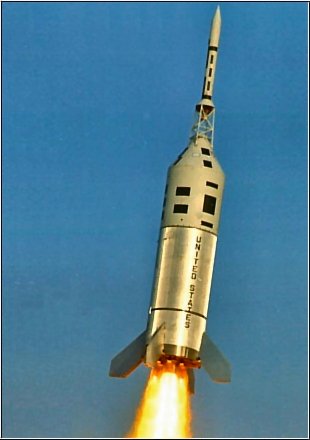
A-001, a second abort test of a boilerplate Apollo spacecraft, using a Little Joe booster, is made at White Sands (New Mexico) Launch Complex 36. Unacceptable wind conditions had forced a 24-hour postponement of the launch, but the vehicle was successfully launched on May 13, 1964, at 12:59:59.7 UTC (05:59 am MST). A ground commanded abort signal terminated thrust of the launch vehicle (by rupturing the Algol motor casing), ignited the launch escape and pitch control motors, and separated the command module from the service module. Some structural damage was incurred by the command module aft heat shield because of recontact with the booster at thrust termination. At approximately 44 seconds, the tower jettison motor was ignited and satisfactorily separated the launch escape tower from the command module.
The Earth landing sequence was normal until a riser for one of the three main parachutes broke as a result of its rubbing against the structure on the command module upper deck. The parachute separated; however, the command module, supported by the two remaining parachutes, descended at rates of 9.1 to 7.9 meters per second (30 to 26 ft/s) instead of the predicted 7.3 meters per second (24 ft/s) with three parachutes. The command module landed 6.8 kilometers (22,400 ft) downrange at 350.2 seconds after attaining an altitude of 9.075 kilometers (29,772 ft) above mean sea level. Except for the parachute failure, all test objectives were satisfied.
The Cincinnati Reds buy Ryne Duren from the Philadelphia Phillies.
Dow Jones Industrial Average: 825.78 (-1.60).
Born:
Stephen Colbert, American comedian and television show host; in Washington, District of Columbia.
Tom Verica, American actor, director and producer (“How to Get Away with Murder”, “Bridgerton”), in Philadelphia, Pennsylvania.
Sara Gomer, English tennis player (Olympics, 1988, 1992), in Torquay, England, United Kingdom.
Cameron Riley, NFL defensive back (Pittsburgh Steelers), in Metropolis, Illinois.
Died:
Diana Wynyard, 58, English actress, of kidney failure.





 History Diaries