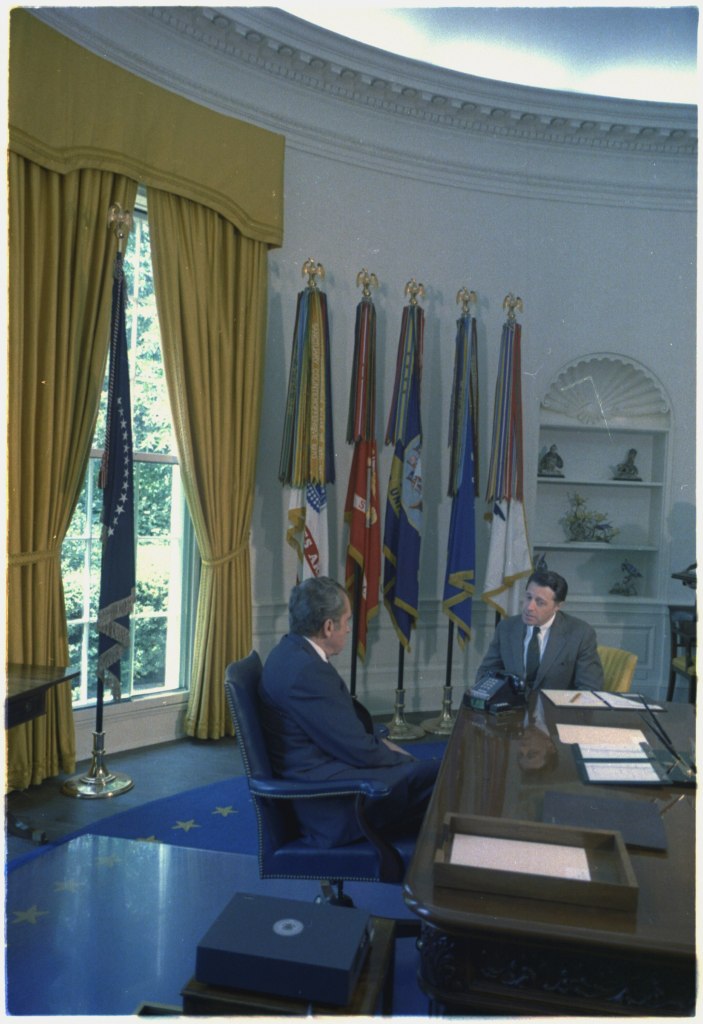
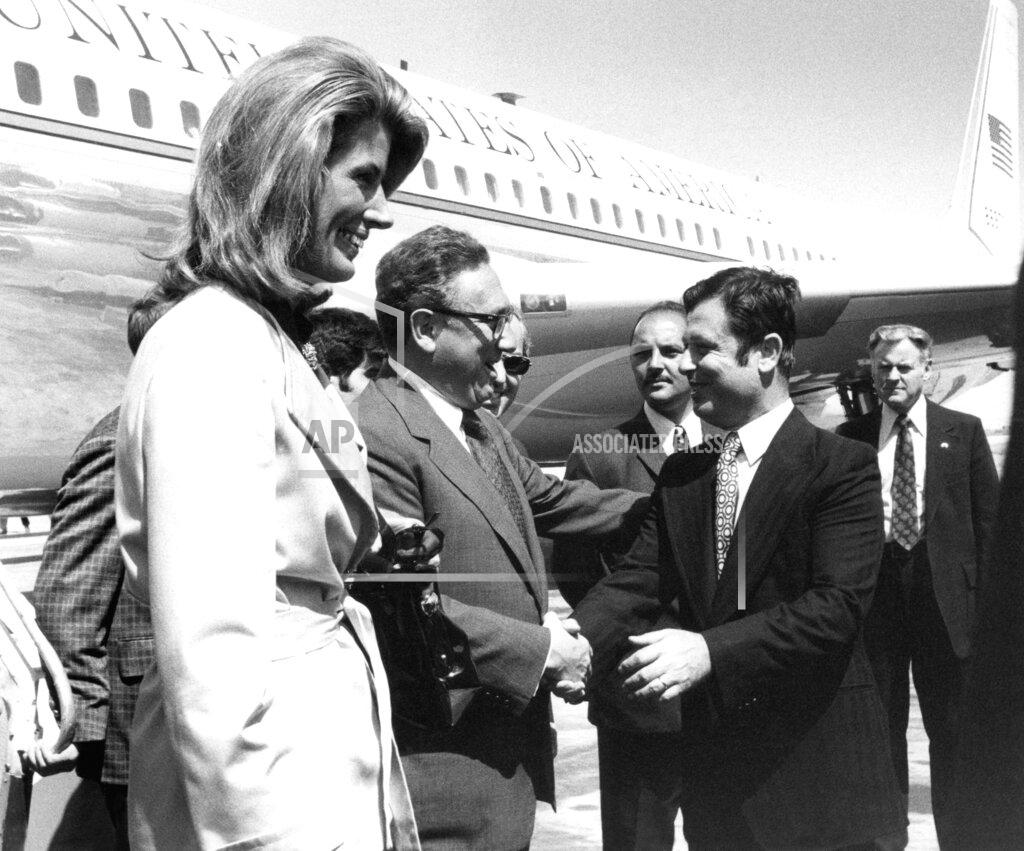
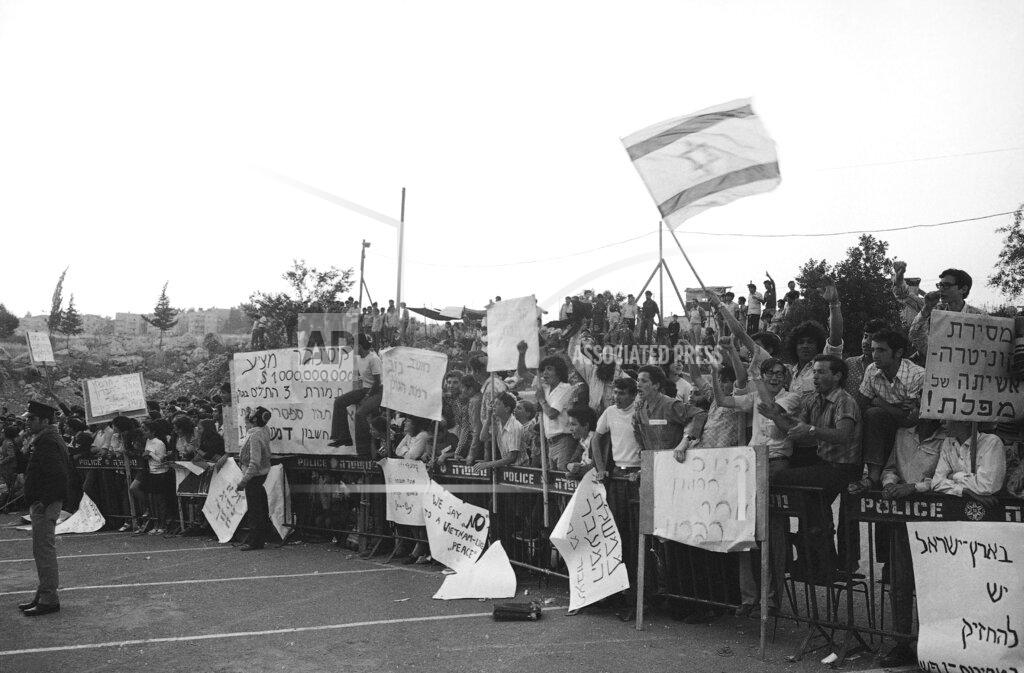
The next 24 to 48 hours will probably be decisive in Secretary of State Kissinger’s efforts to mediate between Israel and Syria, American officials said in Jerusalem, Negotiations apparently entered a crucial phase, the officials reported, and they said that Israeli and Syrian differences over a new demarcation line had been reduced to “a few kilometers.”
The newsmen traveling with Secretary of State Kissinger were flown by helicopter to the disputed Golan Heights area this morning as part of Israel’s effort to impress on Americans the value she places on maintaining control of three hills near the town of El Quneitra.
Israeli aircraft struck Lebanese territory again today, attacking what an Israeli spokesman said were Palestinian terrorist targets near the juncture of the Israeli, Lebanese and Syrian borders. Lebanese officials said that four persons, including woman and two children, were killed and five wounded in the Israeli air strikes early this morning. Israel said no planes were lost. On the Israeli‐Syrian front, the battle begun last March continued. An Israeli military spokesman said that Syrians fired on Israeli positions on Mount Hermon and on other areas along the front. The spokesman said two Israeli soldiers were wounded.
Syria tonight accused Israeli forces of killing a baby girl and wounding four children during shellings of several villages as fighting continued on the Golan Heights front. A military spokesman said Syrian armored troops and missiles were inflicting heavy losses on Israeli tanks and defense installations. The spokesman said the fighting ended everywhere early tonight, except around Mount Hermon where Syrian troops continued shelling Israeli positions.
Egypt today officially rejected “in form and in substance” two messages to President Anwar el-Sadat from Colonel Muammar el-Qaddafi of Libya. Egyptian sources described the messages as “insulting.” The new row ruined an effort by Premier Abdul Salam Jalloud of Libya to harmonize the strained relations between the two governments in a visit to Mr. Sadat last night. The controversy had wider implications because Mr. Jalloud scheduled his two‐day visit here just before a trip to Moscow tomorrow in a bid to increase Soviet‐Libyan cooperation in the economic and military fields. An Egyptian statement today on the Libyan messages said in effect that Colonel Qaddafi had questioned the morality of President Sadat. One of the two messages was broadcast by Radio Tripoli last night before it was received by the Egyptian President.
According to the Middle East News Agency, which is often used for Egyptian Government statements Colonel Qaddafi told Mr. Sadat: “After watching for a period of time all that has come out of Egypt, I am convinced that we are not suffering from a crisis of relations but a crisis of morality. You yourself have called for a return to the morality of the villages and its inclusion in the Constitution. But when will the morality of the villages be put in effect?” The phrase “morality of the villages” is often used to connote Islamic religious devotion, moral rectitude and generally the simple values as opposed to foreign non‐Islamic influences.
The Egyptian statement implied that if Mr. Sadat had had any foreknowledge of Colonel Qaddafi’s message, he would not have received Premier Jalloud. The statement said Mr. Jalloud had requested the meeting for the purpose of normalizing relations. Later yesterday the Egyptian military attaché in Tripoli delivered a message from Mr. Qaddafi to Mr. Sadat similar to the one broadcast by the Tripoli radio, the Egyptian statement said.
The broader implications of relations among Egypt, Libya and the Soviet Union derive from the fact that Libya, one of the most anti‐Soviet Arab regimes in the, past, is understood to be conducting negotiations for the purchase of Soviet arms. President Sadat, on the contrary, has announced that he is ending Egypt’s reliance on Soviet weapons and will shop for new arms in the United States and Western Europe.
A South Vietnam transport aircraft was hit by Việt Cộng ground fire and exploded in the air near the Cambodian border about 50 miles northwest of Saigon, the military command reported. Two crewmen were killed and four are missing. Also, an Air America twin-engine C123, operated by the Central Intelligence Agency, went down in the same area from “unknown causes,” the command reported. The military sources said that an Air America C‐123 transport, on a flight from Phnom Penh to Saigon, crashed at dusk, wounding four crewmen. Government troops threw a security ring around the crash site seven miles south of the city of Tây Ninh. Four crewmen were injured.
Việt Cộng officials in Paris announced they had suspended indefinitely talks with South Vietnamese representatives on the country’s political future. The move follows a boycott of the talks by South Vietnam since April 16, alleging stepped-up Communist attacks. Both sides accused each other of systematic sabotage of the negotiations. The two parties have held 47 sessions since March, 1973, and have made no headway. Under the Paris peace accord they were to have worked out political plans for the future within 45 days.
Pleading old age and poor health, Premier Chou En‐lai has been absenting himself from various state functions in Peking at which he would normally have appeared. The absences are viewed here as being part of a carefully stage‐managed effort to prepare the Chinese people and the world for the 76‐year‐old leader’s withdrawal from active direction of the Chinese Government. Mr. Chou is the only Premier that China has had since the Communists took power in 1949. Whether his withdrawal from an active role is voluntary or under pressure is unclear, but the stress on his age suggests that the absences signify more than a temporary indisposition. Meanwhile, Deng Xiao-ping, who was purged by Mao in the early 1960s, seems to be making a comeback, having been recently photographed with Chairman Mao.
Senator Edward M. Kennedy (D-Massachusetts) warned in a Senate speech that U.S.-Soviet discussions of a treaty allowing small underground nuclear tests raised the threat of a new arms race in tactical nuclear weapons. Kennedy, cosponsor of a resolution backed by 36 senators seeking a treaty to ban all underground nuclear tests, said tests of low-yield weapons might stimulate development of “mini nukes” like artillery shells and mines and increase the likelihood of a nuclear war by making military commanders think it possible to carry out a limited nuclear conflict.
The executive director of the U.N. Children’s Fund (Unicef) said that urgent measures were needed to save as many as 500 million potential child victims of the world economic crisis, living in 70 countries hardest hit by food shortages and high prices. Henry R. Labouisse said that in many developing countries, lower income groups spend about 80% of their earnings for food and cannot cope with price increases of 20% a year. He told a board meeting of UNICEF that the situation was sufficiently grave for the board to consider declaring an emergency.
A majority of Italians want to retain the country’s divorce law, final returns of a two-day referendum indicated. More than 59.1 percent of the 32 million ballots upheld the law that since 1970 has made divorce possible in Italy. Votes in favor of repealing the law totaled 40.9 percent.
Rescue workers dug another body from the mud and rubble of a landslide in the Japanese fishing village of Nakagi, bringing the death toll in last Thursday’s earthquake to 20. Another nine people are believed to have died when the landslide triggered by the quake smashed into Nakagi on the southern tip of the Izu Peninsula, about 70 miles south of Tokyo.
India’s striking rail unions backed down slightly in their confrontation with Prime Minister Indira Gandhi as the government claimed it was gradually restoring train services despite the six-day-old walkout. And militant union leaders appealed to President V. V. Giri to personally intervene to get talks started again. Giri promised he would take up the crisis with Mrs. Gandhi. In a change of policy the unions said they would now negotiate even before jailed union activists were released.
A police detective and a student were killed in Santo Domingo as the Dominican Republic prepared for presidential elections Thursday, but it was not known if the deaths were related to political tensions, as seven slayings were last week. President Joaquin Balaguer, seeking his third four-year term, warned there was danger of a Communist takeover if he was not reelected.
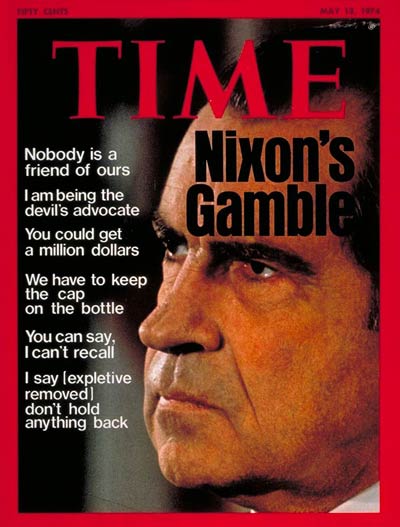
Prominent Senate conservatives of both parties said that they had no intention of pressing either publicly or privately for President Nixon’s resignation. They appeared to have decided that they should stand fast and await developments in the House Judiciary Committee and the full House.
A survey by the New York Times of 65 Republican party leaders in New York, New Jersey and Connecticut found that an overwhelming majority believe that President Nixon should not resign, but they are withholding judgment on his guilt or innocence in the Watergate case. Eleven said the President should quit. The majority view was expressed by Thomas MacKinnon, the Republican chairman of Erie County, which includes Buffalo: “He should not resign; it is a constitutional question and we have a constitutional process we should go by.”
Lawyers for President Nixon and for the special Watergate prosecution argued behind locked doors at the Federal Courthouse today over the prosecution’s latest demand for Watergate‐related White House tape recordings. After listening to both sides, and to lawyers for defendants in the Watergate cover‐up, case as well, Judge John J. Sirica took the matter under advisement. Some of the parties in the case had suggested earlier that Judge Sirica might decide the case immediately, but the judge’s law clerk, D. Todd Christofferson, told reporters later that a decision was unlikely this week.
Earlier in the day Judge Sirica held another long, closed meeting to discuss the final report by the court‐appointed panel of experts on the 18½-minute gap in a crucial White House tape recording. The report, according to sources close to the matter, confirms the panel’s already stated conclusion that the gap was caused by a number of separate manual erasures and provides a long technical explanation of this conclusion.
Highly reliable sources reported that President Nixon, in a letter sent two weeks ago to Judge Gerhard Gesell of Federal District Court in Washington, said that the White House “plumbers” unit was operating under a general delegation of his presidential authority when it broke into the office of Dr. Daniel Ellsberg’s former psychiatrist in 1971. Judge Gesell will preside over the trial of the six men who have been indicted in the break-in.
The Supreme Court ruled that a group of narcotics sellers were illegally convicted in 1970 because the Department of Justice obtained evidence against them with invalid wiretapping orders. The decision may wipe out convictions of more than 600 other federal offenders against whom the same kind of tainted evidence was used. The wiretap orders were issued when John Mitchell was Attorney General.
The country’s six largest cities would get most of the $24 billion in mass-transit funds that would be provided under legislation being prepared by the House Public Works Committee. The funds would be used for capital and operating expenses over the next six years and would provide $8 billion more than requested by President Nixon. They would be provided by new revenues rather than from highway funds, as proposed by the administration.
The Senate Watergate committee has subpoenaed President Nixon’s two brothers for interrogation about a $100,000 campaign payment made four years ago by billionaire Howard Hughes, committee sources said. Arrangements are being made for investigators to question F. Donald Nixon and Edward C. Nixon this week, the sources said. The subpoenas, issued in April, rise from the committee inquiry into the payment made by Hughes’ aides to C. G. (Bebe) Rebozo.
Senator Edward J. Gurney (R-Florida), spent more than six hours with a federal grand jury in Jacksonville, Florida, that is probing possible connections between political contributions and housing contracts. Gurney, a member of the Senate Watergate committee, has admitted that $100,000 was raised in his name without his knowledge. The jury is investigating allegations that a secret fund which may have totaled $400,000 was raised in return for the senator’s influence in the awarding of Federal Housing Administration contracts. Gurney is under a state indictment charging that he violated a law by accepting campaign contributions without appointing a treasurer or setting up a campaign bank account.
The Supreme Court blocked the posting of signs in Chicago’s buses and subways urging the impeachment of President Nixon. On a 5-4 vote, it temporarily stayed a ruling from the U.S. Court of Appeals in Chicago that ordered the Chicago Transit Authority to sell advertising space to a group called the Impeach Nixon Committee. The order will remain in effect until the justices dispose of an appeal that transit officials expect to file with the high court.
By a margin of 29 for and 51 against, the United States Senate rejected a bill filed by Senator Bob Dole of Kansas to allow states to raise the U.S. highway speed limit from 55 miles per hour (89 km/h) to 60 miles per hour (97 km/h). In remarks on the Senate floor, Mr. Dole cited the complaints of truckers that the slower speed stretched out their driving time and cost them money. He quoted Congressional testimony given last winter by Frank E. Fitzsimmons, president of the International Brotherhood of Teamsters, and representatives of the American Trucking Association. In addition to fuel conservation, a strong reason for keeping the lower limit that emerged in an hour of debate was that slower driving saved lives.
Boston Police Commissioner Robert J. diGrazia launched an investigation into charges that some of his men ran naked and stole liquor at a motel in Portsmouth, Rhode Island. Jean Lawler, manager of a Ramada Inn in Portsmouth, claimed that officers not only stripped naked and ran through the night club and up onto the stage and tables but that they also rifled a liquor cabinet, disturbed guests and caused an estimated $1,000 damage. The incident allegedly involved two dozen officers while 100 Boston and 30 New York police were at the motel the Friday night before a Police Day parade on Aquidneck Island. Mrs. Lawler said she called local and state police but no arrests were made.
Federal inspection of more than 500 small Appalachian coal mines believed to be in violation of federal 14 shutdown orders instead of the safety standards have produced only hundreds originally predicted, government figures show. A spokesman for the Mine Enforcement and Safety Administration said the inspections, made during April, showed that most of the mines had taken steps to comply with the 1969 Coal Mine Health and Safety Act.
A federal court in the nation’s capital overruled a controversial 1972 Internal Revenue Service ruling permitting big political donors to avoid paying gift taxes on campaign contributions by channeling the money through multiple fund-raising committees. U.S. District Judge June Green ruled for the plaintiffs, a reform group of tax analysts and others, at the close of oral arguments. She said she would issue a written opinion in a few weeks. Judge Green’s ruling is not retroactive.
A jury began deliberations yesterday in the case against five reputed members of the Black Liberation Army, who are accused of murdering New York Police Officers Joseph A. Piagentini and Waverly M. Jones three years ago. The jury retired for the day a little after 9:30 PM. The case was given to the jury at 1:15 PM, following a two‐hour charge on the law by State Supreme Court Justice Aloysius J. Melia, sitting in Manhattan. If convicted, the five men face sentences of life imprisonment.
KMS Industries of Ann Arbor, Michigan, announced the achievement of nuclear fusion on a small scale using laser light.
In the U.S. state of New York, Mohawk residents of the St. Regis Mohawk Reservation in Franklin County and of Canada’s Akwesasne 59 Mohawk Nation reserve began an occupation of the abandoned Moss Lake Girl Scouts camp near Old Forge, New York, in Herkimer County, reclaiming it as traditional Mohawk land.
Dow Jones Industrial Average: 845.59 (-4.85, -0.57%).
Born:
Brian Geraghty, American actor (“Broadwalk Empire”, “Big Sky”), in Toms River, New Jersey.
Lisa Jacob, American swimmer (Olympic gold medals, 4x100m freestyle, 4×200m freestyle, 1996), in Mission Viejo, California.
Albert Connell, NFL wide receiver (Washington Redskins, New Orleans Saints), in Fort Lauderdale, Florida.
Jozef Čierny, Slovakian NHL left wing (Edmonton Oilers), in Zvolen, Czechoslovakia.
Died:
Denny Shute, 69, U.S. professional golfer (British Open, 1933, PGA Championship, 1936-37).
Jaime Torres Bodet, 72, Mexican public servant and former Director-General of UNESCO, shot himself to death.
Vern Knudsen, 80, American physicist and acoustical engineer, known for the application of acoustical design to architecture.
Lu Han, 79, Chinese general who defected from Taiwan to the People’s Republic of China.

 History Diaries