
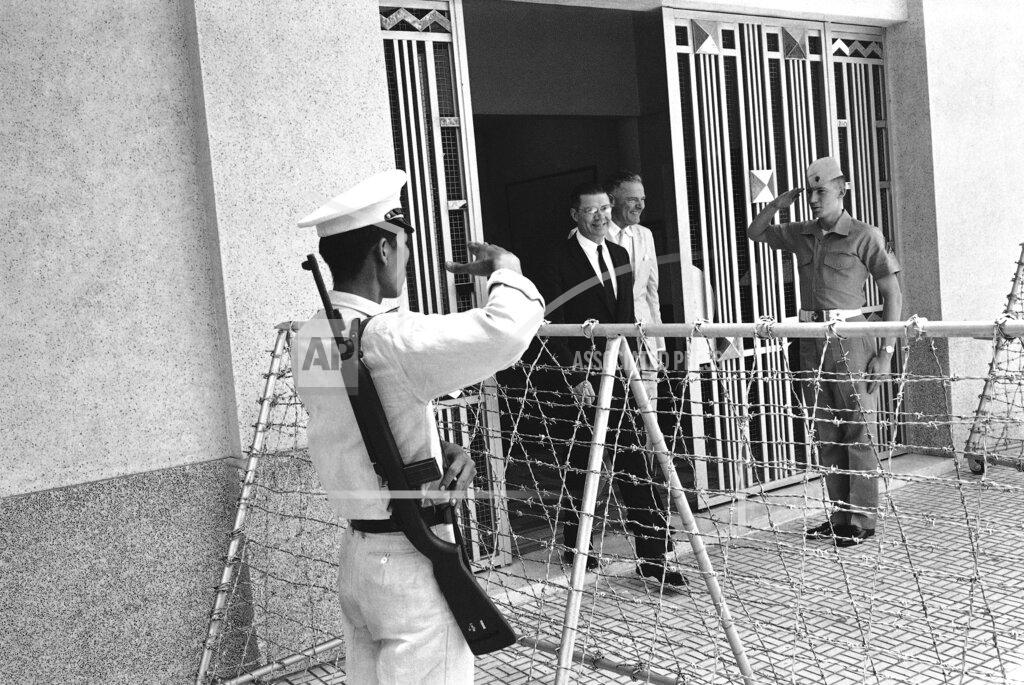
Defense Secretary McNamara and General Maxwell Taylor visit Vietnam (for their fifth fact-finding mission). While McNamara reiterates U.S. support for South Vietnam, he also tells Khánh privately that, although the United States does not ‘rule out’ bombing the North, “we do not intend to provide military support nor undertake the military objective of “rolling back” Communist control in North Vietnam.”
The Secretary arrived this morning for his fifth visit to South Vietnam. He was several hours ahead of schedule. Discreet but elaborate security precautions provided the only note of tension in a visit otherwise free from the air of crisis or need for urgent decisions that marked his previous trips. The security measures were ordered following the discovery over the weekend of a Vietcong plot to kill Mr. McNamara as he drove from the airport into town.
Amid charges that U.S. pilots in Vietnam are endangered (and even losing their lives) due to obsolescent planes, it is announced that 60 U.S. Navy A-1E Skyraider dive bombers are being sent to Vietnam, and that 40 revamped B-26s are being readied for Vietnam. Vietnamese air operations were set back severely in mid-February when the Air Force was compelled to ground all its B‐26’s following a series of fatal crashes caused by failure of one or both wings. The B‐26 grounding order, which covered planes in this country as well in Vietnam, left the T‐28, a modified piston trainer, as the only Air Force fixed‐wing plane in Vietnam for air attack missions. These, too, were found far from ideal for the increasingly difficult operations against the Communist guerrillas in South Vietnam. Helicopters assumed a greater share of the air assault burden.
Informants say that the On Mark Company is actually making almost a brand new plane of the B‐26. A five‐inch support strip is being inserted the full length of the wing next to the main wing spar. Virtually the entire fuselage is being given a new and thicker skin and the tail section is being strengthened and heightened. New engines will increase the total horsepower of the two-engine plane from 4,000 to 5,000 and enable it to land on and take off from much shorter fields than before. The modified craft will be able to carry eight 50‐caliber machine guns in the nose and 12,000 pounds of bombs and other stores.
Secretary of Defense Robert S. McNamara will be called before Congress to answer charges that the deaths of two United States pilots in South Vietnam were due to their obsolescent planes rather than enemy fire. Representative Carl Vinson, Democrat of Georgia who is chairman of the House Armed Services Committee, announced today that the committee would summon the Secretary of Defense to a closed session. Congressional sources indicated that a decision on a full-scale investigation into the adequacy of the military equipment in South Vietnam would depend on the Secretary’s report. It appeared that if such an investigation were ordered would, inevitably, cover the conduct of the war itself.
Two Cambodian jet fighters flew into South Vietnam today and strafed troops searching for Communist guerrillas, sources in Saigon told The Associated Press.
United States Army Rangers are carrying out top-secret training in the mountains of Taiwan. The Rangers appear openly on the streets of Taipei, but the Taiwan Defense Command, under which the Rangers operate, refuses to comment on their presence. Taiwanese who live near where the Rangers operate say they are training special Chinese Nationalist troops. According to one Taiwanese, these selected soldiers are then slipped into mainland China. There is considerable speculation that the Rangers may be training Chinese Nationalist troops for a mission in South Vietnam.
Communist China reaffirmed today its determination to “liberate” Taiwan and denounced recent United States and British policy statements about the Chinese Nationalist island. An editorial on the front page of Jenmin Jip Pao, the official organ of the Chinese Communist party, today was directed specifically against a statement by the British Foreign Secretary, R. A. Butler, describing the future of Taiwan as an “essentially international problem.”
The editorial declared: “The Province of Taiwan is an inalienable part of the sacred territory of the People’s Republic of China. The Chinese people are unshakable in their determination to liberate their territory of Taiwan.” The editorial said that since Washington’s “‘two‐Chinas fallacy” had been increasingly repudiated by public opinion United States officials had found it necessary to “babble about a ‘flexible policy’ toward China and to give currency to a ‘one China and one Taiwan’ formula.” It called this formula “nothing but a variation of the ‘two Chinas’ plot.”
The Chinese Communist party has indicated that internal opposition has developed to some of the policies of Mao Tse‐tung, leader of the party. It made a public attack on “some persons” who disagreed with his program of militant class struggle and his uncompromising stand against the West. The attack was in a half-page article published April 23 in Jenmin Jih Pao, the party newspaper. The article commemorated the appearance on January 1, 1949, of Mr. Mao’s ideological treatise, “Carry the Revolution Through to the End,” and it demanded a rededication to the treatise’s militant principles. Analysts here believe Jenmin Jih Pao’s attack was intended as a warning to moderates in the party councils who had cautioned Mr. Mao against imposing new stringent political controls on the Chinese people.
A campaign of “socialist education,” in progress since late last year, calls on the poorer peasants to “struggle” against the more prosperous peasants and those in private enterprise. A new, far‐reaching system of political supervision over industrial workers, adapting methods used in the army, was ordered last month. Jenmin Jih Pao, seeking to justify intensification of the class struggle, asserted: “Some landlords and rich peasant elements are not reconciled to the doom of their own classes and are attempting to stage a comeback. They still are employing various means to win over degenerated cadres and working people in an attempt to take over leadership.”
Harold Wilson, the leader of the Labor party, which is expected to form Britain’s next government in the fall, said tonight that Aden “must be held as an important base.” Mr. Wilson coupled this support of the Conservative Government’s views of Aden’s strategic role with sharp criticism of the Government’s political activities in the Federation of South Arabia. “In the long run,” Mr. Wilson said at a meeting of European Socialist leaders, “the security of a base depends on the willingness with which it is accepted by the local population.” He said the Labor party would concentrate in the next foreign affairs debate on advocating policies to make the base acceptable to the people of the area. The Labor leader’s acknowledgment of Britain’s need for the Aden base as a communications and staging area should reassure Washington. Some United States officials have been apprehensive that a Labor government, to free itself of charges of colonialism, would be tempted to give up the base.
The Soviet Union and the West have failed to reach a true détente, Secretary of State Dean Rusk told the North Atlantic Treaty Organization today. He emphasized that the United States was not engaged in any talks with the Soviet Union that could lead to historic changes in East‐West relations. Mr. Rusk made two appeals to the United States’ NATO allies against this background. He asked them to recognize that the situation in Cuba could become overnight a serious security problem for all should Cuban‐operated missiles interfere with United States air surveillance of the island. He also requested their help for South Vietnam in its struggle against the Communist guerrillas.
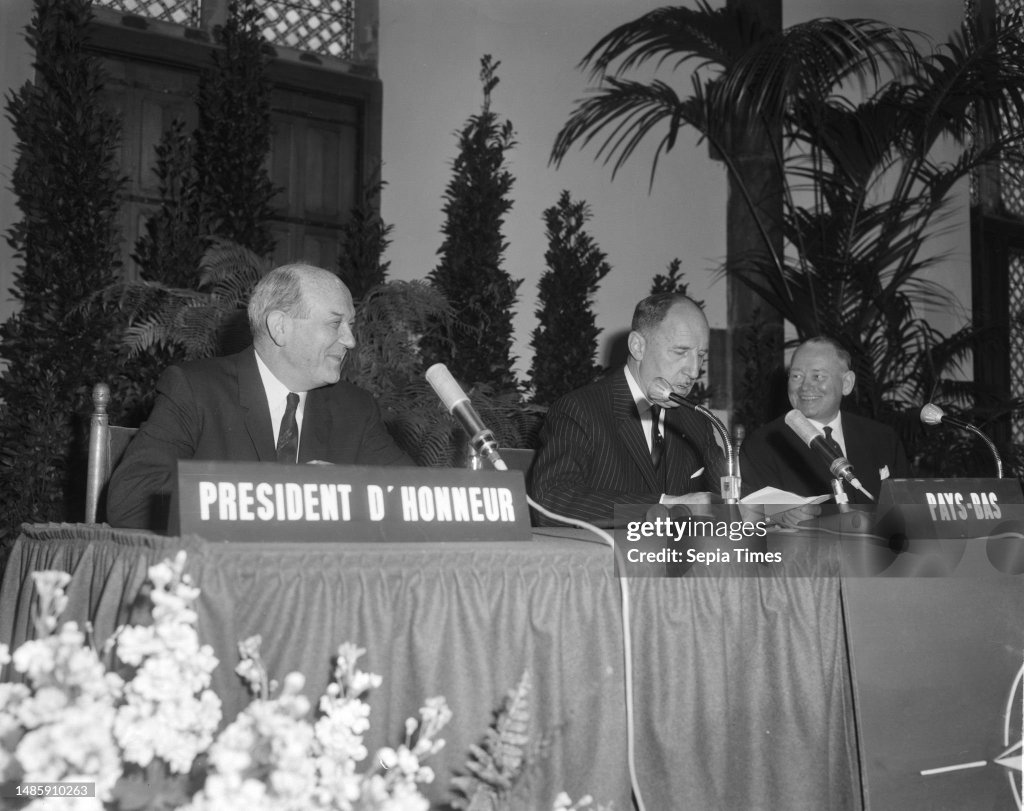
Italian diplomat and politician Manlio Brosio is chosen as secretary-general of NATO. Dr. Dirk U. Stikker will retire as Secretary General at the end of July and Brosio of Italy will replace him. The organization is under pressure from a number of members for reorganization. The reorganization issue will be faced tomorrow when the ministers meet in a restricted session, with each taking only two advisers. Dr. Stikker said the alliance had reached a “challenging” phase. Foreign Minister Joseph M. A. H. Luns of the Netherlands reminded the council that in five years any member would be able to withdraw.
Marco A. Robles emerged tonight as the winner in the hard‐fought battle for the presidency of Panama, according to unofficial returns from Sunday’s election. With more than 90 per cent of the precincts counted, the Electoral Tribunal announced that Mr. Robles, the Government’s candidate and a political moderate, had a lead of 11,000 votes over Dr. Arnulfo Arias. Dr. Arias, the fiery leader of the Panamanian party, immediately challenged the returns and accused the Government and the tribunal of “a scandalous fraud.” He said he would leave a decision on the election results “up to the people.” The tribunal announced that results from 1,039 precincts out of 1,144 had given Mr. Robles 124,830 votes, Dr. Arias 113,764 and Juan de Arco Galindo, the third major candidate, 45,513. The tribunal was almost certain to announce formally Mr. Robles’s victory, by tomorrow morning at the latest.
The first of 507 people to be hospitalized, in the Scottish city of Aberdeen, for typhoid from food poisoning began when a student at the University of Aberdeen was admitted to the infirmary at her dormitory. Two days later, her roommate would become ill, and within a week, the number of admissions to City Hospital had risen to 12. By the end of the month, 238 patients would in isolation at the infectious disease ward. Health inspectors would eventually trace the origin to a supermarket on Aberdeen’s Union Street, where many of the patients had purchased sliced corned beef or other cold meats. The origin had been a seven-pound can of corned beef, imported from Argentina, that had been contaminated with the bacterium Salmonella typhi; other meats cut afterward with the same slicing machine, and then stored in an uncooled display case in front of a window, were tainted with the same bacteria. The epidemic would abate by the end of July, though consumption of corned beef in the United Kingdom would fall by more than half for the rest of the year. Though only 50 supermarket customers were initially infected, the disease had spread by contact from there, leading to the joke that “Only in Aberdeen would you get 507 slices out of a can of corned beef.”
The government of Tunisia passed a law barring foreigners from owning land in the North African nation. In 1958, 20 percent of the land owned by non-Tunisians had been ceded by agreement with France, and in 1960, another 25% was confiscated. Under the nationalization policy, 505,000 hectares (1,250,000 acres) came under government ownership.
The bipartisan civil rights forces in the Senate gathered themselves together today and resolved to halt the Southern filibuster and bring the bill to a vote. If the plans announced by the coalition leaders are resolutely adhered to, there is a possibility that closure can be imposed in 10 days or two weeks and that the bill can be passed before the Republican National Convention, which opens July 13. President Johnson, meanwhile, issued a strong appeal for public pressure in support of the civil rights bill after Mike Mansfield of Montana, the Senate Democratic leader, told him that “progress on the bill to date is nil.”
Yesterday several civil rights leaders were wallowing in a slough of despondence and futile anger over their inability to silence the Southern foes of the bill. Today they were still angry, but their anger had direction. And despondency had given way to optimism — a result of an agreement reached by the Justice Department and Senator Everett McKinley Dirksen of Illinois on a package of amendments. If Mr. Dirksen, the Republican leader, can get commanding support for his amendments from his party colleagues, the votes will be in sight for closure. Mr. Dirksen was confident today that he could get this support. “I see a little dawn like a sheen behind the darkness,” he told reporters after a luncheon conference with the Senate Republican Policy Committee.
Yesterday and today, Mr. Dirksen said, closure was talked of by Senators who would not have countenanced the idea a week ago. “There comes a moment,” he said, “when there’s a feeling in the air that the time has come for action, and we have just about gotten there.”
The more ardent civil rights supporters were in angry mood as the Senate session began today. They had been nursing their wrath for the last week as the Southerners dragged out the debate on amendments to bill providing for jury trials in contempt of court cases. Their anger was fanned by newspaper accounts of an outburst yesterday by Senator Hubert H. Humphrey of Minnesota, the Democratic floor manager of the bill. Mr. Humphrey had laid the blame for inaction on the bill at the door of the non‐Southern Senators who permitted the 19 Southern opponents to bring the Senate’s business to a halt. The anger this morning was directed, first, at these Senators and, second, at Senator Richard B. Russell, Democrat of Georgia, the leader of the Southern forces, who some believed had taken advantage of courtesies extended him.
Senator Paul H. Douglas, Democrat of Illinois, began by saying, “The impression is going out over the country that the advocates of civil rights on the Senate floor do not mean business.” He said the country was tired of the debate, which he said did not illuminate the subject but only protracted the battle. He said the time had come for those who believed in limiting debate to think of filing a closure petition. Senator William Proxmire, Democrat of Wisconsin, agreed, saying that the filibuster had become the longest on record. If the filibuster continues much longer, “it will bring the Senate of the United States into disrepute,” he said. Senator Jacob K. Javits, Republican of New York, said it was “an open secret that we don’t have the votes” for closure. The votes of two‐thirds of the Senators present and voting are required to close debate. If all 100 Senators are present, 67 votes are needed for closure.
President Johnson, echoing Congressional pleas, called today for heavy public pressure in support of his civil rights bill. The President spoke out shortly after Senator Mike Mansfield of Montana, the majority leader, had told him that “progress on the bill to date is nil.” Without public pressure, Mr. Johnson said, the bill would fail and “we will have some very dark days in this country.” The civil rights bill will be defeated, Mr. Johnson said, unless the people “in righteous indignation” make known their support for it.
His statement was part of an exhortation to businessmen to support the bill and to work for equal employment opportunities for Blacks. In turn, that speech was part of a typically diversified Johnson day that kept him busy in several directions. He signed a bill bringing the sale of pesticides under tighter regulation and commented that the measure marked his concern for “the health of every one of our fellow Americans.” He conferred with members of the executive board of the National Association of Manufacturers, challenging them to help bring unemployment below 5 per cent of the working force by the speeding the economic rate. Mr. Johnson also accepted, and obviously was pleased with, an honorary membership in the National Forensic League, an organization of about 200,000 debaters in 1,500 high schools. In response, he said the greatest disappointment of his life was “losing the state championship of Texas the first year I coached debate” at Sam Houston High School in Houston.
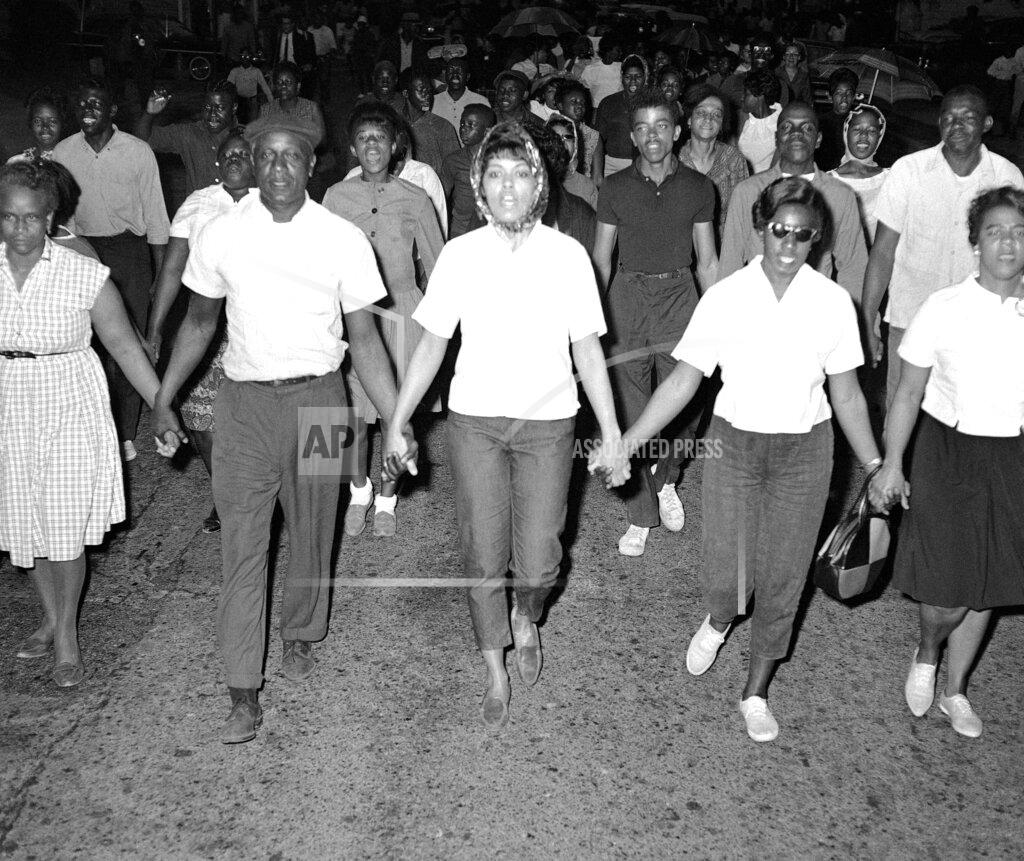
National Guard troops with fixed bayonets and threatening to use tear gas tonight quelled another street demonstration by a crowd of chanting and singing Blacks in Cambridge, Maryland. Last night, the Guardsmen used tear gas, but tonight the crowd dispersed without violence after being confronted by the soldiers. About 150 demonstrators stopped their march, sat down in the street and began singing when the troops appeared. When the soldiers donned gasmasks, the crowd dispersed without incident. Troops last night arrested demonstrators after using tear gas to break up a demonstration following a speech by Alabama’s Governor George C. Wallace.
A responsible farm policy to protect family farms, rural communities and consumers was pledged today by President Johnson. He discussed a host of farm problems, ranging from poverty to low beef prices to foreign trade, and outlined three goals “to preserve the vitality of our American agriculture.” In a meeting with members of the Newspaper Farm Editors Association, he pledged his Administration’s dedication to these goals:
“Commodity programs to protect and preserve our family farm system.
“Community programs to create new jobs and income opportunities for the young people growing up in rural America, to develop new uses for rural resources, to provide new opportunities for urban families, to enjoy green and open spaces which have always been so much a part of American life.
“Consumer programs to develop new uses for food at home, and trade and aid programs which build new markets and help others throughout the world to meet the age-old problem of hunger.”
Senator Barry Goldwater of Arizona said last night that effective progress in civil rights would be achieved without turmoil and bloodshed if Republicans were elected to power in Washington. In a speech to an enthusiastic campaign fund‐raising rally at Madison Square Garden, Senator Goldwater, the leading candidate for the Republican Presidential nomination, indirectly accused the Democratic Administration of President Johnson of acting as “cheerleader” for a “frightful game of violence, destruction and disobedience” over civil rights. He predicted “more violence in our streets” until a Republican President is selected to “cool the fires and the tempers of violence.”
Only then, the Senator added, will it be possible to reach acceptable and lasting solutions to the problems of racial discrimination. Senator Goldwater reviewed a range of foreign and domestic issues, and reportedly emphasized the need for Republican unity in the national election in November. Without mentioning names, he criticized Senator Jacob K. Javits of New York and some other liberal Republicans who have indicated that they would withhold their support if Senator Goldwater became the party nominee at the Republican National Convention in July. Senator Goldwater characterized that as “rule‐or‐ruin” talk by a “faction” of the party, and insisted that any Republican who downgrades fellow Republicans is “pinch‐hitting for Lyndon Johnson.”
A determined Republican effort to reopen the Robert G. Baker investigation got under way today. The move, calling for interrogation of Senators who may have had financial dealings with Mr. Baker, may attract some Democratic support. The demand was put before the Senate Rules Committee today by Senator Clifford P. Case, Republican of New Jersey, in a brief open session marked by noisy partisan strife. Senator Case is not a member of the committee but has been one of the severest critics of its inquiry into the private business affairs of Mr. Baker, who resigned under fire as secretary to the Senate’s Democratic majority. In a heated exchange with the committee chairman, Senator B. Everett Jordan, Democrat of North Carolina, Mr. Case said, “This committee has a sacred duty to go out and get the facts, not just to sit here and listen to what people come and tell it.”
The Cardinals Curt Simmons continues to beat up on the Phillies, winning 4–2, with relief help from Roger Craig. Since the Phillies released him in 1960, Simmons is 13–2 against them.
Gary Geiger’s recurring ulcer problems forces his retirement from the Red Sox for this year.
Dow Jones Industrial Average: 827.38 (+0.31).
Born:
Julius Maada Bio, Sierra Leonean politician (President of Sierra Leone 2018-), in Tihun, Sierra Leone.
Tiffany Helm, American actress (“Friday the 13th: A New Beginning “), in New York.
Joy Ellen Kitzmiller, U.S. badminton player (Olympics, 1992), in Los Angeles, California.
Died:
Clarence Cannon, 85, U.S. Representative for Missouri since 1923 and Chairman of the House Appropriations Committee, died in Washington D.C., soon after announcing his plans to run for a 21st term of office.






 History Diaries