U.S. Defense Secretary Robert S. McNamara renewed American pledges to the South Vietnamese people on his arrival in Saigon today. He said the United States would provide “whatever is required for however long it is required” to defeat the Communist forces threatening South Vietnam. Mr. McNamara arrived from Bonn under tight security for what he described as “another of the regular meetings” he has been having with high-ranking Americans and South Vietnamese here since the United States military buildup began more than two years ago. “During my brief stay here this time, we will review the progress achieved along the lines of the program laid out last March,” Mr. McNamara said. The Defense Secretary declared that he would also review what further action might be necessary to provide economic and military assistance to win the war against the Communist guerrillas.
Maximum security was in force at the airport and along the highway into Saigon to foil any attempts on Mr. McNamara’s life. One plot was discovered Saturday night and three agents of the Việt Cộng, as the Communist forces are called, were arrested. A paratroop battalion and several hundred policemen were stationed along the road and at a highway bridge that the Communist terrorists had planned to blow up under Mr. McNamara. However, the motorcade took a different route into the city. The Defense Secretary was met at the airport by Ambassador Henry Cabot Lodge; General Maxwell D. Taylor, Chairman of the Joint Chiefs of Staff, who arrived yesterday; General Paul D. Harkins, commander of United States forces in South Vietnam, and other high‐ranking United States and Vietnamese officials. Mr. McNamara is paying his fifth visit to South Vietnam since the United States buildup and his second in two months.
Britain’s Commonwealth and Colonial Secretary, Duncan Sandys, conferred in Aden today with the British High Commissioner, Sir Kennedy Trevaskis, and military leaders on the military operation and other problems of the Federation of South Arabia. In the remote Radfan Mountains area near the Yemeni border, not far from this military headquarters, British troops searched villages and camps of the dissident tribesmen for evidence as to the nature and the intentions of their opponents. The Radfan villages — miserable collections of small square stone huts surrounded by thinly plowed fields — are deserted. In response to British leaflets advising civilians to take cover or clear out, the entire population has disappeared. The British are taking care not to damage the villages. They have used no bombs in this operation except in demolishing some concrete emplacements on a high ledge. The Royal Air Force got special permission from London to destroy them with 1,000-pound bombs.
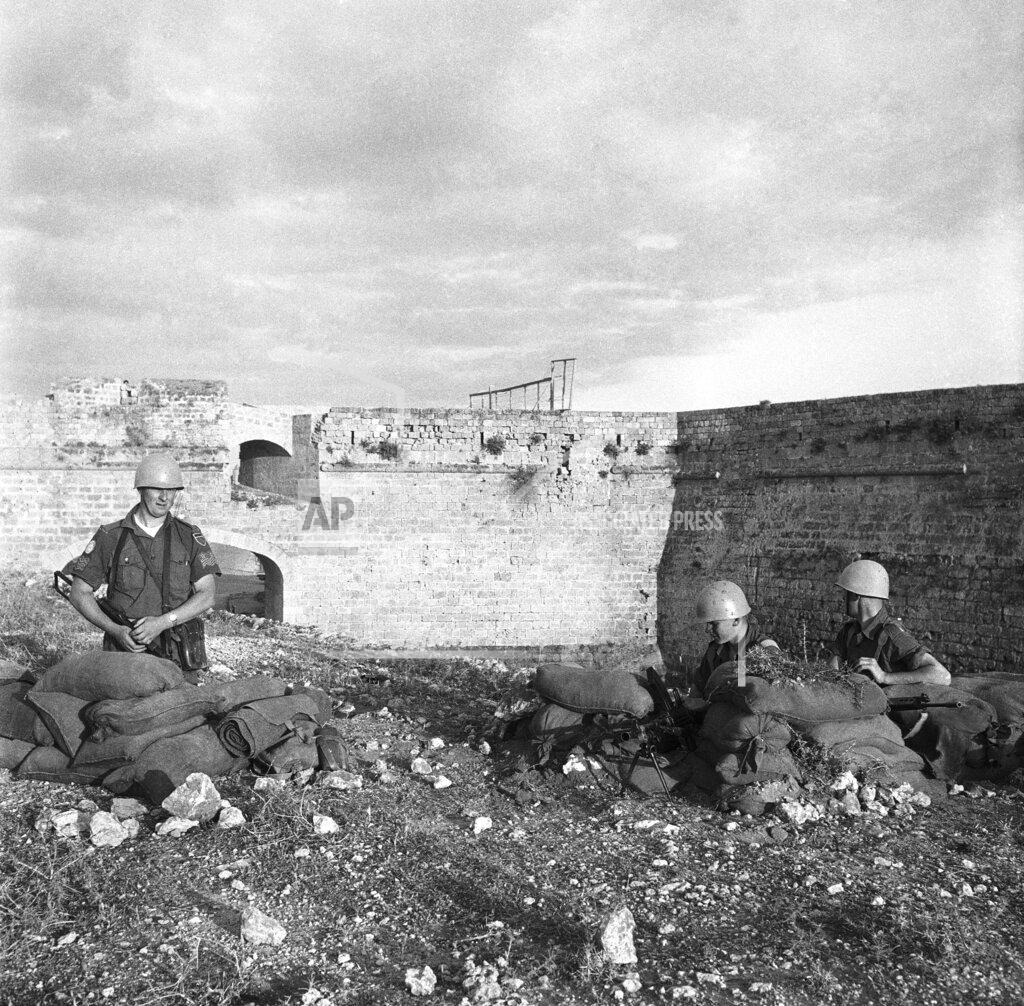
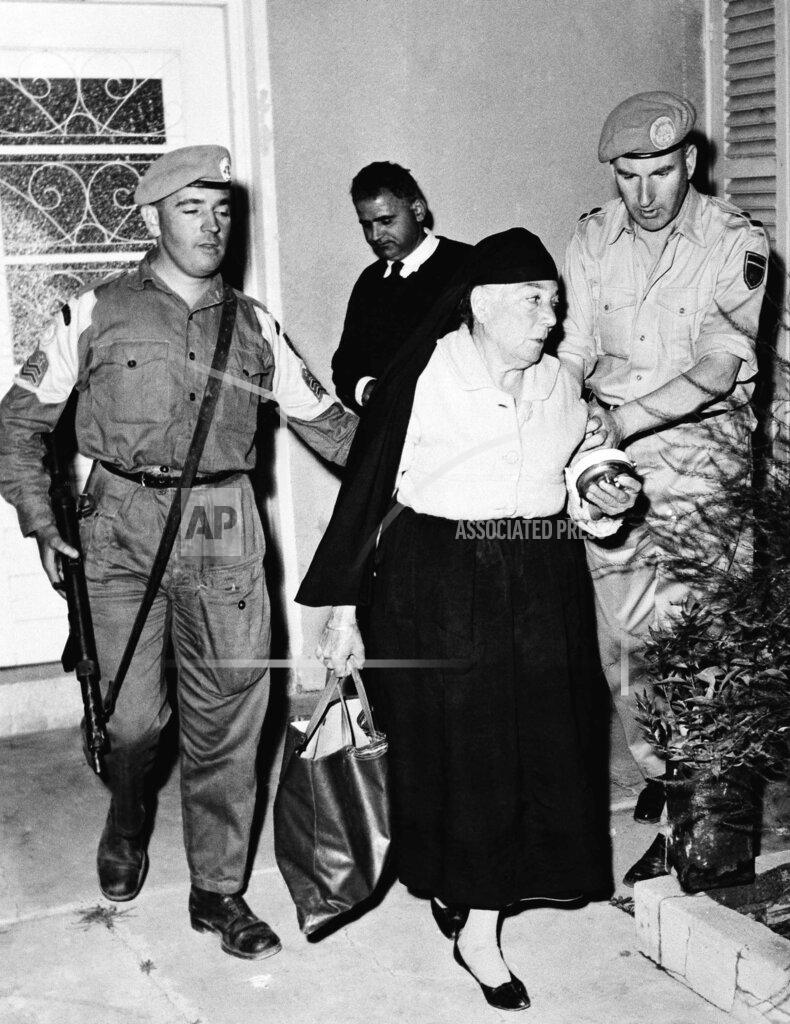
Two Greek army officers, a Greek Cypriote policeman and an aged Turkish Cypriote civilian were shot and killed today in the Turkish quarter of Famagusta, on the island of Cyprus. Another Greek army officer was gravely wounded in the most serious act of violence to have occurred in Cyprus’s major port town on the east coast. The shooting ended a two‐week lull in the strife on the island. Shortly after the shooting, 12 armed Greek Cypriotes entered a store for British servicemen in the Greek sector of town and abducted six Turkish Cypriote employees. Three other Turkish Cypriotes were reported abducted later. Two Turkish Cypriotes were wounded in brief exchanges of gunfire in the northern outskirts. Tension was extremely high at dusk. Irish troops of the United Nations force feared widespread violence in the town. There was an unconfirmed report that Greek Cypriote security forces were massing north of the town.
The killing of the Greek army officers marked the first time since the eruption of violence last December that members of the armed forces of either Greece or Turkey were known to have been harmed in the conflict. All three officers — a major and two captains — were presumed to have been members of the 950‐man Greek army contingent based on the island. Their identity cards were in the possession of the Turkish Cypriote police. The Greek army force and a 650‐man Turkish army contingent are stationed in Cyprus under the agreements by which Britain gave Cyprus her independence in 1960. Archbishop Makarios, Greek Cypriote President of Cyprus, recently denounced the pact providing for the Turkish army force. The Greek Cypriote policeman killed was a son of Michael Pantelides, police chief of Nicosia and one of the best known and most respected police officials on the island.
Galo Plaza Lasso, former President of Ecuador, was named today to a high political post as special representative in Cyprus for the Secretary General, U Thant. He will undertake direct negotiations with the rival Greek and Turkish Cypriotes on immediate and pressing problems. These would include measures to end hostilities and prevent their recurrence and generally to bring a return of normal living conditions for the civilian population. Until now, responsibility for these matters has been carried by Lieutenant General Prem Singh Gyani of India, commander of the United Nations peace‐keeping force in Cyprus. The arrival of Mr. Plaza will free General Gyani to concentrate on military matters.
Premier Khrushchev gave strong Soviet endorsement today to the Arab stand against Israeli diversion of Jordan River waters. The visiting Soviet leader told applauding legislators that Israel had “robbed Arabs of their own sources of water” by her plan to use the river to irrigate the Negev. In an hour‐long speech this morning before the new National Assembly of the United Arab Republic, Mr. Khrushchev praised the country’s “ Socialist progress ” under President Gamal Abdel Nasser and condemned Israel as a “stooge of the imperialists.” He declared: “We support the just demands of the Arab countries that Israel should implement the United Nations resolutions on Palestine.”
These resolutions provide for repatriation or financial compensation to Palestinians who lost their property or homes in the war that followed the creation of Israel in 1948. Mr. Khruschev said the conference of Arab kings and heads of state in Cairo last January made “a great contribution against the stooges of imperialism and against war.” That Arab meeting was called by President Nasser to decide on joint Arab counteraction to Israel’s Jordan River plans. The delegates decided not to try to stop Israel by force, but to press Arab projects for using the waters of Jordan tributaries in Arab territories.
Mr. Khrushchev, with Mr. Nasser sitting at his side, congratulated the U.A.R. on the “long strides” taken since the 1952 revolution. “This is a short period, but the development is an accomplishment of tens of years,” he said. “The imperialists thought the course of life in Egypt would never change, but now the very course of the Nile has changed.” This was a reference to the ceremonies Mr. Khrushchev will attend at Aswan this week, marking completion of the first stage of the Soviet‐financed Aswan High Dam. The first stage consisted of digging a diversion canal to take the flow of the Nile while the High Dam is erected.
The Soviet Communist party said today that Chinese Communist leaders had aimed their ideological spears not against imperialism and colonialism, but against the world Communist movement. The charge appeared in Pravda, the Communist party newspaper, in the third of a series of articles on the Soviet-Chinese ideological dispute. A summary of the article was made available by the English-language service of Tass, the Soviet press agency. Pravda said that the Chinese were seeking to vilify the Soviet Communist party, which it said Peking considers the main obstacle to the realization of its designs for hegemony. The article accused the Chinese leaders of having started a border conflict with India, which follows a policy of nonalignment. In 1962 Chinese forces invaded Indian border areas. Later they withdrew from part of the territory they overran.
The nationalist policy of the Chinese leaders also led them to advertise their friendship with Pakistan, a member of aggressive, imperialist blocs, the article went on. Pravda noted that China’s leaders had at first advanced the slogan of the “Great Leap Forward,” which referred to the goal of a rapid industrial advance. But this failed and the Chinese shifted the emphasis to agricultural production, the article went on. At first, Pravda said, the Chinese regarded the people’s communes as the form of direct transition to Communism, but “then they begin to speak of the impossibility of building Communism before the complete collapse of imperialism.” The communes involved a reorganization of the population into multipurpose units organized along military lines to spur production.
Marco A. Robles, backed by the Government’s political organization, took a substantial lead today in Panama’s bitterly contested presidential election. With slightly over half of the 1,141 precincts counted, Mr. Robles had 71,349 votes, according to the Electoral Tribunal. Dr. Arnulfo Arias, the nationalistic rightist candidate of the Panamanian party, had 62,204. A third major candidate, Juan de Arco Galindo of the Opposition Alliance, who is identified with business and industrial interests, had 26,204. Supporters of Dr. Arias, who had claimed victory this morning, charged that the Government was “falsifying” the results.
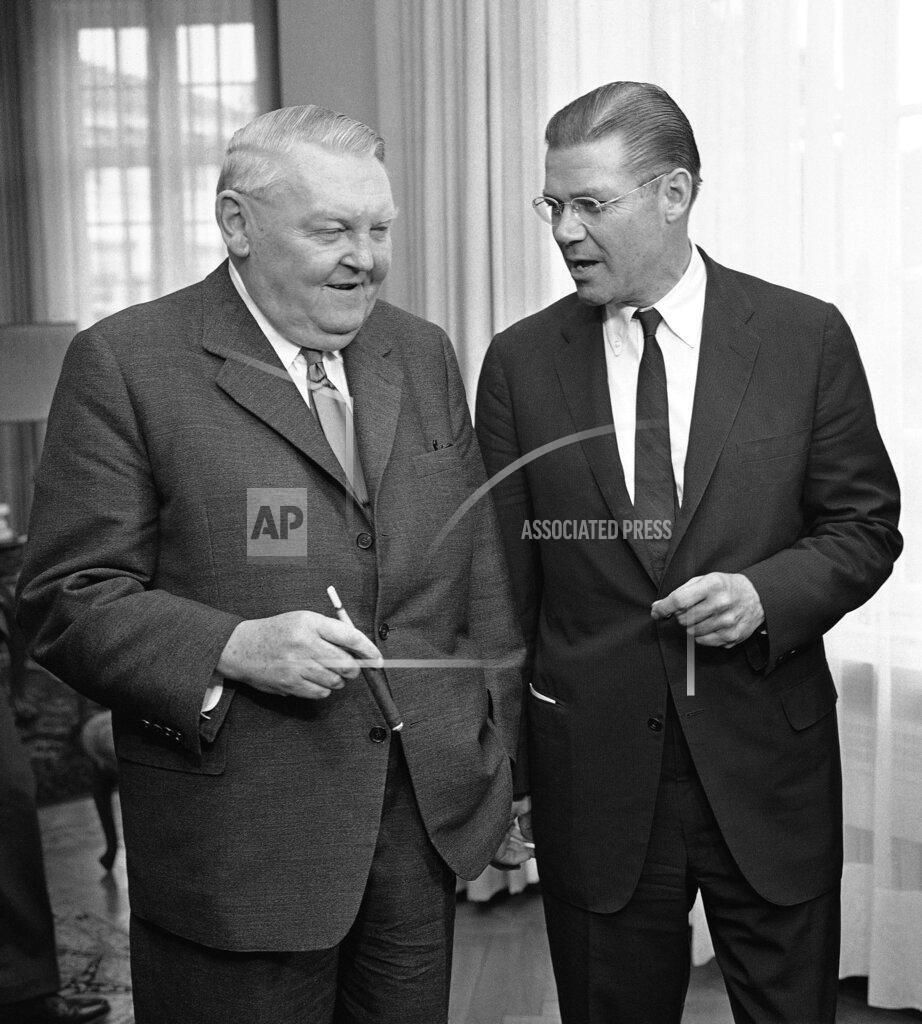
Britain and the United States were reliably reported today to have endorsed the idea of a meeting between Chancellor Ludwig Erhard and Premier Khrushchev. Neither Washington nor London is enthusiastic about a meeting between the West German and Soviet leaders, but they apparently see an endorsement as a means of getting around West Germany’s insistence on a new Western approach to the Russians on the German problem. In The Hague, the Foreign Ministers of Britain, France, West Germany and the United States reasserted their intention to achieve the reunification of Germany on the basis of self‐determination for East Germany. The last formal East‐West negotiations on reunification were at the Foreign Ministers’ conference in Geneva in 1959.
British and American sources in London said today that their governments had decided against the West German proposal for a four‐power conference. France is not believed to be any more enthusiastic about another East‐West argument over Germany at this time. But in the discussions, France was reported to have kept her silence, apparently in the certainty that Britain and the United States would not go along with the German wish. The idea of a meeting between the West German and Soviet leaders has been cropping up since Dr. Erhard succeeded Dr. Konrad Adenauer as Chancellor last summer. It was very much alive a few months ago but was allowed to die away.
A United States C‐135 jet transport carrying servicemen crashed and burned while landing at Clark Air Force Base in the Philippines tonight. The Air Force said that 74 of the 83 persons aboard had been killed. In addition, one man died and two men were injured in a taxi that the plane struck as it landed about a quarter mile short of the runway. The nine survivors from the plane were said to be in serious condition. Ultimately only five would survive. The crew carried out a PAR approach to runway 02. The aircraft descended below the glidepath and the crew were urged to initiate go around as the C-135 had descended below the PAR lower safety limit. By then the co-pilot had the runway in sight and the approach was continued. On finals, the undercarriage struck the perimeter fence. The airplane struck a TACAN facility, hit the ground and slid across a road, striking a cab and killing the driver. The airplane broke up and caught fire.
In Cadiz, Spain, a United States Navy P-2 Neptune long‐range patrol plane crashed into the sea 20 miles south of Rota, and its crew of 10 was believed to have been killed. The plane had been engaged in maneuvers off the Spanish coast. Navy Commander T. A. Graham, directing an air‐sea search for survivors, said that considerable wreckage had been found but that no bodies had been recovered. The plane had been taking part in maneuvers about 20 miles off the United States Polaris submarine base at Rota, Spain. The crew of a Spanish fishing boat said they had seen the plane strike the sea and burst into flames.
The first Habitat store, later a large retail chain, was opened by Terence Conran on London’s Fulham Road.
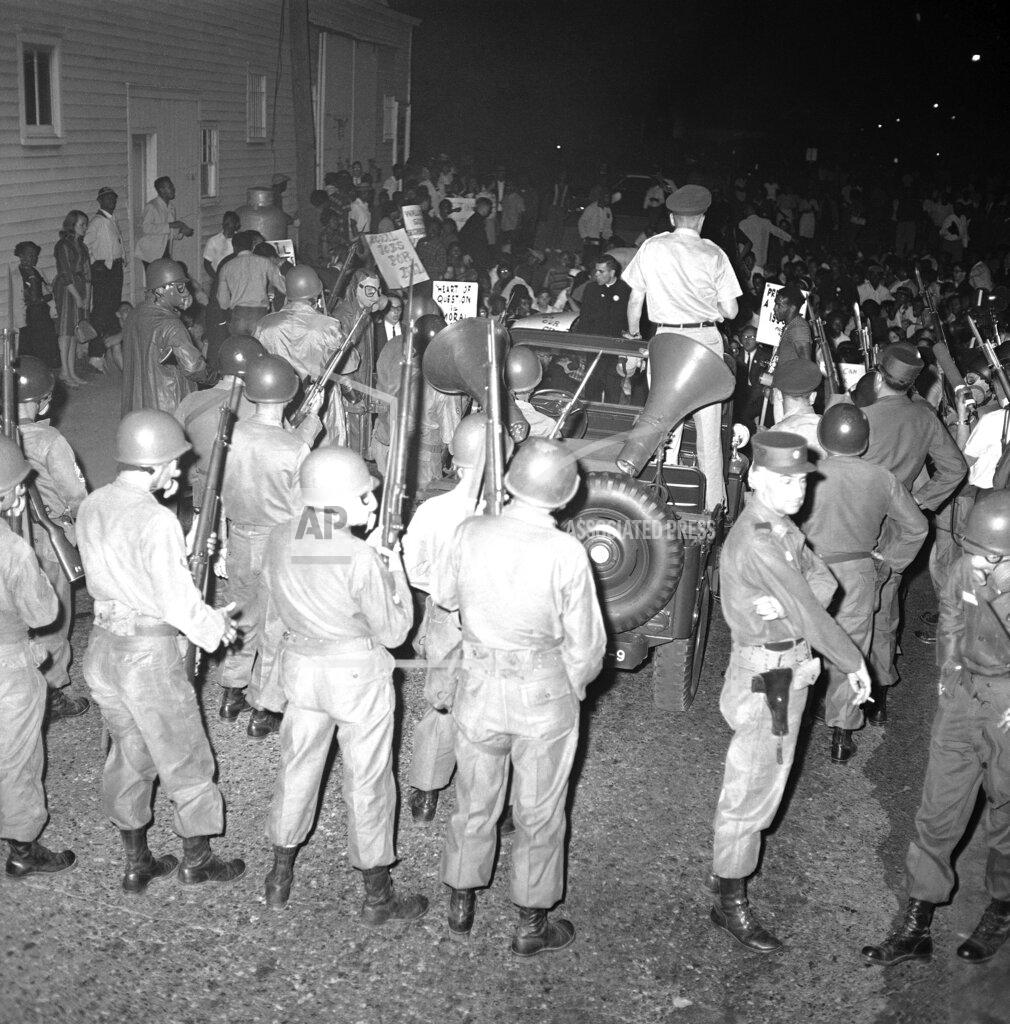
National Guardsmen hurled tear gas tonight to turn back several hundred stone‐throwing Blacks who were demonstrating after a primary‐campaign appearance in Cambridge, Maryland by George C. Wallace, segregationist Governor of Alabama. The demonstration was the second of the night and followed a fiery speech by the Alabamian before a wildly enthusiastic audience of about 1,200 persons. Thirteen demonstrators were arrested in the second protest march. They included Mrs. Gloria H. Richardson, Cambridge protest leader, and two of her young assistants. Seven persons were injured, none seriously. Neither demonstration was witnessed by Governor Wallace, who left here soon after his address. After having broken up the second protest, National Guard patrols with fixed bayonets went into Cambridge’s Second Ward, the Black section, where the two marches had originated, and drove all Blacks off the streets.
In his rousing speech, the Democratic Governor urged his listeners to vote for him in the Maryland Presidential primary next Tuesday as a protest against the civil rights bill now before Congress. Nearly 400 Guardsmen, more than 50 state policemen and the 18‐man police force of this Eastern Shore community of 12,000 had been mobilized and deployed for the Governor’s visit. Cambridge has been under modified martial law since last June 8 because of racial disturbances. Demonstrations have been prohibited. As the Governor finished his speech, 400 to 500 Blacks poured from the Black Elks Hall in the Second Ward, in another part of town. Led by eight Roman Catholic priests from Catholic University in Washington, the demonstrators marched three blocks to a barricade of 100 National Guard troops, who had their bayonets fixed to their rifles.
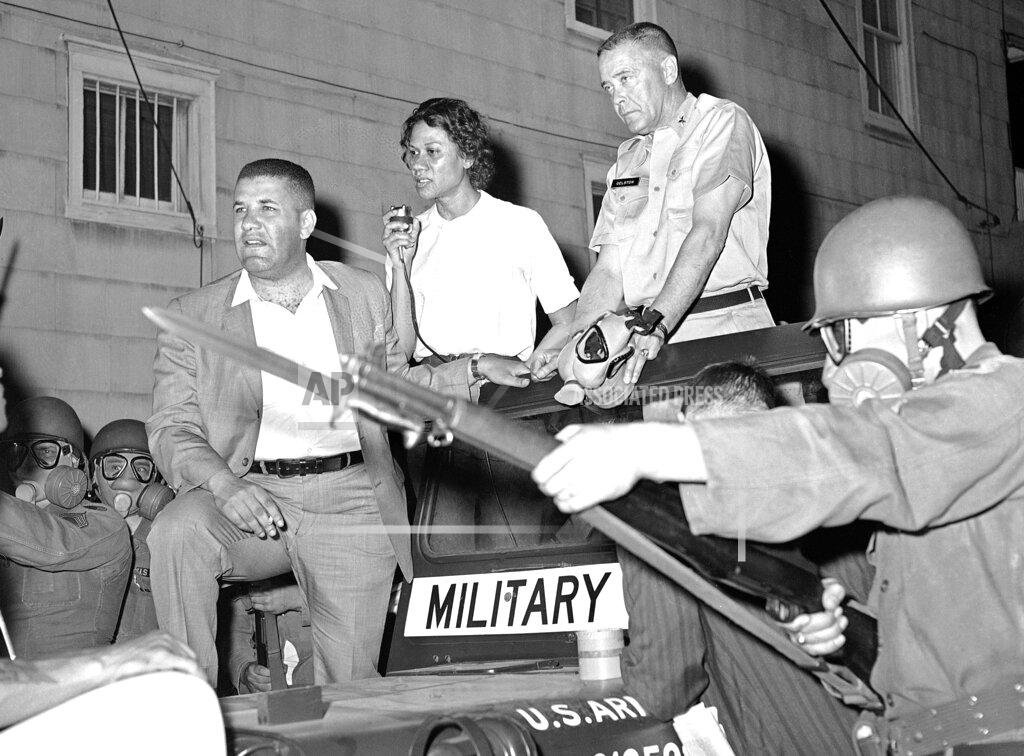
The Guardsmen stood at Washington and Race Streets, on the dividing line between the Black and white sections of this community, where 4,000 Blacks live. The site is five blocks from where Mr. Wallace spoke. The Blacks got no closer. As the demonstrators approached, Brigadier General George M. Gelston, the troop commander here, gave the order “Don gas masks.” The marchers came on, and General Gelston stepped forward, his hands raised. “Get these people back to the church,” he shouted, apparently meaning the Elks Hall. “The other meeting was a complete flop. Don’t ruin your chances by going over there. It’s not even half full.” By “other meeting” the general apparently meant the one at which‐ Governor Wallace spoke.
After a brief conference with Mrs. Richardson, head of the militant Cambridge Nonviolent Action Committee, and Stanley Branche, a Black leader of Chester, Pennsylvania, Mrs. Richardson turned to the demonstrators, many of whom had seated themselves in the center of the street. “I want you to sit in the street and don’t move from your position,” she said. Stones and bottles flew through the air. One bottle smashed on the hood of General Gelston’s jeep as he conferred with the Black spokesmen. Finally, Mrs. Richardson turned to the crowd and said: “Now I want you all to go back.” There were cries of “No, no.” But the demonstrators turned slowly and returned to the Elks Hall. There the Black leaders gave conflicting advice to the throng that overflowed the hall. Some urged the demonstrators to return. Others quoted General Gelston as having reported that “Governor Wallace has left and we have nothing to demonstrate against.”
“We have within our souls and bodies the strength to turn this nation upside down without throwing rocks or bottles,” one Negro leader shorted. “What we do in Cambridge tonight could be the beginning of the long hot summer here and in Mississippi and all over.” Although Mrs. Richardson announced that plans for further demonstrations had been postponed until tomorrow night, some members of the Student, Nonviolent Coordinating Committee marched again against the troops. This committee is a national group, with which the Cambridge committee is affiliated. On this march there were no appeals for the Blacks to turn back. Tear gas grenades flew. The order to use gas was given by Colonel Maurice Tawes, a cousin of Governor J. Millard Tawes, following an exchange between the colonel and Mrs. Richardson.
Senator Hubert H. Humphrey said today that Senate inaction on the civil rights bill should not be charged to the Southern filibuster but to his Northern and Western colleagues who tolerate it. As the Senate began the 10th week and 52d day of “debate” on the House‐passed bill, Senator Humphrey, who is floor manager of the measure, said “the whole procedure is disgusting.” “All that is being accomplished here is a display of adult delinquency,” the majority whip told reporters. However, the Minnesota Democrat said, it is not the 19 Southerners who are chiefly responsible for delaying action on the bill, since “we knew they were opposed” and “their obstructionist tactics were to be expected.” Rather, he said, the blame attaches to the “81 Senators — or some of the 81” — who do not live in the South.
Mr. Humphrey acknowledged for the first time that he and Senator Thomas H. Kuchel of California, the Republican floor manager, were “a long way” from the votes needed to shut off the Southern filibuster. Closure of debate requires two-thirds of the members present and voting‐67, if all are present. But, he said, “the potential votes are here to stop this filibuster,” if the Senators have the will to invoke closure. “Any intransigent minority,” he declared, “can run the Senate if a majority stands around with jelly for a spine.” “So, what we need from the American public,” he went on, “is a demand on the 81 that the Senate start to act like a Senate, and that Senators start to earn their wages, and that Senators abide by the Constitution, which says that a majority shall constitute a quorum to do business.”
President Johnson assured Latin America today of continued United States support “until we build a hemisphere of free nations from Tierra del Fuego to the Arctic Circle.” In a speech at the White House to Latin‐American ambassadors and Alliance for Progress leaders, the President emphasized that the Alliance’s program called not only for economic development and political democracy, but also for a “peaceful democratic social revolution.” Later the President joined with ambassadors and charges d’affaires from 13 Latin‐American republics in signing new loan agreements and letters of commitment totaling about $40 million.
Mr. Johnson also informed the ambassadors that he would appoint Walt W. Rostow, chairman of the State Department’s Policy Planning Council, to serve as United States representative on the Inter‐American Committee for the Alliance for Progress. This is the newly established steering committee for the program. Mr. Rostow will replace Teodoro Moscoso, who resigned from the post last week.
Senator Barry Goldwater has a probable 540 votes toward the Republican nomination for President but no certainty that he can get them all on the first ballot. “Probable” includes those convention delegates listed by Goldwater headquarters as “publicly committed” and others claimed by the Goldwater camp as “favorable.” It also includes some Goldwater backers whose election as delegates is still to come but is thought by political analysts to be virtually certain. A total of 655 votes is needed for nomination.
The Goldwater forces, as well as their foes, recognize that a first‐ballot victory is almost essential if the Senator is to win at all. There are some latent Goldwater votes that cannot be expressed until the second ballot or later, but there seems to be a lot more that are committed to him for only one ballot and may not stay for a second. The California primary on June 2 is almost universally appraised as pivotal. If Senator Goldwater wins it, he will be virtually unstoppable. If he loses, the effect may be politically fatal.
The Senator’s associates say no feelers have been put out about a running mate, and realistically none will be until after the California results are in. Nevertheless, they are willing, after carefully dissociating their “guesses” from Senator Goldwater personally, to speculate on Vice‐Presidential nominees. Heading most lists is Gov. William W. Scranton of Pennsylvania. Then there are Representative William E. Miller of upstate New York, the party’s national chairman; Representative Gerald R. Ford of Michigan and Senator Thruston B. Morton of Kentucky.
The prototype of the American B-70 bomber was unveiled by North American Aviation at its facilities at Palmdale, California. With six engines, and capable of flying at high altitude at a speed of Mach 3, the aircraft would make its first flight on September 21, but would be retired in 1969, without ever going into production. The B-70 was designed as a Mach 3+ strategic bomber capable of flying higher than 70,000 feet (21,336 meters). Like its contemporaries, the Lockheed Blackbirds, the Valkerie was so advanced that it was beyond the state of the art. New materials and processes had to be developed, and new industrial machinery designed and built.
At these speeds, it was expected that the B-70 would be practically immune to interceptor aircraft, the only effective weapon against bomber aircraft at the time. The bomber would spend only a brief time over a particular radar station, flying out of its range before the controllers could position their fighters in a suitable location for an interception. Its high speed made the aircraft difficult to see on radar displays and its high-altitude and high-speed capabilities could not be matched by any contemporaneous Soviet interceptor or fighter aircraft.
The introduction of the first Soviet surface-to-air missiles in the late 1950s put the near-invulnerability of the B-70 in doubt. In response, the Air Force began flying its missions at low level, where the missile radar’s line of sight was limited by terrain. In this low-level penetration role, the B-70 offered little additional performance over the B-52 it was meant to replace, while being far more expensive with shorter range. Alternative missions were proposed, but these were of limited scope. With the advent of intercontinental ballistic missiles (ICBMs) during the late 1950s, crewed nuclear bombers were increasingly seen as obsolete.
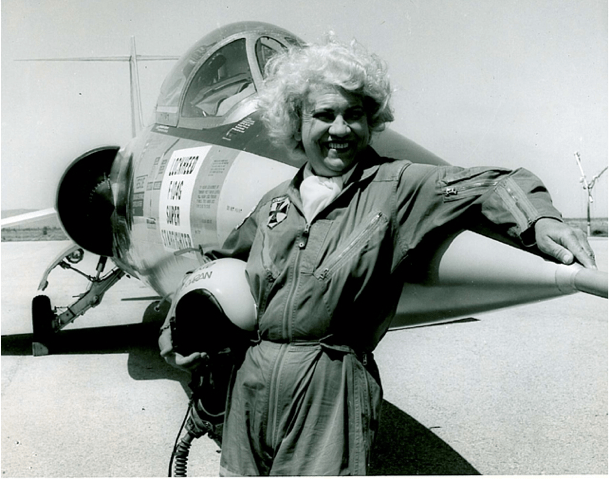
At Edwards Air Force Base, California, Jacqueline Cochran flew a Lockheed F-104G Starfighter, 62-12222, to 2,300.23 kilometers per hour (1,429.30 miles per hour) — Mach 2.16 — over a straight 15-to-25-kilometer course. She was the first woman to fly faster than Mach 2 and she set a new Fédération Aéronautique Internationale (FAI) World Speed Record.
Fred Whitfield hits a 4th inning grand slam and Larry Brown adds a 3-run homer in the 8th as Cleveland takes a 10-run lead into the 9th against Boston. The Red Sox put a scare into the Tribes with a 6-run 9th, all after 2 are out, and Cleveland wins, 11-7.
Dow Jones Industrial Average: 827.07 (-1.50).
Born:
Bobby Witt, MLB pitcher (World Series Champions-Arizona, 2001; Texas Rangers, Oakland Athletics, Florida Marlins, St. Louis Cardinals, Tampa Bay Devil Rays, Cleveland Indians, Arizona Diamondbacks), in Arlington, Virginia.
Trent Hubbard, MLB outfielder and pinch hitter (Colorado Rockies, San Francisco Giants, Cleveland Indians, Los Angeles Dodgers, Atlanta Braves, Baltimore Orioles, Kansas City Royals, San Diego Padres, Chicago Cubs), in Chicago, Illinois.
Bill Bean, MLB outfielder, pinch hitter, and first baseman (Detroit Tigers, Los Angeles Dodgers, San Diego Padres), in Santa Ana, California.
Floyd Youmans, MLB pitcher (Montreal Expos, Philadelphia Phillies), in Tampa, Florida.
Jeff Sellers, MLB pitcher (Boston Red Sox), in Compton, California.
Darryl Pollard, NFL cornerback (NFL Champions, Super Bowl 23 and 24-49ers, 1988, 1989; San Francisco 49ers, Tampa Bay Buccaneers), in Ellsworth, Maine.
Greg Williamson, NFL defensive back (Los Angeles Rams), in Long Beach, California.
Tom Martin, Canadian NHL left wing (Winnipeg Jets, Hartford Whalers, Minnesota North Stars), in Kelowna, British Columbia, Canada.
Ian Kidd, NHL defenseman (Vancouver Canucks), in Gresham, Oregon.
Katie Wagner, American TV personality, model, entertainment reporter (MTV), and daughter of actor Robert Wagner, in Los Angeles, California.
Tim Blake Nelson, American actor (“O Brother, Where Art Thou?”; “The Ballad of Buster Scruggs”; “Watchmen”), in Tulsa, Oklahoma.
John Parrott, English professional snooker player and 1991 world champion; in Liverpool, England, United Kingdom.

 History Diaries