Great Britain gave public assurance to the Soviet Union that proposals already advanced would ask for military aid from the Soviets only after British and French forces had entered the field in any future war. British Prime Minister Neville Chamberlain told the House of Commons that there was no intention of leaving the way open for the Soviets to “be committed to intervention unsupported by” Britain and France. Despite Chamberlain’s statement doubts persisted that the Soviet Union would accept the British proposals for a security pact without further specific guarantees. The Prime Minister gave this assurance, which already had been transmitted through diplomatic channels, in the House of Commons in reply to the Soviet statement last night that stressed the fact that the British and French proposals for enrolling Russia in the list of anti-Axis States did not give any guarantees against a situation whereby Russia alone might have to intervene against aggression.
Mr. Chamberlain said in his reply that the British regarded the Anglo-Russian negotiations as “of greatest importance and urgency” and that it had been made plain that there was no intention that the Soviet Government “should intervene irrespective of whether Britain and France had already, in discharge of their obligations, done so.” “If the Soviet Government wished to make their own intervention contingent on that of Great Britain and France,” Mr. Chamberlain added, “His Majesty’s Government for their part would have no objection.”
In another statement before the House of Commons the Prime Minister urged speed on the conscription and secret mobilization bills, and in response the House voted to limit debate so as to pass the measures next week. Responding to Prime Minister Neville Chamberlain’s urgent demand for speed, the House of Commons cleared the decks today for final passage next week of the Conscription Bill and of its companion measure permitting secret mobilization of Britain’s armed forces.
A drastic “guillotine” motion limiting debate was carried by 283 to 133, and the huge government majority quickly got to work to reject Opposition amendments to the Conscription Bill. The first amendment, however, was proposed by the government itself to exempt Northern Ireland from the provisions of the measure. This was carried by 261 to 21, with the Ulster Conservatives, who resented this concession to “enemies” of Britain, finding themselves for once in the same lobby with members of the extremist Independent Labor party, who proclaimed their hope that the exemption of Northern Ireland would result in the entire rejection of conscription.
Moving the adoption of closure, Mr. Chamberlain reiterated his desire that both the conscription and mobilization bills be approved by the Commons by May 18, so that they could become law before the Whitsun recess at the end of the month. “The reasons for urgency,” he said, “are self-apparent. It is common knowledge that our proceedings in these matters are being watched with very close attention in other quarters, and anything which appeared to be in the nature of dilatory proceedings would certainly have a very discouraging effect on our friends in Europe.”
Russia, meanwhile, began to repair her relations with Poland when Vice Commissar Potemkin had a two-hour talk with Polish Foreign Minister Beck. Some kind of Russo-Polish agreement is not ruled out. Closer cooperation between Warsaw and Moscow on the basis of the existing Polish-Russian treaty and non-aggression pact, was discussed today by Vladimir Potemkin, Soviet Vice Commissar of Foreign Affairs, and Foreign Minister Josef Beck. The conversations, arranged at the suggestion of Mr. Potemkin, who was in Warsaw en route to Moscow, lasted nearly two hours.
Official circles said that the general European situation was discussed. It was added, however, that since the conversations had not a fixed agenda they should not be connected with the present Anglo-French-Russian security negotiations. It is pointed out that this is Colonel Beck’s first personal meeting with any Soviet dignitary since his visit to Moscow in February, 1934. Colonel Beck’s relations with Maxim Litvinoff, deposed Soviet Foreign Commissar, were not very friendly; whenever the two met at Geneva, they usually opposed each other. Mutual distrust and personal aversion always seemed to stand in the way of a useful exchange of views.
In Berlin, where the press continued to charge abuse of Germans in Poland, there was a hint that Germany was not looking forward to an agreement with the Soviet. A news service seemed to envisage the possibility that the Anglo-Russian talks would succeed, and a Foreign Office spokesman discounted in advance any such success.
The delay in the London-Moscow negotiations was still holding up announcement of the Anglo-Turkish pact.
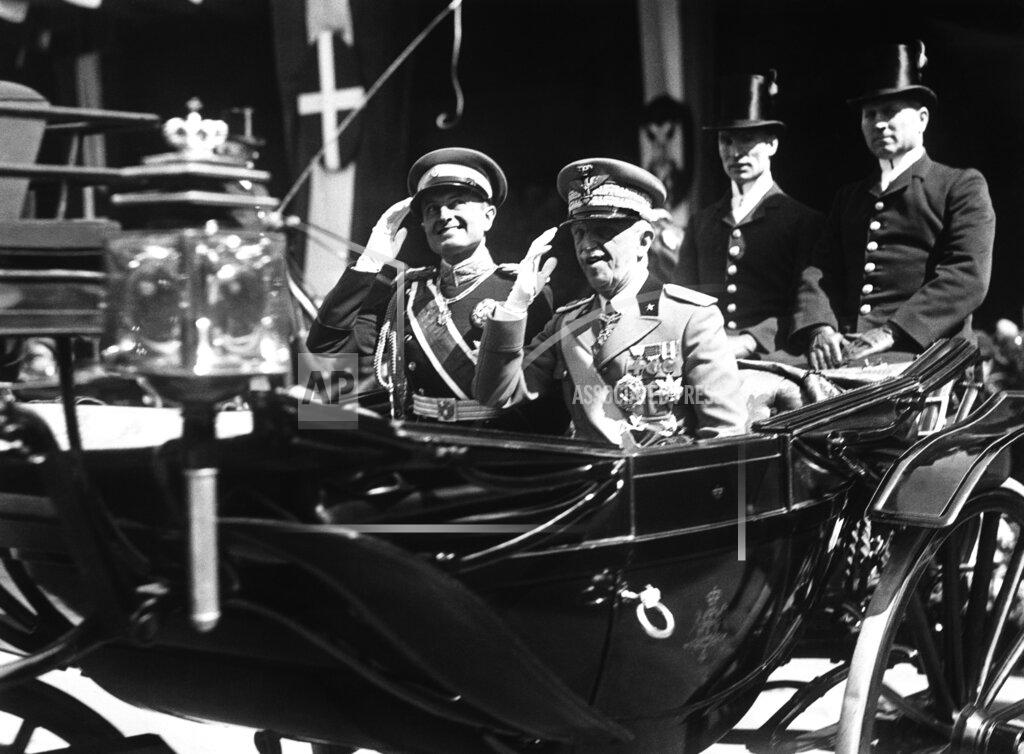
In Italy a visit by the Yugoslav Regent was viewed as solidifying relations between Rome and Belgrade. Italian Prime Minister Benito Mussolini, Italian Foreign Minister Galeazzo Ciano, and Yugoslavian Foreign Minister M. Markovitch conferred for an hour in Rome. Mussolini then met with Regent Prince Paul. Political sources indicated that Prince Paul would insist on maintaining a noncommittal attitude toward the Rome-Berlin axis.
Plans for strengthening Great Britain’s naval forces in the Pacific Ocean were revealed to the press. As a result of negotiations between Great Britain and Australia, British battleships were earmarked for service in the Pacific in the event of an emergency.
Konstantin Umansky is named Soviet Ambassador to the United States. The official Soviet news agency, Tass, announced today that the presidium of the Supreme Soviet had appointed Konstantin Umansky, now counselor and Chargé d’Affaires of the embassy in Washington, as Ambassador to the United States. Mr. Umansky has been in charge of the embassy in Washington since Alexander A. Troyanovsky, the former Ambassador, returned from the United States last June. Mr. Troyanovsky made his first public appearance since returning to Moscow, on March 3 at a luncheon given by Tass. Mr. Troyanovsky left Washington about the time Joseph E. Davies, former United States Ambassador to Moscow, left here last June 10 to take his post as Ambassador to Belgium. Laurence A. Steinhardt is en route to Moscow to fill the post vacated by Mr. Davies.
The Henry Miller novel “Tropic of Capricorn” was officially released in France. It was banned in the United States until a court ruling in 1961.
The British Government has “considerable hope” of British Guiana as a permanent settlement for Jewish refugees from Central Europe, Malcolm MacDonald, Secretary for Colonies, told the House of Commons today in announcing the publication of the report of the special committee that studied the question. At the same time the Colonial Secretary indicated that British policy for Palestine, discussed in detail by the Cabinet today, would be announced soon.
Apparently, the British want to balance off the announcement restricting Jewish settlement in Palestine with some invitation to the Jews to find refuge in British Guiana, for Mr. MacDonald indicated that a statement on the latter subject would also be made before long.
While the detailed outline of Palestine policy is still a closely guarded secret, its unanimous rejection by both sides at the Palestine conference this Winter broke up the conference with no tangible results. The general belief here is that the further immigration of Jews would be restricted over a five-year period — 75,000 for that time is the figure mentioned. At the end of that time the Jewish population would have reached roughly one-third the total population of Palestine, and would be frozen at that figure.
Today in Washington, the Senate debated the Agriculture Department Appropriation Bill, refusing to suspend the rules to consider the Bankhead cotton export subsidy proposal, received the Wheeler bill to guarantee wheat farmers parity prices or cost of production and recessed at 5:08 PM until noon tomorrow. The Temporary National Economic Committee opened a study of consumer problems,
The House considered the $225,188,514 War Department Civil Appropriations Bill, adding to it $50,000,000 for rivers and harbors and flood-control projects, and adjourned at 6:10 PM until noon tomorrow. An appropriation subcommittee opened an investigation of Works Progress Administration activities in Tennessee. The Merchant Marine Committee opened a hearing on the bill to require the Maritime Commission to employ men through union hiring halls.
Suffering from a slight nose irritation, President Roosevelt remained away from his desk in the executive offices today and disposed of a pile of “basket work” and correspondence in his study on the second floor of the White House. At his regular meeting with the press this morning, Stephen T. Early, White House secretary, discouraged the description of the President’s condition as a head cold. He added that Mr. Roosevelt had decided to remain away from his office without consulting Mr. Ross T. McIntire, his physician.
While the representatives of the United Mine Workers and operators of the Appalachian conference were unable yesterday to break the deadlock in their negotiations, despite President Roosevelt’s peremptory demand that they do so without delay, developments in the negotiations early this morning assured the country of substantial relief from the coal shortage arising from the situation.
The United Mine Workers agreed to call off the strike outside the Appalachian area, in the region west of Ohio to the Pacific, representing a total production of 126,000,000 tons of bituminous annually. John L. Lewis, president of the United Mine Workers, announced at 2:45 this morning, upon adjournment of the conference with the coal owners, that instructions would be issued forthwith to the union’s district organizations outside the Appalachian area to sign new contracts with the owners.
The strike outside the Appalachian area was called on May 4 and 5 in support of the 320,000 Appalachian miners made idle by the expiration of the Appalachian agreement on April 1. Resumption of work outside the Appalachian field, which is expected by Monday, will relieve to a great extent the coal shortage confronting railroads, industries and public utilities. Coincident with Mr. Lewis’s announcement, Dr. John R. Steelman, chief of the United States Conciliation Service, who has been trying to bring the conflicting parties together, and participated throughout yesterday’s negotiations, which were at the Hotel Biltmore, made known a proposal by the government affecting the Appalachian stoppage.
He announced that the government will ask such companies and associations in the Appalachian conference as are in agreement with the union’s demands for a union shop or lifting of the penalty clause in the proposed agreement to sign separate contracts with the union and begin operations immediately “in order to relieve the grave crisis facing the nation.”
Congressional leaders received a sharp forewarning today of another long and bitter struggle between the White House and Congress as word reached Capitol Hill that President Roosevelt had definitely rejected the Treasury’s tax revision plan, and virtually forbidden his fiscal aides to present it as an Administration proposal. His determination to resist the plan was said to have been expressed carefully by the President yesterday at an early morning conference at the White House. Participants in the meeting were Secretary Morgenthau, Representative Doughton of North Carolina, chairman of the Ways and Means Committee, and Representative Jere Cooper of Tennessee, chairman of the Ways and Means subcommittee on taxation.
Under Secretary Hanes, who shared responsibility with Secretary Morgenthau for the Treasury program, did not attend the conferences; neither did Senator Harrison of Mississippi, chairman of the Senate Finance Committee. The report of the White House tax meeting and what took place there reached the Capitol coincidentally with the information that the sudden resignation of General Robert E. Wood, Chairman of the Board of Sears, Roebuck & Co., as temporary business adviser to Secretary Hopkins, had its genesis in the aggravated question of business tax revision.
General Wood was said to have become convinced that the Administration could not be persuaded to sponsor a business-encouraging tax program at this session, and so he returned to his office in Chicago. Approved Advisory Council Plan The particular proposals which General Wood advocated were those adopted last Fall by the Business Advisory Council of the Department of Commerce, and which members of that organization had understood until recently had been approved in the main by Mr. Hopkins himself. They followed closely the proposals worked out by Mr. Hanes, and the subsequent program published by the Brookings Institution.
A bitter fight over farm payments, relief and “works” funds in the House was presaged today by a politically unorthodox coalition of urban and rural representatives who overrode the Administration and economy group leaders to add $50,000,000 to the non-military appropriation bill for the War Department. The urban elements were well represented in two roll-call votes which added, first, $25,000,000 for flood control by a vote of 171 to 165 and, second, added $25,000,000 for rivers and harbors improvements by a vote of 182 to 155.
The Appropriations Committee a few hours before had slashed these sums from the bill, on the grounds that they exceeded the Budget Bureau figures by $50,000,000. It was stated on the House floor that in restoring this figure, it was the intention of the flood control group to take this amount from the next relief appropriation bill. Representative Rayburn, majority leader, told the House that President Roosevelt had promised to allot this amount out of the 1940 fiscal Year Relief Bill to rivers and harbors and flood control, and pleaded with the members not to vote for the increase.
A biographer says Woodrow Wilson desired a third term as president to establish the League of Nations, but friends discouraged the idea.
An Ohio House bill bans women from serving as cocktail waitresses. “Women can’t mix a good cocktail,” the legislator says.
The Florida Senate tonight passed a House approved bill setting up a municipal primary for white persons only in Miami, where men in white robes recently paraded through the Black section warning Blacks to stay away from the polls. The act was introduced last week on the day a primary was held in Miami to select City Commissioners. The measure had been advertised in Miami sixty days previously. B. Solomon, Black leader in Miami, said an attack on constitutionality of the act would be made by the Negro Citizens Service League if the measure is signed by Governor Fred Cone. Following the primary last week, Miami city officials said a large number of Blacks cast votes despite the demonstration by white robed figures.
Bill Klem, behind the plate at the Reds game in Cincinnati, celebrates his 35th anniversary as a National League umpire. He then calls the 10–5 Reds’ loss to Brooklyn.
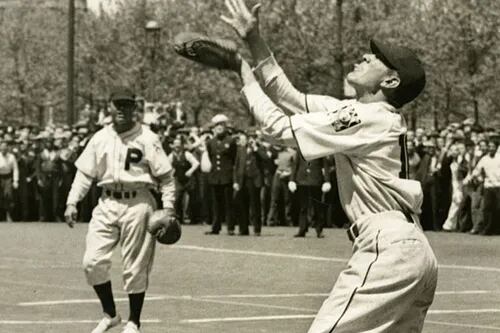
Phillies rookie catcher Dave Coble catches a ball dropped from the 521-foot-high Philadelphia City Hall. The rookie catcher handles the 521-foot dropped ball cleanly but likens the experience of a man jumping into his arms.
U.S. Army officials leave for Brazil. The visit is important, the U.S. says, to future relationships.
Chile’s new envoy, Alberto Cabero, pushes a strong U.S. tie. He assures investors that their government is not extremist.
Japanese reports that at least 150,000 Chinese troops had been trapped by encircling movements in Northern Hupeh and Southern Honan, involving the probable capture of seven important Chinese generals, were received in Shanghai with considerable skepticism.
Although it is conceded the Japanese Army has scored important strategic advances and has upset the Chinese plans for a May offensive in this region, it is doubted that the outcome of this series of battles will be anything beyond lengthening of the Japanese lines, the capture of several important cities and the causing of heavy losses of men and materials among the Chinese. The terrain of Northern Hupeh lends itself admirably to the Chinese tactics, designed for escape from these traps. Japanese leaders made similar claims before the capture of Nanking, Suchow and Hankow, but most of the Chinese forces escaped the traps.
By strictly controlled residence permits Chungking’s population will hereafter be maintained at a maximum of 200,000, Mayor Chang Tze-cheng announced today. This is a reduction of approximately 500,000 from the total before last week’s air raids. The mayor said new fire lanes to facilitate fire control would be immediately opened in congested districts and that work was being rushed on bomb shelters. He announced that construction of the three-mile tunnel from one end of the city to the other, which has been going on for eight months, will be completed in three months. The tunnel will provide a bomb-proof shelter for 100,000 persons.
Chuanchow, fifty miles north of Amoy, was heavily bombed by Japanese planes again today with casualties estimated in the thousands. Fires from incendiary bombs spread throughout the city. Dispatches from Amoy said many children drowned attempting to escape. Chuanchow is deserted in the daytime. Buses, banks and customs offices operate only at night.
Dow Jones Industrial Average: 132.82 (-0.85).
Born:
Bruce Tarbox, NFL guard (Los Angeles Rams), in Nyack, New York (d. 1979, of a heart attack while playing tennis)
Died:
James Parrott, 41, American actor and film director (heart attack).
 History Diaries