Two Vietnamese terrorists were reliably reported today to have admitted that an explosive charge they were caught laying was designed to kill Defense Secretary Robert S. McNamara. The Defense Secretary is due Tuesday for a 36‐hour visit. General Maxwell D. Taylor. Chairman of the Joint Chiefs of Staff, arrived in Saigon early Monday, said a dispatch by United Press International.
The two men were picked up by South Vietnamese policemen shortly before last midnight at a bridge on the main road between downtown Saigon and the civil and military airport. When caught, they were stringing electrical detonation wire under the bridge. A mine of the type used by Communist Việt Cộng terrorists was found nearby, not yet connected with the wires. The terrorists said they were acting under orders to prepare the bridge to be blown up when Mr. McNamara was driven across on his arrival in Saigon on Tuesday, qualified sources said. The concrete bridge carries the main airport road over a small stream that winds through Saigon’s suburbs. Visitors are normally driven along this route, the only convenient way into town from the airport.
United States security officials expressed pleasure at the vigilance shown by the South Vietnamese police in finding the two men and their equipment. The bridge is on a poorly lighted section of road and traffic is light late at night. The McNamara visit comes during the period of an intensive security alert during a series of Communist holidays — May Day, the 10th anniversary last Thursday of the fall of Điện Biên Phủ and the May 19 birthday of Hồ Chí Minh, Communist leader of North Vietnam. The defeat of French forces by Vietnamese Communists in the siege at Điện Biên Phủ, near the Laotian border, marked the end of France’s control in Indochina.
President Hồ Chí Minh of North Vietnam says it would be sheer stupidity for the United States and South Vietnam to carry into the North the war against his Communist Việt Cộng forces. He made the statement in an interview last month with Wilfred S. Burchett, a Communist-oriented Australian‐born newspaperman who now works in Moscow. The interview was made available after Mr. Burchett’s return here. President Hồ Chí Minh said that French proposals for neutralization of Indochina deserved attention, but that withdrawal of all United States forces and arms from South Vietnam was a necessary condition for restoring peace.
The Asian revolutionary, who will be 74 years old on May 19, compared the United States position in Vietnam to a fox “who has already got his two hind legs caught in a trap, and by still trying to jump around is doing his best to get his front legs caught as well.” Asked about reports that the United States and Premier Nguyễn Khánh of South Vietnam were considering pushing the war into the North, he declared: “How can they talk about marching to the North when they cannot even control areas in the immediate vicinity of Saigon? This is sheer stupidity.” He said also that North Vietnam “has powerful friends ready to help” in event of such action — apparently a reference to Communist China.
Prince Norodom Sihanouk said today that aid from the Soviet Union, Communist China and France had enabled Cambodia’s army to “take an eye for an eye and a tooth for a tooth” in border clashes with South Vietnam. The Cambodian Chief of State, in a thinly veiled attack on the United States, made the statement as French officials formally presented him with military supplies for which he had negotiated with the French Defense Minister, Pierre Messmer, during the latter’s recent visit here. Prince Sihanouk called France Cambodia’s “most loyal friend.” He said President de Gaulle’s attitude toward Southeast Asia contrasted sharply with “the blindness of those, who by their senseless policies, have created an extremely dangerous situation in Laos and South Vietnam.” This was viewed as an allusion to the United States‐supported war against Communist guerrillas in South Vietnam and American support of the neutralist Government of Laos.
Premier George Papandreou of Greece today called union of Cyprus with Greece “the only right solution” for the island in the long run. Premier Papandreou, in an interview published in the news magazine Der Spiegel, proposed these steps to settle the Cyprus crisis: Occupation of the island by the United Nations peacekeeping force for several years if necessary to achieve a stable pacification, enactment of a United Nations‐guaranteed statute to protect Turkish Cypriote minority rights and a United Nations‐supervised plebiscite to determine whether a majority of Cypriotes want union with Greece.
Dr. Arnulfo Arias, a stanchly nationalistic candidate, built up a lead today for President of Panama in yesterday’s election. On the basis of early returns Dr. Arias’s Panamanian party ran ahead in the popular vote. Dr. Arias led in the key province of Panama and in this capital city over his principal rival, Marco A. Robles, who heads the government coalition parties. With 55 of the capital’s 360 precincts counted, Dr. Arias had 6,508 votes, against 5,614 for Mr. Robles. A third candidate, Juan de Arco Galindo, who headed a slate of six parties in what was called the Opposition Alliance, had 2,441 votes in this tally.
Scattered returns from the provinces also gave Dr. Arias an early lead. Panamanians turned out in record numbers to elect a President and Legislature. All reports were that the balloting was generally peaceful. A festive atmosphere seemed to prevail everywhere in this small and diverse republic — in the urban slums, affluent suburbs, mud‐walled villages and highland cities.
The air of peace was in sharp contrast with the bitter crisis of four months ago, when mobs in the capital and the interior rioted against the United States over the question of sovereignty over the Panama Canal Zone. Dr. Roberto F. Chiari cannot succeed himself as President. The count of the votes will be tedious because each voter used two paper ballots. one for the President and two Vice Presidents, and the other for Deputies representing 19 parties.
Premier Khrushchev congratulated Egyptian youth tonight on following the Arab Socialist leadership of President Gamal Abdel Nasser. He said The United Arab Republic and the Soviet Union were progressing along parallel lines. “We fight together for the complete eradication of imperialism,” the Soviet Premier declared. Mr. Khrushchev addressed a rally of more than 100,000 people in a new Cairo stadium. He was introduced by Mr. Nasser as a man who has stood by our side.”
The Soviet Communist party said today in a major policy statement that world Communism should be a “voluntary union of likeminded people” in which no single party would exercise “hegemony.” The Soviet party said it believed in equality and had voluntarily renounced its “’leading role” in the Communist movement. The statement in Pravda, the Soviet party organ, said a voluntary union of parties could he realized only on the basis of a “creative” Marxism adapted to the changing needs and conditions of the period. The theoretical foundations of such a Marxism, the paper said. are to be developed jointly by all parties and should not be handed down “peremptorily from the summit of a theoretical Olympus.”
The Pravda statement on a need for “ideological unity” in the face of the Chinese Communist challenge was the first of a series of editorial articles promised by the newspaper. They are regarded here as a formal reply to a similar series that has been published since September by the Chinese Communists on key issues dividing Moscow and Peking. Today’s statement questioned the Chinese view, expressed February 1 in the party newspaper, Jenmin Jih Pao, that the history of world Communism had Demonstrated that, “like everything else, the international working‐class movement tends to divide itself in two.” As examples the Chinese cited the Bolshevik‐Menshevik split of 1901 and the split between Trotsky and Lenin’s successors in the 1920’s.
Relations between Soviet leaders and United States diplomats in Moscow have developed to a point where Americans can obtain private advance word on Russian attitudes in the dispute with Communist China. The improved relationship was described by the United States Ambassador to the Soviet Union, Foy D. Kohler, in testimony before the subcommittee on national security of the Senate Committee on Government Operations. The testimony, given April 8, was made public today. Mr. Kohler replied to questions about the degree to which his contacts with Soviet leaders provided insights into Soviet thinking, he said:
“Leaving the personality of the incumbent aside, I think the role of the Ambassador in the Soviet Union is a very key one. The leadership there rather concentrated. You get to know all of them and the opportunities to communicate with them are very frequent now. You get from them senses of what is bothering them in a way that you do not get out of any published material in a country where there is a completely controlled press and where everything that is in the press is purposeful in one way or another.” Mr. Kohler was asked by Senator Henry M. Jackson, Washington Democrat and subcommittee chairman, whether he could obtain a correct estimate on the Kremlin’s views “outside of the doctrinaire published policy.”
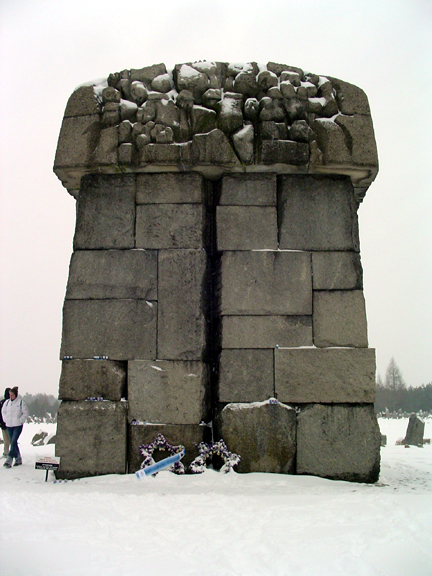
The commemorative memorial to the victims of the Treblinka death camp was dedicated in Poland. Designed by Adam Haupt and Franciszek Duszenko, the memorial was a broken 26-foot obelisk surrounded by 17,000 pieces of sharp granite.
The United States is prepared to enter into a generous military aid and sales agreement with India, qualified sources in Washington said today. Although India may not immediately obtain the advanced supersonic jet fighters she is seeking, she is likely to get formidable jet fighters armed with air‐to‐air Sidewinder missiles. In addition, the Indians are expected to obtain substantial equipment for controlling air defenses from the ground, as well as conventional arms and transport for mountain combat troops. The Indians are credited here with having put together a reasonable, well‐prepared series of plans to be considered in pending negotiations for a long-range military assistance agreement.
The Senate’s leisurely pace in considering the civil rights bill has raised strong possibilities of a post‐convention Congressional session reminiscent of that in 1960. While Congressional leaders are not wholly resigned to the prospect, they have begun to give serious thought to the growing threat of a legislative backlog that cannot be handled by mid‐July. If such a jam developed, Congress would have to recess for the Republican National Convention, which starts July 13 at San Francisco. It would probably reconvene July 20 and try to finish its work before the opening of the Democratic National Convention at Atlantic City August 24.
If Congress failed to finish before then, another recess for the Democratic convention and a final session in September would be necessary. A September session, in the estimation of most leaders, is unlikely, but cannot be ruled out. President Johnson called attention to the developing backlog of legislation at his news conference Wednesday. Listing five Administration bills for action, in addition to the civil rights bill, he said that he might call Congress back after the Republican convention and, if necessary, after the Democratic convention. It is unlikely, however, that the President will need to exercise his authority to recall Congress. A mere Presidential request would probably accomplish the desired result, with Congress recessing in July instead of adjourning for the year.
In 1960, Congress returned of its own volition in August after standing in recess for both the conventions. The Democrats had nominated two Senators, John F. Kennedy for President and Mr. Johnson for Vice President. The Republican ticket was headed by Richard M. Nixon, then Vice President, with Henry Cabot Lodge, then United States representative at the United Nations, as his running mate. Little was accomplished at the politics‐ridden session that followed. On President Johnson’s list for action this year are medical care for the aged under Social Security, a food‐stamp plan to aid the needy, the omnibus antipoverty bill, the Appalachian relief and rehabilitation program, and pay increases for Federal officials. The House has passed the Administration’s food‐stamp bill, but none of the other measures has reached the floor of either chamber.
Congress must also vote on the annual bill authorizing funds for foreign aid, which has not emerged from committee, and a number of relatively routine but time‐consuming measures before adjourning for the session. These include all 12 annual appropriation bills, six of which have been passed by the House but none by the Senate. Among other matters classified as “must” legislation are an increase in the national‐debt limit, the annual extension of excise‐tax rates, renewal of the Renegotiation Act for Recouping Excessive Profits on Government Contracts, and an increase in the United States financial contribution to the International Development Association. The House has passed the renegotiation bill and the Senate has passed the development measure. All of the others are still to be considered in both chambers.
A great many businessmen who normally vote Republican are ready to support President Johnson next fall on one condition: That they approve of his running mate. The Democratic ticket that would draw their vote — and money, too — against any presently foreseeable Republican combination would have Secretary of Defense Robert S. McNamara in the second spot. The nomination of Attorney General Robert F. Kennedy as Vice President would, on the other hand, end any chance Mr. Johnson has of drawing widespread business support, according to many of the corporate executives who met here this weekend as members of the Business Council.
Mr. Kennedy is regarded as hostile to business, primarily because of the recent antitrust activities of the Department of Justice. The business leaders indicated they had not yet made up their minds about other Vice‐Presidential possibilities, including Sargent Shriver, the director of the Peace Corps and of the President’s antipoverty program. They dislike Senator Hubert H. Humphrey of Minnesota, another Vice‐Presidential prospect, but they do not rule out the possibility that they might vote for a Johnson‐Humphrey ticket. Whether an actual majority of the 100‐man Business Council intended to support a Johnson‐McNamara ticket was not clear. Many members traditionally refuse to discuss politics at council meetings. Among the corporate presidents and board chairmen who would express their views, however, a clear majority favored a Johnson‐McNamara slate. Mr. McNamara formerly headed the Ford Motor Company.
The Apollo astronauts recently spent the early morning hours clustered around the base of a telescope, gazing at a 36inch image of a waning full moon. For many of the 29 test pilots, it was the first close telescopic look at the moon, on which one of them will set foot some five or six years from now. The night‐long vigil at the Kitt’s Peak National Observatory, near Tucson, Arizona, was far more than an introductory look at the moon, however. It was part of a training program that is transforming supersonic test pilots into field geologists who can go prospecting on the moon with a scientifically trained eve.
The program represents a new facet in the training of astronauts. Until recently the emphasis has been placed almost exclusively on training the pilot to fly a spacecraft under the unnatural condition of weightlessness. Now they are being given a scientific education that has impressed some leaders in the scientific community with its thoroughness. At the Ellington Air Force Base near the Manned Spacecraft Center in Houston, a wooden hut has been transformed into a one‐room classroom for the astronauts. With rock specimens on the desks, meteorites and tektites on the wall and a six‐foot model of the moon by the teacher’s desk, the room resembles a geology classroom at any college. The school has its own faculty — three young graduate geology students hired by the space agency in addition to four geologists on loan from the United States Geological Survey.
Interior Secretary Stewart L. Udall said today that the logical starting place in President Johnson’s attack on poverty would be the nation’s Indian reservations. He said in an interview that he agreed with the suggestion by Senator Hubert H. Humphrey yesterday that the anti‐poverty program begin with pilot projects on reservations. Elaborating in an address to a national conference on Indian poverty, Mr. Udall said Mr. Johnson wanted Indians “in the very forefront” of the program because they were suffering more from poverty today than any other group. Mr. Udall cited a long list of statistics showing the destitution in which many of the nation’s 400,000 reservation Indians live as a result of poor opportunities for education, jobs, health and housing.
Senator Barry Goldwater of Arizona picked up 23 more first‐ballot votes at state conventions this weekend as the number of delegates to the Republican National Convention, to be held at San Francisco on July 13, passed the halfway mark. An Associated Press survey of the 701 delegates now chosen shows Senator Goldwater with 266 first‐ballot votes for the party’s Presidential nomination. The remainder of the delegates are lined up this way: 43 for Ambassador Henry Cabot Lodge, 7 for former Vice President Richard M. Nixon, 4 for Governor Rockefeller of New York, 63 for Gov. William W. Scranton of Pennsylvania, 108 for favorite‐son candidates and 210 uncommitted or not stating a choice.
Although Governor Rockefeller has only four delegates com mitted to him at this time, he is expected to capture most of the 92 delegates in the New York primary June 2. He could also pick up 86 more with a victory in the California primary the same day. Senator Goldwater’s headquarters has maintained that the Senator will have 450 of the 655 votes needed for the nomination, not counting the 86 he would gain by winning in California. The Senator added 23 delegates in Missouri, Virginia and Wyoming yesterday.
Senator Kenneth B. Keating said yesterday that he would back the Presidential candidacy of Senator Barry Goldwater only if the Arizona conservative pledged to support a liberal platform such as that adopted at the 1960 Republican convention. The upstate Republican, seeking re‐election this November, stated he could not now support many of the positions espoused by Mr. Goldwater. Mr. Keating said it would be “very difficult” to support a candidate who opposed “forward‐looking legislation” favored by a cross‐section of the party.
Mr. Keating, speaking on the W.C.B.S. radio program, “Let’s Find Out,” took a position similar to that of his colleague, Senator Jacob K. Javits. Mr. Javits announced last week that he would not commit himself to support Mr. Goldwater if the latter were selected as the Presidential standard‐bearer. Mr. Javits, mentioning differences between Senator Goldwater’s views and those of liberal Republicans, said then: “I will not commit myself to support Senator Goldwater if he is the nominee. I’m an American first, then a Republican.” Mr. Keating said he did not believe that the Republican convention would select Mr. Goldwater. He said that a number of other possibilities, including Henry Cabot Lodge, the Ambassador to South Vietnam, showed surprising strength. However, he reiterated his support for Governor Rockefeller.
Singer and film actor Frank Sinatra almost drowned in an undertow while swimming in Hawaii, where he had been filming “None but the Brave.” One of the co-stars of the movie, Brad Dexter, swam out to rescue Sinatra and helped save his life.
Vic Morabito, managing owner of the San Francisco 49ers in the National Football League, died today in San Francisco’s St. Mary’s Hospital of a heart attack. He was 45 years old and had managed the team for six years. Mr. Morabito was the younger brother of Tony Morabito, the founder of the team, who died here of a heart seizure in October, 1957, while watching a game between the 49ers and the Chicago Bears.
Born:
Steve Gage, NFL defensive back (Washington Redskins), in Claremore, Oklahoma.
Carl Painter, NFL running back (Detroit Lions), in Watseka, Illinois.
Guy Teafatiller, NFL defensive tackle (Chicago Bears), in Concord, California.
Mark Andre, French-born classical music composer; in Paris, France.
Died:
Mikhail Larionov, 82, Russian avant-garde painter and founder of Rayonism.
Carol Haney, 39, American actress and Tony award winner (“The Pajama Game”), from pneumonia.
Vic Morabito, American businessman and co-owner of the San Francisco 49ers NFL team, of a heart attack.
 History Diaries