General Khánh tells Ambassador Lodge that he feels it is necessary to declare full-scale war on North Vietnam, have the United States start bombing the North, and send 10,000 U.S. Special Forces troops ‘to cover the whole Cambodian-Laotian border.’ Khánh is beginning to feel a lack of support for his efforts. Lodge does not inform him that the United States has already developed its own plan to bomb the North.
In secret testimony before the House Armed Services Committee (released 19 June) William Bundy, now assistant secretary of state for East Asian and Pacific affairs, says that the United States must drive the Communists out of South Vietnam even if it means “attacking countries to the north.”
A company of United States military policemen will be sent to South Vietnam later this month to help protect American installations and personnel, State Department officials said today. The decision was made known a day after the Assistant Secretary of State for Far Eastern Affairs, William P. Bundy, said that such action was under consideration, Mr. Bundy had cited a new wave of terrorism in Saigon by the Việt Cộng. Two companies of United States military policemen were withdrawn from South Vietnam last December. Officials said that the new unit, of undisclosed size, would replace them.
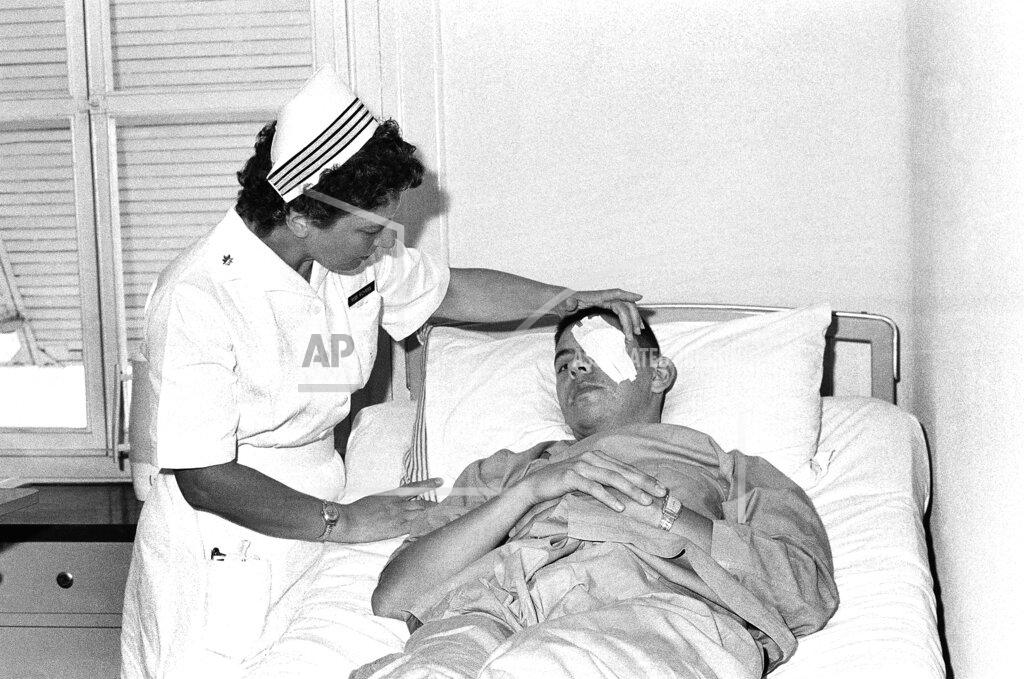
It was not known whether the military policemen would be permanently stationed around United States installations or what their relationship to Vietnamese security forces would be. The sinking Saturday of a United States ferryboat, a grenade attack on American servicemen Saturday evening and the ambushing of a jeep carrying members of the International Control Commission Sunday were viewed here as signaling an increase in the terrorist campaign. Officials believed that the Việt Cộng guerrillas were becoming increasingly bold and that new acts of terrorism were to be expected. However, it was said, there are no plans to remove dependents of United States personnel from the country.
The Soviet Union, in a further aggravation of its conflict with Communist China, demanded today to be recognized as an Asian as well as a European nation. In a statement sent to all independent Governments in Asia and Africa, it denounced the “racist” policies of Chinese leaders and by implication compared the leaders to the rulers of Nazi Germany. The text of the blistering 2,000‐word Government declaration was published in Izvestia, the Government newspaper, and was distributed by Tass, the official press agency. It was an answer to a Chinese effort to prevent the Soviet Union’s participation in a major Asian‐African conference scheduled for next March in Bandung, Indonesia. The Soviet statement was interpreted here as a major new development in the Communist conflict.
Observers expect the Chinese Communists to reply that they consider the Soviet Union an occupier of Asian territory rather than a genuine Asian nation. The Chinese have been saying that large parts of Soviet territory in Asia were seized from China in the 19th century. The treaties concluded then have been attacked by the Chinese as “unequal” and therefore unjust. The ideological conflict and the Sinkiang border dispute, which in the past have been largely separate, are thus being telescoped. This is likely, observers believe, to lead to even greater tension. The conference next March will be called the Second Afro-Asian Conference. It will be patterned on the first conference, held at Bandung in 1955.
The Chinese campaigned against Soviet participation at a 22‐nation preparatory meeting held in Bandung in April. The statement today said Foreign Minister Chen Yi, the Chinese delegate, had sought to remove the Soviet Union from the family of Asian and African states by saying it was neither an African nor an Asian power. Marshal Chen is “at odds with geography,” the statement said. It added: “Every educated person knows that the Soviet Union is not only the biggest European but also the biggest Asian power. “The Soviet Union accounts for about 40 percent of Asia’s territory. The Asian part of the Soviet Union is almost twice as big as the territory of all of China.”
Premier Khrushchev accused the North Atlantic Treaty powers today of seeking to convert Cyprus into an “unsinkable aircraft carrier.” “The opponents of independence of the young republic of Cyprus do not leave her in peace,” the Premier declared in an interview published by the Government newspaper Izvestia. He said the Soviet Government opposed “all and every interference” in the internal affairs of Cyprus and all attempts from outside to impose on Cypriotes the terms of a solution of their problems. “The Soviet people want the bloodshed on the island to end and the Greek and Turkish communities to live in harmony,” the Premier said.
This was Mr. Khrushchev’s first public statement on Cyprus since February 7, when he wrote to the United States, British and French heads of Government. In the letters, which were much stronger than today’s interview, he warned that any attempt to encroach on the sovereignty of Cyprus would represent a “serious danger to general peace” and could become the “source of international complications fraught with grave consequences.” No such warning was contained in today’s statement. The statement by the Premier was anticipated in somewhat stronger terms this morning by an article in Pravda, the official party organ. The article accused the NATO powers of “intrigues and diplomatic maneuvers” as well as “provocative propaganda” against President Makarios of Cyprus.
Sakari S. Tuomioja, the United Nations mediator in the Cyprus crisis, expressed confidence tonight that the dispute would end in “a negotiated settlement and not war.” The Finnish diplomat returned from London to a city about as unwarlike as it has been at any time since the strife between Greek and Turkish Cypriotes erupted last December. It was the final day in the four‐day Eastern Orthodox Easter holiday, and the Greek Cypriotes made the most of it. The roads around the capital were jammed with motorists, except for the road north to Kyrenia, which is controlled by the Turkish Cypriotes. For the fourth successive day there was no serious violence reported by the United Nations anywhere on the island.
British forces in Aden were reported on good authority tonight to be preparing a vigorous punitive expedition against guerrilla forces harassing one of the principal land trade routes in the Federation of South Arabia. While a joint operational force of about 3,000 British and federation troops was being built up, British troops continued probing and reconnaissance in strength to determine the positions of tribesmen and intruding Yeminis in the rocky heights close to the Yemen border. The First Battalion, King’s Own Scottish Borderers, has been sent from Britain to take the place of the East Anglian Battalion in Aden, which has joined the British‐led federal troops in the border area. In the House of Commons, Sir Alec Douglas‐Home said that Yemeni military incursions into Federation territory were being made with substantial military aid from the United Arab Republic.
The Prime Minister’s comments reflected the disquiet in Government circles over the build‐up of Egyptian forces in the republican‐held part of Yemen. “Everyone’s object,” he said, “has been to create conditions” under which President Gamal Abdel Nasser of the United Arab Republic could withdraw his troops “within a reasonable time.” Sir Alec added: “The only result has been that, whereas there were 28,000 a year ago, there are now something like 40,000.” Sir Alec said there was no doubt that the violent subversion in the Radfan, the hilly area just below the frontier, was maintained and encouraged from Yemen, and that support from across the frontier was on a large scale.
British authorities protested today to the Soviet Union “the inhuman behavior” of East German border guards who fired on two fleeing East Germans, severely wounding one of them. The incident took place last Thursday on the border between East and West Germany near Bad Harzburg. The British Ambassador to West Germany, Sir Frank Roberts, sent a protest to the Soviet Ambassador to East Germany, Pyotr A. Abrasimov, saying he held the Soviet Government responsible for the conduct of East German border guards. Two youths trying to get through the barbed wire were captured and two reached West German territory. The guards fired at the two when they were on the Western side of the line, Sir Frank asserted.
Panama will ask the United States for important economic concessions, but has no present intention of pressing for a formal revision of the treaty under which the United States controls the Canal Zone. This was disclosed today by high Panamanian officials who are preparing position papers for talks scheduled to open in Washington later this month. The talks are planned to seek “the prompt elimination of the causes of conflict” between the two countries. Panama’s new aim represents an important shift from her previous position that the treaty of 1903 had to be revised as a condition for a resumption of friendly relations with the United States. The change has taken place quietly and without publicity to avoid injecting the sensitive international issue into the already heated political campaign for the Presidential election scheduled for May 10.
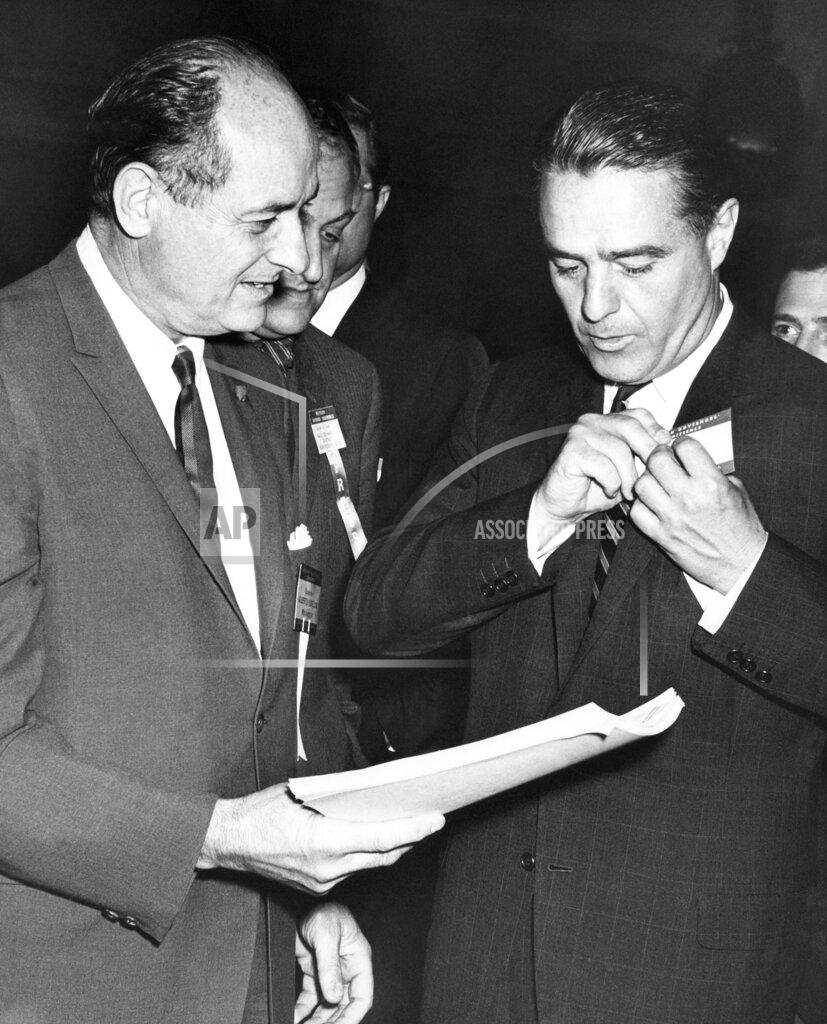
Christian A. Herter, speaking for the United States, complained today at the opening ceremonies of the Kennedy round of tariff negotiations that there had been too much procrastination and too little progress in the preparatory talks to date. A few minutes later, a spokesman for the European Common Market, Jean Rey of the trade bloc’s Executive Commission, indicated that the decisions the United States and other countries wanted would not be forthcoming soon. France was the conspicuously reluctant partner. In the public meeting France’s delegation was present but did not speak. Most other major countries made statements. In a private meeting of the Common Market’s six member countries — West Germany, France, Italy, Belgium, the Netherlands and Luxembourg — France dissented from a proposed declaration of some basic negotiating ground rules that most other countries had accepted.
The Gandak River Irrigation and Power Project was inaugurated in Nepal by Nepal’s King Mahendra Bir Bikram Shah and India’s Prime Minister Jawaharlal Nehru, four years after the two nations had agreed to the construction of a barrage to dam the river to provide electrification of the area.
The Soviet Government today closed the Moscow bureau of Time and asked the magazine’s correspondent to leave the country within “a few days.” Israel Shenker, the corresponded, was summoned to the Ministry of Foreign Affairs. Leonid M. Zamyatin, chief of the Ministry’s press department, then read a statement accusing Time of printing a “vicious anti‐Soviet article containing slanders” in its April 24 issue, which had a picture of Lenin on the cover.
Officials of the Justice Department and Senate leaders will begin a series of talks tomorrow aimed at achieving a “package deal” on the amendments to the civil rights bill offered by Senator Everett McKinley Dirksen, the Republican leader. Eleven amendments to Title VII, dealing with job discrimination, and probably no more than one or two to Title II, dealing with discrimination in public accommodations, will be involved. Mr. Dirksen submitted his amendments to the section on fair employment opportunity nearly three weeks ago. But he has held back his amendment to the section banning discrimination in hotels, motels, restaurants, theaters, sports arenas and gasoline stations. As the Republican leader, Mr. Dirksen plays a crucial, and perhaps the commanding, role in the struggle to get Senate approval of the bill passed by the House on Feb. 10.
The bipartisan civil rights coalition has the votes to pass the bill. But to bring the bill to a final vote, the coalition leaders must have the votes — two‐thirds of the members present and voting — to shut off the Southern filibuster. From 22 to 25 Republican votes will be necessary to impose closure. Mr. Dirksen’s amendments have been framed to induce about seven Republicans to vote for closure. Inevitably some of the amendments weaken the bill. For example, one amendment to the fair employment section would give a state agency jurisdiction in a job discrimination case for 90 days before the Federal commission could take it over. It would further require that the aggrieved person file suit on his own after the commission had failed to secure voluntary compliance with its orders. The House bill would allow the commission to file suit.
Roy Wilkins warned yesterday that the failure of Congress to enact a “satisfactory” civil rights bill would drive cautious and conservative Blacks into groups led by radical and militant leaders. In an interview, Mr. Wilkins, the executive secretary of the National Association for the Advancement of Colored People, said that the Black was essentially conservative and cautious. Further, he said, the Black is willing to work through traditional American processes to achieve equality. But these qualities, and attitudes, as well as the ability of leaders such as himself to survive, would be challenged if Congress failed to pass a satisfactory bill, he declared. Mr. Wilkins emphasized that the fate of the bill would decide whether Blacks, no matter what their grievances, would be able “to hold on a little bit longer,” or whether they would lose faith in traditional techniques.
The Supreme Court left standing today a decision that school boards have no constitutional duty to end racial imbalance resulting from housing patterns. The action was a major setback for civil rights forces attacking what they call de facto segregation in Northern cities. This is the situation in which neighborhood public schools are all, or predominantly, Black or white. The Supreme Court did not itself pass on the merits of the problem today. It simply declined, in a brief and unexplained order, to review the lower court ruling. Nevertheless, those who oppose moving pupils by bus to end racial imbalance will doubtless take comfort from the Supreme Court’s refusal to consider the contention that such action is constitutionally required. The case came from Gary, Indiana. According to the Black plaintiffs, 97 percent of that city’s Black public‐school pupils are in predominantly Black schools.
The Court of Appeals for the Seventh Circuit, in deciding the case last October, found that the school imbalance did not result from any official policy. The court said that school districts had been drawn originally on non‐racial lines and that their racial characteristics had changed with population shifts. In taking the case to the Supreme Court, the complainants did not challenge these findings They did not argue that the Gary school board had deliberately caused the racial division of its schools. The argument was, rather that it is unconstitutional for a school board to “acquiesce” in such de facto segregation. The petition to the Supreme Court suggested that the Constitution’s bar against racial discrimination required the school board to take affirmative action. Such affirmative action could presumably be a redrawing of school zones to improve racial imbalance. It could be forced busing of pupils to distant schools. It could be pairing of schools, the so‐called Princeton plan.
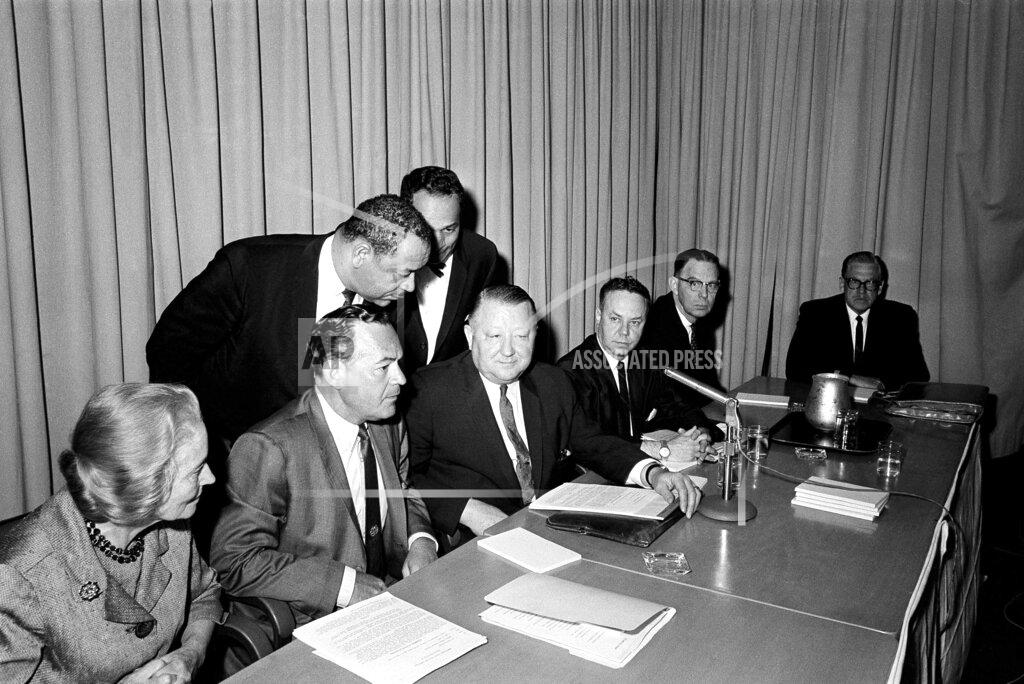
A meeting called by the New York City Commission on Human Rights in an attempt to settle a plumbers’ dispute in the Bronx ended in failure yesterday after tumultuous arguing. The principals at the meeting, which was marked by repeated table‐banging and by shouting, expressed doubt about the chances of reaching agreement. The meeting was held as union plumbers, for the third straight working day, refused to work with four nonunion plumbers — three Puerto Ricans and a Black — who had been hired by the contractor to work on the New York City Terminal Market. After the meeting, which was held at the commission’s headquarters at 80 Lafayette Street, the chairman, Stanley H. Lowell, said: “We met for nearly four hours. We are all tired. I am not optimistic. I had no success.”
The House approved without dissent today a tough bill to stop invasions of United States fishing waters by foreign trawler fleets. The principal offenders have been Russians, Cubans and Japanese. The legislation would impose a maximum sentence for violations of a $10,000 fine, a year’s imprisonment, or both, and would permit the vessels and their hauls to be seized. Under present law, the Coast Guard may only order offending vessels beyond the three‐mile limit and, if necessary, escort them to international waters. Protests have come from East and West Coasts that this has not prevented a steady growth of poaching.
A group of Republicans professing coolness toward both Senator Barry Goldwater and Governor Rockefeller announced today the formation of an organization to support other possible Presidential nominees in California’s primary June 2. The organization, calling itself “The Committee of Responsible Republicans,” includes several members of the party’s state and county central committees. It will exhort Republicans to vote for the Rockefeller slate of delegates, which is the only alternative to the Goldwater slate on the ballot. Write‐in votes are not permitted in California.
The U.S. House of Representatives passed a resolution, by voice vote, recognizing that bourbon whiskey was a “distinctive product of the United States” and asking that U.S. government agencies “take appropriate action to prohibit the importation into the United States of whiskey designated as bourbon whiskey”. The measure, “an expression of congressional sentiment” rather than a law, had passed the U.S. Senate in September, and noted that Scotland, Canada and France prohibited the importation, respectively, of scotch, Canadian whisky and cognac.
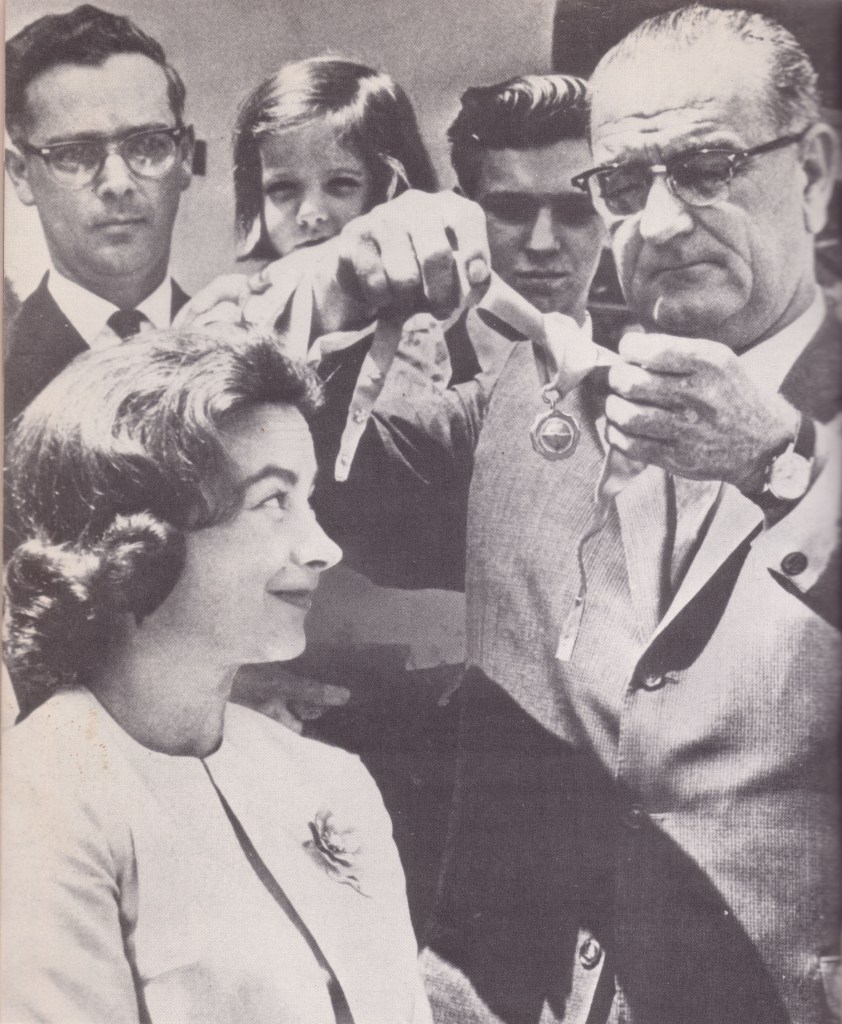
President Johnson held his beagle puppies erect by their ears today to have their pictures taken — and, incidentally, to show any doubters that the beagles do not object. “Now, don’t yelp,” Mr. Johnson said to one of the two dogs, Him and Her, as he gently lifted it by the shoulders to a sitting‐up position. Once the puppy was sitting up straight enough to suit him, the President put his hands to the ears and held the dog erect on its hind legs while photographs were taken. The puppy seemed to enjoy the whole procedure. Mr. Johnson told reporters again — as he had on Saturday — that handling them by the ears was not painful, and that any resultant yelps were yelps of joy.
Pulitzer prize awarded to Richard Hofstadter (“Anti-intellectualism”).
Soap opera “Another World” premieres on NBC TV in the United States.
Leon Wagner has 5 RBIs and breaks a 3–3 tie in the 7th with a grand slam as the Indians trip the host Red Sox, 7–5. Rookie Bill Spanswick allows all the Tribes’ runs.
Bob Allison hits 2 homers and drives in 5 runs but that’s it for the Twins scoring as they lose to the host White Sox, 10–5.
Dow Jones Industrial Average: 823.83 (+6.73).
Born:
Goran Prpić, Croatian tennis player (Hopman Cup Yugoslavia 1991 [with Monica Seles]), in Zagreb, Croatia, Yugoslavia.
Kevin Meuth, NFL tackle (New York Giants), in Richmond, Texas.


 History Diaries