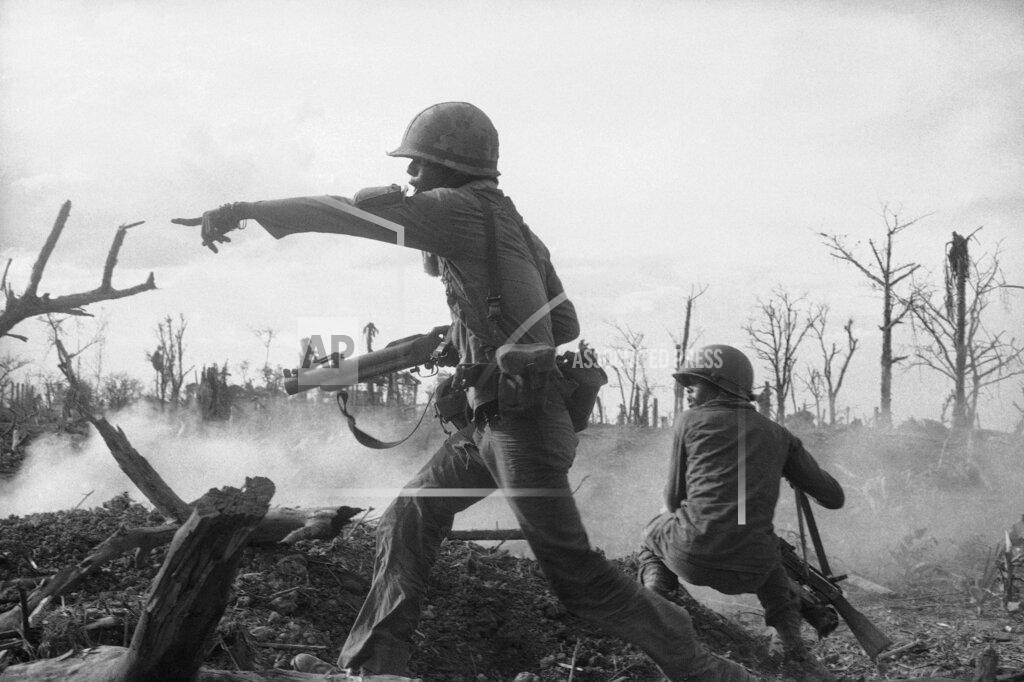
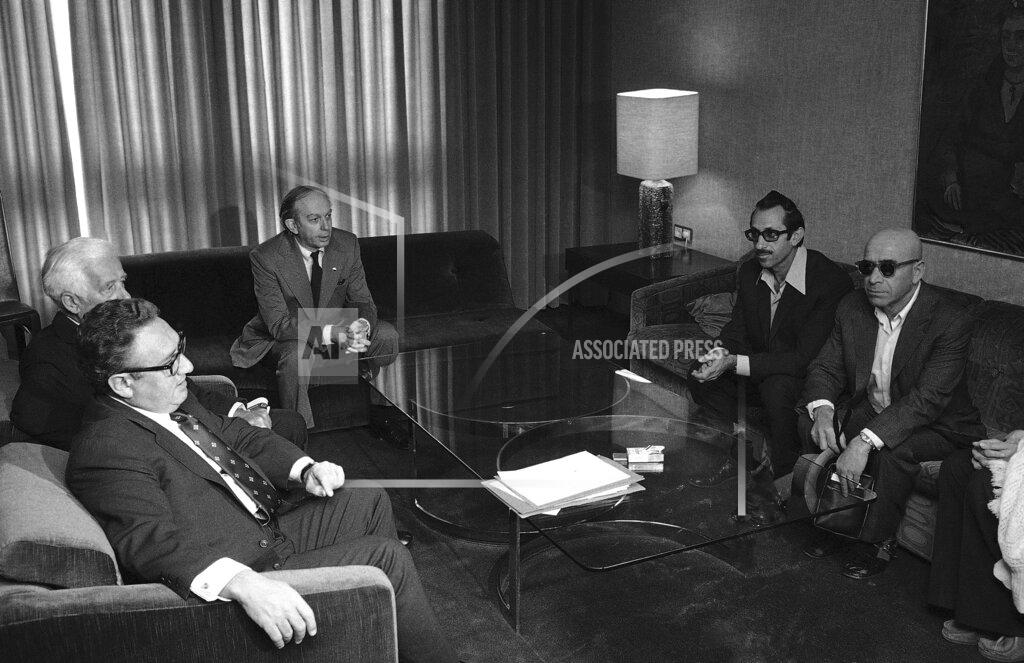
The United States said that Secretary of State Kissinger and President Hafez al-Assad of Syria had made “some progress” toward a troop separation agreement between Israel and Syria on the Golan Heights. Apparently, no specific agreements were reached on any of the outstanding issues, and the thorny question of where to put the line separating the Israeli and Syrian forces was put off until Monday or Tuesday when Mr. Kissinger will again be in Damascus.
Because of rumored threats against Secretary of State Kissinger’s life, American security officials have flown two bulletproof limousines from Washington to him in the Middle East. One of the vehicles was seen in Israel yesterday. It picked Mr. Kissinger up at the Tel Aviv airport, drove him to Jerusalem and on his business calls in Jerusalem, then took him to the airport this morning. He was met by a similar limousine at the Damascus airport. The limousines are driven by American Secret Service agents. There have been unverified reports that assassination groups are seeking to attack Mr. Kissinger in order to cut short his peace efforts. In Damascus today security personnel, most of them in civilian clothes, stood every 10 yards on the highway into the city armed with Soviet-made submachine guns.
Israeli planes and artillery attacked Lebanese territory below this long mountain ridge again today. The Israelis described their targets as Syrian troops and Palestinian guerrillas using Lebanon as a bane in a “war of attrition” on Israel’s northern borders. The “mini war,” as a senior Israeli military source called it earlier this week, or a “war of attrition,” begun by Syria has now continued for 52 days, causing the death of about 30 Israeli soldiers and the wounding of many more. The shooting and deaths are in an area where Israeli leaders are probably willing to yield considerable territory in a settlement.
Israeli warplanes attacked southern Lebanon today, wounding two Palestinian commandos, according to witnesses in the area. A Lebanese Defense Ministry communiqué said last night that four commandos and a civilian were wounded yesterday when Lebanese border areas, came under Israeli shelling and air raids.
At a time when major emphasis is being placed on postwar reconstruction in North Vietnam, the Vietnamese Communists appear to be following a mixed long‐range strategy in the rest of Indochina that assumes time is on their side. Diplomats and officials in the three other nations of Indochina — Cambodia, Laos and South Vietnam — are in general agreement that the North Vietnamese and their Việt Cộng allies are unlikely to make any dramatic initiatives in the near future. In Cambodia, where the civil war is entering its fifth year, the Vietnamese Communists play only a supporting role behind the local insurgents, according to Western analysts.
“They’re still helping them fire their captured 105‐mm guns, and even some of their rockets and mortars,” said one well informed diplomat who specializes in military matters. But he said that the advisers were now “mostly Việt Cộng, not North Vietnamese.” There are estimated to be 20,000 to 25,000 North Vietnamese troops in Cambodia, mostly hugging the border with South Vietnam. As they have for some time, the Communist‐led insurgents called the Khmer Rouge have kept the battle‐weary Phnom Penh army on the defensive for most of the 1974 dry season, which is just ending. “The North Vietnamese have got no‐lose situation,” said one American analyst. “The Khmer Rouge are certainly not going to do worse next year.”
In the meantime, the North Vietnamese conserve their infiltration routes and staging areas in eastern Cambodia. Some analysts in Phnom Penh argue that the North Vietnamese prefer the unsettled present situation to a Khmer Rouge victory, which might oblige them to divert scarce resources to feed large urban centers such as Phnom Penh. Moreover, it is argued, the collapse of the Lon Nol Government could rekindle the Indochina issue in the United States and somehow spark an unwelcome confrontation between Hanoi and Washington.
But other informants report that the North Vietnamese have kept up their shipments of arms to the Khmer Rouge, even though they have not furnished any new weapons that would give the insurgents a qualitative edge in the fighting. The last two months, one source said, have seen particularly heavy deliveries, which may have been in return for Cambodian rice supplied to North Vietnamese troops on the South Vietnamese border. Intelligence sources report continued flare‐ups, at a low level, between North Vietnamese and Khmer Rouge units, which seem to be sparked by traditional animosities and shortages of rice. In Laos, the North Vietnamese appear satisfied with the formation last month of a coalition Government by the American‐backed Vientiane side and the Communist‐directed Pathet Lao. The coalition permits the better‐organized Pathet Lao to pursue the all‐important “political struggle” without bothering North Vietnamese interests in South Vietnam.
The month‐old coalition Government of Laos decided today against convening the National Assembly, “due to present political circumstances.” The step was reportedly taken at the insistence of pro‐Communist ministers in the coalition. The decision, which effectively closed the 60-member assembly, drew complaints from many legislators. “This is a silent revolution against us,” said one. The assembly, which makes the final decision on the annual budget and all international agreements, was due to be opened by King Savang Vatthana May 11, designated as Constitution Day. A Government spokesman, Ouday Souvannavong, said that the Cabinet had debated for an hour before deciding not to reopen the assembly. About 40 deputies met this afternoon to discuss the matter, and one remarked: “This is typical of the Pathet Lao.” That is the pro‐Communist faction that agreed last month to form a coalition government with Laotian neutralists and members of the former Vientiane Government.
The sensitive issue of foreign troops on Laotian soil is emerging as a major problem for the three‐week‐old coalition Government here. Under the terms of the agreement that created the Government from the factions of rightists, neutralists and the Communist‐led Pathet Lao, all foreign troops illegally stationed in Laos are to leave by June 4. The Premier, Prince Souvanna Phouma, a neutralist, has said repeatedly that the departure must take place. One of the ranking Pathet Lao leaders, Foreign Minister Phoumi Vongvichit, has expressed doubt that American military advisers will leave when they are supposed to. Rightist and neutralist leaders in the Government say privately that they doubt that the 55,000 North Vietnamese troops believed to be in Laos will leave in the foreseeable future. The leftists say that anti-Communist Thai troops stationed here have not left yet. And there is the problem of 20,000 Chinese road‐builders and troops who have been in northern Laos for about 10 years.
A leading Soviet commentator charged today that a “well-orchestrated campaign” was being waged in the West against better relations with the Soviet Union, including the plans for President Nixon’s visit here next month. The assertion, made by Yuri Zhukov in the Communist party newspaper Pravda, generally followed: the line increasingly taken by the Soviet press that Moscow has been struggling to relax international tensions in the face of stiffening resistance from various Western opponents. However, some Western diplomats here sense that the argument has been sharpened by the veiled implication that a sinister conspiracy was under way to sabotage reconciliation between the Soviet Union and the West, particularly the United States.
The diplomats suggested that Moscow might be trying to prepare further justification at home and abroad for any backlash caused by soviet intransigence on the issue of human contacts, currently being negotiated at the European security talks in Geneva. The Russians have resisted calls for a freer exchange of people and ideas, advanced by European participants at the 35‐nation conference, on the grounds that they constitute attempts to interfere in the internal affairs of the Communist bloc.
About 5,000 people in a carnival atmosphere filled a soccer field in Lourenco Marques, the capital of Mozambique, a Portuguese territory, to watch an event that would have been unthinkable before the military coup in Portugal. “Long live liberty!” shouted a speaker. “Frelimo! Frelimo!” retorted a cluster of hecklers in the crowd. Frelimo is the Front for the Liberation of Mozambique, and anyone shouting his support for it or for liberty before the coup in Lisbon would have been taken into custody by the secret police. Troops of the front, directed from their bases in Tanzania, continued their war with the Portuguese army.
President Nixon has ordered the United States Embassy in Bonn, West Germany to provide a “full report” on what Atlantic alliance secrets may have been passed on to East Germany by the official on Chancellor Willy Brandt’s staff who confessed last week to being a spy, according to American and German officials. Mr. Nixon ordered the report as soon as the spy’s existence became known, according to a diplomatic source. The spy, Günter Guillaume, was on the Chancellor’s staff from early 1970 until April 24, when he was arrested and confessed, He had a top security clearance and his responsibilities were in the area of domestic political affairs.
An unsigned letter threatening the destruction of 19 stolen Irish art masterpieces valued at $19.2‐million was received in Dublin today. It said the paintings, stolen from a home last Friday, could be saved only if $1.2‐million in ransom is paid and four convicted terrorists jailed in England are transferred to prison in Northern Ireland. The deadline, the letter said, is May 14. The police here expressed belief that the letter, hand printed on a single sheet of lined paper, came from people responsible for the thefts. According to the police, the letter was accompanied by three pages from the diary of the owner of the masterpieces, Sir Alfred Beit. The diary was taken by the five‐member gang that stole the paintings.
Authorities in New Delhi, trying to block a nationwide railroad strike threatened for Wednesday, intensified their roundup of union leaders and militant workers. The arrests were protested by scattered strikes during the day. Union leaders who have not been arrested called for stepped-up preparations for the strike.
Colombian serial rapist Daniel Camargo Barbosa was arrested in Barranquilla for his first of at least 72 murders.
Politicians in both parties say they see a deepening crisis for the Republicans in President Nixon’s Watergate transcripts. The problem, they say, is more in the tone than the technicalities of what went on in the White House, and campaign veterans are raising questions about the Republican party’s future. For several days Washington has been too busy reading the transcripts to react to them. But, politicians say, as they get deeper into the more than 1,200 pages of Mr. Nixon’s intimate conversations with his aides, the picture of the President’s outlook begins to outweigh even the question of whether he did anything wrong.
A number of officials close to the Watergate inquiry have concluded, on the basis of careful review of the edited White House transcripts, that John Dean testified with credibility and lucidity last summer about his conversations with President Nixon. They are also known to believe that Mr. Dean’s testimony before the Senate Watergate committee was more accurate than the President was in subsequent public accounts of their conversations.
The General Accounting Office said it was forwarding to the Justice Department a possible conflict of interest case involving Robert Bowen, an executive of the Phillips Petroleum Corporation, who is on leave working for the Federal Energy Office. The G.A.O. said Mr. Bowen’s duties, including his involvement in commenting on Energy Office policies, “may possibly be in violation” of criminal statutes governing conflict of interest.
The nation’s unemployment rate declined slightly in April to 5 percent of the labor force, while one measure of total employment — employer payroll reports — showed a rise of slightly more than 100,000 jobs to a record of 76.9 million. Economists in and out of government still expect some rise in joblessness later this year, but fears of extensive unemployment because of the energy shortage or other factors have receded.
Three suspects in a series of 12 random “Zebra” murders in San Francisco were arraigned there in Superior Court. Four others were released for lack of evidence. The seven men were arrested Wednesday after the lawyer for an unidentified informant gave information to Mayor Joseph Alioto that led to their arrest. The three who were arraigned were Manuel Moore, 29 years old, charged with murder and conspiracy to commit murder; Larry C. Green, 22, murder, conspiracy to commit murder, kidnapping, robbery, and two counts of assault with a deadly weapon; and J. C. Simon, 29, two counts of murder, conspiracy to commit murder, one count of assault with a deadly weapon, and one of robbery.
A mid‐city hideout believed to have been used by the kidnappers of Patricia Hearst was discovered by the authorities in San Francisco last night, but it had been abandoned. Apparently, the hideout, an apartment at 1827 Golden Gate Avenue in a racially mixed neighborhood, was used by the kidnappers as recently as a week ago. There were reports that one of those living in the apartment had been identified as Donald C. DeFreeze, the spokesman who calls himself General Field Marshal Cinque of the self‐styled Symbionese Liberation Army. It was not known how many members of the group had used the apartment and there was no immediate information whether Miss Hearst had been seen in the building.
The discovery of the apparent hideout in the heart of the city was viewed here as only mildly surprising. The group came to the attention of law enforcement officials by announcing in a letter to the news media that it had been responsible for the killing of Dr. Marcus A. Foster, a black man who was superintendent of Oakland’s public schools. It was later found that members of the group had used a hideout within two blocks of the school district’s headquarters, where the killing took place. Two weeks ago, when there was speculation that the group was hiding out in the Berkeley area, the F.B.I. tended to disagree. “They might be right here in San Francisco,” said Mr. Bates, the agent in charge.
Federal agents say they have uncovered evidence of an extensive, systematic air-travel kickback scheme in which millions of dollars in illegal rebates have been secretly funneled by airlines to travel agents. A federal grand jury has heard testimony in recent weeks that major airlines — including Pan American, Trans World and many foreign lines — have for years been paying illegal, under-the-counter rebates to high-volume travel agents, which rarely were reflected in lower fares.
A United Airlines strike was averted 10 hours before the deadline yesterday when the company reached a tentative pact with the International Association of Machinists. The agreement would grant periodic base‐pay increases to a maximum of 16.8 percent over the 26‐month life of the contract, from last September 1 to October 31, 1975. The figure includes two cost‐of‐living increases of up to 10 cents an hour each, depending on changes in the Consumer Price Index.
Federal agencies have ordered the sale of unleaded gasoline expanded and have announced that gasoline is expected to be more plentiful by June 1 than It is today. The Environmental Protection Agency yesterday ordered 111,000 service stations across the country to begin selling least one grade of unleaded gasoline by July 1. Meanwhile, the Federal Energy Office said that gasoline would be more plentiful effective June 1. In announcing its order on unleaded gasoline, E.P.A, said that 60 to 85 percent of the 1975 model cars coming out this fall would be equipped with catalytic converters, which clean engine exhausts but can be damaged by leaded gasoline.
The Federal Energy Office has moved to make its petroleum allocation regulations more flexible as shortages diminish. Beginning June 1, the F.E.O. announced, states will be permitted to distribute fuel reserves, known as “set‐asides,” to local areas with shortages Previously, the special stockpile was available only to hardship cases. In addition, the agency said, increased allocations of certain types of fuel will be made if surplus fuel is available after original allocations are filled. The products involved in the revision are aviation fuel, propane, residual fuel oil and middle distillate fuels such as diesel, kerosene and home heating oil.
The Houston Astros get an assist from part of the Astrodome crowd as they drop the Cardinals, 4–1. Two female fans run nude through the outfield during the seventh-inning stretch. The distracted Cards give up three runs in the bottom half of the frame. A two-run single by Doug Rader is the key hit. Claude Osteen goes the distance.
Dow Jones Industrial Average: 845.90 (-5.16, -0.61%).
Born:
Princess Haya bint Hussein of Jordan, Olympic equestrian, daughter of King Hussein and his third wife, Queen Alia; in Amman, Amman Governorate, Jordan.
Jukka Hentunen, Finnish National Team and NHL right wing (Olympics, Team Finland, silver medal, 2006; Calgary Flames, Nashville Predators), in Joroinen, Finland.
Dwayne Morgan, NFL tackle (Atlanta Falcons), in Griffin, Georgia.
Joseph Kosinski, American computer-generated imagery (CGI) expert and film director (“Tron: Legacy”) in Marshalltown, Iowa.
Died:
Helen Hemingway Benton, 72, owner and publisher of Encyclopædia Britannica, widow of U.S. Senator William Benton.






 History Diaries