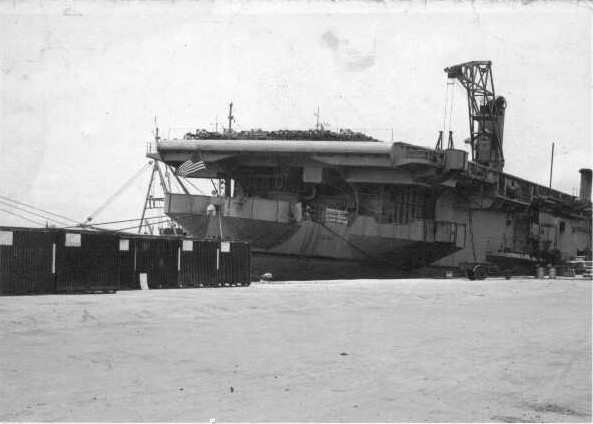
An explosion of a charge assumed to have been placed by Việt Cộng terrorists sinks the USNS Card (T-AKV-40; formerly CVE-11) at its dock in Saigon; no one is injured (and the ship will be raised and repaired). The Card, a World War II escort carrier being used as an aircraft and helicopter ferry, arrived in Saigon with its load on 30 April. A North Vietnamese frogman sank the U.S. Navy aviation transport USNS Card after it had taken on a cargo of helicopters at Saigon. At about 5:00 in the morning, a hole was blown in the Card below the waterline, and the ship began sinking, eventually reaching the bottom of the 48-foot-deep Saigon River. The flight deck and superstructure remained above the surface, and all 73 men on board were able to escape uninjured. The ship was soon refloated and repaired.
Captain Borge Langeland, 55‐year‐old civilian skipper, of New Orleans, said the full extent of the damage to the Card, or the size of the hole, had not been determined “but the hole must be very big and it probably will be many weeks before the Card can leave Saigon for the United States.” “The explosion hammered through the ship, jarring engine room attendants,” Captain Langeland reported. “The ship began to take water immediately, forcing several crewmen to hurriedly evacuate their quarters. The crew immediately closed off the lower compartments.” Second Mate Raymond Arbon, 45, also of New Orleans, who was on watch at the time of the explosion, was knocked down but unhurt. Pieces of the ship’s steel railing and planks from the pier to which she had been moored were scattered across the wharf and the Card’s steel superstructure was bent by the blast. The Card, built in 1942, is now under charter to the United States Military Transport Service, and manned by an all‐civilian crew. She has made several trips to Saigon in the last year, carrying helicopters, planes and vehicles.
First Lieutenant Ronald Hines of Middletown, New Jersey, died last Sunday trying to save the life of a wounded Vietnamese Army captain. Lieutenant Hines and a Captain Pam served together during the eight months the lieutenant had been in Vietnam. He was the captain’s United States military adviser. Captain Pam, wounded in the knee by a Communist guerrilla’s bullet, survived. Lieutenant Hines, who had dragged him into a foxhole and then helped carry him back to their armored personnel carrier under fire, was fatally wounded in the chest a yard from the carrier. The 25‐year‐old American was posthumously awarded the Vietnamese Cross of Gallantry with palm cluster and the National Order, the highest Vietnamese decoration for valor. He has also been recommended for a silver star. He is survived by his wife and two small children.
Hundreds of United States servicemen sleep under mosquito nets every night at outposts across South Vietnam, sometimes in dugouts built up with sandbags, sometimes in backrooms of crumbling houses that may double as district or battalion headquarters, sometimes under the open sky during military patrols. Some Americans, those away from a big headquarters, cook their own meals of canned goods over small stoves. American helicopter pilots preparing to lift Vietnamese troops into rice paddies of the Mekong Delta can turn their radios to the Armed Forces Radio network and hear the same breakfast programs that housewives listen to at home. When Americans get sick there are American helicopters to evacuate them to American field hospitals. An American post office brings them letters from home. American military telephone operators switch their calls to American installations in opposite corners of the country.
The United States has established what amounts to an expeditionary force in South Vietnam with all the command links, support units and facilities associated with an army overseas. It is unlike any other expeditionary force the United States has mounted. It is a force without fighting men. American troops pull triggers but do not engage in combat. For two years it has been a force with six major commands, which command nothing of the war to save South Vietnam from a Communist insurgency. It is a force marked by anomalies, ambiguities and frustrations. It is the proving ground for the next generation of leaders of the American defense establishment.
Prince Souvanna Phouma, the neutralist Premier, said today that the neutralist and rightwing factions of his coalition Government had merged. He said at a news conference that he had become leader of the two parties. He expressed hope that the third faction in the coalition — the pro‐Communists — would join in the merger. Prince Souvanna Phouma also said he was assuming direction of all military affairs in Laos. He made the announcement on the eve of his departure for Khang Khay in the Plaine des Jarres area, headquarters of the Pathet Lao, which is the military arm of the pro‐Communist Neo Lao Hak Xat. He will confer tomorrow with his half-brother, Prince Souphanouvong, leader of the Pathet Lao. The head of the shaky coalition regime said that as Minister of Defense as well as Premier, “I will effectively direct all military affairs.”
There was no word from General Phoumi Nosavan, a Deputy Premier and right‐wing leader. Earlier proclamations of unity have not been followed by concrete actions. Prince Souvanna Phouma said he had not been able to perform his defense duties before because the right‐wing military faction that staged the coup here two weeks ago had maintained control of the army. He said reforms would be instituted in the armed forces to return them to the situation prior to a coup staged by General Kong Le, a neutralist, in August. 1960. The promise of reforms produced speculation that rightwing and neutralist armed forces would be merged. The prior coup was staged by General Kong Le, a neutralist, in August, 1960. That coup led to the ouster of Premier Tiao Somsanith. “The group we used to call the ‘Savannakhet group’ [right wing] has disappeared,” the prince said. “I am speaking in the name of the center [neutralist] and right wing.”
He addressed an appeal to the Pathet Lao to cease all military activity to create a better atmosphere for the meeting with Prince Souphanaouvong tomorrow. “I will ask them to help me by softening their position so that I can solve the Laotian crisis which has lasted very long,” he said. Fighting between the Pathet Lao and right‐wing troops flared on the Plaine des Jarres earlier in the week. Western sources say the Pathet Lao is backed by as many as 6,000 North Vietnamese regulars. Neutralist forces have been estimated at 8,000. Right‐wing troops total 50,000. But the right‐wing forces were spread thin guarding heavily populated areas near Thailand along the Mekong River. They also had 3,000 in Vientiane.
Greece and Turkey lodged protests against attacks by Greek and Turkish Cypriotes on each other at an extraordinary session of the North Atlantic Council today. The Council assembled at the request of Nuri Birgi, the Turkish Ambassador to the North Atlantic Treaty Organization, Mr. Birgi vehemently protested the latest Greek Cypriote attacks against the Turkish Cypriote population on the island. Christos Palamas, the Greek representative, issued an equally strong protest against Turkish Cypriote actions against Greek Cypriotes. He also asked the Council to delay a judgment until the directives outlined by the United Nations Secretary General, U Thant, to the Security Council could be implemented.
Mr. Thant, in a report filed Wednesday, called for a “top-level political officer” to negotiate measures to end the conflict on the island, which erupted in December over Greek Cypriote efforts to limit the Turkish Cypriotes’ constitutional right to veto legislation. He also advanced a plan calling for freedom of travel, removal of fortified positions, a return of Turkish Cypriotes to their normal positions in the police and other government services, disarming of civilians, a general amnesty and restoration of normal judiciary functions. Dr. Dirk U. Stikker, Secretary General of NATO, presided over the meeting of the Council. This is the highest civil authority in the 15‐nation alliance.
Mr. Palamas blamed Turkey’s “arbitrary actions” for a deterioration in relations between the two countries. Greece is determined. qualified sources said, to oppose action by the alliance as long as the Cyprus issue is before the United Nations. Neither delegation at the 90‐minute meeting showed any willingness to do more than expound its government’s position on Cyprus. There was, in the words of one participant, no room, or even encouragement, for negotiation. Dr. Stikker returned yesterday from visits to Ankara and Athens. Ostensibly the visit was to discuss defense problems of NATO’s southeastern flank and the agenda for the alliance’s ministerial meeting scheduled for The Hague May 12. Qualified sources reported, however, that Dr. Stikker had emphasized that other allies felt that Greece and Turkey should give the fullest support to United Nations mediation and should remember that their quarrel imperiled the west’s defense position in a vital strategic area. The Turkish Government, the sources said, told Dr. Stikker that it was dissatisfied with the partiality some of its allies appeared to be showing for the Greek Cypriote cause.
The reappearance of the Cyprus problem before the Council compounded the alliance’s mounting difficulties. Both Greece and Turkey have always upheld the American concept of military integration of command within the alliance. But the present crisis is driving the two countries apart. The Greeks now are hostile to combined‐command exercises or troop maneuvers in cooperation with Turkish forces. Both countries, moreover, are participating in talks on the establishment of a nuclear surface fleet manned by crews of mixed nationality. This force’s establishment would carry military integration into the area of nuclear arms and hence would bolster the United States against France’s campaign for national military independence. Should the split between Greece and Turkey widen, it is said, progress on the nuclear fleet is likely to be delayed and the French position will be strengthened.
A Turkish Cypriote bus was fired on by a gunman in a car outside Nicosia today. A Turkish Cypriote spokesman said tonight that a 65‐year‐old man was killed. Elsewhere in the capital the United States Ambassador‐designate to Cyprus, Taylor G. Belcher, ran into trouble at Turkish Cypriote roadblocks when he tried to drive his Greek Cypriote butler and cook through Nicosia’s Turkish quarter. A United States Embassy spokesman said that the Turkish Cypriotes did not want to allow Greek Cypriotes through territory they control, even in Mr. Belcher’s car. The cook and butler later reached their destination in northern Kyrenia where Mr. Belcher has a villa, by taking a roundabout route by bus.
Thousands of Czechoslovak students and youths clashed with hundreds of policemen on May Day in Prague, according to reports received here tonight. The demonstrators chanted “Long Live Freedom!” and “Down with the Gestapo!” according to witnesses. Ceteka, the official Czechoslovak press agency, said only that a number of “troublemakers” who tried to disturb yesterday’s celebration of the holiday had been arrested. The press agency denied that students had been involved. Two demonstrations were suppressed by the police. Independent reports said that 12 or 15 arrests were made in the disorders at a gathering of students and other youths for a poetry reading in Kinsky Park and in a demonstration later at Wenceslas Square in the heart of Prague. In both places they were reported manhandled by club-swinging policemen. Police dogs were reported to have been sent to Kinsky Park.
The reports gave this account of the incidents: The outburst started at the park when about 3,000 youths gathered in the evening near a monument to Karel Hynek Macha, the 19th‐century Czech poet. A similar poetry‐reading assembly at the monument was broken up last year. Between 300 and 400 plainclothes policemen infiltrated the gathering and uniformed policemen in great numbers were nearby. The assembly’s organizers apparently had been denounced to the authorities. At a signal, the police moved in to disperse the throng. They broke the crowd into small groups and urged them out of the park. Shouts of “Gestapo!” were heard, and pushing and shoving began on both sides. The policemen swung clubs and blackjacks. A general melee erupted. Dogs and searchlights were brought up, but it could not be verified that the dogs were actually used on the youths. No shots were fired.
Queen Elizabeth II and The Duke of Edinburgh’s seven-week-old son was christened Edward Antony Richard Louis – today he is The Earl of Wessex.
Senator Hubert H. Humphrey said today that civil rights forces would move before the ‘end of this month to shut off all debate on the bill now before the Senate. The Minnesotan, who is Democratic floor manager of the House‐approved measure, said he believed it would be necessary to invoke the Senate’s debate‐limiting closure rule. “Some Senators do not want to stay on this bill all summer,” he remarked. “We will get closure if we need it, and I think we will need it.” Mr. Humphrey discussed parliamentary strategy in an informal news conference as the Senate, in another Saturday session, completed eight weeks of debate on the measure.
On the floor, Mr. Humphrey challenged Southerners to let the bill come to a vote without closure, which requires a two-thirds majority of the members present and voting. Apparently with tongue in cheek, he said he might propose Monday that the Senate unanimously agree on a time limit for discussion of amendments and on a date for voting on passage. When reporters sought elaboration, he said he was merely trying to “needle” his Southern friends. However, he went on: “I would be more than willing at any time to enter into a reasonable agreement limiting debate on amendments and setting a date certain for a vote on passage. I would advance this very seriously as an open proposal to the opponents.”
Mr. Humphrey pointed out that, once closure was invoked, each Senator would be limited to an hour of talk. He said a “much more generous” arrangement could be made by unanimous consent if the Southerners would agree. The date for a final vote would be “negotiable” when such an arrangement was discussed, he said. “It might even be late June,” he said. “That’s O.K. with Humphrey. Or we would make Independence Day a meaningful national holiday by setting the vote for July 4th.”
The Southerners had no public comment, but it was clear from their private remarks that they were unlikely to enter into any such agreement, now or later. The first votes on amendments are expected next week under an informal agreement with the Southerners. Several versions of a proposal to require jury trials in criminal contempt‐of‐court cases arising from the bill’s enforcement provisions are expected to be disposed of. There is still no indication, however, when votes may come on numerous other pending or prospective amendments.
Senator Goldwater suggested tonight that racial equality in voting and in education were the only civil rights that could be pressed legislatively without engendering more outbursts of violence across the country. “We are going to see more violence in our streets before we see less,” he declared, unless a national Administration more moderate in the civil rights realm is installed. His words appeared to be a renewed overture for support from the Southern states — and like‐minded elements elsewhere — at the Republican National Convention July 13.
Asserting that he was simply applying “the Republican principle of getting things done at the local level before calling out the Federal programs, or the Federal troops,” Senator Goldwater continued: “Where are the states which today are witnessing the most violence? I sadly remind you that they are the very states where there is the most talk about brotherhood and the very least opportunity for achieving it. And there is above all the oldest law of all: You cannot pass a law that will make me like you or you like me. This is something that can happen only in our hearts.”
About 1,000 students participated in the first major student demonstration against the Vietnam War, marching in New York City as part of the “May 2nd Movement” that had been organized by students at Yale University. The rally was followed by a march to Times Square and the United Nations. On Broadway there were slight traffic delays as thousands of passersby stopped and stared at the demonstrators. There were no incidents. Marches also occurred in San Francisco, Boston, Seattle, and Madison, Wisconsin.
Senator Barry Goldwater received more than 75% of the vote in the Texas Republican Presidential referendum, “a nonbinding survey of voter sentiment.” Senator Barry Goldwater scored a sweeping victory last night over all opponents in the Texas Republican Presidential preference primary. In the Democratic gubernatorial primary contest, Governor John B. Connally Jr. triumphed over his liberal opponent for the nomination, Don Yarborough. Senator Ralph W. Yarborough, a liberal Democrat, won renomination, defeating Gordon McLendon, a conservative. Running second to Senator Goldwater was Ambassador Henry Cabot Lodge, who got his support entirely by write‐in votes. The Arizona Senator’s name was on the ballot, as were those of Governor Rockefeller of New York, Senator Margaret Chase Smith of Maine and Harold E. Stassen, former Minnesota Governor. Others who got write‐in votes were former Vice President Richard M. Nixon, Governor William W. Scranton of Pennsylvania and Governor George Romney of Michigan.
With only 10 weeks before the Republican National Convention, the most important man in the race is probably the one who has been in it longest and hardest and with the least success — Governor Rockefeller of New York. He is the most important man not because he is the favorite son or even has much chance to win. He is that because he still appears to be, just as he did on that November day when he announced his candidacy, the only candidate who can stop Senator Barry Goldwater of Arizona. Governor Rockefeller could do that, in the opinion of most political professionals, by defeating Senator Goldwater in the California primary one month from today. But he will have to come from behind to do it.
Victory for Senator Goldwater in California would deliver to him that state’s 86 delegates. Added to those he has and to the others he seems certain to win in various state conventions, the California delegates would give him a first-ballot strength that might well stampede the convention. A California victory also would help to remove from Senator Goldwater the stigma of the defeat he suffered at the hands of Henry Cabot Lodge in New Hampshire on March 10, of the one Mr. Lodge probably will hand him in the Oregon primary on May 15, and of the showing the Senator made in the Illinois primary on April 14. He. won in Illinois, but his victory was widely recorded as unimpressive. Those setbacks made it seem to some observers that Senator Goldwater’s candidacy had collapsed. But former Vice President Richard M. Nixon, the most professional of the Republican possibilities, pointed out this week that “the real ball game” was the delegate strength that Senator Goldwater has been amassing. So great is the Goldwater strength in local and state Republican organizations that he has gone on collecting delegates despite his setbacks, Mr. Nixon said.
The automobile industry this year is tooling up for one of its most significant model changes in history. Sources here report that the 1965 autos, scheduled to begin rolling off production lines this summer, will embody more basic styling changes than any since the 1955 model year. Public response to these new cars will determine whether the industry will be able next year to sustain its current record level of sales. And the magnitude of the costly model change may influence the outcome of the industry’s labor negotiations this summer. A production planner for a leading company said: “Everything seems to be getting the brush this year. This is the year of the big change.”
First ascent of Shishapangma the fourteenth highest mountain in the world and lowest of the Eight-thousanders.
The long running BBC television documentary series “Horizon” was broadcast for the first time, with the new BBC-2 network presenting “The World of Buckminster Fuller”.
Beatles’ “Beatles’ 2nd Album” goes #1 & stays #1 for 5 weeks.
West Ham United won the FA Cup for the first time in their history, beating Preston North End 3–2 at Wembley Stadium.
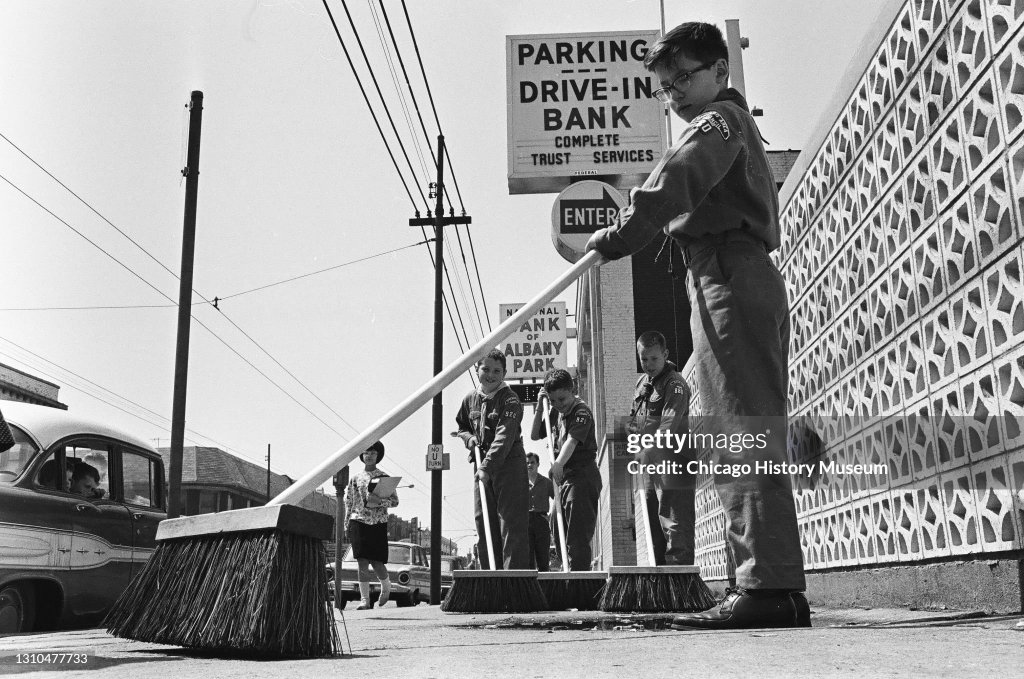
Forty-six teenagers were injured, one fatally, in an escalator accident at Baltimore’s Memorial Stadium, where they were given free admission to a baseball game between the Orioles and the Cleveland Indians. Ironically, the youngsters were among 20,000 who had been invited for “Safety Patrol Day”. Annette S. Costantini, 14, was at the front of the line and was crushed by the stampede that resulted when the top of the escalator was partially blocked by a wooden barricade.
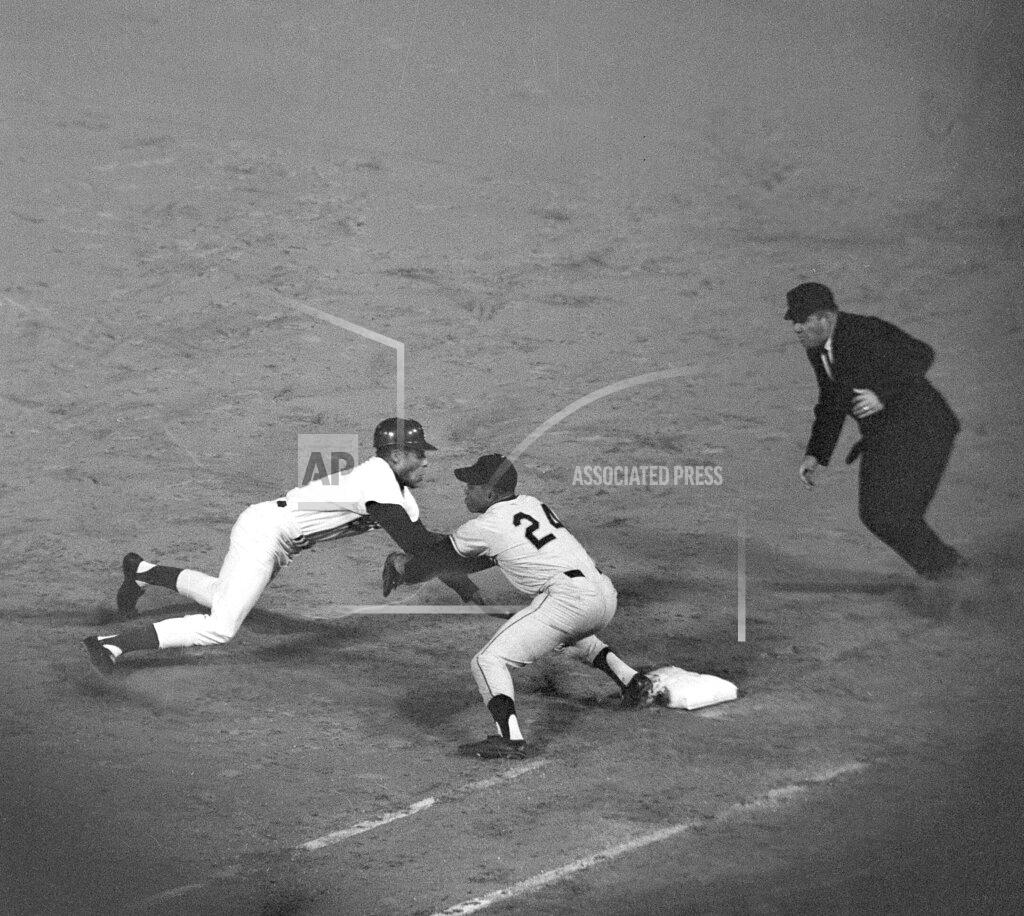
Minnesota becomes the 3rd club to hit 4 consecutive home runs in one inning. Tony Oliva, Bob Allison, Jimmie Hall, and Harmon Killebrew do the damage in an 11th-inning explosion that gives the visiting Twins a 7–3 win at Kansas City. The first three clouts are served up by Dan Pfister, and the last by Vern Handrahan. The Twins total 6 homers in the win.
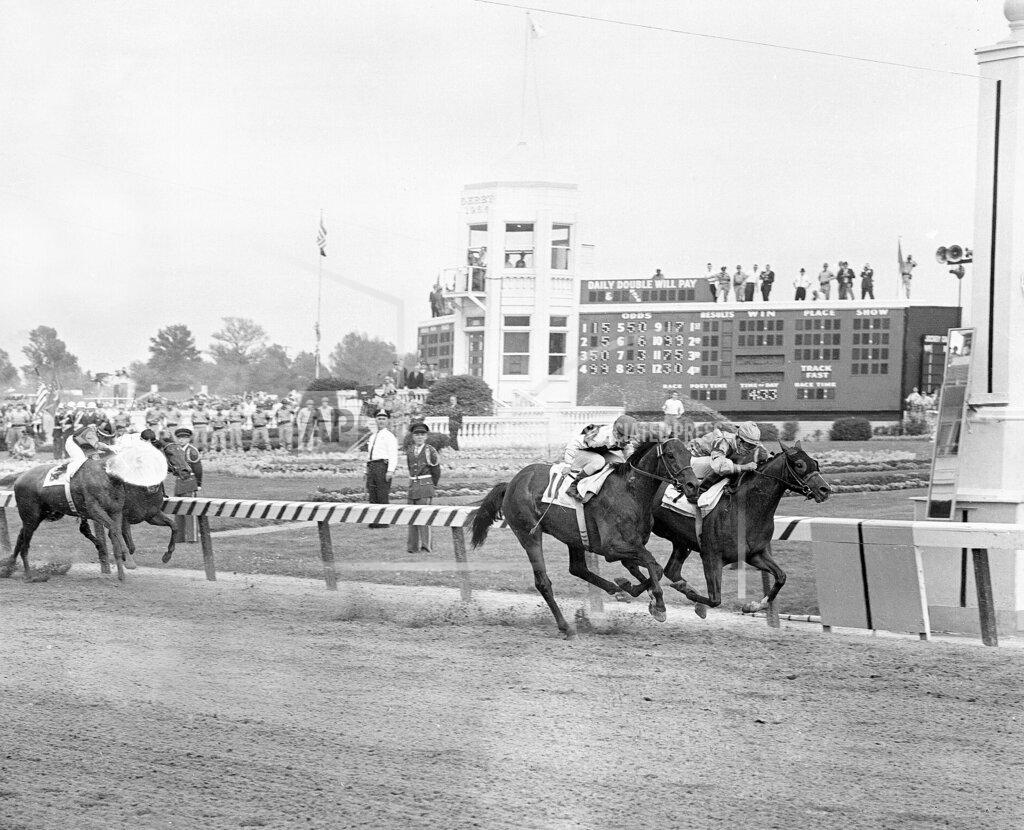
90th Kentucky Derby: Bill Hartack aboard Northern Dancer wins in 2:00.
Born:
Ron Burton, NFL linebacker (Dallas Cowboys, Phoenix Cardinals, Los Angeles Raiders), in Richmond, Virginia.
Died:
Henry Hezekiah Dee and Charles Eddie Moore, both 19, were hitchhiking in Meadville, Mississippi, when they were kidnapped, beaten and murdered by members of the Ku Klux Klan. Their badly decomposed bodies would be found by chance two months later in July, during the search for three missing civil rights workers (James Chaney, Andrew Goodman, and Michael Schwerner). More than 40 years would pass before James Ford Seale would successfully be prosecuted for the murders, and convicted in 2007 at the age of 72. Seale would die in prison in 2011.
Lady Nancy Astor, 84, American-born British politician who became the first woman to ever serve in the United Kingdom’s House of Commons. She was born as Nancy Witcher Langhorne near Danville, Virginia, in 1879, and served from 1919 to 1945.

 History Diaries