Administration officials said that the Soviet Union had begun negotiations on a treaty for a limited ban on underground nuclear testing — a project that has been sporadically discussed since 1958. Officials said it was hoped to have a treaty ready for signing during President Nixon’s planned visit to the Soviet Union, probably at the end of June. Meanwhile, a House Foreign Affairs subcommittee was told that Soviet delegates to an informal meeting in Helsinki had indicated a new flexibility in their country’s position on the issue of inspection, which has been blocking a proposed treaty banning production of chemical weapons.
The envisioned agreement on underground nuclear tests was described by one Administration official as “a threshold treaty, not a total ban.” He said that underground test explosions under a certain magnitude would probably continue after the limitation went into effect. The official added that the ban would not affect detonations designed for ostensibly peaceful purposes such as canal excavation or attempts to create underground chambers for storing natural gas. It was on August 5, 1963, that the Soviet Union and the United States agreed on a treaty outlawing nuclear tests, in the atmosphere, in space and under water. Since that time, the United States has conducted 255 underground tests, according to the official records of the Atomic Energy Commission.
Bitter artillery and tank‐gun duels erupted the length of the Israeli‐Syrian cease‐fire line today in a sudden increase of fighting that was apparently timed to the arrival in Israel of Secretary of State Kissinger. Israeli military sources said today that the Syrians had initiated the artillery exchanges, which were described as the heaviest and deepest‐striking since the war last October. In response, the Israelis used long‐range guns to shell two Syrian Army camps within 10 miles of Damascus.
Israeli fighter‐bombers also struck three times during the day at Syrian positions and reported Arab guerrilla concentrations on both, the Syrian and Lebanese slopes of Mount Hermon. Military sources here contend that Syrian observation posts have been established inside Lebanese territory and that the Syrians are actively being assisted by guerrilla units.
During the night, the Syrians carried out one of their boldest commando raids since the war. The small detachment penetrated behind Israeli lines near the disputed 9,200‐foot peak of Mount Hermon and ambushed a patrol of three Israeli tanks shortly after midnight. Opening fire with antitank weapons, the commandos hit at least one of the tanks and set it afire. One of the four Israeli crew members was listed in a communiqué as killed and the others as missing and presumed captured by the Syrians.
Although Israel had been prepared for an intensification of the fighting for Mr. Kissinger’s arrival, the action nonetheless caused concern in Jerusalem. The Israeli Cabinet convened in special session this morning to hear a report on the situation by Defense Minister Moshe Dayan and the Chief of Staff, Maj. Gen. Mordechai Gur. The meeting was still under way as Mr. Kissinger arrived in Jerusalem this morning to begin negotiations on separation of Israeli and Syrian forces.
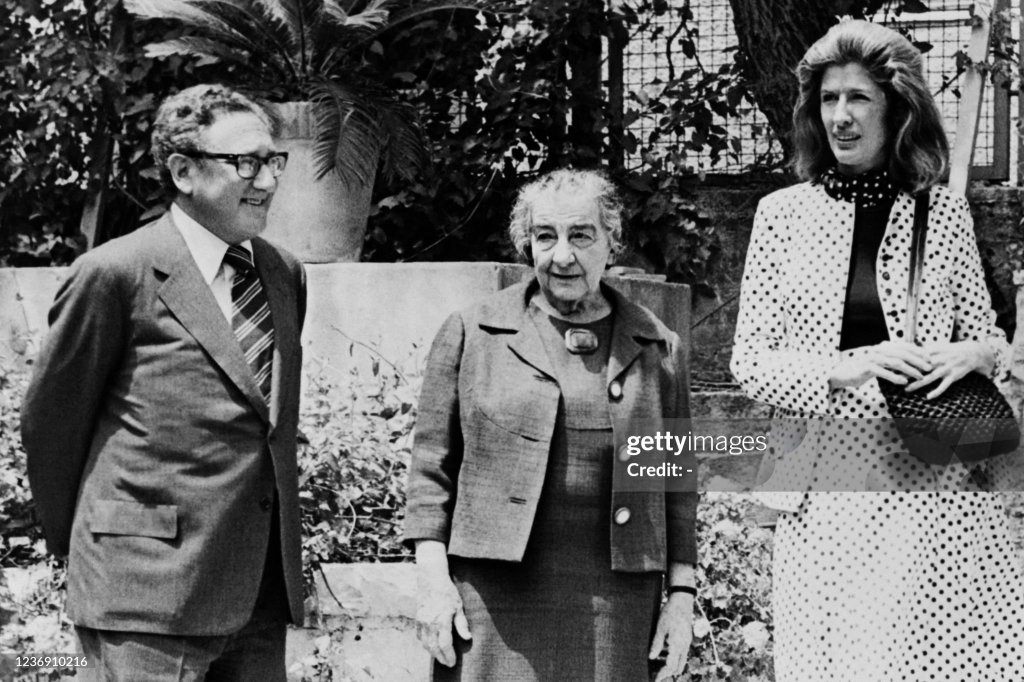
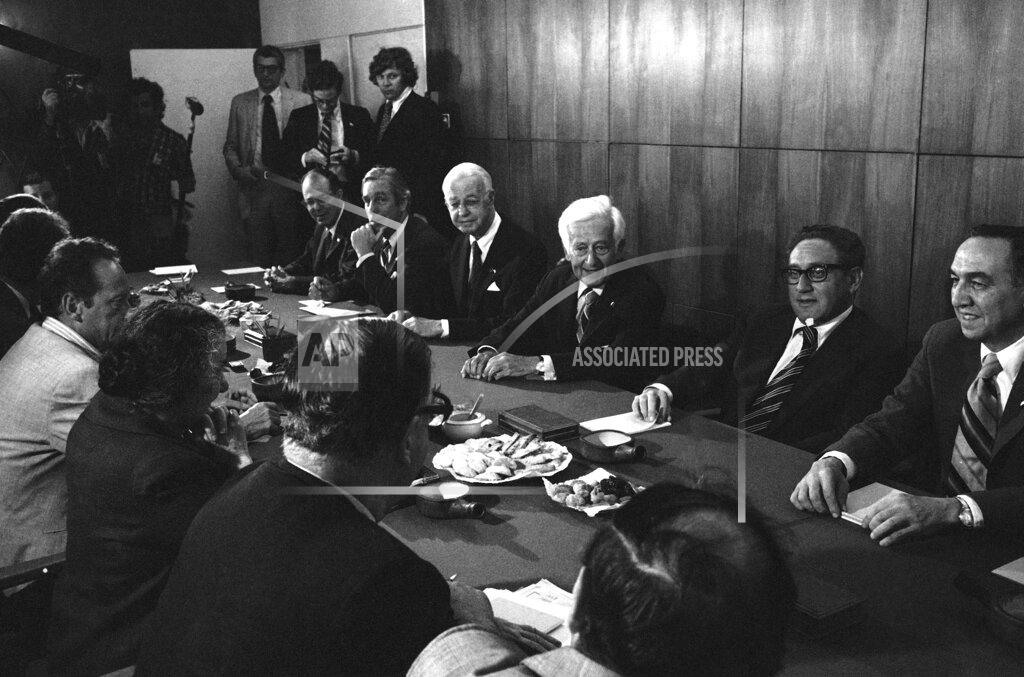
Secretary of State Kissinger met with Israeli leaders in Jerusalem for talks aimed at bringing about an Israeli-Syrian troop separation agreement. Mr. Kissinger, who will fly to Damascus tomorrow for talks with Syrian leaders, urged the Israelis to make the first moves toward a compromise on the issue, but they indicated they would not be rushed into changing their proposals, especially in light of the stepped-up fighting on the Golan Heights.
The Soviet Union demanded that China immediately return a helicopter and three-man crew that was forced to land six weeks ago or suffer “inevitable consequences of this provocative stand,” the news agency Tass said. Dep. Foreign Minister Leonid Ilyichov, head of the Soviet delegation at the suspended Sino-Soviet border talks, called in Chinese Ambassador Liu Hsing-chuan to deliver the protest, the agency said. Ilyichov reiterated the Soviet position that the helicopter was on a medical mercy mission when it lost its bearings because of the weather and ran out of fuel.
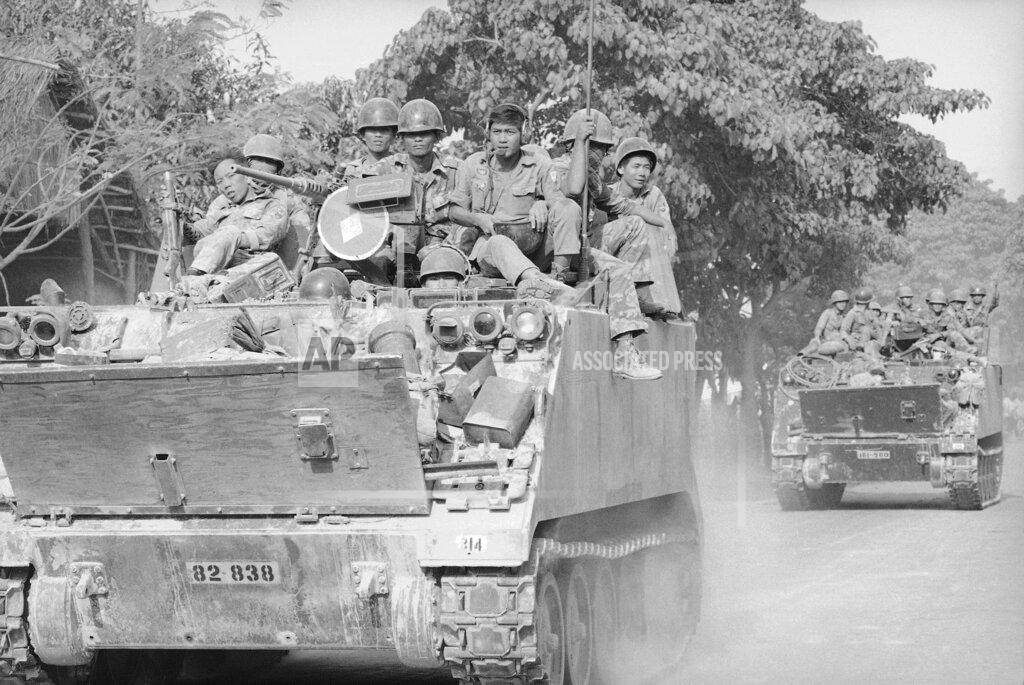
Saigon military forces withdrew to the South Vietnamese border after a four-day incursion into Cambodia, field reports said. The Saigon command acknowledged earlier that some of its air and artillery strikes “may have” spilled over the border, but denied that its ground forces crossed into Cambodia. The command claimed that 175 North Vietnamese troops were killed in two separate battles along the border. Twelve government soldiers were reported killed.
The return of the people of Bikini Atoll, the U.S. atomic test site, to their home of 25 years ago has been postponed indefinitely, officials at the headquarters for the American-administered Pacific Trust Territory said. The announcement followed a statement from the former residents that they would not return until the United States agreed to pay $3 million to the people, a request that is being studied. The 360 residents were to return May 15. Radioactive debris has been removed from the atoll, new trees planted and 40 of a planned 78 houses built.
Pan American World Airways will make a cash payment to the families of victims of the April 22 Pan Am jetliner crash on the island of Balibut only if the victims were Japanese, a Pan Am spokesman said in Tokyo. The spokesman said families of the 29 Japanese dead aboard the plane would each receive 1.2 million yen (about $4,360) over and above any compensation agreed upon later.
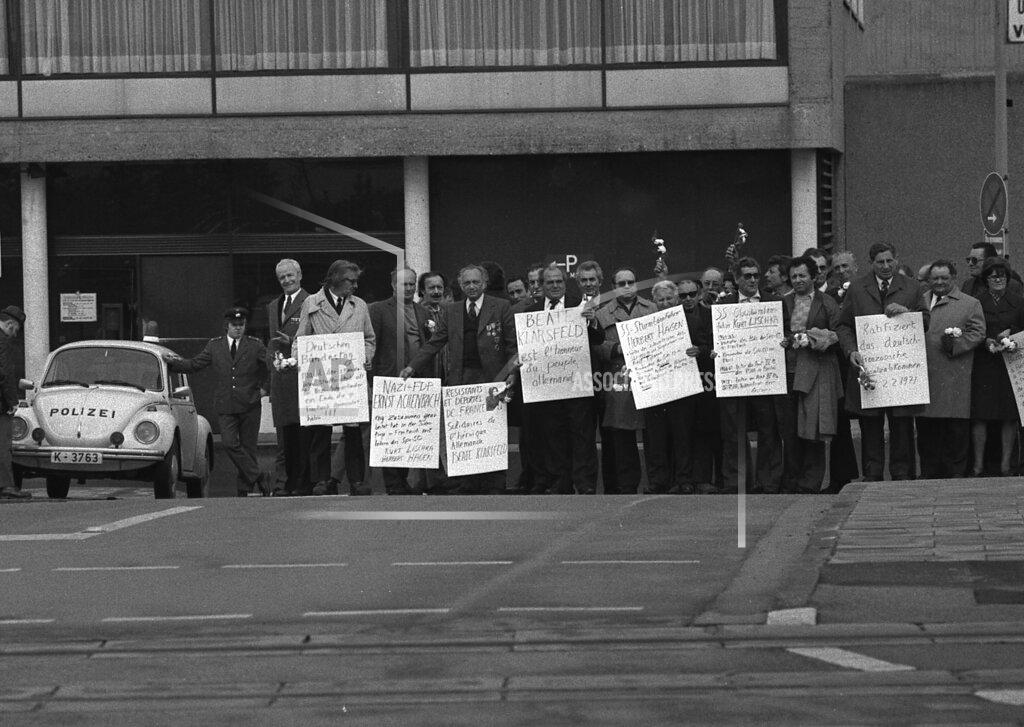
West Germany’s unofficial diplomatic mission to East Germany, the “Permanent Representation Office” (Ständiger Vertretungen), opened in East Berlin with Günter Gaus as the West German representative. In that the position of the West German government was that the German Democratic Republic in the east was illegal, the two nations stopped short of giving recognition to each other’s governments. At the same time, East Germany opened its office in Bonn, with Michael Kohl as its envoy.
General Antonio de Spinola, head of the military junta that overthrew Portugal’s dictatorship, ordered amnesty to thousands of young Portuguese men who had been charged with desertion for fleeing the country to avoid serving in colonial wars. Spinola said that any draft dodger who reported to his military unit within 15 days would not be charged with desertion, and that any soldiers convicted of desertion would be released from prison to return to peacetime military service.
Six Catholic civilians were killed and eighteen wounded when the UVF (Ulster Volunteer Force) detonated a bomb at the crowded Roman Catholic-owned Rose & Crown Bar on Ormeau Road, Belfast, Northern Ireland. Police theorized at the time that Protestant extremists were behind the attack on the bar — which is also patronized by many Protestants — but declined to lay blame on any sectarian organization.
A caller claiming to be a member of the gang that stole 19 paintings last week in the world’s biggest robbery told a Dublin newspaper that three of the masterpieces would be “returned in ashes” unless a $250,000 reward offer was canceled. A London insurance firm offered the reward Monday for the recovery of the paintings, valued at $20 million, and information leading to the arrest of the robbers.
Hundreds of union leaders were arrested in India in a government move to head off a rail strike threatened for Monday that could cripple the Indian economy. One union leader died of a heart attack while in custody. Angered by his death and the hundreds of predawn arrests across the country, the unions broke off talks with the Government, which controls the railroad system. Workers walked out at Bombay, Bhopal, Lucknow, Ahmadebad, Patna and several other key rail centers, suspending rail services.
Since India’s economy depends heavily on the rail system, officials view the prospect of a nationwide strike as the greatest threat Prime Minister Indira Gandhi’s Government has faced. Vowing that the “wheels will be kept moving,” Mrs. Gandhi has ordered army reserves to stand by in case the 100 unions representing, nearly two million railroad workers begin the strike they have threatened for Monday. The unions have said that they will strike Indefinitely unless their demands for better wages and working conditions are met.
The crash of an ATESA airlines DC-3 in Ecuador killed all 22 people aboard, when the plane flew into the side of the inactive Tungurahua volcano in the Andes, east of Quito. The airplane was on its way from the airport at Puyo to Ambato when it hit the 16,480 feet (5,020 m) volcano at an altitude of 11,200 feet (3,400 m).
The 47.69 carat Star of South Africa diamond was sold at an auction in Geneva for 1.6 million Swiss francs (equivalent to £225,300 or $542,000). The Star of South Africa diamond, which launched the South African diamond rush when a shepherd boy found it in 1869 on a farm near the Orange River, was sold for more than half a million dollars at a Geneva auction. The pear-shaped 47.70carat gem went to an unnamed private buyer. A spokesman for Christie’s, the London auctioneers, confirmed that the diamond had been in the possession of an American family.
The House Judiciary Committee voted overwhelmingly to give President Nixon’s attorney, James St. Clair, wide latitude in questioning witnesses at the committee’s impeachment hearings. The committee also voted to allow live television coverage of the hearings, which are expected to begin later this month.
Investigators for the House Judiciary Committee have apparently constructed a chain of circumstantial evidence linking President Nixon’s 1971 decision to increase government milk price supports to a pledge by dairy industry groups to give $2 million to the President’s re-election campaign. The chain was outlined in one of several documents submitted to the White House to justify the committee request for 141 White House tapes.
The original Watergate prosecutors reportedly broke off all contact with their superiors in the Justice Department in April, 1973, after Assistant Attorney General Henry Petersen refused their demands that he end his close association with President Nixon. Authoritative sources said the break came after Mr. Petersen refused to heed warnings that he would be a witness against John Dean in any Watergate cover-up trials and, thus, should not continue to advise the President.
Of the hundreds of gaps in the edited White House transcripts, none seems so crucial as the omission of more than five hours of presidential conversations on April 15, 1973, the day the White House says the tape ran out. Thus, there is an incomplete record of the President’s first talk with the Watergate prosecutor.
General Alexander Haig, the President’s chief of staff, reportedly refused to answer questions before a closed session of the Senate Watergate Committee. Senate sources said General Haig produced a letter from the President invoking both executive privilege and the attorney-client privilege in ordering him not to answer questions, which focused on a $100,000 gift from Howard Hughes to C. G. Rebozo.
Former U.S. Vice President Spiro Agnew was disbarred from the practice of law in a unanimous decision of the Maryland Court of Appeals, the highest in the state. Agnew, who had pled no contest to a charge of tax evasion on October 10 and resigned the office, was described by the Court as “so morally obtuse that he consciously cheats for his own pecuniary gain.”
The Securities and Exchange Commission filed a civil complaint against the Penn Central Railroad and various subsidiaries, officers and directors, charging them with fraud in connection with the 1970 collapse of the railroad.
Army Lieutenant William L. Calley Jr., who is free on bail from his 1971 court-martial conviction in the My Lai massacre, may take a job to pay off debts and finance his defense, the Pentagon has ruled, as long as the job does not discredit him or the service. Calley, who is awaiting a presidential review of recent action cutting his life term to 10 years, hasn’t received any pay since his conviction nearly three years ago, his lawyer said. If Mr. Nixon concurs in the reduction, Calley will be sent to the Ft. Leavenworth Disciplinary Barracks.
Richard O. Simpson, chairman of the Consumer Product Safety Commission, said his agency has identified 61 companies whose products might have killed or injured users but who have not notified the government about it. He said letters were sent out to the 16 firms asking them whether the injuries should or could have been reported to the commission as the law requires. He did not name the firms involved.
The Senate passed 69 to 10 a $458 million bill designed to speed research into better ways to deliver health care services to the public. The measure — which now goes to conference with the House — also would provide new funds for making available health care statistics and for aid to medical libraries. The bill would set up a National Center for Health Services to conduct research into better health care systems.
U.S. Treasury agents Daniel M. Patterson, 33, and Joseph R. Clapp, 35, both of Michigan, were jailed on charges they conspired to import and sell heroin-the first Treasury men to be so charged. Three other persons were arrested in the case which charged that heroin was bought in Mexico and peddled in telephone booth caches in the Detroit area. The arrests followed a three-month investigation that began with a tip from a Michigan state policeman. Buyers reportedly were assured they were safe because a Treasury man protected the operation.
A federal review board reported declassification of millions of government documents and records since 1972, but left open a possibility that “secret” stamps are going on newspapers as fast as they are coming off old ones. The situation was described in a report to President Nixon by the interagency classification review committee set up to guarantee compliance with his 1972 executive order for reform of the system used to classify information on national security grounds. The panel said 13 agencies covered by the order had made “significant progress” but said it had not yet determined if the total inventory of classified documents was actually declining faster than government officials were adding to it.
Rep. Wright Patman (D-Texas), chairman of the House Banking and Currency Committee, has reported raising more than $100,000 for his reelection campaign, $33,945 of which has come from savings and loan and banking interests, according to the citizens lobby Common Cause. Patman faces two challengers in Saturday’s Texas primary.
Prices of steel, copper, brass, chemicals and other major basic materials were increased on the second day after the end of most wage-price controls. But while prices of some airplanes and air conditioners were raised, the maker of Hormel meat products announced a price cut of 7 to 14 percent, including a 7-cent reduction in the cost of a can of Spam.
A two-year study by the New York research staff of the National Urban League has found widespread racial bias in the Coast Guard. Warning of a potentially explosive situation, the report urges better internal communication and greater opportunity for advancement of members of minority groups.
Dow Jones Industrial Average: 851.06 (-2.82, -0.33%).
Born:
Jon Oringer, American computer programmer and billionaire businessman, founder of Shutterstock; in Scarsdale, New York.
Matt Berry, English actor known for Toast of London, 2015 BAFTA Award winner for Best Male Performance in a Comedy Programme; in Bromham, Bedfordshire, England, United Kingdom.
Chang Chen-yue, aboriginal Taiwanese rock and hip-hop musician, 2013 Golden Melody Awards winner for Best Album; in Suao Township, Yilan County, Taiwan.
Garðar Thór Cortes, Icelandic tenor, in Reykjavík, Iceland.
Died:
James O. Richardson, 95, United States Navy admiral, commander in chief of the United States Fleet (CinCUS), relieved of command after warning against the redeployment and concentration of the Pacific Fleet at Pearl Harbor in Hawaii in 1941.
Frank Morales, 66, Indian journalist and newspaper columnist, editor of The Indian Express 1957 to 1972
Ebbe Munck, 69, Danish Resistance fighter in World War II, later Denmark’s Ambassador to Thailand and chief of the royal court.

 History Diaries