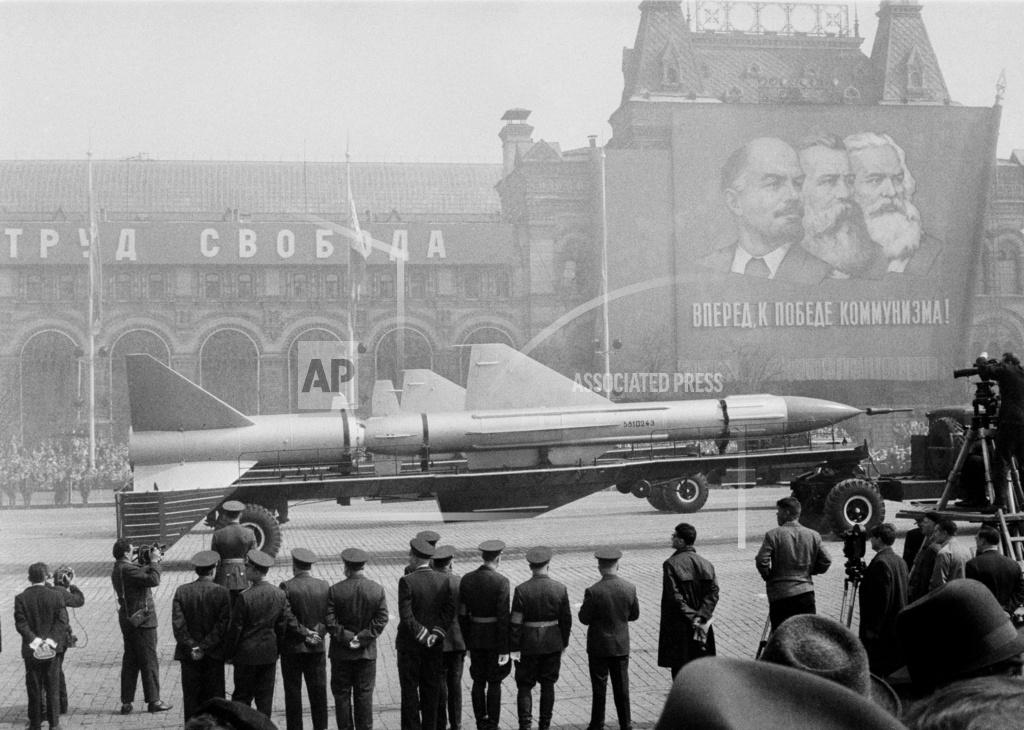
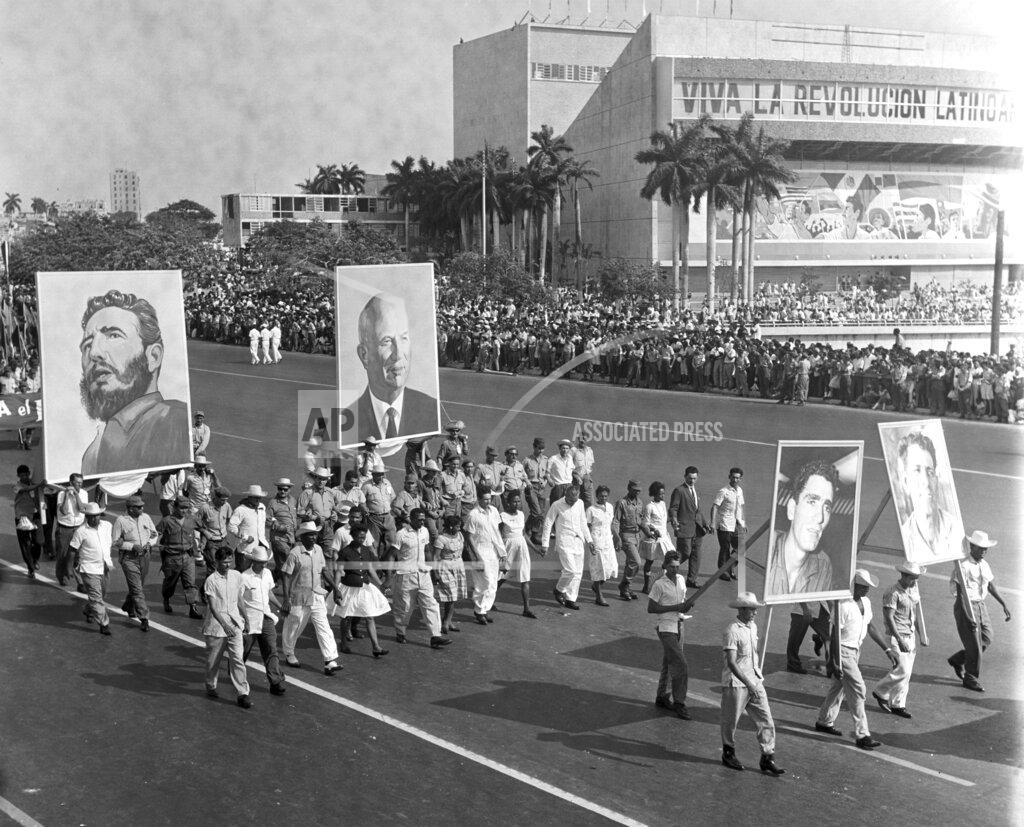
Soviet Premier Khrushchev warned today that United States policies toward Cuba could “drag the world into the abyss of another world war.” The Soviet leader issued his warning a few hours after the Soviet Union had paraded its military might, including many during the annual May Day ceremony in Red Square. Western observers termed the warning one of the toughest and most direct statements made by the Soviet Government since the missile crisis of 1962. Premier Fidel Castro, in a May Day speech in Havana, said that Cuba would have to face developments in the dispute with the United States alone, without direct Soviet support. Although he denounced United States surveillance flights as illegal, Dr. Castro promised to use legal means to settle the issue. “We have been patient, we are and will be patient,” he said.
Mr. Khrushchev denounced as “evil fabrications” assertions made in official United States statements that surveillance flights over Cuba were in keeping with agreements reached by President Kennedy and Premier Khrushchev in October, 1962. “There was no such understanding, nor could there have been one,” the Premier declared. “The Soviet Union will never reach any understanding with another state at the expense of a third country.” “We have always declared and we declare once more that threats against Cuba, continued violations of [Cuban] sovereignty and flights into Cuban airspace may have catastrophic consequences,” the Soviet leader continued. Those who would suffer these catastrophic consequences, he added, would be those who conduct a “policy of aggression against Cuba.”
Mr. Khrushchev gave his warning in the form of a speech at a Kremlin dinner in honor of Soviet and foreign participants in the May Day celebrations. President Ahmed Ben Bella of Algeria, the most prominent foreign guest present, was awarded the title Hero of the Soviet Union during the dinner. Mr. Ben Bella is believed to be first non‐Communist foreign statesman to be so honored. The Algerian leader is known to be an ardent admirer of Premier Fidel Castro. Significantly, Mr. Khrushchev in his speech hailed the close relations between Algeria and Cuba as well as the friendship between Algeria and the Soviet Union.
Earlier, Mr. Ben Bella stood at Mr. Khrushchev’s side on the Lenin Mausoleum as the two men, flanked by top members of the Soviet leadership, applauded a display of Soviet military power. A large contingent of Soviet rocket forces held the place of honor in the parade. It dwarfed the other groups including armored forces, artillery and airborne troops. The rockets include one type that had never been displayed before, according to Western observers. This was a 25-foot-long surface‐to‐air missile apparently meant for battlefield use against low‐flying tactical aircraft. It was hailed by the Soviet press as a “formidable new weapon.”
Menacing comments by Premier Khrushchev and some surprisingly mild comments by Premier Fidel Castro today about United States flights over Cuba tended to cancel each other out, in the view of analysts in Washington. Officially, the Administration said nothing new. It reasserted the need to conduct aerial reconnaissance over Cuba to prevent the re‐establishment of offensive missile bases. But it did not wish to say anything that might provoke Moscow or Havana into new promises of belligerence. Privately, officials showed no alarm about the day’s developments. There is always concern, of course, when Premier Khrushchev speaks of the possibility of “catastrophic consequences” if the flights over Cuba continue. The prevailing belief here is that the Soviet leader must demonstrate to Communist China and other Communists that he has not sold out the Cubans in some tacit deal with the United States.
The alternating sounds of a Hebrew chant and the shuffling of pickets’ feet marked a protest by 700 young men and Women near the headquarters of the Soviet mission to the United Nations in New York yesterday. The pickets, representing the Student Struggle for Soviet Jewry, marched for four hours. They sought to call attention to conditions under which three million Jews live in the Soviet Union. Signs in English, Russian and Hebrew had such legends as “Open Up Jewish Houses of Worship,” “We Cannot Keep Silent Any Longer,” and “Why No Matzohs?” It was the refusal of Soviet authorities to permit the importation of matzohs during Passover this year that provoked the latest protests over the pressures placed upon Jews in Russia. Other picket signs protested that hundreds of synagogues had been closed in the Soviet Union, that no rabbinical schools are permitted to operate, that Jewish culture is being stamped out and that Jews who wish to emigrate are not permitted to do so.
Cyprus basked in a warn Mediterranean sun today and there were virtually no incidents to mar the beginning of the four-day Greek Orthodox Easter holiday. The United Nations peacekeeping force reported sporadic shooting in the mountains around the Kyrenia Pass during the night. However, all but occasional shots ceased with daylight. A few other minor shooting incidents during the night also were reported in scattered localities. The unilateral Greek Cypriote cease‐fire in the St. Hilarion Castle area west of the pass remained in force. Whether the quiet there resulted from the cease‐fire and the Easter holiday or from the presence of new permanent United Nations posts in the area was unclear. Highly placed Greek Cypriote officials expressed fears that the Turkish Cypriotes might initiate violence during the holiday, hoping to catch the Greek Cypriotes off guard. Turkish Cypriote officials said they did not expect new violence during the holiday unless the Greek Cypriotes started it.
In this atmosphere of complete mistrust, the United Nations apparently was moving ahead somewhat more forcefully to halt the fighting. One step was the establishment of 12 permanent posts in the Kyrenia Pass area. The key posts are at the entrance to St. Hilarion Castle, a Turkish Cypriote redoubt above and west of the pass; behind the Greek Cypriote lines west of the castle, and in three Turkish Cypriote villages on the south ern slope of the mountain range just west of the Nicosia‐Kyrenia Road where it mounts to the pass.
Chancellor Ludwig Erhard told a large May Day rally in West Berlin today that the East German Government was seeking to achieve “permanent, just and peaceful settlements” with the Soviet Union and the other East bloc countries. West Germany “is aware of the legitimate security interests of our Eastern neighbors, in view of the Nazi horrors of the past,” he said, “but I want to repeat once more that we seek understanding and friendly relations with all countries on a basis of mutual respect.” Dr. Erhard’s remarks were seen as a reaction to President Johnson’s recent public suggestion that West Germany should strive for better relations with the Soviet Union. The President made the suggestion in an interview with the West German magazine Quick. The Chancellor rejected any ideas of political talks with the East German Communists. He said: “The officials of East Germany cannot be our partners in negotiations. They operate as puppets under the Soviet military power.”
As Dr. Erhard was addressing about 300,000 Berliners in their Sunday best on the Square of the Republic, near the wall erected by the Communists, the East Germans staged a military parade half a mile away to the east of the wall. Units of the armed forces paraded past Walter Ulbricht, the Communist leader, to the tunes of Prussian marches. Heavy artillery, antiaircraft and antitank rockets, Soviet-made tanks of the T‐54 model and other heavy equipment were displayed in a 35‐minute show of military power. This year’s speeches and slogans were carefully worded to avoid any threat to West Berlin. Alfred Neumann, a politburo member, who was the main speaker, emphasized East Germany’s willingness “to do everything possible to contribute towards reaching a detente and an understanding between the two German states and within the world.”
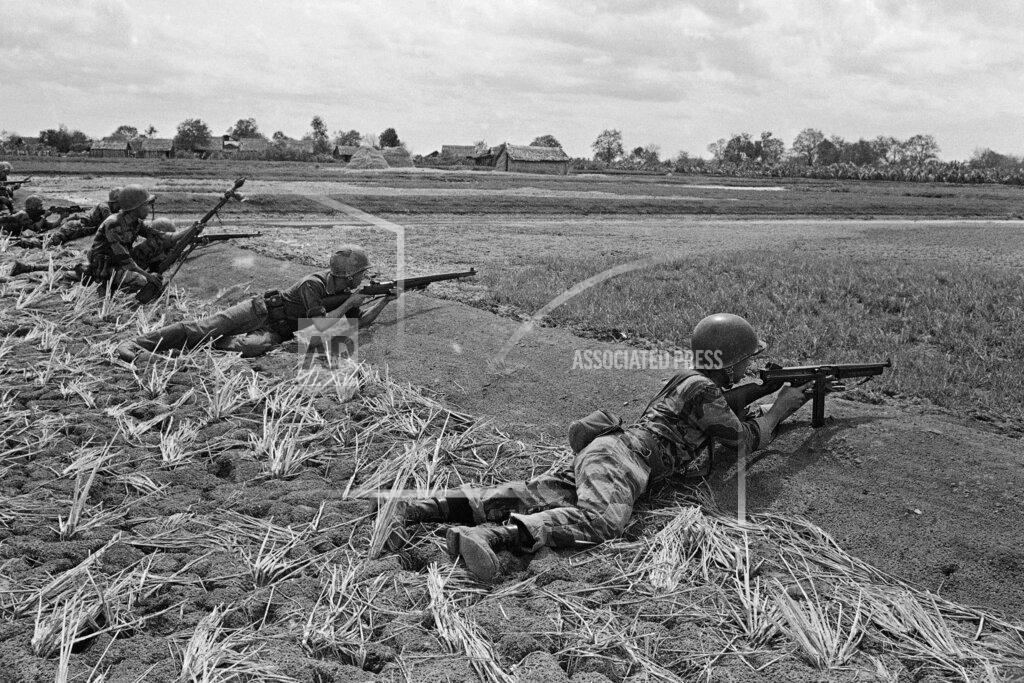
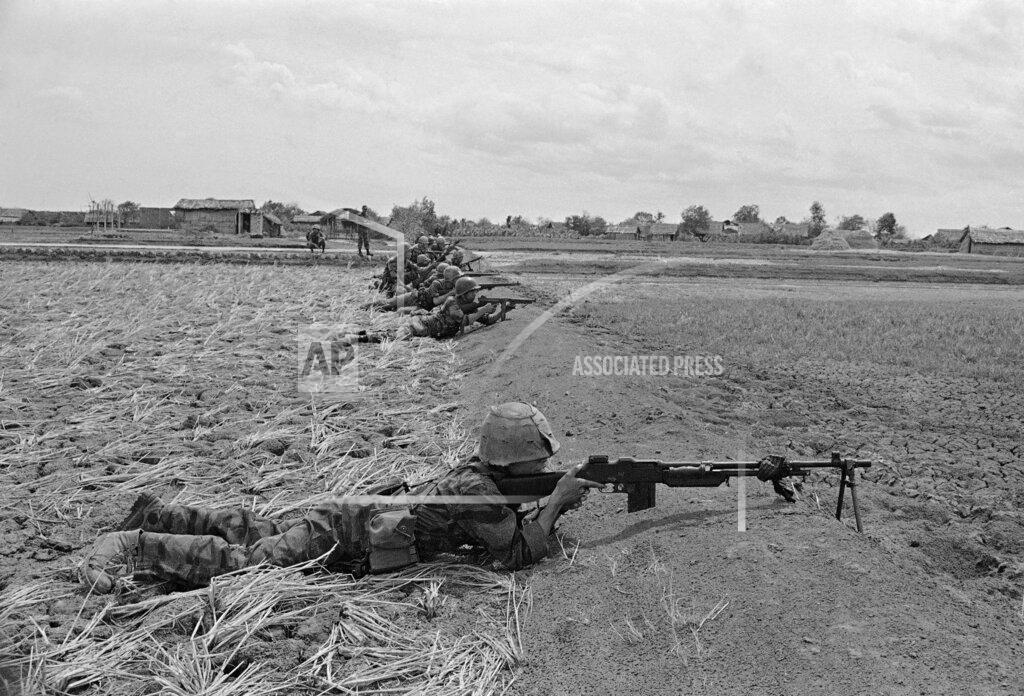
Four officers of the South Vietnamese armed forces’ Ranger Command will take a two‐month course at the Australian Army jungle fighting training center in Queensland, Australian Defense Minister Shane Paltridge said today.
Two Tokyo policemen were seriously injured when hit by rocks today during a May Day clash with about 900 leftist students in front of the Diet (Parliament). Several other policemen and students were slightly hurt in the 30‐minute clash, which followed an unauthorized snake dancing and sit-down demonstration. The fight ended when the police used high‐pressure water guns mounted on trucks. Five students were arrested in the clash. Three students were also arrested in Osaka for what was termed “excessive snake‐dancing.” Japan’s May Day rallies and parades otherwise were among the quietest and most orderly of recent years. About a million and a half workers took part. Labor’s belligerent mood of early April has largely vanished after plans for a 12‐hour strike by about five million workers, scheduled for April 17, was canceled. The General Council of Japanese Trade Unions shifted its emphasis from political to economic issues in preparing slogans for the May Day rallies.
President Sukarno said today that he would issue an action command to “21 million volunteers” Sunday to crush the Federation of Malaysia. In a May Day speech to about 12,000 persons gathered at the Bung Karno Sports Palace on the outskirts of Jakarta, the President said that, since the last general rally he had addressed April 13, he had been awaiting the attitude of the Malaysian Prime Minister, Prince Abdul Rahman, on the issue between them. Mr. Sukarno added that “now I think I know what it is.” “Therefore,” the President went on, “I have ordered all 21 million Indonesian volunteers to hold simultaneous roll‐calls throughout Indonesia to receive my command of action.” Prince Abdul Rahman said at Kuala Lumpur on April 26 that he regarded his victory in that Malaysian election the previous day as support for a firm stand against Indonesian threats to Malaysia.
The Senate debate on the civil rights bill came to an angry boil for the first time today when Senators Jacob K. Javits and Richard B. Russell clashed over the quality of justice that might be expected of Southern juries in civil rights cases. The heated exchange, which lasted 20 minutes and ended up in a handshake, began when Mr. Javits, Republican of New York, found fault with a jury trial amendment offered by Senator Thruston B. Morton, Republican of Kentucky. Earlier today, the Senate’s leaders announced that they planned to begin voting on jury trial amendments next Wednesday. Mr. Russell did not positively commit himself to a vote on that day but said he thought the Senate might look forward to it unless “something unforeseen happened.” Under the Morton proposal a defendant would have the right of a jury trial in any case of criminal contempt of court arising out of the antidiscrimination provisions of the civil rights bill.
It thus differs fundamentally from the amendment proposed by Senators Everett McKinley Dirksen of Illinois, the Republican leader, and Mike Mansfield of Montana, the Democratic leader. Their amendment would give a judge discretion to try a criminal contempt proceeding with or without a jury, but would also limit the penalty in a non‐jury trial to $300 and 30 days in jail. Mr. Javits began by saying that, while it was right to limit penalties in non‐jury trials, the judge should have “some deterrent power.” He went on to say that in certain parts of the country, defendants know that if they get a jury trial in civil rights contempt cases, they will be turned free.
Senator Russell, the Georgian leader of the Southern opponents of the bill, leaped to his feet, his face flushed with anger, and demanded that Mr. Javits cite a case where this had happened. Thereupon, Mr. Javits angrily protested the interruption without asking leave according to Senate rules. He then said that an example was a denial of voting rights to Blacks in a forthcoming election in violation of a court order. A judge needed the power to punish such a violation after the act, he argued. Civil contempt, under which a convicted person can purge himself by promising not to repeat the offense, would not rectify the wrong done, Mr. Javits said, because the Black would already have lost his vote.
When he had finished, Mr. Russell said he was sick and tired of having the New Yorker repeatedly say: “We all know that in the South, the juries will violate their sworn oath.” Mr. Javits, he said, always managed to suggest that there was “something fundamentally evil and sinful about people living in the South.” Moreover, he said, Mr. Javits always made his statement about Southern juries with “a little sneer on his face.” Southerners, he went on, deserved better treatment than to have the Senator from New York insinuate from day to day that they are a “vile and lowly people.”
He then recalled a recent account in The New York Times of a woman who was stabbed repeatedly by a prowler in the middle of the night while people in neighboring apartments looked on and neither responded to her calls for aid nor telephoned the police. “I say that couldn’t happen in the South — demean it as you may,” Mr. Russell said.
White union plumbers at a huge New York city project in the Bronx refused again yesterday to work with four nonunion plumbers — three Puerto Ricans and a Black. On Thursday, they had refused to work on the ground that they had inadequate toilet facilities. Yesterday, a spokesman said the reason was their refusal to work with nonunion personnel. However, moments before the spokesman made this statement, several of his co‐workers shouted their feelings to whoever wanted to listen. “Animals don’t mix, why should people have to?” one said. “God created me white. Is it any fault of mine they’re created another color?” another asked.
One plumber, his face flushing, shook an accusing finger in the direction of Theodore Brown, a Black official of the City Commission on Human Rights, and shouted: “I want a crack at his job right now just like they want to take mine.” None of the union plumbers give his name. The City Commission on Human Rights, which is investigating, indicated that it was convinced the dispute was a racial one and called all parties involved to a conciliation conference today at 3 P.M.
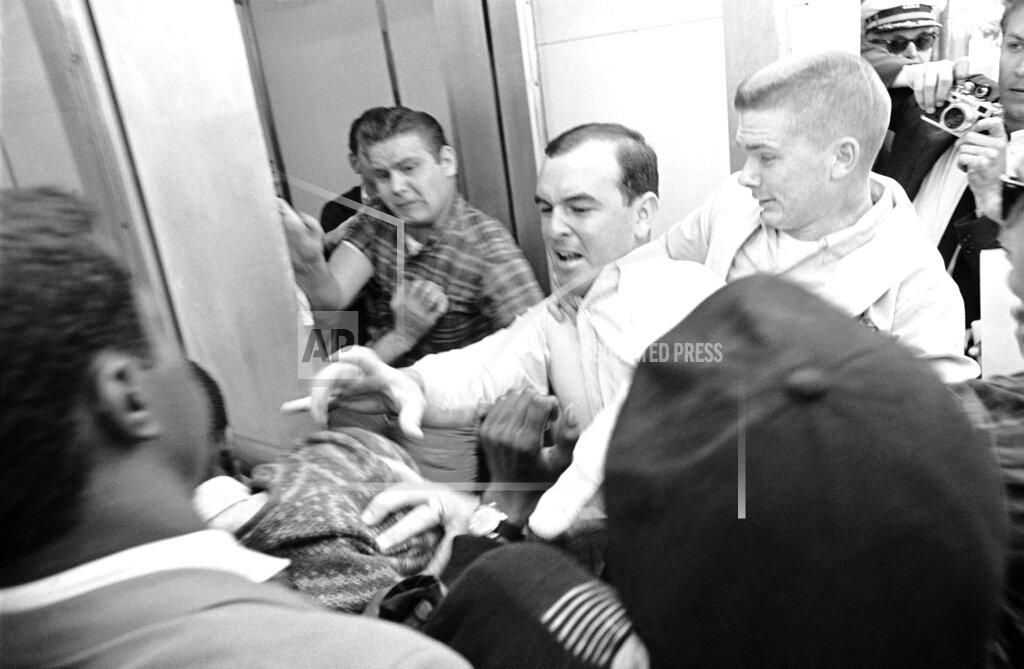
Governor George C. Wallace of Alabama drew noisy picketing and a false bomb threat today as he pressed a campaign to woo Republican cross‐over votes in Tuesday’s Indiana Democratic Presidential primary. Policemen and pickets clashed when 200 booing, sign‐waving demonstrators tried to force their way into a Fort Wayne hotel room where Mr. Wallace held a news conference. No one was injured. While the police battled the pickets, an anonymous caller reported that a bomb had been planted in the Van Orman Hotel, scene of the news conference. Firemen searched the building but found no explosives.
Attorney General Robert F. Kennedy called on the legal profession tonight to address itself to the problems of poverty, racial discrimination and other great social ills. Lawyers, he said, “have conveniently, perhaps lazily, abdicated responsibility for dealing with major social problems to other professions — to sociologists, educators, community organizers, social workers, psychologists.” Mr. Kennedy made a Law Day address at the University of Chicago Law School. His speech, quite broad in its criticism of the profession, urged the bar to get over a preoccupation with form and get interested in the substance of the challenges to American society. First among these he listed as “the phenomenon of massive privation to which our nation is now awakening.” He said lawyers must join in “the unconditional war on poverty to which President Johnson has summoned all of us.”
The Warren Commission, investigating the assassination of President Kennedy, will question his widow, who was with him when he was shot, a spokesman said today. What form the questioning will take will be announced later. Mrs. Kennedy could give her testimony in person before the commission or by deposition. The spokesman said that she had indicated she was willing to cooperate with the commission, headed by Chief Justice Earl Warren. Three Federal Bureau of Investigation agents — John W. Farn, now retired, John L. Quigley and James B. Hosty Jr — will testify Tuesday morning.
At 4:00 a.m. at Dartmouth College, mathematics professors John Kemeny and Thomas Kurts ran the first program written in BASIC (Beginners’ All-purpose Symbolic Instruction Code), an easy to learn computer programming language that they had created. The original version had 14 statements (DATA, DEF, DIM, END, FOR, GOSUB, IF, LET, NEXT, PRINT, READ, REM, and RETURN) and nine built in DEF functions (Sin, Cos, Tan, Atn, Exp, Log, Sqr, Rnd, and Int). Kemeny would write later that “We at Dartmouth envisaged the possibility of millions of people writing their own computer programs.”
President Johnson purchased today the first of a new denomination of $75 Series E savings bonds bearing the picture of President Kennedy. In a ceremony in the Cabinet Room at noon, Mr. Johnson gave Secretary of the Treasury Douglas Dillon a check for $56.25. The bond bore serial number 1. A spokesman for the Treasury Department said Mr. Johnson had ordered the bond March 16. Other low‐numbered bonds also had been ordered in advance, he said. The bonds bearing the serial numbers 2 and 3 were bought by the Kennedy family for the children of the late President, John Jr. and Caroline.
General John P. McConnell was named by President Johnson today to succeed General William F. McKee as Vice Chief of Staff of the Air Force next July 31. General McKee is retiring. The President’s choice of General McConnell was widely assumed to be preparatory to the officer’s appointment as Chief of Staff of the Air Force when General Curtis E. LeMay retires next February 1. General McConnell is now deputy commander of the European Command. He is 56 years old, a graduate of the United States Military Academy at West Point, class of 1932, and has been a flier for more than thirty years.
The visiting Cubs make it look easy, scoring 10 runs in the first inning to shoot down the Colt 45s, 11–3. Billy Williams has a grand slam and a single for 5 RBIs (a club record) in the big inning, and adds a run-scoring double in the 8th to lead Chicago.
Earl Battey has a grand slam and drives in 6 runs as the Twins double the Athletics, 10–5.
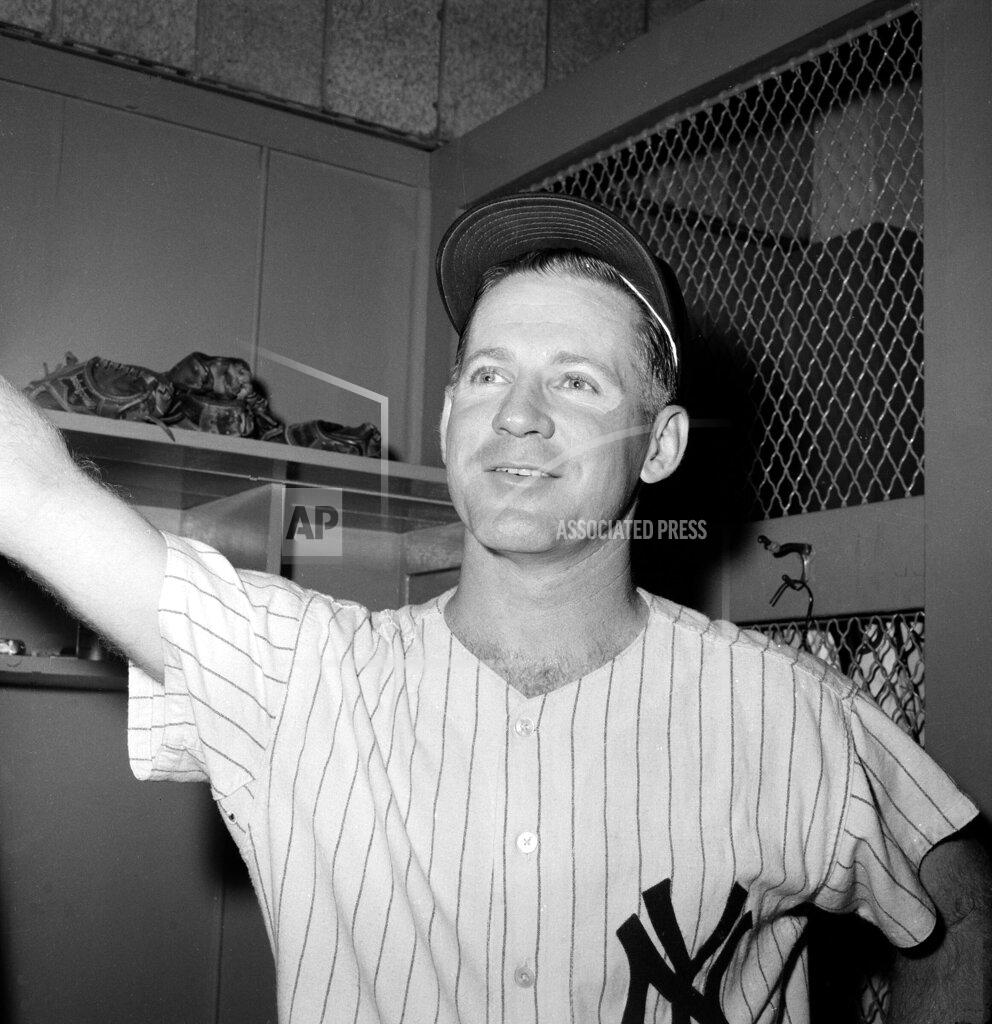
Whitey Ford allows just two hits and the Yankees edge the Senators, 1–0.
Dow Jones Industrial Average: 817.10 (+6.33).
Born:
Sarah Armstrong-Jones, daughter of Princess Margaret & Lord Snowdon, in Kensington Palace, London, England, United Kingdom.
Yvonne van Gennip, Netherlands speed skater (Olympic gold medals, 1,500m, 3,000m, 5,000m, 1988), in Haarlem, Netherlands.
José Lind, Puerto Rican MLB second baseman (Pittsburgh Pirates, Kansas City Royals, California Angels), in Toabaja, Puerto Rico.
Dan Gakeler, MLB pitcher (Detroit Tigers), in Mount Holly, New Jersey.
Jeff Bregel, NFL guard (NFL Champions, Super Bowl 23 and 24, 1988, 1989; San Francisco 49ers), in Redondo Beach, California.
John Clay, NFL tackle (Los Angeles Raiders, San Diego Chargers), in St. Louis, Missouri.


 History Diaries