Poles fail to see a war over Danzig and believe a compromise can be reached.
The German memorandum delivered to the Polish Foreign Office on Friday while Chancellor Adolf Hitler was attacking Poland will be answered in the same manner. A Polish memorandum, repudiating the German accusation and rejecting Danzig’s incorporation into Germany and a highway across Pomorze [the Polish Corridor], but leaving the door open for further negotiations, will be delivered at the Berlin Foreign Office while Foreign Minister Josef Beck and Premier Felicien Slawoj-Skladkowski are addressing the Sejm (Parliament), probably on Friday. It was reported in Poland that Chancellor Hitler had demanded a German motor road right of way across Pomorze 15.5 miles wide, The Associated Press stated.
Certain influential military circles hold that Warsaw should not enter into new negotiations with the Nazis unless the Germans withdraw their demands regarding Danzig. This view is expressed in the military journal, Polska Zbrojna, which published one of the strongest criticisms of Herr Hitler’s speech and of German policy generally. “Danzig is at the mouth of a great Polish river,” it says, “and we cannot give it up. The Polonization of Danzig is notable; therefore, why should the Germans show so much interest in what to them is but one of their provincial towns?”
The Gazeta Polska, official organ of the Polish Government, tomorrow will publish a noteworthy statement concerning the position of Danzig. “Germany,” it will say, “has shown her regard for international engagements by her recent occupation of Memel, by her denunciation of solemn treaties. She has demonstrated quite clearly that German policy aims at separating Poland from her outlet on the Baltic Sea, the importance of which to Poland needs no emphasis. The policy of Berlin thus creates a situation that forces Poland to go further in her demands concerning the status of Danzig than she did formerly when concluding with Germany the pact of 1934.”
Both Paris and London seemed to be hopeful that a Polish-German compromise on Danzig could be reached. Reports from the two capitals indicated a disinclination to be forced to fight on this issue. It is already evident that the day has not yet come when France and Britain are prepared to oppose Germany’s forceful revision of the peace treaty terms on her eastern frontier with a definite “no.” For in proportion as Warsaw has stiffened in its refusal to meet what the Germans consider a reasonable settlement of the Danzig and Corridor issues, Paris and London seem to have inclined toward compromise and some new plan for reaching an agreement that appears to be halfway between a Runciman inquiry and a League of Nations commission. Nothing definite has yet been agreed. What is being proposed in some quarters may not even see the light of day. There is no doubt, however, that after having excited Polish expectations and roused public sentiment in Warsaw to a rather heroic pitch, the French and British Governments are now advising the utmost prudence on Foreign Minister Josef Beck in the reply that he is scheduled to make to Chancellor Hitler’s last speech.
With the arrival of the German Army commander in Rome it was believed new pressure was being put on Italy by Germany for a full-fledged military alliance. But it was significant that according to all reports the Brenner Pass between the two countries was being fortified on both sides. With the arrival in Rome of Colonel General Walther von Brauchitsch, Commander-in-Chief of the German Army, who will remain in close contact with Italian military leaders for ten days, talk of an open military alliance with Germany has become stronger. One finds today almost a general belief that it is coming sooner or later and some even fix the date: at May 7 when General Brauchitsch returns from Libya. That seems premature unless Russia joins the democratic bloc with an accord that would be taken by the Axis powers as a further threat to their existence. A military alliance could then be considered an answer.
It has been the tendency in newspapers and official quarters for the last few days to stress the idea that Italy, like Germany, is being menaced by warlike democracies and hence must strengthen her position for purely defensive purposes. That is the way new financial sacrifices are being presented to the country. “Italians know very well,” says the newspaper Popolo d’Italia in a typical editorial, “by a thousand obvious signs that against their desire for peace and work are directed the arms and hostility of the whole world, which is the enemy of well-being, progress, economic development, peace and, in short, of the Italian people.”
Italians express dismay over Hitler’s speech, alarmed at the prospect of war with Poland.
The question of peace or war, however, was considered by Nazi spokesmen to have been put up to the democracies and their partners.
Chancellor Adolf Hitler’s Reichstag speech left the world situation unchanged, and an open question still remains as to whether he will wage war tonight or tomorrow or whether he must wait until the Hitler generation grows up, Erika Mann, daughter of Thomas Mann, declared yesterday. She spoke at the New York Society for Ethical Culture, Central Park West and Sixty-fourth Street. Miss Mann termed preparation for “later at the front” as the leitmotif of education in the Third Reich.
“All children in Germany are living by twenty-five pages from Hitler’s ‘Mein Kampf’ and by nothing else on earth,” she said, “and hatred is the most important instrument used in their education. Because the future behavior of these children is of paramount importance to Germany and to the world, they are merciless little prisoners of three concentric circles.” The first and narrowest circle, she said, is the realm of the family, which the State is fighting and which, up to this time, it is conquering. The child’s school life forms the second circle and is a Nazi circle almost without a gap. she asserted. The Hitler Youth Organizations form the third circle, with a curriculum of warfare, she added.
A new German decree causes Jews lose their right to rent protection. Landlords are sanctioned by law to evict Jewish tenants.
Chancellor Hitler said in his Reichstag speech that Rumania had expressed satisfaction that she would have direct communication with the Reich. Well-informed Rumanian circles point out that Herr Hitler forgot to mention the date when Rumania made that declaration, last September during the crisis when Rumania’s chief aim was to prevent Hungary’s occupation of Carpatho-Ukraine. The Rumanian Cabinet then believed in the continued existence of Czecho-Slovakia and felt that Germany would be satisfied if she possessed an express highway across that country.
Speaking of the dismemberment of Czecho-Slovakia, Chancellor Hitler said: “It was a fact that perhaps only one single State was interested in preservation of the status quo and that was Rumania; the man best authorized to speak on behalf of that country told me personally how desirable it would be to have a direct line of communication with Germany, perhaps via Carpatho-Ukraine and Slovakia.”
A world movement striving for Czechoslovak freedom has grown under the former president Edvard Beneš, who is now a lecturer at the University of Chicago.
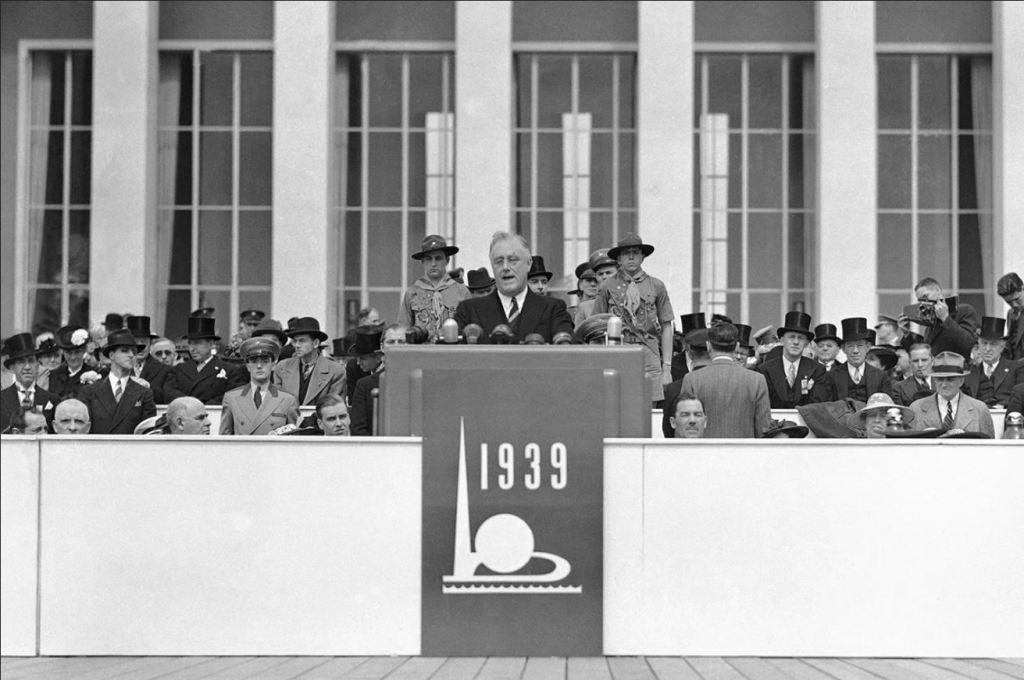
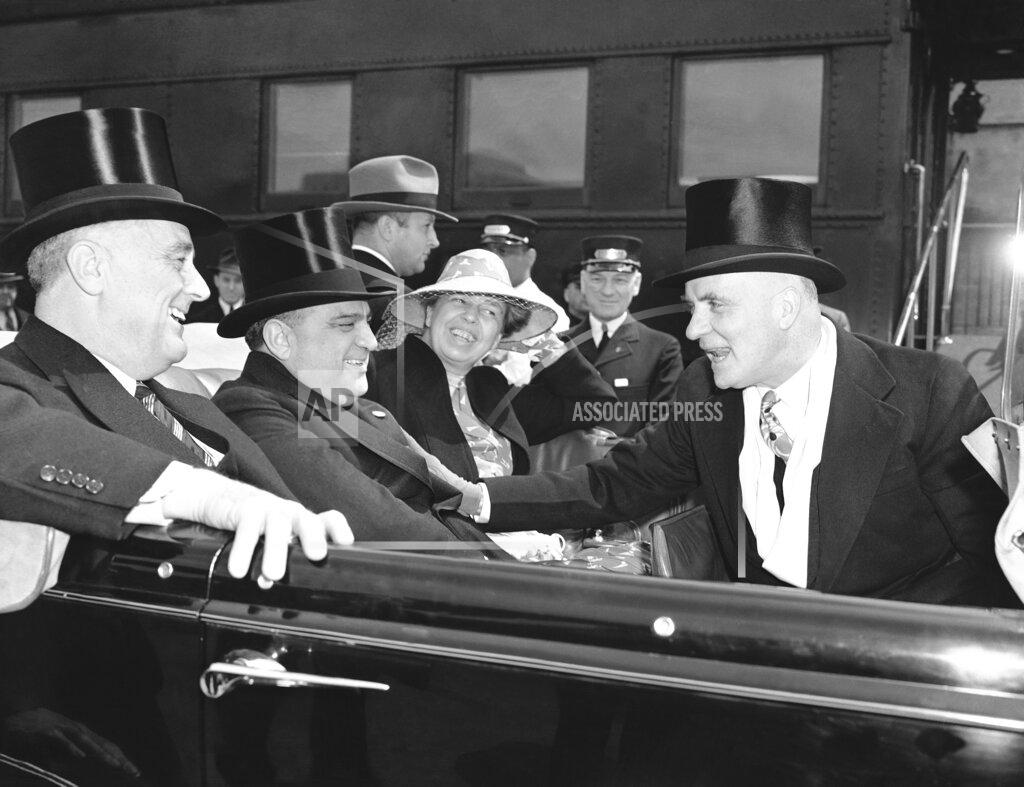
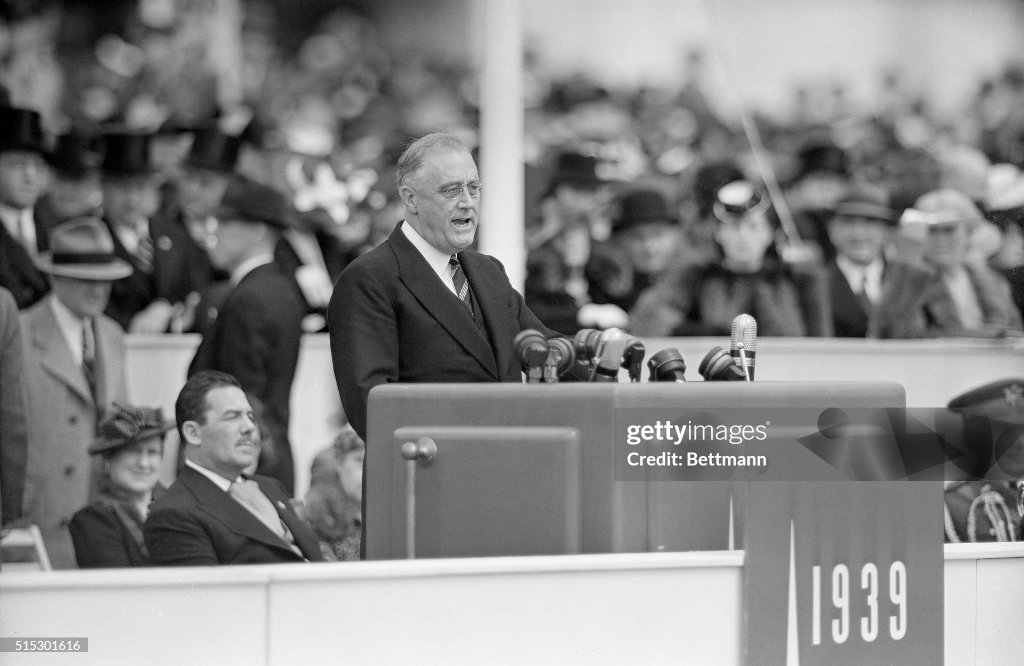
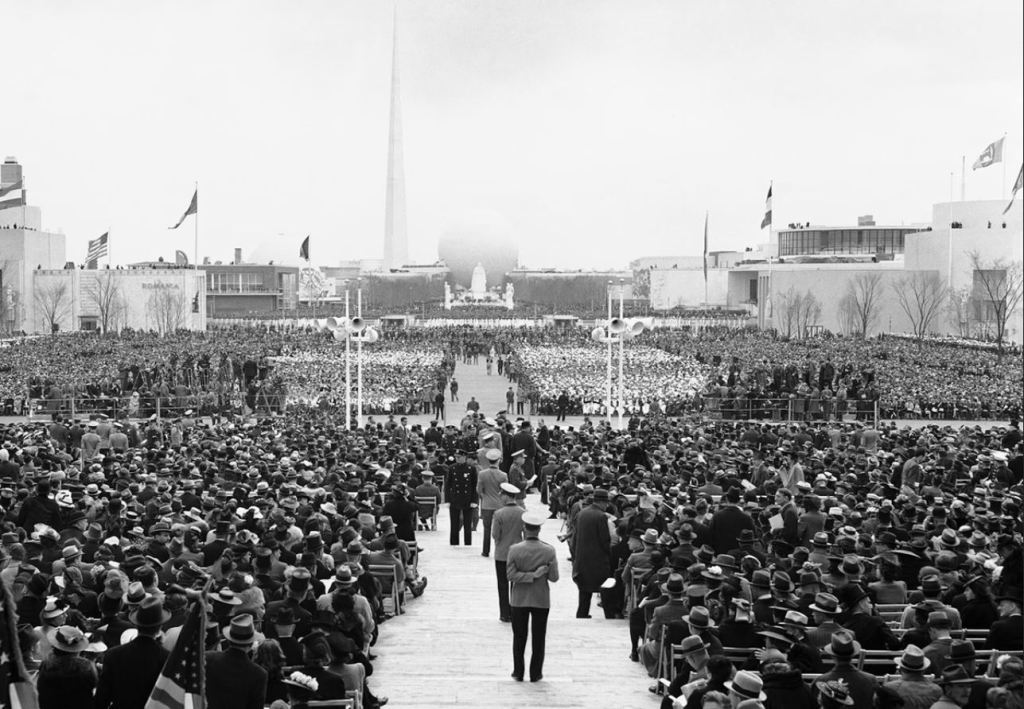
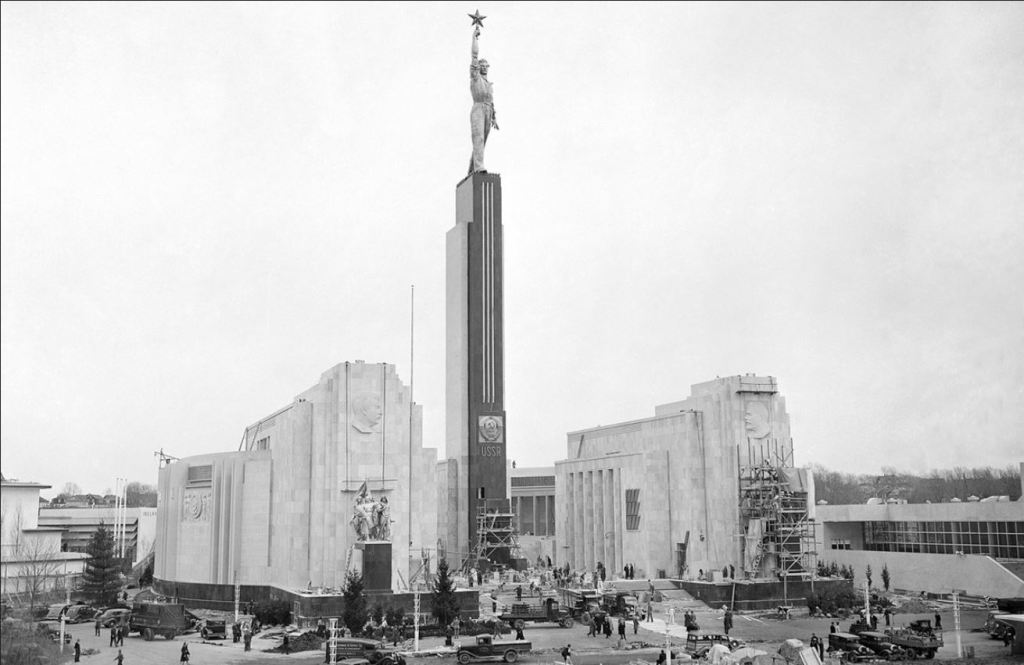
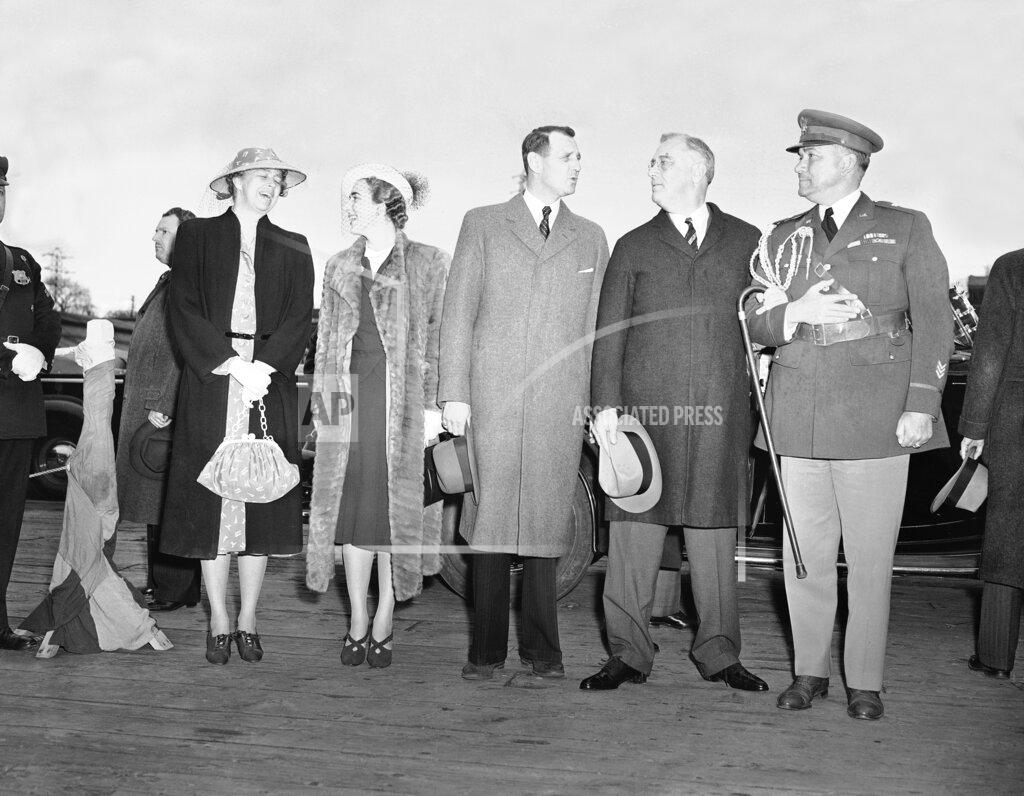
The 1939 New York World’s Fair opened. NBC inaugurated its first television broadcast with coverage of President Franklin Roosevelt at the event. The New York World’s Fair, billed as a look at “the world of tomorrow,” officially opens. Roosevelt becomes the first U.S. President to appear on TV when NBC-RCA television broadcasts the opening of 1939 New York World’s Fair
The biggest international exposition in history was officially opened at 3:12 PM this afternoon when President Roosevelt formally dedicated the New York World’s Fair 1939 in an address before a gathering of 60,000 persons in the open-air Court of Peace. Governor Lehman, Mayor La Guardia, Sir Louis Beale, British Commissioner General to the Fair and spokesman for the nearly sixty foreign nations that have exhibits, and Grover A. Whalen, president of the Fair Corporation, also made speeches at the opening ceremonies. They joined the President in emphasizing the message of peaceful progress that the Fair brings to mankind in an era when the whole world is troubled by war and threats of war.
When the President officially declared the Fair open, he brought to a climax ceremonies that included a parade of 20,000 uniformed soldiers, sailors and marines, foreign groups in picturesque native costumes from nearly all the countries of Europe, Asia and the Americas, and the workmen who built the Fair, in their overalls and white caps. Starting at the Trylon and Perisphere, the Theme Center of the Fair, the parade passed down Constitution Mall to the Court of Peace with flags waving, bands playing and spectators applauding until it ended with a colorful pageant in the Court of Peace.
In his first public utterance since Chancellor Hitler’s virtual rejection of his plan to assure the peace of Europe for another ten years, President Roosevelt served notice on the world yesterday that the nations of the Western Hemisphere were “united in a desire to encourage peace and good-will among all nations” and voiced their hope that time would break down the barriers to tranquility on the Continent.
In a brief address dedicating the New York’s World’s Fair to the cause of international amity and declaring it “open to all mankind,” the President said that the American wagon was hitched to the star of peace, and asked that the months ahead “may carry us forward in the rays of that hope.” For those who had expected a more direct reference by President Roosevelt to the state of affairs in Europe or something that might be interpreted as a reply to the German Chancellor’s all but complete throwdown of his peace guarantee proposal there was disappointment, for his attitude regarding that had to be inferred from what he said of the traditional aspirations of the American republics.
Of recent years, American historians would write that “sectionalism and regional jealousies diminished and that the people of every part of your land acquired a national solidarity of economic and social thought such as had never been seen before,” the President said. He added that “wise tolerance” almost as much as the American form of government had made possible this unity of sentiment in a nation made up of so many different creeds and national derivations. The President recalled that democratic government had endured unchanged in this country longer than in any other country on the globe at any period of history, a circumstance he attributed to the wisdom of the framers of the Constitution.
Administration leaders in Congress, finding little encouragement to hope for world peace in the European developments since Chancellor Hitler’s address on Friday, adopted the view today that this country should step up its national defense program to even greater speed.
House leaders arranged to bring up this week the Naval Supply Bill, which is to include funds to start work on two 45,000-ton battleships, and on the $65,000,000 naval air base program, already adopted. It was not disclosed what total the Appropriations Committee had decided to recommend. President Roosevelt asked for $790,429,453. Chairman Walsh of the Senate Naval Committee said it was his belief that the German leader’s reply to President Roosevelt’s peace plea should strengthen the determination of the United States to build up speedily its navy and its army air force.
“So far as our national defense is concerned,” Mr. Walsh asserted, “we cannot accept the promises of Hitler or any other statesman of Europe that the Western Hemisphere will be free from attack.” Congress already has authorized most of the program, and funds to carry out part of it were voted in the War Department Appropriation Act. Mr. Roosevelt got in that measure $50,000,000 of the projected $300,000,000 Air Corps expansion.
Congress has been in session nearly four months and has disposed of only two of the major controversial items on its calendar. At least seven important issues remain to be settled in the two months that remain of the session if present plans are followed and a late summer sitting is avoided by adjournment around July 1.
None of the major measures is on the calendar of either chamber for this week. The most progress that can be expected is that one or more of these measures may come from committees to the floor of the House or Senate. The two issues that have been settled are the limited authorization for the President to reorganize executive agencies and the expansion of national defense, for which necessary appropriation bills have been passed. The decks also have been cleared of considerable of the routine, most of the important departmental appropriation bills having been disposed of.
The following matters remain to be dealt with:
- Amendments to the Social Security Act, the National Labor Relations Act and the Wages and Hours Law.
- Revision or extension of existing neutrality law.
- The amount of the appropriation and the method of disbursement for relief during the 1940 fiscal year.
- A farm program including the highly controversial question of export and domestic subsidies on farm products.
- Legislation to repeal, modify or continue in effect certain provisions of the tax laws that are estimated to yield an annual revenue of around $2,000,000,000 even if general tax revision is not attempted.
Except for tax proposals, all of these measures are in the legislative mill. On some of them committee hearings are in progress; on others committee action has ended. There is a possibility that proposed amendments to the Wages and Hours Law may come up in the House tomorrow. Representative Mary Norton, chairman of the Labor Committee, has indicated that she will try to bring up under suspension of the rules the proposals which her committee has approved. If this is not done, the proposals must lie over at least a week.
The Federal Lighthouse Service celebrates its 150th anniversary. The service aids navigation along 40,000 miles of shoreline.
The Tropicana ballet of Havana, Cuba, forms
Baseball’s “Iron Man”, Lou Gehrig, plays his 2,130th consecutive game with the New York Yankees. This was also his final game ever played; suffering from ALS, Gehrig took himself out of the starting lineup in the next game three days later. He remained on the Yankees as team captain for the rest of the season. Gehrig goes hitless in four at-bats against the Senators Joe Krakauskas and is now hitting just .143. On defense he covered the bag at first base as if his feet were mired in mud. The graceful athletic ability that made him a joy to watch was painfully missing.
After a hitless game against Washington today, Gehrig decided that he couldn’t kid himself any longer. In the previous weeks he had stumbled over curbs and even fallen down in the locker room while changing his pants. Although he had no clue why, nearly all of his great baseball abilities had been drained from his once-muscular body. This will be the last game in his remarkable streak, though the Iron Horse makes the trip to Detroit with the team. Krakauskas wins, 3–2.
Tommy Bridges scatters six hits and the Tigers rack up 19 as they beat the Indians, 14–1. Charley Gehringer has a grand slam for the Bengals.
Bolivia’s dictator Gérman Busch’s rule is absolute; he abolishes laws and courts.
Paraguay voted today for a new government to be headed by General José Felix Estigarribia, her Minister to Washington and hero of the Chaco war with Bolivia. It was the first Presidential election since the beginning of the Chaco war in 1932 and General Estigarribia was the only candidate for the Presidency, with Luis Alberto Riart, Minister to Rio de Janeiro, as his running mate for the Vice-Presidency. The two were the candidates of the Liberal party. The National Republican party did not participate on the grounds that “there are no liberties in Paraguay today and the rights of her citizens are not respected.”
With Chinese troops threatening Nanchang, former capital of Kiangsi Province, on three sides, military headquarters reported today that a “high commander” would take charge of the final effort to recapture the city. The Chinese lines were said to be ten to thirty miles away. The Japanese reported Saturday that the Chinese had abandoned their drive to recapture Nanchang and were retreating.
Following their recent reoccupation of Tungshan in Southeast Hupeh the Chinese are besieging Tsungyang to the west. Chinese advance columns were said to have gained Sienning and other points on the Canton-Hankow railway between Yochow and Hankow. Several hundred persons were killed in Japanese airplane bombings of eight cities yesterday and today. The cities attacked were Sian in Shensi, which was raided three times; Shaoyang and Chenchi in Hunan, Loyang in Honan and Hungyen, Linghai, Haimen and Wenchow on the coast.
Born:
Bob Hendley, MLB pitcher (Milwaukee Braves, San Francisco Giants, Chicago Cubs, New York Mets), in Macon, Georgia.
Paul Lindquist, AFL defensive tackle (Boston Patriots), in Brockton, Massachusetts (d. 2003).
Ellen Taaffe Zwilich, American composer (1st woman composer to win Pulitzer Prize for Music, 1983), in Miami, Florida.
Pieter van Vollenhoven, husband of Princess Margriet of the Netherlands, in Schiedam, Netherlands.
Naval Construction:
The Вое́нно-морско́й флот СССР (ВМФ) (Soviet Navy) Project 7U-class (Storozhevoy-class) destroyer Smely (Смелый, “Valiant”) is launched by Zhdanov (Leningrad, U.S.S.R.) / Yard 190.

 History Diaries