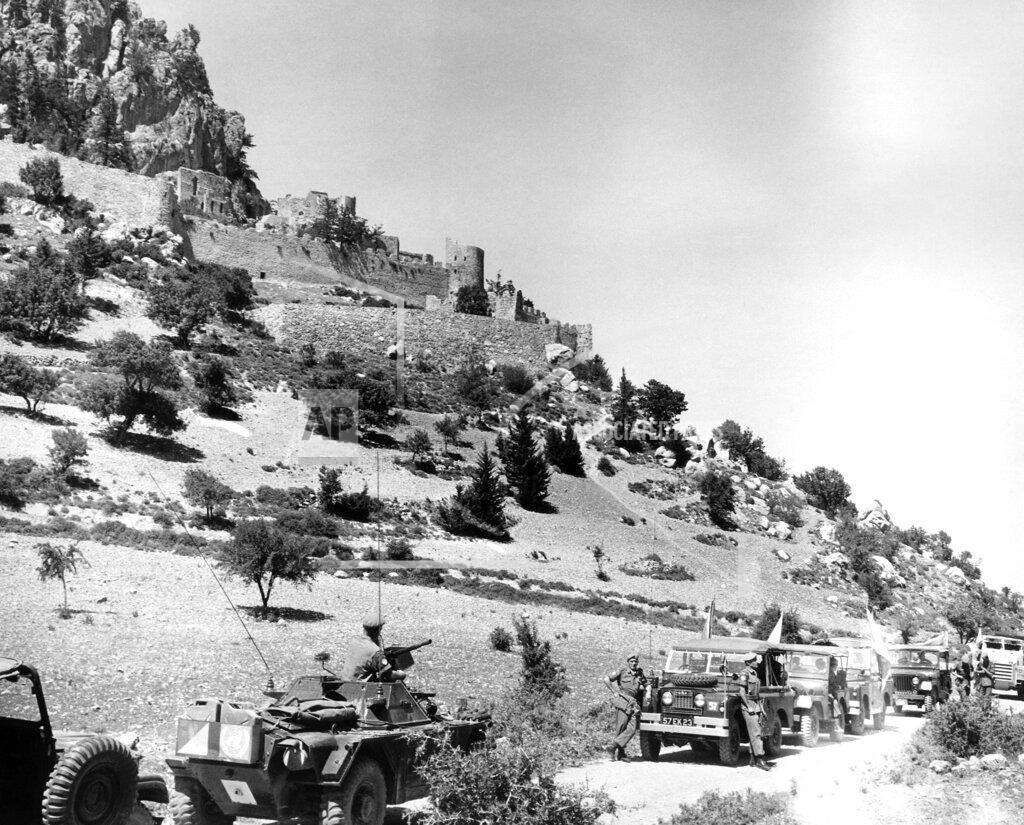
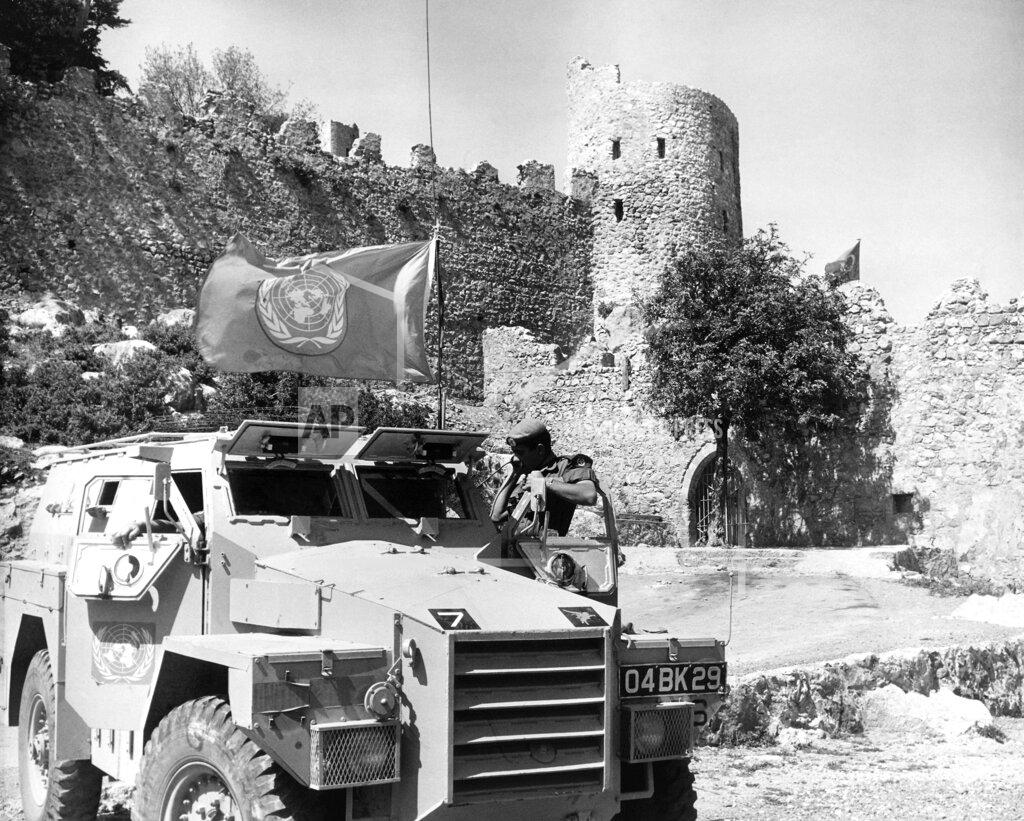
Members of the United Nations peace‐keeping force have disarmed, in the first such action, a group of Cypriote fighters. The action took place last night in the village of Timi, near Paphos, on the southwest coast of Cyprus when a United Nations patrol made up of Swedish soldiers was fired on for two hours by Greek Cypriote forces in the village. As a result of a Greek-approved cease‐fire, which appeared rather tenuous following today’s clashes, the world body established 12 new permanent posts along the mountain crest in the St. Hilarion‐Kyrenia Pass area and on both its northern and southern flanks. Although the patrol in the Timi incident last night identified itself in both English and Greek as a United Nations unit, 2,000 rounds were fired at it by the Greek Cypriotes, according to a United Nations spokesman.
The Swedes fired 45 shots in return. Later, when order was restored, the patrol entered the village and rounded up 40 Greek Cypriote irregulars between the ages of 18 and 20 and two policemen. The Greek Cypriotes were surrounded by four armored cars and 36 Swedish soldiers with their arms trained on the irregulars in the town square. The Swedes ordered the Greek Cypriotes to “lay down your arms.” Some of the irregulars complied; others did not. The Swedes then moved in and disarmed those who had refused the order. The Swedes turned over the arms of the irregulars to the police in Paphos and only returned the weapons of the two village policemen who were licensed to bear arms.
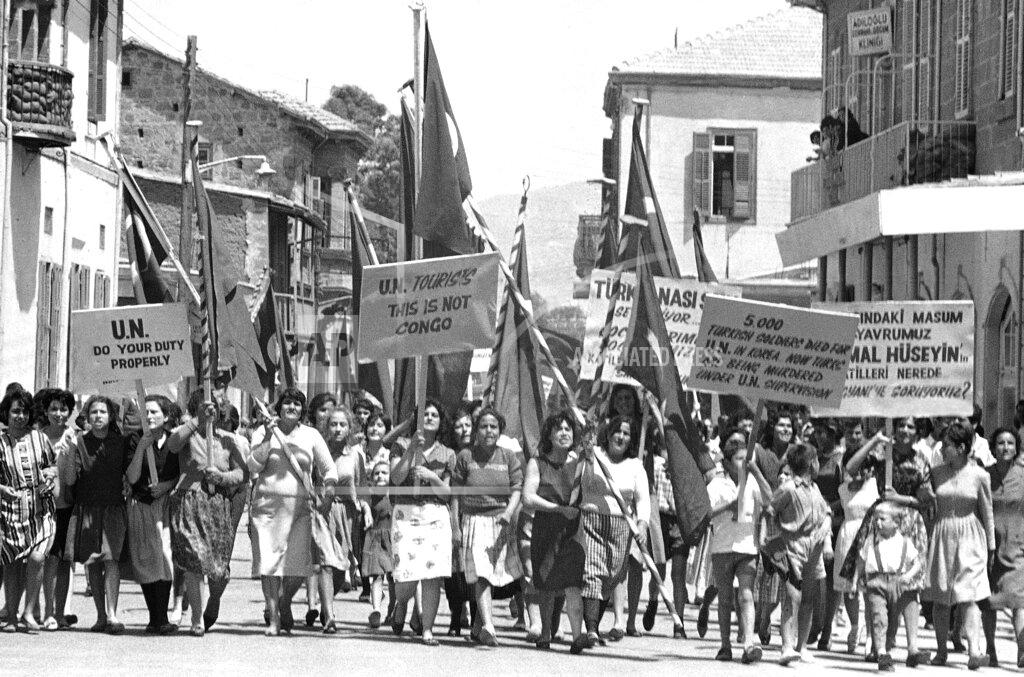
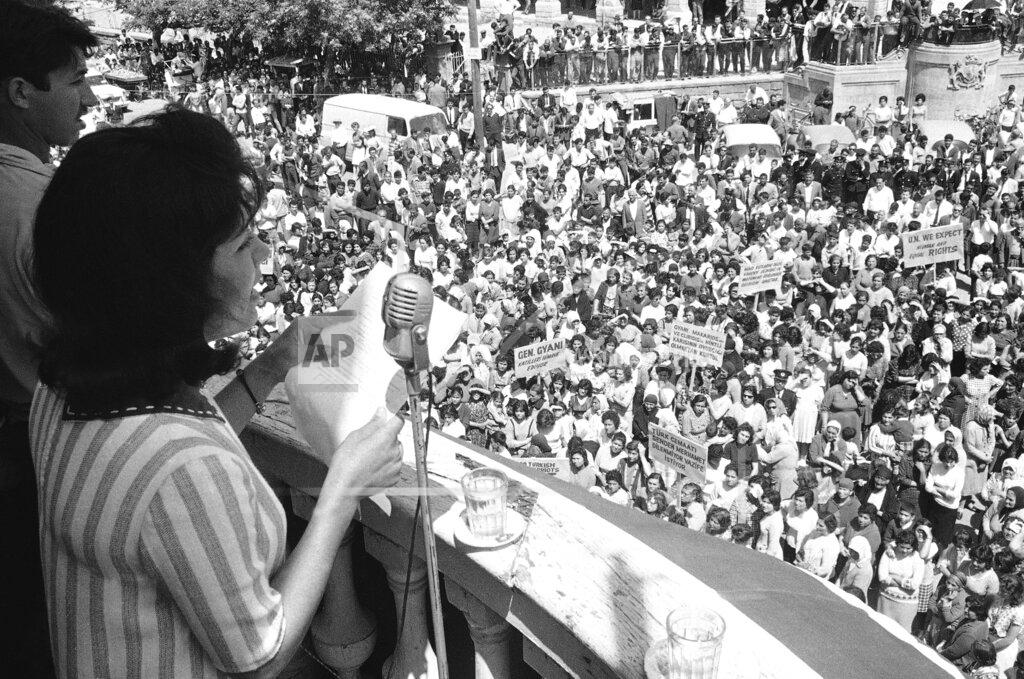
Today three Turkish Cypriotes were killed and two wounded in new clashes near St. Hilarion Castle above the Kyrenia Pass. The renewed violence on the mountain top near the pass began six hours after President Makarios had ordered the Government forces to cease fire, a unilateral move that was not reciprocated by the Turkish Cypriotes. A United Nations spokesman said Lieutenant General Prem Singh Gyani, commander of the peacekeeping force, expressed regrets over a United Nations communiqué last night that said the world body had been “unaware” of any cease‐fire arrangement in the St. Hilarion area. The spokesman said that General Gyani had been informed of the cease‐fire order by Archbishop Makarios, himself, when the general went to see him last evening. At the presidential palace in Nicosia a high official indicated this evening that there would be no military operations by the Greek Cypriote forces during the four‐day Orthodox Easter holiday, which begins tomorrow. He reiterated the governments assertion of last night that the operations in the mountains above the Kyrenia pass were designed to stop Turkish Cypriote harassment of Greek Cypriote villages below.
Most neutral observers believe the Greek Cypriotes’ plan was to capture the castle, which guards the pass on the west, and then seize the pass. The pass area, one of the most heavily defended Turkish Cypriote positions on the island, is the northern terminal point for Turkish Cypriote control of the Nicosia-Kyrenia Road. Its loss would be a serious blow to the Turkish Cypriotes. The aim of the new posts set up by the United Nations will be to discourage further firing by both sides and to discourage any advance on each other’s positions. Previously Canadian troops had patrolled the area, returning to their bases at nightfall. The Cyprus fighting erupted just before Christmas over proposals by Archbishop Makarios to amend the Cyprus Constitution so that the Turkish Cypriote minority’s veto powers would be ended. Later the Archbishop called for abrogation of the Treaty of Guarantee and the Treaty of Alliance signed with Britain, Greece and Turkey in 1960 when the former British colony achieved independence. The treaties permitted the three countries to keep troops on the island and to intervene if necessary to maintain the status quo.
About 75 special forces personnel from the Philippines will come to South Vietnam next month, informed sources said today. The sources confirmed a report published in the English‐language newspaper, The Saigon Post, that Philippine special forces would be sent here to train and advise Vietnamese troops in antiguerrilla warfare. The men would be experienced troops who had been involved in the successful campaign that eliminated the Communist Huk guerrillas a decade ago. Ngô Đình Diệm, when he was President, rejected a plan to bring Philippine units here. The idea had been suggested by the man who was then chief of United States intelligence in Saigon, John Richardson. The new plan calls for the Philippine troops to be distributed as advisers through a large number of Vietnamese units, rather than for them to be used as a single fighting force. The United States and Australia now have military personnel here helping Vietnamese forces learn and develop antiguerrilla techniques.
President Johnson and Secretary of State Dean Rusk have said recently that they would like to see “more flags” in South Vietnam. Mr. Rusk was understood to have discussed the question with Philippine officials when he was in Manila earlier this month. Meanwhile, special security precautions were ordered by United States official following a tip that Việt Cộng terrorists would attempt bomb attacks on May Day. A warning was issued to American military personnel to stay off the streets as much as possible and to avoid the United States Information Service building in central Saigon, which seemed to be a likely target.
Diplomatic Secretary of State Rusk flies to Ottawa, Canada, to make secret arrangements with J Blair Seaborn, Canada’s new representative on the International Control Commission; Seaborn will be visiting Hanoi in June and the United States wants him to convey to the North Vietnamese Government an offer of U.S. economic aid if it calls off its forces and support for the Việt Cộng.
Việt Cộng guerrillas penetrate Long An, a provincial capital, and capture 74 Việt Cộng defectors; other Việt Cộng raid Tân An and kill six women and five children.
In other action in South Vietnam, four United States Marines were wounded and a helicopter was downed. The guerrillas fired on a fleet of Marine helicopters taking South Vietnamese forces out of a battle area 35 miles west of the northern city of Da Nang. A Marine officer and an enlisted man were wounded in one helicopter, a spokesman said. A Marine enlisted man in another helicopter was also hit. The Việt Cộng fire knocked out the engine of a third helicopter. A crew member was wounded as it fell. The United States spokesman said the crew had destroyed the helicopter before they were rescued.
Prince Souvanna Phouma declared today that he had decided to remain as Premier of the coalition Government and to make a final effort to unify Laos. The neutralist Premier appealed to members of the Cabinet who had left the country to return to Vientiane so that the Government could exercise its full executive powers. “Their security will be fully assured,” he said. There are two neutralist and two right‐wing ministers abroad in addition to the Communist Pathet Lao ministers who are in territory held by their troops.
Prince Souvanna Phouma published his statement as he made efforts to reach accommodations with both the Pathet Lao and the right‐wing military revolutionary junta that seized control of Vientiane in a coup d’état April 19. The coup has complicated the task of the Laotian Premier, who for the last four years has sought to end civil strife in this Southeast Asian kingdom. Little hope is held here that in the coming months the Premier can do much more than maintain a precarious balance among the contending factions. The onset of heavy rains next month will limit military operations and ease some of the tensions. Little fighting has been reported since the Pathet Lao attack Monday that swept right‐wing and neutralist forces from Phou San, the key ridge on the northeast fringe of the Plaine des Jarres.
Premier Fidel Castro warned today against any more United States plane flights over Cuba, declaring: “We will defend our sovereignty, whatever it may cost and wherever it may happen.” He said he was ready to seek a peaceful solution to problems with the United States, but if Washington wanted war, “There will be war.” Premier Castro made the statement in a four‐hour talk with foreign reporters and diplomats at a Japanese diplomatic reception that lasted into the early morning. His remarks set the stage for an address he will deliver tomorrow at Havana’s big May Day celebration. Diplomats expect him to hit hard at the United States. The Soviet Union has supported Cuba’s protests on the flights. “We will prevent these flights to the limits of what our weapons can do,” Premier Castro asserted. In Washington, a State Department spokesman reaffirmed a determination to continue the surveillance flights.
Syrian merchants opened their shops this morning after the Government issued an ultimatum threatening to confiscate every shop that did not have shutters open by 10. Travelers from Damascus this afternoon said merchants in the capital ended their eight‐day strike quickly after the Damascus radio broadcast the ultimatum. A decree issued by Maj. Gen. Amin Hafez, President of the Revolutionary Council, in his capacity as military governor had warned that the contents of all stores that remained closed “for no legal reason” would be confiscated and store owners court‐martialed for “undermining state security.” During the day a military court in the northern city of Aleppo sentenced nine Syrians to death and 11 others to prison terms ranging between two years and life. The defendants, who included five retired sergeants, were part of a group that in March raided Aleppo’s police station, including the city’s military police post. General Hafez, in a news conference Saturday, said the attackers were agents of the United Arab Republic’s intelligence. Merchants in Damascus went on strike April 20 in protest against what they called Baathist ruthlessness in crushing an uprising in Hama, 150 miles northeast of the capital. The revolt was in protest against Socialist measures of the regime.
The Government of President Kwame Nkrumah has abandoned its barrage of anti‐American propaganda, which led to a serious strain in relations with Washington. For more than three weeks there has been a notable absence of the attacks in the Government‐controlled radio and press. Editorial assaults and Government‐sponsored demonstrations reached a peak in January and early February with the expulsion on charges of subversion of four Americans, who were visiting professors at the University of Ghana. The State Department strongly protested and recalled Ambassador William P. Mahoney Jr. to Washington for “urgent consultations.” The Ambassador’s recall and frank talks between Under Secretary of State W. Averell Harriman and President Nkrumah here four weeks ago undoubtedly influenced the Government. But the main factor, according to most American officials, was the Government’s realization that it needs large amounts of foreign capital to restore the country’s deteriorating economy.
The United States economy quietly set a record today that many observers consider more important than the glowing records reported monthly in the statistics on output. employment and income. With another month of good business completed in April, the economy today established a peacetime record in the duration of a period of expansion without recession. April was the 38th month of the current expansion, which began in March, 1961, beating the former record of 37 months in 1945–48. Some analysts maintain that the expansion from the bottom of the depression in 1933 to the recession in 1937 was longer, but this is generally regarded as a special case. Mass unemployment persisted throughout the period.
Every sign indicates that the present expansion, aided by the recent tax cut, has many more months to go, with both private and Government economists convinced that it will last through the rest of this year, at least. The record duration for expansion, established before and during World War II, is put at 84 months. One remarkable feature of the current expansion, in the view of most analysts, is that it has proceeded so long without any notable inflation. Although fears of a revival of inflation exist both in and out of the Government, the record to date shows six years of stability in wholesale prices and an unusually small upward movement of consumer prices, averaging about 1.3 percent a year. The consumer price index rose one‐tenth of 1 percent in March, the Labor Department’s Bureau of Labor Statistics reported today. But this increase only wiped out the slight decline of the price index that was reported for February.
Senate Democratic and Republican leaders were confident today that Southern opponents of the civil rights bill would permit a vote Wednesday on the jury trial amendment without first forcing the imposition of closure. The vote on this amendment will be the first substantive vote on the House‐passed bill. Senate debate began March 9. Both Senator Mike Mansfield of Montana, the Democratic leader, and Senator Everett McKinley Dirksen of Illinois, the Republican leader, told reporters that no agreement on a voting date had been reached with Senator Richard B. Russell of Georgia, the Southern leader. However, Mr. Mansfield said, “I’m very hopeful and very encouraged that we may get to vote on this amendment without closure.” He added that he hoped the vote would come “about the middle of next week.” Mr. Dirksen said he was “thoroughly encouraged that we’re going to vote next week.”
It was a day marked by conferences and confusion. In midafternoon the word was passed that an announcement would soon be made of an agreement to vote on Wednesday. But the announcement never came. Later, it was said that a parallel for what might be expected to happen next week could be found in what happened on March 26. On that day, after talking for 15 days against the motion to make the civil rights the formal pending business, the Southerners suddenly stopped talking and the motion was brought to a vote. Meanwhile, Senator Hubert H. Humphrey of Minnesota, the bill’s Democratic floor manager, provided an unscheduled divertissement. At the outset of the session, Mr. Humphrey told his colleagues that “the President has made it manifestly clear that he expects the Senate to do its work.”
“The President,” Mr. Humphrey went on, “wants a civil rights bill with the coverage and enforceability that are included in the House bill. He supports and recommends the House bill.” So far Mr. Humphrey was safely inside the guidelines of Administration policy for public pronouncements. But then, in an apparent effort to reassure those who have resisted the idea that the House bill must be adopted without change, he said: “But he expects the Senate to work its will, and that does not preclude amendments. I have said previously to Senators, and I say it now publicly, there will be amendments. I am sure the President will do his best, through whatever means he has as the leader of our country, to get an effective, workable civil rights law.”
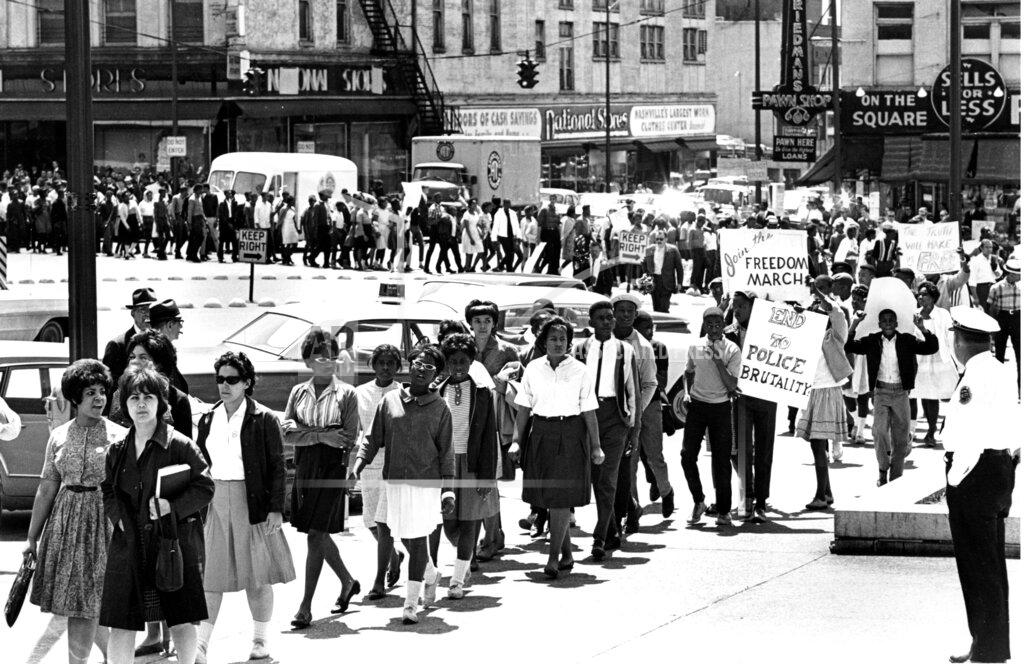
More than 100 Jewish business and civic leaders from 30 states today joined the mounting number of citizen groups that have come to Washington to support passage of the Administration’s civil rights bill. Leaders of the Senate coalition supporting the bill applauded the lobbying efforts, but Senator Jacob K. Javit s, Republican of New York, declared they were not enough. At a meeting of the bipartisan civil rights leadership in the Senate this morning, Mr. Javits said that it had become “crystal clear that the country is just not yet aroused, alerted, agitated, or excited enough about the bill to force it through now.” He warned: “Unless the bill is passed in the next six weeks, we will face serious disorders in many cities. We should not legislate under threats, but it is just as wrong for us to provoke demonstrations by denying any longer the elementary justice in this bill.”
Richard M. Nixon rejected today President Johnson’s offer to brief him on United States intelligence reports. The former Vice President said Mr. Johnson’s offer to keep possible Republican Presidential contenders informed would set a bad precedent. He said the offer should be made only to whomever the Republicans nominated. At a news conference here, Mr. Nixon said his experience had shown him that intelligence reports “weren’t worth much” when widely disseminated. “And if they’re any good,” he said, “they shouldn’t be.” Mr. Nixon, an unannounced candidate for the Republican Presidential nomination, arrived here this morning by plane from New York. Mr. Nixon said it would be “a major disaster for the Republican party,” if Mr. Johnson was elected in November. He condemned “defeatist” Republicans who, he said, were prepared to give up without a fight.
On his party’s candidate, Mr. Nixon said, “California will pretty much decide who will be nominated.” And he referred to Senator Barry Goldwater’s primary contest there against Governor Rockefeller on June 2 as a “political Armageddon.” “If Goldwater wins, and then marshals the support of Northern delegates, he has it all sewed up. But I don’t predict this,” he said. and continued: “If Goldwater loses, the nomination will go to some other candidate, but I don’t believe the convention will choose a man Goldwater doesn’t like.” Mr. Nixon referred to the write‐in victories of Henry Cabot Lodge, Ambassador to South Vietnam, as “primary sideshows,” and he called Mr. Goldwater’s collection of pledged delegates “the real ball game.” At a party fund‐raising dinner tonight attended by 2,000, Mr. Nixon attacked the Johnson foreign policy and foreign aid programs. He said they constituted a nation‐by‐nation “rollcall of disaster and defeat.”
Governor Rockefeller said tonight that he was baffled by the Presidential candidacy of Henry Cabot Lodge, “a person who isn’t there.” Mr. Lodge is Ambassador to South Vietnam. Governor Rockefeller, ending a long day of campaigning in the West Virginia primary with a news conference and reception, told a questioner that Mr. Lodge’s candidacy posed a “complicated situation.”
“It is very interesting and very difficult,” he said, “to handle a person who isn’t there, who says nothing on any issues, who is in an area of the world that is an area of deep concern to the American people and who also is working for the opposition or for the Administration in power.” These remarks reflected the feeling of the Governor and his staff that he would have won the New Hampshire primary had Mr. Lodge not been a write‐in candidate there; and that they could win the Oregon primary if the Ambassador were not involved in that state.
Ambassador Henry Cabot Lodge has left an impression in Washington that he intends to remain in South Vietnam at least until June and probably until it is clear whether he can win the Republican nomination for President. Mr. Lodge is said to have conveyed this impression in recent conversation and communication with high Administration officials. It means that he will not use his expected victory in the Oregon primary May 15 as a reason to enter the campaign and that he will make no decision until well after the California primary on June 2. Senator Barry Goldwater of Arizona is a slight favorite to defeat Governor Rockefeller in the important California contest. Mr. Lodge, who has won the New Hampshire and Massachusetts primaries, is not in contention in California because no write‐ins are permitted.
Arnold S. Zander, the founder of the 220,000-member AFL-CIO State, County and Municipal Employees (SCME) and its President since 1936, was defeated by challenger Jerry Wurf by a margin of only 21 votes at the labor union’s national convention in Denver. The final vote was 1,450 for Wurf, and 1,429 for Zander. Delegates then approved Wurf’s motion to declare Zander “President Emeritus”, with the full $21,000 annual salary until retirement.
Dow Jones Industrial Average: 810.77 (-2.04).
Born:
Tony Fernandes, Malaysian businessman (AirAsia), in Kuala Lumpur, Malaysia.
Barrington Levy, Jamaican reggae musician and singer (“Englishman”), in Clarendon, Jamaica.
Jeff Reboulet, MLB second baseman, shortstop, and third baseman (Minnesota Twins, Baltimore Orioles, Kansas City Royals, Los Angeles Dodgers, Pittsburgh Pirates), in Dayton, Ohio.
Jon Shields, NFL guard (Dallas Cowboys), in Vancouver, Washington.
Died:
Howard Buffett, 60, American businessman and politician, father of Warren Buffett.
 History Diaries