
The United States proposed a $4 billion assistance program for the most economically distressed countries. The wide-ranging proposal was submitted to the United Nations in a special session of the General Assembly on raw materials and development. It would have the industrialized countries and affluent oil producers provide emergency help over the next year and a half in the form of grants and loans, but also would include commodity assistance such as food, oil and fertilizer.
Secretary of State Kissinger arrived in Alexandria, Egypt, and immediately conferred with President Anwar Sadat as part of an effort to build broad support for a compromise troop separation agreement between Israel and Syria. The mood for the meeting, held at a time of rapidly improving Egyptian‐United States friendship, was symbolized by Mr. Sadat when he told the new Mrs. Kissinger, “You’re among Henry’s family.” The two discussed the Middle East situation, including Mr. Kissinger’s ideas for bringing about Israeli‐Syrian disengagement when he begins shuttling between Jerusalem and Damascus later this week. Mr. Sadat and Mr. Kissinger later had a private dinner with their wives at a villa east of this city on the Mediterranean.
Earlier in the day, he completed talks with President Houari Boumediene of Algeria, and as he left, he told newsmen that he had “increased hope” for the success of the talks. As he was leaving Algiers this afternoon, Mr. Kissinger told newsmen that he now had “increased hope” for the success of the disengagement talks as a result of what he called the “understanding and support” given to him by Mr. Boumediene. Aboard the Air Force Boeing 707 jet between Algeria and Egypt, a senior American official said that the talks with Mr. Boumediene had had the same goal as those yesterday in Geneva with the Soviet Foreign Minister, Andrei A. Gromyko and tonight and tomorrow with Mr. Sadat: to gain support for a Syrian compromise on disengagement.
Fighting flared again between Israel and Syria in the Golan Heights today as Israeli leaders worked out their strategy for talks with Secretary of State Kissinger later this week. Deputy Premier Yigal Allon called the latest phase in the seven‐week battle along the Golan front a serious escalation of the conflict. Visitors at the front today saw Israeli jets swooping for more than an hour to bomb and fire rockets at Syrian targets on the slopes of Mount Hermon.
On the ground, Israeli and Syrian artillery battled at intervals throughout the day across the ceasefire line. Syrian shells crashed into Israeli‐held territory. A military spokesman said that one soldier had been wounded. The clashes followed a heavy air battle yesterday, with Israel reporting the downing of four Syrian MIG‐21’s. The spokesman said two Syrian soldiers were killed last night in a clash with an Israeli patrol east of the salient conquered by the Israelis last October.
In Jerusalem, officials predicted that one of Secretary of State Kissinger’s priority objectives would be to halt the Golan battles before moving on to try to close the gap between the two countries over separation of forces. Israel’s Ambassador to Washington, Simcha Dinitz, who flew here to prepare for Mr. Kissinger’s visit, said he expected the negotiations to be tough. Officials in Tel Aviv regard the abandoned town of El Quneitra, in Israeli‐occupied territory, as the key to the success or failure of Mr. Kissinger’s mission.
There have been press reports in Israel that the United States supports Syrian demands that Israel relinquish the rained town, situated just west of the 1967 cease‐fire line, as part of a disengagement agreement. Israeli proposals submitted in Washington by Defense Minister Moshe‐Dayan recently involved Israeli territorial concessions in the salient occupied last October but not to territory captured in the six‐day war of 1967. Israeli officials said there also were serious differences over the nature of a United Nations presence in a proposed buffer zone to separate the two armies. They said the Israelis insisted on troops of the United Nations Emergency Force in such a zone, while the Syrians wanted unarmed United Nations truce observers.
The Lebanese Defense Ministry reported that Lebanese troops exchanged fire for two hours today with an Israeli force that encroached on Lebanese territory near Mount Hermon. A communique broadcast by the Beirut radio said one Lebanese soldier had been wounded.
South Vietnamese bombers attacked North Vietnamese long-range guns inside Cambodia after more than 1,000 artillery shells hit a government outpost on the Vietnamese side of the border, according to Saigon military sources. The sources said the bombers flew about 30 strikes against the Soviet-built 130-mm. guns, which have a range of 17 miles and are the biggest in the North Vietnamese arsenal. South Vietnamese infantrymen supported by armor and heavy air strikes crossed two and a half miles into Cambodia in a raid aimed at North Vietnamese gun positions bombarding Government outposts on the Vietnam side of the border, military sources reported today. The sources said that South Vietnamese warplanes and artillery had bombarded North Vietnamese positions on both sides of the Cambodian border to the west and northwest of Saigon before the raid. According to the cease‐fire agreement, both North and South Vietnam are required to “respect the neutrality of Cambodia.” But the Saigon command has said that it reserved the right of “hot pursuit” into Cambodia.
China, the world’s most populous country, will take a day off today to celebrate the traditional Communist holiday of May Day. Peking, which does not have a parade, will be turned into a city of carnivals, with a host of song-and-dance performances and colorful sideshows in the numerous parks. The festivities will be dampened by the current drive to wipe out antisocialist ideas and practices.
Irish extremists looking for weapons burst into an isolated farmhouse in County Down, about 30 miles south of Belfast, seized a shotgun and then burned the house down while the farmer looked on, police said. In Ballymena in County Antrim security forces defused two powerful suitcase bombs. Army officials said the bombs could have caused havoc in the city’s business district.
Irish police seeking the $20.4 million art treasures stolen from the home of Sir Alfred Beit said a newspaper relayed to them a telephoned ransom demand for distribution of $12 million worth of food in the African Congo. Police said they were not taking the call very seriously but are investigating it along with a number of other anonymous calls. Beit, meanwhile, told newsmen the paintings were insured for less than $2.4 million because of high insurance costs.
House of Commons leader Edward Short said in London that he had received $600 from a local party boss now jailed for six years on corruption charges but said it was repayment for legitimate expenses. Short, deputy leader of the Labor Party, released a statement after Newscastle party boss T. Dan Smith said in a television interview he paid Short the money for services as a public relations consultant. Short said he never worked for Smith and that the money was reimbursement for expenses for party work.
Italy, in an unexpected and one-sided move, imposed severe restrictions on all imports of manufactured goods. The measure, aimed at fighting inflation and bolstering the lagging lira, caused consternation among Italy’s partners in the European Economic Community, who pleaded with the government to at least postpone the decision.
In West Germany, nine construction workers were killed and 11 seriously injured in the collapse of a new overpass, being constructed over an autobahn between Kempten and Ulm in Bavaria. Workmen were pouring concrete into forms on top of an autobahn bridge under construction in Bavaria when the structure collapsed, plunging at least 27 workers 50 feet to the ground where wet concrete and debris piled up on most of them. Nine were killed and 11 seriously injured. A team of Munich engineers: had given the go-ahead to pour concrete on the 200-foot span on the new superhighway between the resort town of Kempten and the city of Ulm.
The permanent U.S. representative to the Organization of American States asked that the hemispheric group speed up its efforts to restructure itself. William S. Mailliard told the OAS General Assembly on the eve of the end of its 12-day session in Atlanta that a faster pace on reform efforts begun last year was needed to “clear up some of the roadblocks to inter-American cooperation.”
Luis Acevedo Andrade, the General Secretary of the Communist Party of Chile and former mayor of the Chilean town of Coelemu, was arrested by Coelemu police and then transferred to the custody of the police in the larger city of Concepción. Acevedo would never be seen in public again, becoming one of the “desaparecidos” during the rule of dictator Augusto Pinochet.
The U.N. General Assembly rejected the credentials of South Africa’s delegation to the current special session on raw materials but acquiesced in a presidential ruling that the move did not affect South Africa’s rights as a U.N. member. Assembly President Leopoldo Benites of Ecuador said the 86-26 vote was tantamount to a condemnation of South Africa’s racial policies. The Western powers opposed the motion, which was made by Syria.
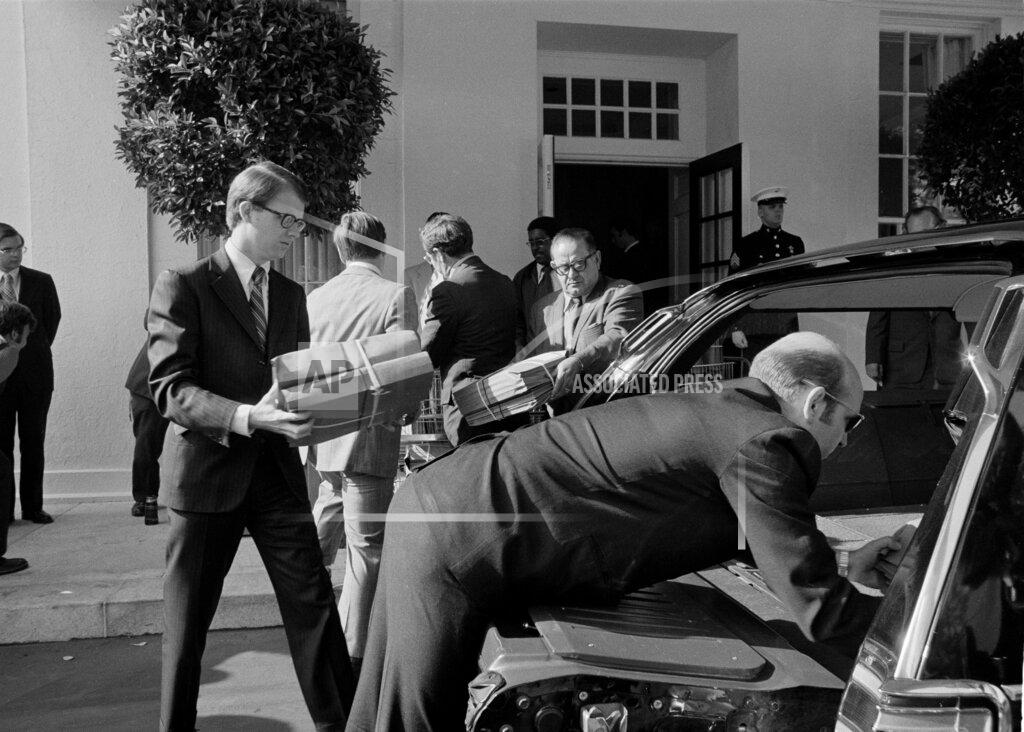
The transcripts of the recordings of President Nixon’s Watergate conversations show that Mr. Nixon never discouraged the payment of hush money to one of the Watergate conspirators. They depict Mr. Nixon as having been primarily interested early last year in keeping the facts of the Watergate case from becoming public, but as having been indecisive on the best way of accomplishing it.
Democrats on the House Judiciary Committee are weighing a formal move to cite President Nixon for “noncompliance” with the committee’s April 11 subpoena of White House tape recordings. But most Republicans on the panel are balking at the legal challenge to the President, and a number of them expressed qualified acceptance of the White House substitution of 1,308 pages of edited transcripts for the subpoenaed tapes.
The White House declared that President Nixon was never criminally liable in the Watergate cover-up attempt despite statements he made in conversations with key figures in the scandal. The White House made the declaration in a 50-page legal argument accompanying the release of the edited transcripts.
“Blemishes and all,” President Nixon said and he warned of ambiguities, embarrassments and brutal candor in the 1,308 pages that provide perhaps the closest look outsiders have ever had of a President in private and certainly of the private Richard Nixon.
President Nixon will refuse to yield tapes and documents sought by the Watergate special prosecutor. The President’s Watergate lawyer, James St. Clair, told newsmen that he would move to quash the prosecutor’s subpoena, which was authorized April 19. When asked on what grounds he would try to suppress the special prosecutor’s subpoena, Mr. St. Clair mentioned two: that of the confidentiality of Presidential communications, and that the special prosecutor, Leon Jaworski, had not shown that the material he wanted was necessary for the prosecution of his case against seven former associates of President Nixon. Those seven men are accused of taking part in or lying about a conspiracy to cover up involvement in the 1972 break‐in at Democratic National Committee headquarters at the Watergate office building. “I firmly believe,” Mr. St. Clair said, “that Mr. Jaworski would not have indicted those people if he did not have enough evidence to convict them.” Therefore, he implied, there was no need for further evidence.
Judge John J. Sirica refused today to disqualify himself from presiding at the Watergate cover‐up conspiracy trial of seven top former aides to President Nixon and in his re‐election campaign five of the seven defendants, whose tentative trial is set to begin in September, had filed motions to have Judge Sirica removed from the case, charging among other things, a pro‐prosecution bias. In response, Judge Sirica turned down the motions on every point raised by the defendants. The attempt to remove him from the case was made by former Attorney General John N. Mitchell; former White House counsel Charles W. Colson; John D. Ehrlichman, President Nixon’s former domestic affairs adviser; Kenneth Wells Parkinson, a lawyer for the re‐election campaign committee; and Gordon C. Strachan, a liaison man, between the committee and the White House. “Every action, decision and comment of the court cited by defendants arose in the course of official judicial activities,” Judge Sirica said. He noted that the five defendants had made much of his comments in the original trial of the men who broke into the Democratic party’s headquarters in the Watergate office building in June, 1972.
The last of the Phase III wage and price controls implemented by U.S. President Nixon came to an end with the expiration of the statutory authority, after failing to stop the increase of inflation. With many a dry eye in both houses, Congress went about its business routinely today and let pass into history the nation’s first comprehensive peacetime wage and price controls. The enabling legislation, the Economic Stabilization Act, which was thrust upon a reluctant President Nixon by a Democratic Congress in May, 1970, expired at midnight. That ended the relatively‐few areas of controls that had not already been terminated by the Cost of Living Council. Among the industries whose controlled prices and wages ended were machinery, steel, copper, state and local government, construction, health care and food processing. The inability of controls to stop inflation, combined with labor’s belief that wages have been held down more than prices, were the principal reasons that Democrats in Congress soured on controls. Liberal Democrats such as Senator Birch Bayh of Indiana, who a year ago proposed a freeze of food prices, now favor letting all controls lapse.
Farm prices declined 6 percent in the month ended April 15, the second consecutive monthly decrease, holding out the hope for some relief for shoppers at supermarket counters. The Farm Price Index, at 183, was 20 points, or about 10 percent, below the peak reached in February and 11 points below the March level.
Attorneys for indicted Senator Edward J. Gurney (R-Florida) asked a Florida court to dismiss a charge that he violated a state campaign contribution reporting law on the grounds that the law was so vague it would expose him to new prosecution for the same offense regardless of the case’s outcome. The attorneys criticized the indictment as unlawful because the grand jury heard testimony from an “unauthorized witness,” presumably a state representative supporting a state senator seeking Gurney’s seat.
The Labor Department has been delaying carrying out the legal mandate to help Vietnam veterans get jobs, William H. Kohlberg, assistant secretary of labor for manpower, admitted to the Senate Veterans’ Affairs Committee. He said the department was now doing a better job because of the panel’s prodding. Committee Chairman Vance Hartke (D-Indiana) said that during 1973 and so far this year, the unemployment rate for veterans aged 20 to 24 had been significantly higher than for nonveterans in the same age group.
An Amtrak passenger train, the Floridian, derailed near the northern Indiana community of Winamac, injuring 29 of the 121 persons on board. Twenty-seven of the injured were treated and released from the Pulaski County Memorial Hospital. The other two did not require hospital treatment. The train was en route from Miami to Chicago.
A Metro Airlines turbo-prop crashed on takeoff at Galveston, Texas, airport. Officials said six persons were killed and six were injured in the crash.
An unidentified man climbed over the White House’s 8-foot-tall wrought iron fence along Pennsylvania Ave. and strolled to the front portico of the Executive Mansion before being tackled by guards. The incident occurred minutes after President Nixon left by auto for a hotel where he was to address a U.S. Chamber of Commerce meeting.
A Rhode Island prison inmate has been charged with breaking an institution rule by allowing his 5-year-old son to stay overnight with him in the minimum-security building. A prison official said Gerard T. Ouimette, 33, if found guilty could be reassigned to a facility with tighter security. Desk officers are supposed to keep a record of visitors and should have been aware the boy had not left at the end of visiting hours, the prison official said. Ouimette, of Providence, was sentenced to five years on May 29, 1969, for possessing a gun after being convicted of a violent crime.
Agnes Moorehead, the actress, died yesterday in the Methodist Hospital in Rochester, Minnesota, where she had been under the care of Mayo Clinic physicians. She was 67 years old. Although Miss Moorehead was perhaps best known to modern audiences as Endora, the witch, in the television series, “Bewitched,” she was a highly versatile actress who was equally at home on television or radio as on the stage and in the movies.
Nolan Ryan of the California Angels strikes out 19 batters in a 4-2 win over the Boston Red Sox. Ryan ties a record established by Hall of Famer Tom Seaver for the most strikeouts in a single game. During the game, after trying to lay down a bunt, Doug Griffin is knocked unconscious by a Nolan Ryan fastball, resulting in the Red Sox second baseman missing two months of the season with a concussion and suffering temporary hearing loss. The beaning, which most likely led to the premature end to the Boston infielder’s career, makes the Angel right-hander rethink his role as an intimidator on the mound.
Dow Jones Industrial Average: 836.75 (+1.33, +0.16%).
Born:
Cedric Jones, NFL defensive end (New York Giants), in Houston, Texas.
Chris Darkins, NFL defensive back (Green Bay Packers), in San Francisco, California.
Died:
Agnes Moorehead, 73, American stage, film and TV actress best known as “Endora” on the popular TV series “Bewitched,” of uterine cancer.
Pál Szécsi, 30, Hungarian popular music singer, committed suicide.




 History Diaries