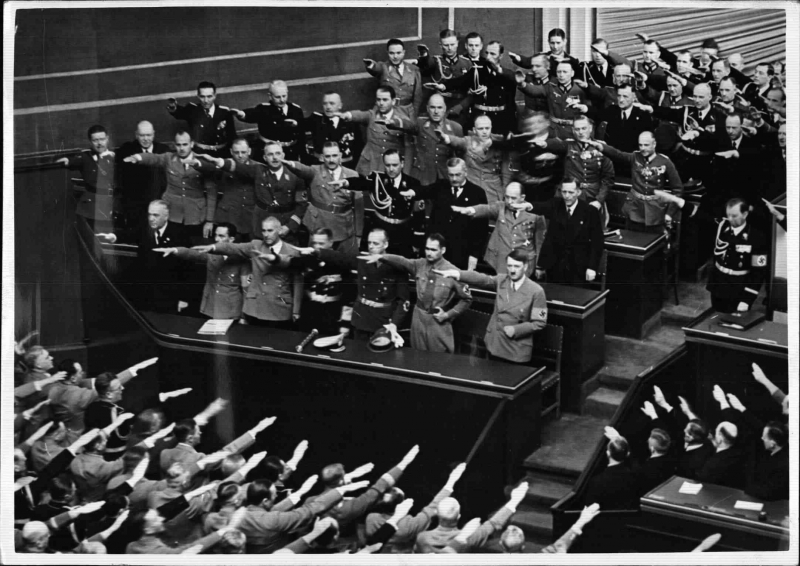
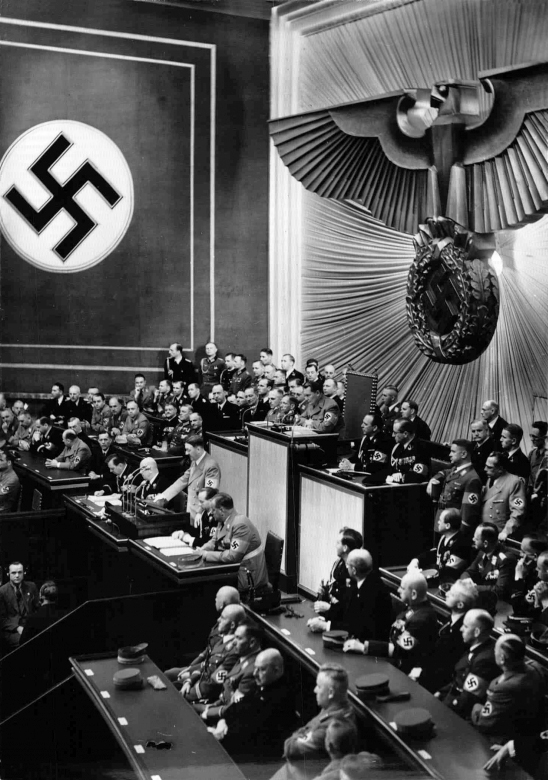
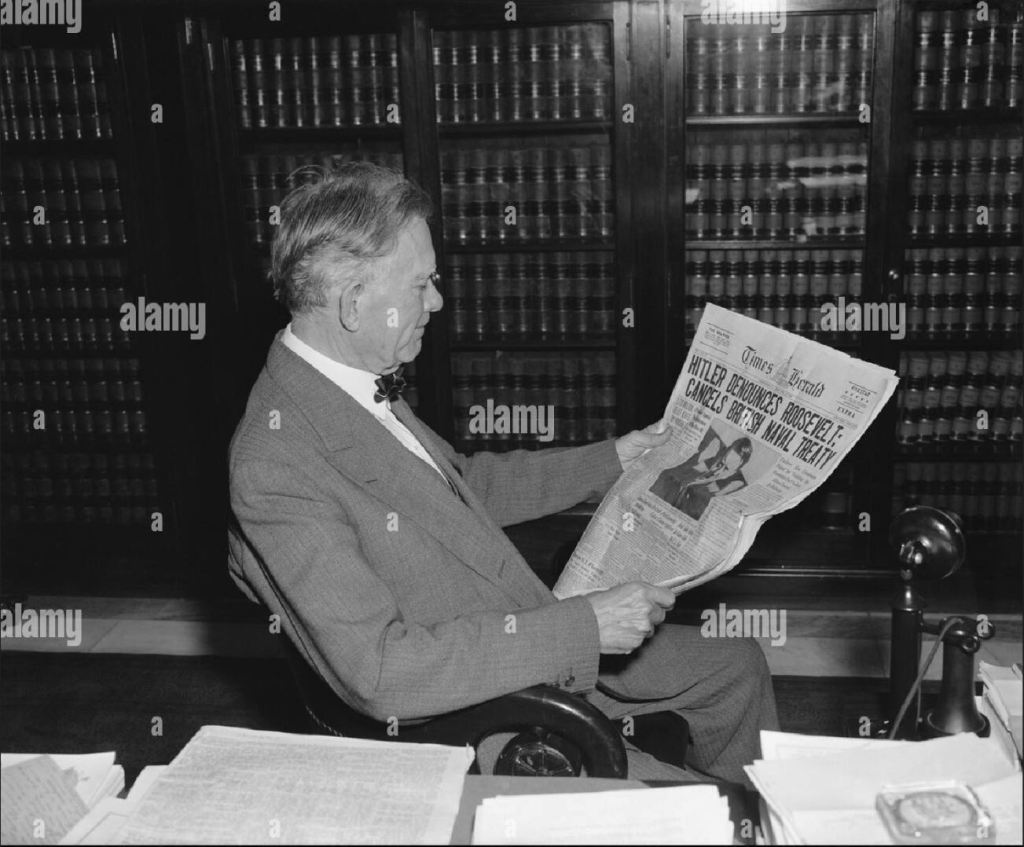
Hitler made a speech to the Reichstag, meeting in the Kroll Opera House in Berlin, renouncing the Anglo-German Naval Agreement and German–Polish declaration of non-aggression, yet offered to negotiate new non-aggression pacts with any nations that asked for them. Hitler evoked laughter in the Reichstag by reciting, in exaggerated and sarcastic tones, the thirty-one countries that President Roosevelt had listed in the telegram of two weeks earlier. He officially renounces the Anglo-German Naval Treaty of 1935, which had restricted the German navy to one-third the size of the Royal Navy, as well as the German-Polish Non-Aggression Pact of 1934, accusing the British and Polish governments of attempting to “encircle” Germany. Chancellor Hitler also renewed his demands on Poland regarding Posen and Danzig and offered bilateral non-aggression pacts to the Scandinavian and Baltic states.
Chancellor Hitler, in a scornful speech before the Reichstag, denounced three treaties, replied in critical tones to President Roosevelt’s truce proposal and defended his actions in Europe. One pact he abrogated was the non-aggression treaty with Poland, and at the same time he emphasized he wished the return of Danzig and cession of a right-of-way across Pomorze. Another accord he canceled was the Anglo-German naval treaty, and the third was the Munich consultative agreement with Britain. To Mr. Roosevelt, the Chancellor declared he was ready to pledge non-aggression to the thirty-one nations named by the President provided such pledges were reciprocal and the other nations took the initiative.
Poland’s reaction was one of firm refusal to cede any territory and of renewed military precautions. The memorandum from the Reich government outlining its views in the present state of Polish-German relations was delivered to the Foreign Office here today by the German Charge d’affaires at the very moment Chancellor Hitler began his speech. No information is obtainable by the press as to the contents of the memorandum but official circles declare that it will be examined carefully and attentively. There is a tendency to regard the document as a preliminary step to the opening of new negotiations between Poland and Germany with a view to concluding a new agreement replacing the 1934 non-aggression pact that Herr Hitler denounced today.
The Poles, it is understood, are prepared to negotiate a new understanding and to discuss the Danzig problem but under normal conditions without pressure or intimidation.
Poland intensified her military precautions at the Polish-German frontier where many of Poland’s 1,300,000 men now under arms are stationed and military activity especially was noticeable near Danzig, The Associated Press reported.
The memorandum, it is believed, repeats in more diplomatic form the views Herr Hitler expressed in his speech and declares that the non-aggression pact must be considered non-existent because it was violated by the Poles when they entered an agreement with Britain. Official circles explained that so far as Danzig is concerned the Germans, during the last five years, have always maintained that the fate of this provincial city was of minor importance to them but that the Danzig problem should not adversely affect Polish-German relations and undermine the non-aggression agreement. As far as German communications through the so-called Corridor, they have always been treated favorably by the Polish Government although Germany violated certain conventions in connection with traffic such as, for instance, the prompt payment for railroad transit.
The extra-territorial road through the Corridor is out of the question, it was added. Such a demand, it was said, had already served the Germans as a pretext to disrupt a neighboring country; such methods could not be applied to Poland. The Polish-German non-aggression pact, it was further said, was a bilateral arrangement and a unilateral denunciation of the agreement was sure to provoke a strong reaction. Germany never received the right to decide what was best for Poland’s interests, it was added, and the 1934 pact could never be interpreted as preventing Poland’s cooperation with the western powers.
The question of whether the Polish-British agreement was contrary to the non-aggression pact should be left for diplomatic exchanges, it was said. In this case such exchanges were rendered impossible by the fact that since April 6 — the date of Prime Minister Neville Chamberlain’s pronouncement of the Polish-British guarantee — diplomatic contacts with the Reich government have been cut off because Foreign Minister Joachim von Ribbentrop would not see the Polish Ambassador, Josef Lipski, and the German Ambassador here, Hans Adolf von Moltke, never returned from his Easter vacation.
Rumors circulated in Rome that Premier Mussolini might follow his partner’s lead by denouncing the Anglo-Italian agreement. Amid a general fear of an approaching war, which Chancellor Adolf Hitler’s address intensified here today, came rumors that Italy might in her turn denounce the Anglo-Italian Pact of April 16, 1938. These reports, however, must be taken cautiously and they cannot be confirmed in official quarters. These reports are, perhaps, more symptomatic of the rising tension in Italy since the announcement of British conscription than a true foreshadowing of events to come. But something is expected. Herr Hitler’s reply to President Roosevelt was very different from Premier Benito Mussolini’s mild protestation of peace, and there may well be some move from this end of the Axis to bring Italy’s policies into line with Germany’s.
Herr Hitler’s speech has been interpreted by the ordinary Italian as another step toward war and from that viewpoint it has brought regret and disappointment. Such feelings, of course, are not expressed in official circles or in the first reactions that are to be found in the press. Herr Hitler’s reaffirmation of the strength of the Axis echoes what is constantly being said here and because of that the official attitude on everything that Herr Hitler states is praise as a matter of policy. The newspapers reflect the same attitude and outwardly one gets the impression of complete harmony.
London found the speech had done nothing to relieve the tension. The British Government pushed ahead today with its conscription plans and its defensive alliances in spite of the comparatively mild and almost apologetic tone of certain passages in Chancellor Adolf Hitler’s speech. Prime Minister Neville Chamberlain met his leading Cabinet colleagues to discuss the draft of the conscription bill that will be published Monday night and debated in the House of Commons Thursday. At the same time British diplomacy showed no signs of slackening in its efforts to bring Russia and Turkey into the anti-aggression front of Europe.
Soviet Ambassador Ivan M. Maisky returned to London today from his consultations in Moscow and found a message saying that Viscount Halifax, Foreign Secretary, would be delighted to see him at the Foreign Office at his earliest opportunity. So the two men arranged to compare notes tomorrow morning on the progress of the Anglo-Russian talks, which aim to create an Eastern front against Germany in case of war.
By coincidence or design, warships of the British Home Fleet, led by the battleship HMS Nelson, assembled at Portland today after their Easter leave. The ships concentrated while Herr Hitler was speaking, just as last September they arrived at their battle stations in Scotland on the day of the Nuremberg speech that helped to precipitate the Czech crisis.
Such friendly references as Herr Hitler made to Britain today may, no doubt, be reciprocated publicly by Mr. Chamberlain in the House of Commons next week. Taking a leaf from Herr Hitler’s book, the Prime Minister can say with perfect sincerity that he admired Germany’s past achievements and would regard war between Britain and Germany as a needless tragedy for mankind, but the British found nothing in the speech to justify even the slightest abandonment of their new policy, which has led them in six short weeks to assume military responsibilities to three countries in Eastern Europe and to impose compulsory military training at home.
Paris was somewhat encouraged yet was apprehensive over the danger spot at Danzig, while Moscow took solace in the thought that the Chancellor had divided Europe into two camps and thus removed the long-standing Bolshevik bogey.
Sudeten-German Nazis incite anti-Jewish riots in Jihlava (Iglau), Czechoslovakia. Many Jewish shops and stores are damaged.
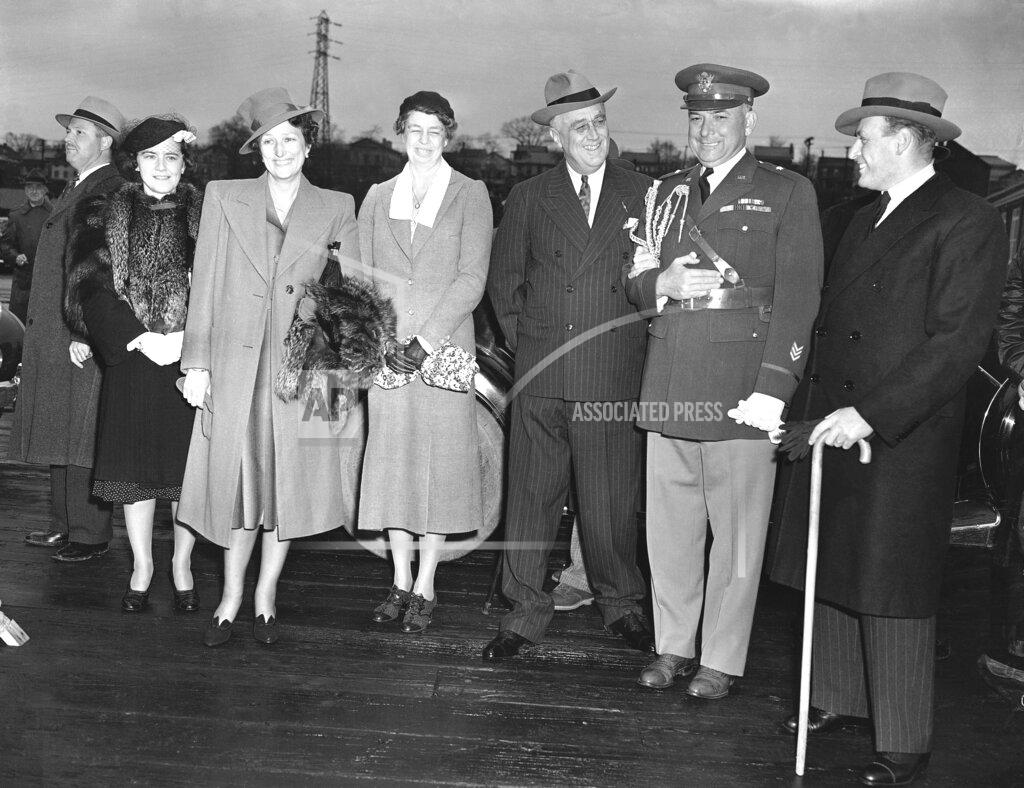
President Roosevelt greets his royal guests, Prince Olav and Princess Martha of Norway.
“It left the door about an inch open,” President Roosevelt commented on Chancellor Adolf Hitler’s reply to his proposal that the Rome-Berlin Axis pledge a ten-to-twenty-year guarantee of the territorial integrity of thirty-one European States, in which the Nazi chief called for specific proposals on the basis of absolute reciprocity.
The Chief Executive’s off-hand judgment, presumably directed at the opportunities for an amicably negotiated settlement of Germany’s demands within the limits of Chancellor Hitler’s statement of his attitude, was offered in response to a direct question from Crown Princess Martha of Norway as to what he thought of the speech.
Fewer than fifty persons were within earshot of the exchange that followed, and some of it was missed entirely amid the hub-bub that followed the handshaking and picture taking of the President and Mrs. Roosevelt with the Princess Martha and Crown Prince Olav and their entourage as they debarked at a lumber yard dock at Poughkeepsie. Without waiting for a formal introduction to the royal couple by George Summerlin, chief of protocol of the State Department, the President extended his hand in greeting first to the princess and then to the prince, just behind her. Cameramen maneuvered for position while keen-eyed Secret Service operatives and local and state police kept back the crowds.
“What did you think of Hitler’s speech, Mr. President?” inquired the Crown Princess. “Six o’clock in the morning is rather early, don’t you think?” Mr. Roosevelt parried first, referring to the hour the broadcast of the speech started here. Newspaper photographers and newsreel cameramen began jostling each other, and for a moment or two the President’s conversation was blanked out. Then he was heard by those closest to remark: “How can anyone have a reaction to a speech that lasts more than two hours?” The remark about the door being left open about an inch followed a few seconds later.
[Ed: Roosevelt is hopelessly naive if he thinks there is seriously still room for guarantees of peace.]
The Senate was in recess today in Washington. The Foreign Relations Committee heard proposals to amend the Neutrality Act. The Interstate Commerce Committee heard a witness testify that the Wheeler bill creating a special court for railroad reorganization would act as a brake against depressions.
The House also was in recess. Its Ways and Means Committee unanimously voted to recommend “freezing” for three years the old age security tax, under social security, at 1 percent instead of allowing it to go to 1½ percent as under existing law. The Foreign Affairs Committee continued hearings on proposals to amend the Neutrality Act.
The question of the constitutionality of a section of the revenue laws levying an income tax on the salary of Federal judges taking office after June 6, 1932, was laid before the Supreme Court today. Solicitor General Robert H. Jackson asked the court to sustain the section, while attorneys for Judge Joseph W. Woodrough of the Eighth Circuit Court sought its rejection. Judge Woodrough left the District Court in Nebraska on May 1, 1933, to become a judge of the Circuit Court of Appeals, at a salary of $12,500. In March, 1937, he and Mrs. Woodrough filed an income tax return but did not include the $12,500 in their gross receipts. As a result, the Internal Revenue. Bureau made an assessment which amounted, with interest, to $660. Judge Woodrough sued successfully in the Nebraska District Court for a refund. The government appealed to the Supreme Court.
The advance guard of World’s Fair visitors began to trickle through New York’s railroad terminals, bridges and tunnels today, with indications that many thousands would arrive for Sunday’s official opening. With the Weather Bureau predicting “probably fair” for Sunday, with more than thirty vessels of the Atlantic fleet nearing port, and with the Bronx-Whitestone Bridge to be dedicated tomorrow, Fair officials were confident that their estimate of an attendance of 1,000,000 for the opening day would be realized. Although the Fair will not be 100 percent ready, by any means, when the gates open, the management was satisfied that it would be as nearly ready as any other World’s Fair has been, or more so. They felt that this one will be so much bigger than previous fairs that even in its incomplete stage it will have so much more to see than anyone can possibly cover in a day that no one will be disappointed at the failure of some of the exhibits to be ready.
Bad weather in the last few weeks, labor troubles and the foreign situation were given as factors that have delayed construction and the receipt of exhibits in some cases. It was emphasized, however, that the buildings that will not open, or will open in a seriously incomplete condition, will be in a distinct minority. Even in the amusement zone, which is the most retarded part of the Fair from a construction standpoint, it was said that fifty-five or more attractions would be ready for business when the first-day crowds arrive. The management promised that the streets in the amusement zone would be satisfactorily paved by Sunday.
A new low-cost, two-cylinder automobile, designed for a top speed of fifty miles an hour and a gasoline mileage of fifty to the gallon, was introduced to distributors and newspapermen today at the Indianapolis Motor Speedway by Powel Crosley Jr., Cincinnati manufacturer and owner of the Cincinnati Baseball Club. Radical in design, the car will sell f. o. b. for $325 for the two-passenger convertible coupe and $350 for the four-passenger convertible sedan, the only models in which it is to be manufactured, at Richmond, Indiana. The car will be manufactured in Cincinnati as well, but Richmond will be the final shipping point.
It is said that the car will accommodate persons taller than six feet, although the automobile itself is only ten feet long from bumper to bumper, mounted on a wheelbase of eighty inches. It has three speeds forward and reverse, four-wheel mechanical brakes and is equipped with safety glass. The two-cylinder engine is of a light aviation four-cycle type. An aviation-type suction blower, an integral part of the flywheel, provides air cooling. The drive shaft runs straight to the rear axle without going through universal joints as in the conventional car. The Crosley automobile weighs only 925 pounds and has a gasoline tank of four-gallon capacity which is estimated to be at least a 200-mile fuel supply. The crankcase holds only two quarts of oil. The gear shift and steering arrangements are not essentially different from those of other makes.
At Crosley Field, the Cincinnati Reds skin the Chicago Cubs again, as Ival Goodman hits a 3-run homer in the 9th, good for a 7–6 win.
General Duan Lang ordered his Chinese 79th Division to disengage south of Nanchang, Kiangsi (today Jiangxi) Province, China after suffering high casualties during a Japanese counterattack. Fifteen Chinese divisions, which since Sunday have been attacking Japanese lines extending from south of Nanchang to the vicinity of Kaoan, today abandoned this drive and began a general retreat in the whole sector, according to a semi-official announcement from Nanchang tonight. The Chinese were said to have abandoned 900 dead on the Kaoan front west of Nanchang, the former capital of Kiangsi.
The Japanese military spokesman in Shanghai today denied the Chinese had recaptured Kaoan. He declared the Chinese troops had not been nearer than twelve miles of Kaoan or Nanchang. The last Chinese attacks on Nanchang, he said, were on Tuesday and Wednesday thirteen miles south of the city and all were beaten off. The last attack at Kaoan, he declared, was made Wednesday when about 1,000 Chinese troops launched an assault. He said the Chinese, after being beaten off, fled to the northwest. He asserted the Japanese line was intact, from a point thirteen miles south of Nanchang to a point twenty miles west on the Nanchang-Kaoan Highway.
The Japanese spokesman charged today that Chinese guerrillas were resorting to poison and bacterial warfare. He said food poisoned with arsenic had arrived at Nanking on a string of junks from the Hohsien area in Anhwei Province. He charged that in Nanking fifty persons were poisoned, suffering from within an hour after eating rice and twenty-six horses died in Nanking after eating barley. In a village outside Nanking’s walls near Sun Yat-sen’s tomb he said thirteen horses died after eating barley from the same shipment. Japanese troops occupy the town of Hohsien but most of the territory between Hohsien and Nanking is completely controlled by Chinese guerrillas.
Japanese airplanes have been bombing Fukien and Chekiang Province cities along the Chinese coast throughout the week, possibly in preparation for naval action to close the last open Central and South China ports. The casualties in Foochow and Wenchow were estimated at several hundred. One bomb was reported to have killed 100 persons who were in a hotel at Foochow awaiting ships.
Dow Jones Industrial Average: 128.38 (-1.40).
Born:
Hank Whitney, ABA power forward (New Jersey Americans, Houston Mavericks-Carolina Cougars), in Brooklyn, New York.
Naval Construction:
The Royal Navy Fiji-class (Crown Colony-class) light cruiser HMS Jamaica (44) is laid down by Vickers Armstrong (Barrow-in-Furness, U.K.).
The Nihon Kaigun (Imperial Japanese Navy) minelayer HIJMS Hatsutaka (初鷹, “Years First Hawk”), lead ship of her class of 4 (1 not completed), is launched by the Harima Shipyard (Kobe, Japan)
The Вое́нно-морско́й флот СССР (ВМФ) (Soviet Navy) “K” (Katjusa)-class submarine K-23 is launched by Sudomekh (Leningrad, U.S.S.R.) / Yard 196.
The Вое́нно-морско́й флот СССР (ВМФ) (Soviet Navy) “M” (Malyutka)-class (3rd group, Type XII) submarine M-58 is launched by Krasnoye Sormovo (Gorkiy, U.S.S.R) / Yard 112.
The Kraljevska mornarica (Royal Yugoslav Navy) destroyer Beograd, lead ship of her class of 3, is commissioned.
The Royal Navy “J”-class destroyer HMS Jersey (F 72, later G 72) is commissioned. Her first commanding officer is Lieutenant Commander Alec Murray McKillop, RN.
 History Diaries