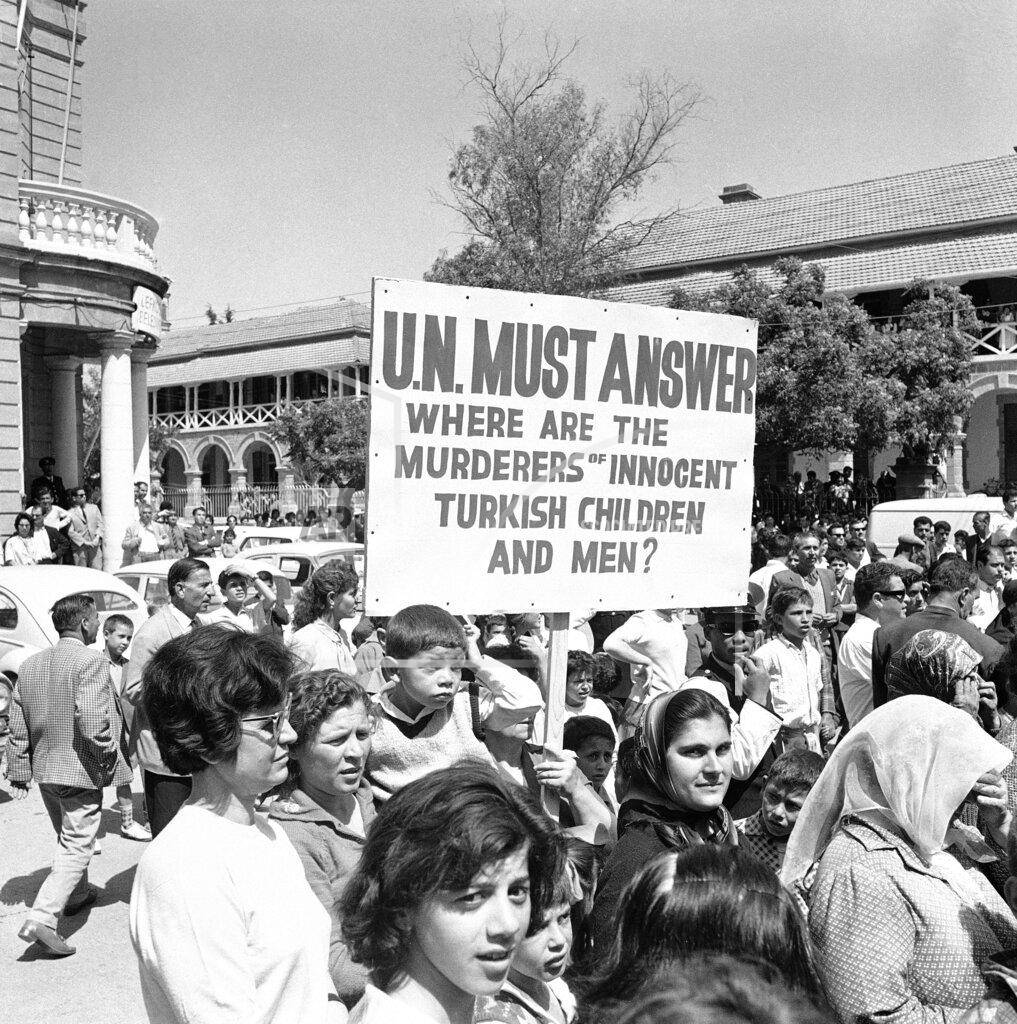
The commander of the United Nations peacekeeping force on Cyprus, Lieutenant General Prem Singh Gyani, was reviled, threatened with death, spat at and stoned today by Turkish Cypriote crowds in the Turkish quarter in Nicosia. As General Gyani left a meeting this evening at the residence of Dr. Fazil Kutchuk, Vice President of Cyprus and leader of the Turkish community, a crowd of several hundred Turkish Cypriotes vented their anger against him. They shouted “Death to Gyani” as they hurled stones at his car and pounded on it with their fists. One elderly man said, “If he comes back here again he will not leave alive.”
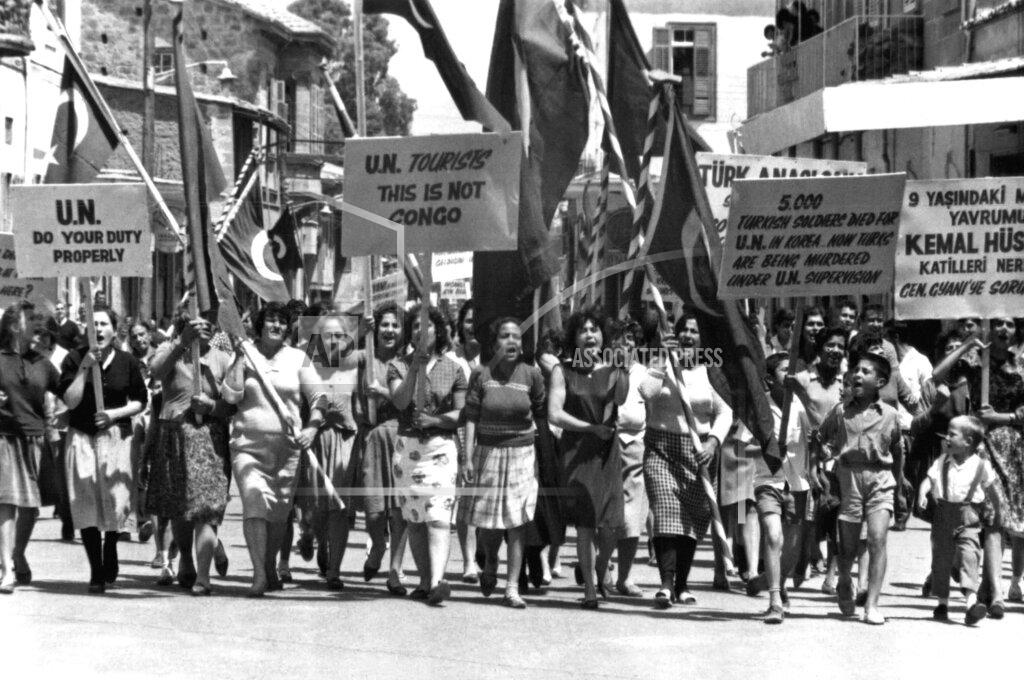
Anger against General Gyani and the United Nations has been mounting steadily among the Turkish Cypriotes, who feel he is not being impartial in his peacekeeping task. The general’s visit to Dr. Kutchuk was the second time today he had gone to see the Vice President about the general situation on the island and the recent upsurge of violence in the Kyrenia Pass area in the north and at the village of Ayios Theodhoros in the south. In the morning, General Gyani was forced to turn back from the quarter by thousands of demonstrating Turkish Cypriote women.
This evening, when the general again went to see Dr. Kutchuk, he was provided with a Turkish Cypriote police escort. This morning’s demonstration started at Ataturk Square in the Turkish quarter. The women, some of them pushing baby. carriages, carried banners and placards denouncing the general and the United Nations. One sign read, “The United Nations is a disgrace.” Another said, “Gyani, tool of Makarios, go home to India.” Archbishop Makarios, President of Cyprus, is the leader of the Greek community. A Turkish Cypriote committee of women refugees gave Dr. Kutchuk a protest message to be relayed to U Thant, Secretary General of the United Nations, Premier İsmet İnönü of Turkey and General Gyani. The Turkish Cypriotes have had doubts about General Gyani’s impartiality from the beginning, particularly because India, his nation, has been opposed to partition, which they favor. Now they are calling him “Gyanides” to indicate their belief that the general favors the Greek Cypriotes, who outnumber them four to one.
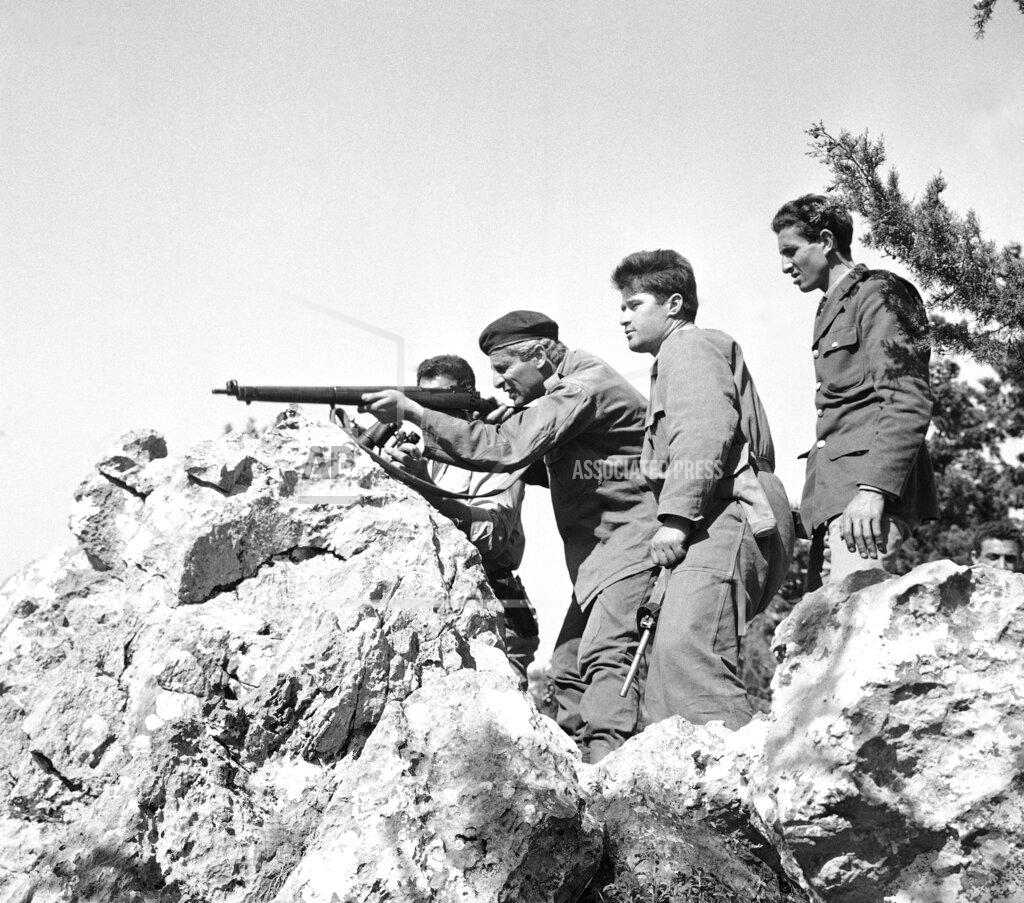
North of Nicosia, there was heavy firing today along the mountain crest near St. Hilarion Castle just west of the Kyrenia Pass. The Greek Cypriotes captured positions around the ancient fortress yesterday during. a deftly executed night attack. This morning, according to a Canadian soldier of the United Nations peace force, the Greek Cypriotes dropped about 10 mortar shells on Turkish Cypriote positions guarding the approaches to the castle. The Greek Cypriotes also poured heavy automatic‐weapons fire on the Turkish Cypriote positions, which responded with less power. The firing then became spasmodic until the evening, when it increased sharply in intensity.
At Ayios Theodhoros in the south, heavy firing between the hostile communities in the morning died down during the rest of the day. The Turkish Cypriote fighters who had used the Turkish school as a fortified position have left the building at the insistence of the United Nations. The school is housing women and children of the Turkish community. The United Nations has set up a post in the school and has assured the Greek Cypriotes that the Turkish Cypriote fighters will not return.
Lieutenant General William C. Westmoreland, named yesterday to be the next commander of the American forces in South Vietnam, is trying to end what he calls the “psychosis of the rainy season” among Vietnamese troops and their American advisers. A qualified source said the 50‐year‐old general had prepared new tactical instructions for the Government troops to use against the Communist guerrillas in the coming four months of seasonal rains. He thus hopes to end a long prevailing belief that the tactical advantage goes automatically to the guerrillas when the rains come. General Westmoreland’s appointment, announced by President Johnson yesterday, came as no surprise here. Ever since he arrived last January 27 as deputy to General Paul D. Harkins, General Westmoreland has been quietly at work on long‐term plans in both the tactical and organizational fields.
General Westmoreland is to take over his new command on August 1 when General Harkins retires. A long overlap between the two men, who have worked in adjoining offices, was arranged to ensure continuity of effort. The announcement of General Westmoreland’s appointment coincides with a general overhaul of the United States command here. Both structural and personnel changes are involved. Last week a new chief of staff was named, Major General Richard G. Stilwell, who has been assistant chief of staff for operations. Two other assistant chiefs of staff arrived in Vietnam at the same time as General Westmoreland: Brigadier General Ben Sterberg of the Army, head of the personnel staff, and Brigadier General Carl A. Youngdale of the Marines, head of the intelligence staff. General Stilwill’s successor as head of the operations staff is to be Brigadier General William E. Dcpuy of the Army, who is scheduled to arrive this week. Shortly after his arrival, General Westmoreland turned to the problem of how to fight the Việt Cộng in the rainy season when the government’s advantage in firepower and equipment has usually faded before the Việt Cộng skill in using small guerrilla units.
Heavy tropical rains in the summer months turn wide expanses of the critical Mekong Delta into a quagmire where infantrymen fear to tread. Large parts of the country are completely under water. Mechanized units are unable to maneuver in flooded rice paddies and heavy artillery shells fired with high trajectories fall ineffectively into the mud. General Westmoreland held consultations with the field advisers who Worked through the last rainy season, with a view to deriving new tactics. General Westmoreland is inheriting a military situation in which the Việt Cộng are showing increasing boldness in large unit operations. Again this weekend in the delta, a Việt Cộng battalion chose to dig in and fight rather than filter away after an initial engagement.
Two U.S. Senators — a Democrat and a Republican — called today for South Vietnamese raids into North Vietnam to lessen the pressure from Communist attacks. But another Democrat said it would be a great mistake to create “the launching pad for another Korea.” Senator Frank J. Lausche. Democrat of Ohio, said North Vietnamese Communists should not be allowed to have “a privileged sanctuary,” immune from attack. Senator Hugh Scott, Republican of Pennsylvania, agreed. Their views were expressed when Senator Scott interviewed his colleague from Ohio on a program taped for television and radio use on Pennsylvania stations. Senator Frank Church, Democrat of Idaho, said that striking into North Vietnam would lead to the commitment of United States and Chinese Communist troops and “a hopeless entanglement, the end of which is difficult to see.” Senator Church spoke on a recorded non-network television program. “Youth Wants to Know.”
Communist Rumania, in a new effort to bring about a truce between Moscow and Peking, published an urgent call today for a meeting of Soviet and Chinese leaders with Rumania as mediator. In a statement carried by its major newspaper, Scinteia, the Rumanian party also said that the Russians had “agreed in general” to the truce plan. It said it was the Chinese who so far had failed to heed it and had continued their anti‐Kremlin campaign. The statement, issued by the official Rumanian press agency Agerpress, said the Rumanians believed it was “the duty of every party to do its utmost to avert the danger of a split.”
The Rumanian proposal was aimed at bringing the Russians and Chinese to agree to form a commission of officials of the three parties, which would make preparations for a worldwide meeting of Communist party leaders. Such a meeting, the Rumanians proposed, would “comprise all Communist parties of the world, not merely certain parties.” But, the statement said, although the Russians agreed to examine the proposal, the Chinese have not yet made known what they think about it.
This conference, proposed to the Russians and Chinese last March, should serve to “discuss and finalize” an appeal to all the Communist and Workers parties to solve controversial issues in conformity with the norms jointly established at the 1957 and 1960 Moscow conferences concerning relations between Communist parties, the statement said. The statement and an accompanying “policy analysis” outlining the views of the Rumanian party ran to more than 12,000 words. It disclosed the contents of documents whose publication was decided on by the party’s Central Committee last Wednesday after a weeklong plenary session.
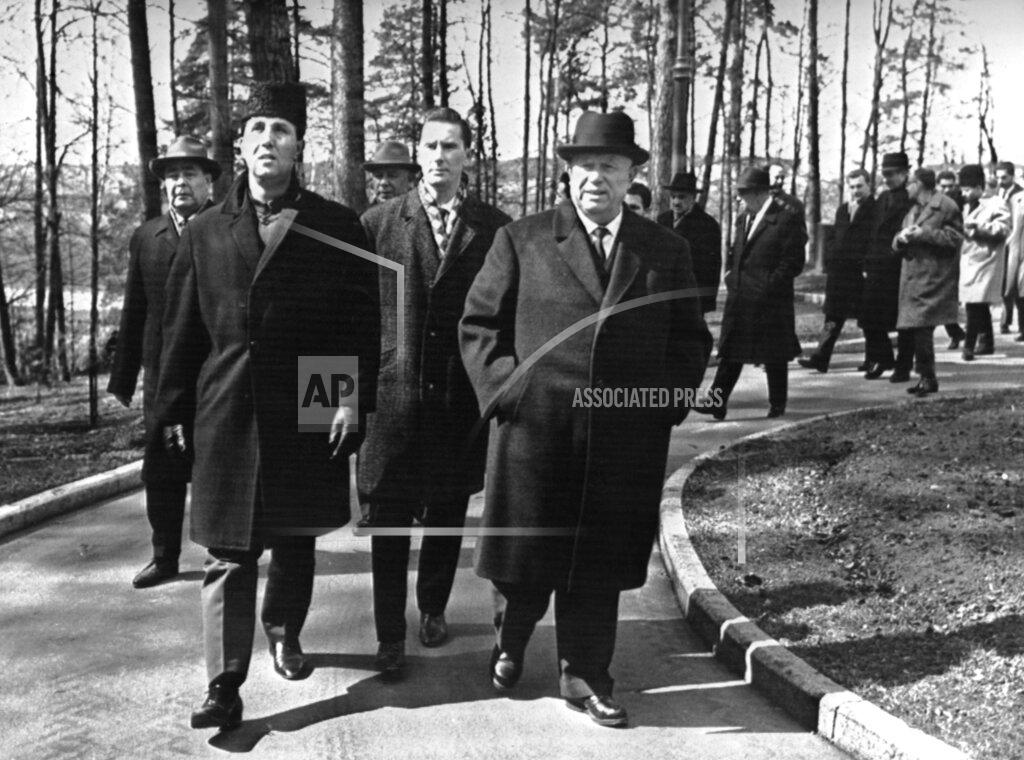
Peking today denounced recent Soviet attacks on the Chinese Communists as “nothing but lies, sophistry, and abuse.” It was the first Chinese counterattack following publication in Moscow of a report by Mikhail A. Suslov, the Soviet party’s leading theoretician, for the Central Committee of the Soviet Communist party. The report denounced the Chinese Communists and was followed by attacks on Peking by Premier Khrushchev. Also today a major policy speech by Premier Chou En‐lai was published in Peking, denouncing the Soviet appeal to world governments to renounce the use of force in territorial disputes. The Chinese leader described the call, made by Mr. Khrushchev in a New Year’s message, as a “new fraud that served imperialist policies of aggression and war.”
At 12:01 a.m., the United Republic of Tanganyika and Zanzibar officially came into existence after the national assembly of Tanganyika joined Zanzibar in voting to approve the merger of the two East African republics, announced three days earlier by Tanganyikan President Julius Nyerere and by Abeid Karume, the President of Zanzibar. At the time, Tanganyika had 9,000,000 inhabitants and the island of Zanzibar had 300,000. Nyerere became President, and Karume Vice President, of the new nation. In July, the government would announce a contest for a new name for the United Republic, and the winning entry — Tanzania — would be announced by Nyerere on October 29. April 26 continues to be celebrated as “Union Day” in Tanzania.
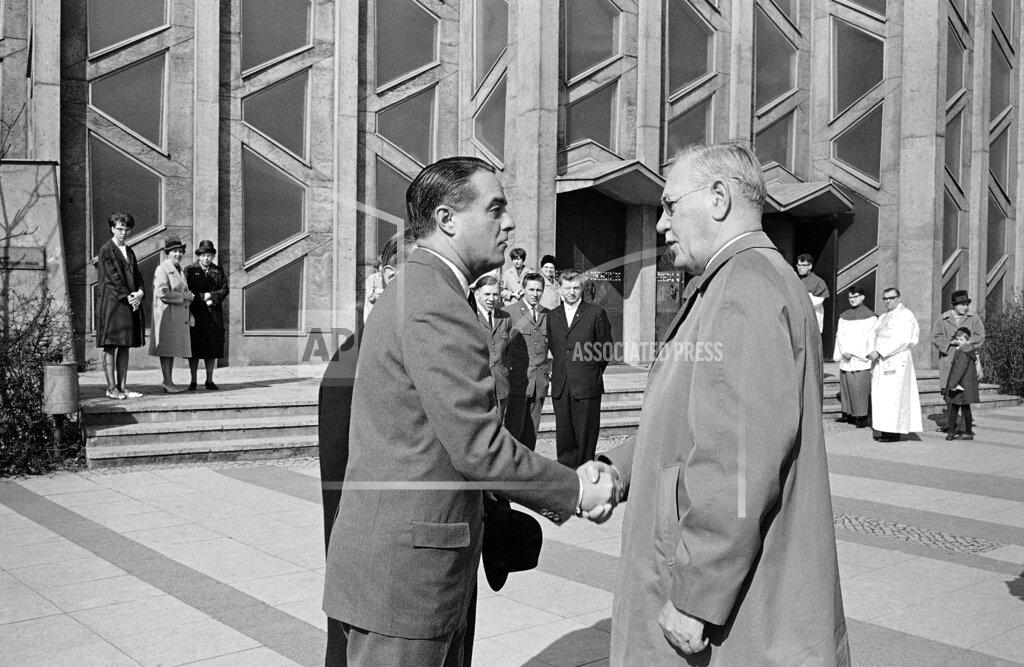
Chancellor Ludwig Erhard achieved a striking personal victory today in the first test of his government at the polls. Exceeding its own predictions, the Christian Democratic Union won 46.2 per cent of the popular vote in provincial elections in the populous southwestern state of Baden‐Württemberg. The Government party surpassed the 39.5 per cent it achieved in the last state election in 1960 and missed an absolute majority in the 120-member State Parliament by only two seats. In direct contests in 70 election districts its candidates defeated nine Social Democratic incumbents. The elections in Baden‐Württemberg — the last provincial balloting before the 1965 national elections — was watched for signs of how the political winds were blowing in West Germany since the retirement of Konrad Adenauer. The question was whether Dr. Erhard, who took over from Dr. Adenauer as Chancellor last October, would be able to reverse a long decline of Christian Democratic fortunes at the polls. The answer tonight was yes.
President de Gaulle’s policy of independent nuclear armament for France was sharply attacked today at a rally that united the Communist and non‐Communist Left, at least temporarily. In the keynote speech, Jules Moch, former Socialist Minister of the Interior, termed the fight against General de Gaulle’s “force de frappé” the chief aim of the opposition. He declared: “The force de frappé is not only ruinous but also inefficient. It is useless in defense, both in retaliation and as a deterrent.”
Senator Hubert H. Humphrey of Minnesota predicted today that the forces behind the civil rights bill would have the votes to shut off the Southern filibuster in early May. Senator Humphrey, the Democratic leader in the civil rights debate, said that the count was now just four or five votes short of the 67 needed for closure. He suggested that the Southerners might give way rather than let the issue actually go to closure. This forecast was given by Senator Humphrey on a Columbia Broadcasting System television program, “Face the Nation.” Other supporters of the legislation have been speculating that the debate will go on through the summer. Tomorrow the Senate will go into its 41st day of talk on the House‐passed legislation. Southerners have so far prevented a vote on any provision in the bill and there is no clear sign of their doing otherwise in the next few days.
Senator Humphrey noted the agreement between Democratic and Republican leaders on a modified amendment to provide jury trial in criminal contempt cases that result from violation of court orders under the legislation. The amendment “has tremendous support already in the Senate,” he said, “and it will be the first victory for the proponents of the civil rights bill.” Judges would be given discretion by the amendment to order trial by themselves or by juries. But in any non‐jury case the sentence would be limited to 30 days in jail or a $300 fine. In reply to a question, Mr. Humphrey said he thought he could get a vote on the amendment this week “or, if need be, a few days later.” The leadership’s problem in reaching any votes was illustrated by this uncertainty about the Southerners’ allowing a vote on an amendment designed to make the bill more acceptable to the South. The decision to press the jury trial amendment marks the abandonment of the theory, much discussed earlier, that the bill should be passed exactly as it left the House.
The Democrats are now trying to button down agreement with the Republican leader, Senator Everett McKinley Dirksen, on amendments to the employment and public accommodations titles. These might clear the way for bipartisan agreement on the whole measure. Senator Humphrey suggested that the jury trial compromise was a sign of progress in this regard. He even hinted that broad enough bipartisan agreement on the bill might cause the Southerners to back off and allow a vote without being forced to by closure. “We are not sure that we are even going to need closure,” he said. He also suggested that some Southern Senators “underestimate the political temper and tenor in their own states.” The Humphrey estimate of 62 or 63 votes for closure is higher than some others have given. Neither side is actually disclosing its tabulations at this point.
Two weeks of deliberations by the House Ways and Means Committee have failed to produce any signs of progress on the Administration’s program of health care for the aged. The committee has been meeting in closed session several days a week since April 9, having completed hearings earlier this year. Members said today that no votes had been taken and that no promising compromises had been offered. “Prospects of favorable action are no better and perhaps a bit worse than they’ve been from the start,” one member reported. The Administration bill calls for hospitalization, nursing care and clinical services for persons over 65 years old as part of the Social Security program. The benefits would be financed by an increase in the Social Security payroll tax.
The measure has been bogged down in the 25‐member Ways and Means Committee since its introduction early last year, with proponents unable to muster a majority of 13. No Senate hearings are planned unless the House acts. All 10 Republicans on the committee and at least three of the 15 Democrats are opposed to the principle of financing health services through the Social Security tax system. The Administration will not accept any compromise that fails to provide Social Security financing, and the opponents will not consider any that does. The deadlock, consequently, continues. Wilbur D. Mills of Arkansas, the committee’s influential chairman, is among the apparently implacable Democratic opponents. Others include A. Sydney Herlong Jr. of Florida and John C. Watts of Kentucky.
The settlement of the five-year‐old dispute over railroad work rules by President Johnson and a team of skilled mediators was one of the most significant episodes in the history of American industrial relations. The frantic two weeks that led to the agreement last Wednesday was also the most dramatic instance of Presidential intervention in a domestic crisis since President Kennedy beat down the steel price increase two years ago. The accord relieved the country of the possibility of a national railroad strike. It gave the institution of free collective bargaining a new lease on life in an industry where it had seemed dead. It removed a cloud that had hovered over the bargaining system as a whole. And it illuminated the personality and methods of the new President perhaps more than any other event of the last five months.
The National Association for the Advancement of Colored People has called for demonstrations this summer at all public construction sites in New York state. The organization said yesterday that the blame for resumption of demonstrations must be attributed to Governor Rockefeller and Mayor Wagner for not canceling contracts involving unions and contractors who practice discriminatory hiring. It was emphasized that the demonstrations would be “more militant and more dramatic” than the protests here last summer that resulted in the arrest of hundreds of demonstrators. All 53 N.A.A.C.P. branches in the state have been urged to participate in the demonstrations, and other demonstrations were threatened in large urban centers throughout the nation.
Thomas Toolen, the Roman Catholic Archbishop of the archdiocese of Mobile, Alabama, ordered the desegregation of all Roman Catholic parochial schools in his jurisdiction, which included all of the state of Alabama, and 11 counties in Florida west of the Apalachicola River. “I know this will not meet with the approval of many people,” Toolen wrote in a pastoral letter read at all congregations at Sunday services, “but in justice and charity, this must be done.”
Several hundred African-Americans met in Jackson, Mississippi to organize the Mississippi Freedom Democratic Party, an alternative to the all-white state Democratic Party.
James R. Hoffa is in danger of losing his access to union funds to pay his legal fees. The threat arises as the president of the International Brotherhood of Teamsters goes on trial in Chicago today on Federal charges of misusing $20 million in union pension reserves. John J. O’Rourke of New York, an international vice president, has formally asked that no more money for Hoffa’s defense be spent from the union treasury, pending a meeting of the full executive board. He acted after Edward Bennett Williams, the Teamsters’ general counsel, had informed him that it would be illegal to use union funds to pay for Hoffa’s lawyers and court expenses.
Mr. O’Rourke made his demand in a telegram sent Saturday to John F. English, the union’s secretary‐treasurer, at its headquarters in Washington. The union spent nearly $1 million on legal charges last year, with much of it going to defend Hoffa. The Teamster chief has been in and out of courts through all of the seven years since he became president of the 1,500,000‐member truck union, the country’s biggest and strongest labor organization. His only conviction came this year when he was sentenced to eight years in a federal penitentiary for jury‐tampering. He has announced his determination to appeal the conviction to the Supreme Court.
LPGA Titleholders Championship Women’s Golf, Augusta CC: Marilynn Smith retains title; beats Mickey Wright by 1 stroke.
The Boston Celtics beat the San Francisco Warriors, 105–99, to win the NBA Championship, four games to one. The victory marked the Celtics’ sixth consecutive title.
Born:
Tod Bass, American actor (“Rowan & Martin’s Laugh-In”), in Los Angeles, California.
Tim Jordan, NFL linebacker (New England Patriots), in Madison, Wisconsin.
Billy Poe, NFL guard (Cincinnati Bengals), in Ironton, Ohio.
Greg Quick, NFL tackle (Atlanta Falcons), in Laurinburg, North Carolina.
Died:
E. J. Pratt, 82, Canadian poet (“Towards the Last Spike”).
Jacinto Cruz Usma, 31, Colombian terrorist and bandit chief known as “Sangrenegra”, was killed near the town of Las Brisas in the Valle del Cauca Department, after a gun battle with the 8th brigade of the Colombian Army. During a four-year period, Sangrenegra and his associates murdered 223 policemen and public officials. Jacinto’s brother, Felipe Cruz, had tipped off the army after Jacinto had threatened to kill him and his family.
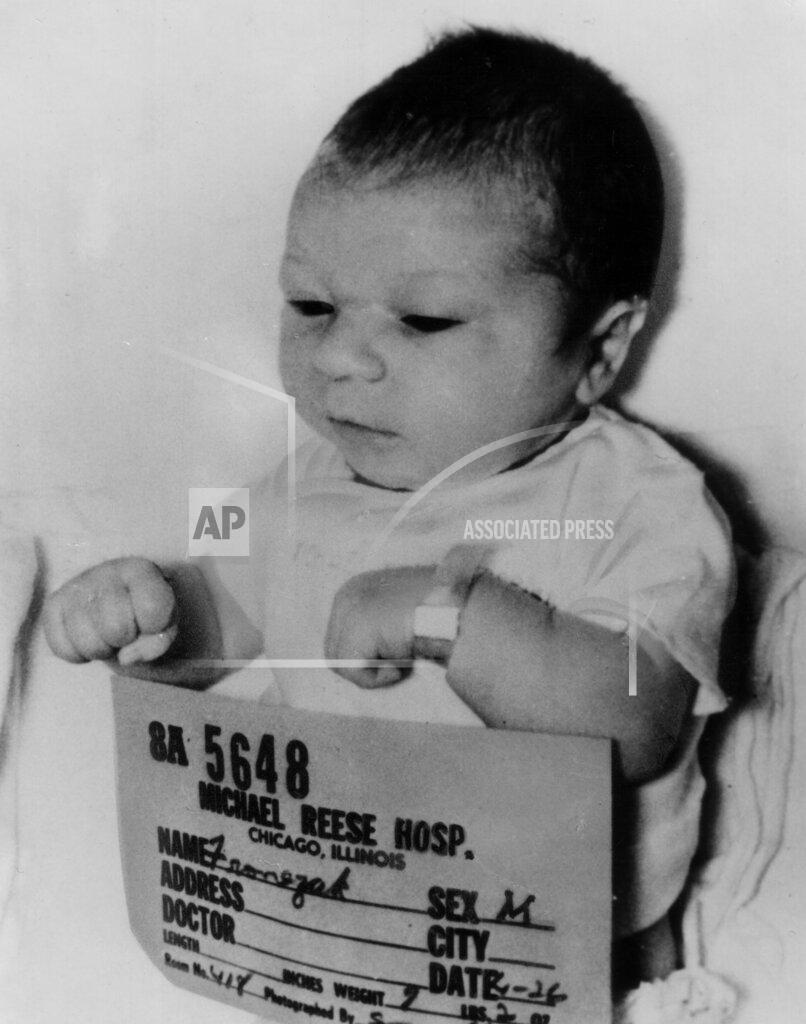
[Two years later, the FBI told the baby’s parents that they believed they may have found Paul in New Jersey. The parents met the New Jersey child and said it was their child, and the child was raised as Paul Fronczak. Paul Fronczak doubted his identity as both a child and an adult, and after taking a DNA test in 2012, discovered that he was not related to his raised parents, Dora and Chester Fronczak. In 2015, he was identified as Jack Rosenthal, who had disappeared in 1965. Additionally, he had a twin sister named Jill Rosenthal who also disappeared. The original 1964 kidnapping victim was found alive in Michigan in 2019, now named Kevin Ray Baty. Baty died from cancer in 2020.]


 History Diaries