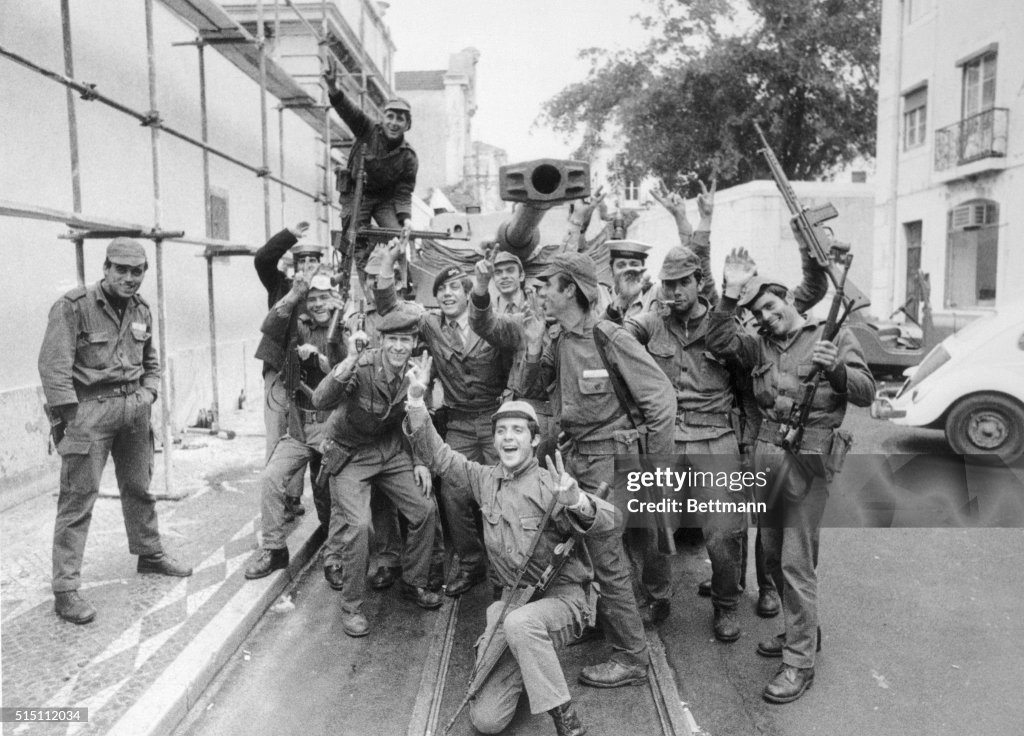
The day after the overthrow of Portugal’s Premier Marcelo Caetano, the seven-member Junta de Salvação Nacional, chaired by General Spinola, announced that it would govern Portugal until further notice, but that it would restore democracy and bring an end to Portugal’s colonial rule of Mozambique, Angola and other colonies. The first act of the Junta was to announce amnesty for all political prisoners (except for those with prior criminal records) jailed during the Estado Novo regime; 172 were released on the same day, including Hermínio da Palma Inácio and 76 others imprisoned at the Fortress of Caxias outside of Lisbon.
The military take‐over in Portugal by officers committed to peace in the country’s three African territories was greeted yesterday by guerrilla pledges to step up efforts against the authorities in Portuguese Guinea and Angola. There was no immediate reaction, however, from the organization fighting a war of independence against the Portuguese in Mozambique. Elsewhere in Africa, the coup was welcomed in black‐ruled countries. In South Africa, Prime Minister John Vorster said the events in Portugal “underlined the uncertainty of our day.” In Rhodesia, Prime Minister Ian D. Smith said that his country “does not interfere in the internal affairs of other countries” and that he believed Rhodesia would continue to enjoy the best of relations with Portugal.
An Angolan guerrilla movement declared today that the Portuguese coup would make no difference to “the Angolan people’s relentless struggle” against Portuguese rule. A statement by the left‐wing Popular Movement for the Liberation of Angola predicted that the new Portuguese rulers would pursue Portugal’s colonialist policies, and added: “This coup of generals aims only at perpetuating the exploitation of the Angolan people under another form.”
The African nationalist organization that proclaimed independence in a “liberated area” of Portuguese Guinea last September said in a broadcast today that the coup in Portugal was a chance for the Portuguese to get out of Africa. The organization, known as the African party for the Independence of Guinea‐Bissau and the Cape Verde Islands, added that it was going to step up its action to “liquidate the largest possible number” of Portuguese troops to put an end to the country’s “odious colonialism.” This, the movement said, would be concrete support for the Portuguese people and for the “healthy forces in the army.”
By a vote of 247 to 233, the lower house of West Germany’s parliament, the Bundestag, narrowly passed a law allowing abortion of a pregnancy in the first trimester. The bill repealed paragraph 218 of the 1871 German penal code. The nation’s supreme court suspended the law on June 21, and would strike it down as unconstitutional on February 25, 1975.
Obviously troubled by the disclosure that one of his aides has confessed to being an East German spy, Chancellor Willy Brandt charged Friday that the East German regime had acted toward him with personal hostility. Brandt expressed his feelings of personal disappointment during a parliamentary debate about the espionage affair involving Guenter Guillaume, 47, an assistant in the chancellery office. Guillaume was among six persons arrested Wednesday on suspicion of spying for the East Germans.
Adding to the chancellor’s bitterness was the fact that he had made improved relations with East Germany a cornerstone of his foreign policy. And he obliquely but unmistakably made this clear when he opened his speech by observing: “There are times. ladies and gentlemen, when one is inclined to think that one is spared nothing.” He then went on to charge that the East Germans had used “a particularly skillful and cunning agent” to infiltrate his staff. However, he stopped short of saying whether Bonn plans to take any countermeasures against the Communist German state.
A gang of armed art thieves directed by a young woman raided the mansion of Sir Alfred Belt, a gold-mining millionaire, in Blessington, near Dublin, tied up everyone in the house and stole masterpieces valued by the police at $20.4 million. Works by Goya, Reubens and Vermeer were among the stolen paintings. Dublin art sources said it was believed to be the biggest single art robbery ever.
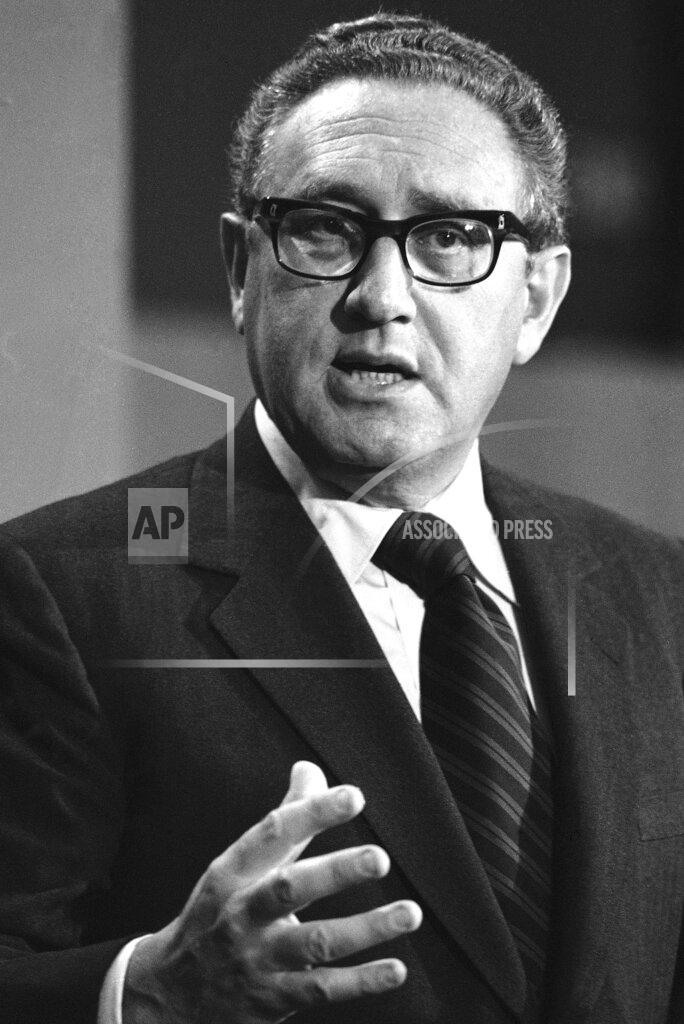
U.S. Secretary of State Kissinger strongly defended the Administration’s foreign policy today against any suggestion that President Nixon was trying to manipulate it for domestic political advantage. At a news conference in the State Department, Mr. Kissinger heatedly and specifically assailed Senator Henry M. Jackson for asserting that the Administration was planning a “quick‐fix” accord on strategic arms, at June’s summit, meeting with the Russians to buttress Mr. Nixon’s position against impeachment charges. “We are conducting our foreign policy on the basis, as I have said before, of the national interest—not geared to any deadlines, and not geared to the present domestic difficulties,” Mr. Kissinger said. He acknowledged, however, that Mr. Nixon’s problems could weaken the conduct of foreign policy over the long term, but said that so far American foreign policy had not been affected by “the Watergate discussion.”
The Soviet press, in its first major reaction to fighting in northern Iraq, has accused Turkey of arming and abetting Kurdish rebels against the Iraqi Government. The charge, which was made today by the Communist party’s newspaper, Pravda, and also distributed by the official press agency, Tass, suggested that the Soviet leadership had become increasingly concerned about the newest phase of the Kurdish struggle for self‐rule. Pravda offered no evidence to support its contention that Turkey, encouraged by unspecified “imperialist and other external reactionary forces,” had been supplying weapons, ammunition and money to the forces of Kurdish leader, General Mustafa Barzani. But it alleged that the Turkish Government had resolved to “weaken the progressive regime” in Iraq by fomenting “enmity” between the Kurds and Arabs.
The implicit stand taken by Moscow against the rebels, whom Pravda described as “Kurdish extremists,” was at variance with professed Soviet support for many other “national liberation” movements around the world. However, the Soviet Union is conscious of its own Kurdish minority along its southern borders. The Soviet Kurds, estimated to total nearly 89,000 in the 1970 Soviet census, are culturally and linguistically akin to the Kurds of Iraq. The Soviet Union has developed a stake in the stability of the Baathist regime in Baghdad, with which it has assiduously developed good political and economic ties.
Units of Ethiopia’s Fourth Division in Addis Ababa and police commandos staged mutinies in Addis Ababa, military sources said. The situation in the capital was extremely confused during what appeared to be separate mutinies.
In Addis Ababa, Ethiopia’s Army arrested more than 200 high-ranking government ministers and military officers on charges of corruption. The former government ministers had resigned on the day after an attempted coup d’état on February 25 but had been blocked from leaving the capital.
Five Chilean civilians were tried secretly yesterday and sentenced to death by an army court‐martial in San Fernando, a farming center about 80 miles south of here, according to church sources. The five men were identified as Nelson Gonzalez, Hector Fuentes Araoz, Jose Balaguer Sara, Humberto Vargas Vargas, and Miguel Lopez Gonzalez. They were accused, the sources said, of having given weapons instruction to leftists in the San Fernando area before the September 11 military coup that deposed the elected Marxist Government.
The condemned men were part of a group of more than 20 prisoners who faced closed court‐martial proceedings that started last week. Military officials denied permission to representatives of the Red Cross to attend the trial. A Ministry of Interior spokesman would neither confirm nor deny the report of the death sentences. The San Fernando court‐martial contrasts with the highly publicized air force court‐martial of 57 military officials and 10 civilians accused of sedition and Marxist sympathies. Six air force men face death sentences if found guilty, and the others face sentences ranging from 18 months to life imprisonment.
The air force trial, which began on April 17 and is expected to last more than a month, is the first court‐martial involving military men. It also is the first that has been open to public scrutiny through the presence of newsmen and foreign legal observers. Attorneys defending political prisoners have expressed hope that the air force trials would not be a “showcase” and would instead set a precedent in opening military court proceedings and establishing legal precedents for the treatment of detained persons. Hundreds of Chilean leftists have been tried by closed military courts during the last seven months. The military junta has disclosed the execution of 96 persons after court-martial proceedings. On Wednesday, an air force general, Gustavo Leigh, a member of the four‐man junta, said that the government would begin proceedings next week against the remaining political prisoners — more than 6,000 — and expedite the release of those not facing charges.
President Nixon will reportedly seek public support next week for a decision to give the House Judiciary Committee transcripts rather than the tape recording of Watergate-related conversations subpoenaed for the impeachment inquiry. Dean Burch, counselor to the President, told a meeting of the Republican National Committee in Washington that Mr. Nixon would turn over “a massive body of evidence” to the committee.
What has been called “the Don Nixon memorandum” throughout the 45-day Mitchell-Stans trial was the first official document the jury asked to review in its first full day of deliberations. Robert Vesco, who apparently wrote the memorandum, threatens President Nixon with disclosure of the secret $200,000 cash contribution he had made to the President’s re-election campaign unless a federal investigation of Mr. Vesco’s business affairs “is stopped promptly.”
Senate investigators have concluded that excessive secrecy and concentration of power in the Presidency gave rise to the Watergate scandal, and they have drafted recommendations to drastically diffuse that power as a safeguard against any recurrence. The findings are in a draft of the final report of the Senate Watergate committee, to be submitted to the Senate by the end of May after the seven Senators agree on its final form. A copy of the draft was obtained by. United Press International. The report recommends that White House powers be diluted by giving more independence to Government agencies, particularly the Justice Department, the Federal Bureau of Investigation, the Internal Revenue Service and the Central Intelligence Agency.
One committee source called the draft report an attempt to “curb raw Presidential power.” Another said the aim was to “deflate a royal executive branch.” The draft was prepared by a staff group on Presidential powers and approved by senior members of the committee staff. It calls for a ban on political campaign activity, by top aides in the White House and Justice Department. One proposal is for the creation of a permanent special prosecutor, operating independently of the Justice Government officials accused of wrongdoing, especially in political campaign matters. The report recommends giving Congress more powers, particularly in overseeing activities of Government agencies and maintaining controls over White House spending.
The Senate Finance Committee voted unanimously today in favor of the nomination of William E. Simon as new Secretary of the Treasury. The full Senate is expected to confirm him next week. Mr. Simon, nominated to replace George P. Shultz, who is resigning, appeared briefly at a closed meeting of the committee. Within 10 minutes after Mr. Simon left, the committee chairman, Russell B. Long, Democrat of Louisiana, announced the unanimous vote. Mr. Simon, former head of the Federal Energy Office and Assistant Treasury Secretary, stirred little controversy during hearings by the committee this week and is expected to be (confirmed overwhelmingly by the Senate.
Profits reported by major oil companies for the first quarter of 1974 have shown increases averaging nearly 80 percent from a year ago, but some analysts estimate that they may be much higher. A number of oil companies indicated that they had set aside certain amounts of profits to cover first quarter costs that might be incurred later this year, such as tax increases and higher retroactive costs of crude oil.
Vice President Ford, in his first major speech on economic policy, endorsed today the use of tax incentives to expand industrial capacity in industries where there are shortages. Wilbur D. Mills, Democrat, of Arkansas and the chairman of the House Ways and Means Committee, has advocated the idea but it does not, so far at least, have the support of the Nixon Administration. The Vice President made the suggestion in a speech to the governing council of the American Bankers Association, which was meeting in White Sulphur Springs, Va. His office released the text of his prepared remarks here. Mr. Ford’s theme was the need to control inflation, which he described as “world public enemy No. 1.”
The General Motors Corporation announced that its earnings in the first quarter of 1974 declined by 85 percent from the 1973 first quarter. Net income for the first quarter of 1974 was $120 million, or 41 cents a share, compared with $817 million, or $2.84 a share a year ago. It was the lowest first quarter figure since 1948.
An internal Atomic Energy Commission study released today contains a warning on what it called “entirely inadequate” safeguards to prevent the theft by terrorist groups of uranium and plutonium for the manufacture of homemade atomic bombs. “We feel that the danger is large and growing,” the report said. It cited “increasing dissemination” of precise and accurate instructions on how to make simple nuclear weapons and “increasing professional skills, intelligence networks, finances and level of armaments of terrorist groups throughout the world.”
The prime rate for commercial bank loans — one of the basic interest rates in the nation’s economy — moved to new high ground as the Franklin National Bank went to 11 percent from 10½ per cent, and several California banks went to 10¾ percent. The prime rate and the galaxy of other short-term rates such as Treasury bills, commercial paper and bank certificates of deposit also have risen rapidly.
The Federal Aviation Administration ordered an emergency “in-depth” inspection of the world flight operations of Pan American World Airways following the crash on Monday of a Pan American Boeing 707 jet on Bali. It was the fourth crash of a Pan American 707 in the last nine months.
Governor Byrne of New Jersey and Mrs. Ann Klein, the state’s Commissioner of Institutions and Agencies, took what they said was a first step in closing the Trenton State Prison soon after an eruption of violence in which five guards and three inmates were injured. Eighty-three inmates are to vacate one of the prison’s seven wings. Their cells will become office and storage space.
Peter Phillip Mauchlin, who, bombed a bank near Union Square last October injuring 10 persons, was sentenced to 30 years yesterday in Federal Court for that crime and for having robbed three other Manhattan banks. The slender, dark‐haired, 29‐year‐old Mr. Mauchlin was then taken to Newark, where Federal Judge Frederick B. Lacey sentenced him to 25 years for the armed robbery of the Meadowlands National Bank of North Bergen, New Jersey, of $14,372 on March 1, 1973. Both sentences will be served concurrently, but will be added to 14 years Mr. Mauchlin still owes on a 15‐year sentence for having robbed a bank in North Bergen on September 8, 1970. He was serving that sentence when he escaped from federal custody just outside Baltimore as he was being transferred from a federal prison at Lewisburg, Pennsylvania, to one in Atlanta in February, 1973. He made a second escape from federal custody this month.
Henry Fonda, who collapsed Tuesday with what physicians called “total exhaustion,” was not released from Lenox Hill Hospital as expected yesterday because of a worsening of his condition. Mr. Fonda collapsed after a performance of his one‐man show, “Clarence Darrow,” at the Helen Hayes Theater. A hospital administrator said late yesterday that the 68‐year‐old actor Would remain several more days until control of his heart rhythm was gained.
The Cincinnati Reds overcome a 3–1 deficit by scoring 8 runs in the 7th to beat the Chicago Cubs, 9-3. Hank Aaron hits his 6th home run of the year, a grand slam.
Colorado defeats Nebraska 2–1 in an NCAA-record 22-inning game. James Smith has 10 at bats.
In what is dubbed the “Friday Night Massacre” the Yankees trade 4 pitchers, including Fritz Peterson and Steve Kline, to the Indians for first baseman Chris Chambliss and hurlers Dick Tidrow and Cecil Upshaw.
Dow Jones Industrial Average: 834.64 (+6.96, +0.84%).
Born:
Ivana Miličević, Croatian-American actress (“Banshee”), in Sarajevo, Bosnia and Herzegovina.

 History Diaries