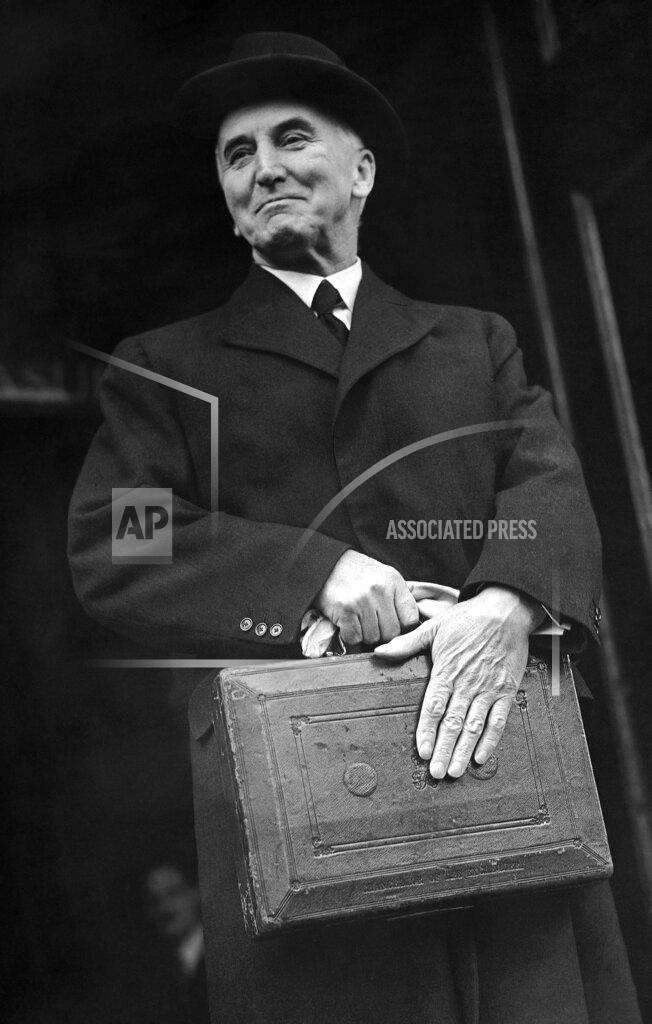
On Budget Day in the United Kingdom, Chancellor of the Exchequer Sir John Simon raised taxes to help finance the £630 million defense budget. A staggering budget, swollen by the cost of war preparations, was set before Britain yesterday. Defense costs total nearly half of the £1,322,000,000 program. It provides tax increases on motor cars, tobacco and sugar, as well as higher death duties and surtaxes, which lend it a “soak the rich” flavor.
A few hours after the Cabinet had taken its momentous decision to impose compulsory military service the British Government called upon its hard-pressed taxpayers today for still more sacrifices to pay for the staggering cost of the rearmament program. The increased taxation was made necessary by the recent decision to double the Territorial Army, which will lift the total cost of defense in the present financial year from the estimated figure of £580,000,000 [the pound was quoted at $4.68¼ in New York yesterday] to £630,000,000 and perhaps more.
The Neville Chamberlain government announced that due to international events, a bill would be introduced in parliament introducing military conscription for all males aged 20 and 21. Not content with this preparation for war, the British Cabinet took the plunge of conscription. Today Prime Minister Chamberlain is expected to announce the calling up of 1,000,000 youths now, and millions ultimately, for training. Conscription: will come to this easy-going, freedom-loving land tomorrow, when Prime Minister Neville Chamberlain is expected to announce the immediate start of compulsory military training for hundreds of thousands and ultimately millions of men. It will be a revolution in the British way of life, a reversal of British traditions of voluntary service that have lasted in times of peace for hundreds of years. Nobody can tell what its effects may be upon the highly stratified British social structure or upon the economic life of the country. But at least there is hope in London tonight that its immediate influence abroad will be decisive in deterring aggression and keeping peace. More than anything that has yet happened, it will be Great Britain’s answer to the march of the fascist powers toward “domination of the world by force,” as Mr. Chamberlain has described it repeatedly in recent weeks.
The decision was heartily welcomed in Paris, which expected it to swing the balance toward peace.
The French, incidentally, in a move explained as one toward unity in the country, decreed prosecution for publications inciting hatred against persons of any particular race or religion. The decree allows state prosecution for the spreading of anti-Semitist hate. The decree declares that, in view of the efforts the nation is making for national defense, “hatred between citizens must be suppressed and every possible effort must be made toward harmony and discipline.”
“Everything contributing to division among the French people tends to weaken the nation’s strength,” says the decree. “Maintenance of public liberty should be conditional upon safeguarding our collective interests. One of these liberties — freedom of the press — already has had to be modified on account of certain abuses. But experience shows that, nevertheless, the present legislation is inadequate to prevent certain campaigns of suspicious origin tending to weaken the morale of the nation.
“It must be noted that this decree does not in any respect alter the fundamental notion of liberty. It aims only at coordinating that notion with others that are inseparable from a republican regime. In this respect no reason of race or religion should be permitted to alter equality between citizens. No hereditary circumstance should be allowed to weaken the feeling of fraternity among members of the French family. It is not only the interests of individuals but national collectivity as well that is involved. Everything that divides, weakens. Everything that reinforces union renders stronger.”
Continuing their diplomatic efforts, the British invoked the assistance of the Turks in winning Russia over to the coalition.
Yugoslavia kept her position flexible; her officials emphasized the need to collaborate with the country’s neighbors.
The Poles expect Hitler to be conciliatory and will not make more concessions.
Meanwhile, in Berlin Britain’s newly returned Ambassador sought an audience at the Foreign Office and was kept cooling his heels while high officials conferred with other foreign visitors and Chancellor Hitler made ready to deliver Friday’s reply to President Roosevelt, which will be broadcast throughout Germany and abroad. Whatever else Herr Hitler might say in his speech, Tokyo reports indicated he would be unable to announce a military alliance with Japan. In that country deliberations on the issue were still proceeding, but various factors, including the dispatch of the United States fleet back to the Pacific, were believed to preclude any closer tie with the Axis.
Although Sir Nevile Henderson, the British Ambassador, who returned to Berlin yesterday, is reported to have requested an audience at the Foreign Office, he has not yet been able to obtain an appointment. Chancellor Adolf Hitler and his immediate foreign political advisers, it was stated, will be preoccupied with receiving foreign visitors and political allies during the rest of the week in engagements so important that an appointment for Sir Nevile has not yet been fixed. He will probably be received by an undersecretary tomorrow.
The nature of the message that the Ambassador is reported to have brought back from London is not revealed. His unexpected return here, for that matter, is accepted as a purely “routine matter,” and there appears to be no intention to magnify it into something of diplomatic significance. A communiqué earlier today denied reports that Sir Nevile had been in consultation with Foreign Minister Joachim von Ribbentrop. No date for such a meeting has been fixed, it was stated.
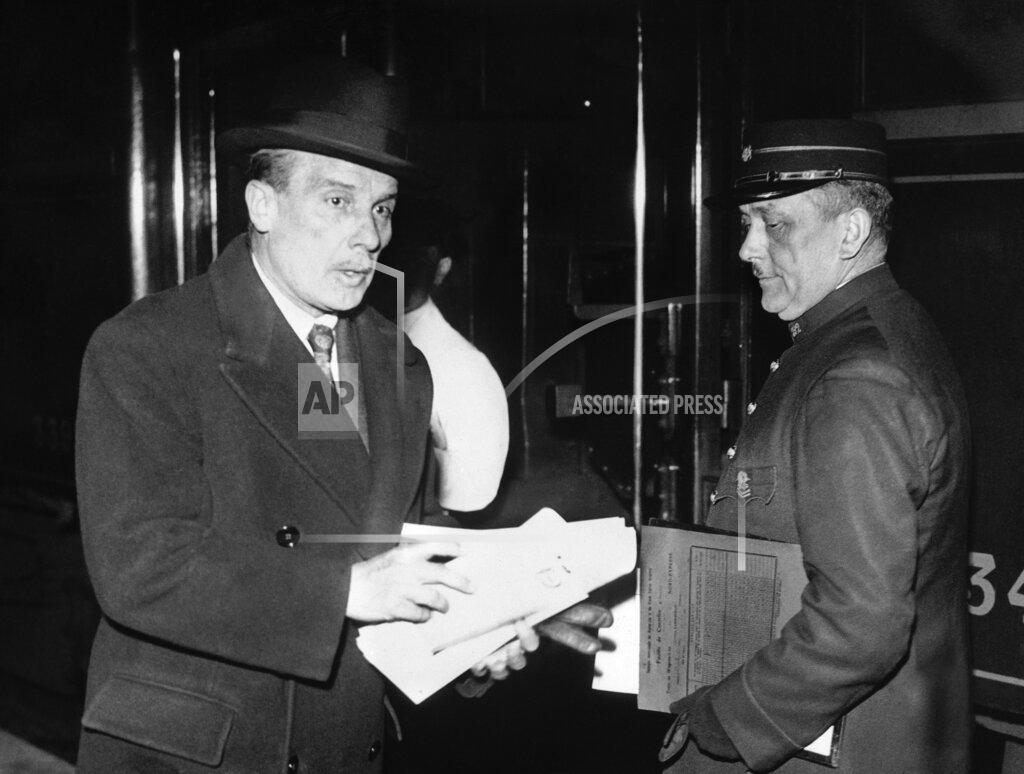
Robert Coulondre, the French Ambassador, who was called home simultaneously with his British colleague after the German invasion of Czecho-Slovakia, will return to his post tomorrow. Alexander Cincar-Markovitch, the Yugoslav Foreign Minister, arrived in Berlin late this afternoon and got a reception at Tempelhof Airfield akin to a state ceremony. His visit is cited as proof that Yugoslavia has “opted” for the Axis powers. The German press designates British attempts to minimize or discredit the Reich’s relations with Rumania and Yugoslavia as “sour British grapes.” Conscription “propaganda” also evokes sardonic comment and is dismissed as political shadow boxing in the face of the traditional opposition of the Labor Party and the trade unions to compulsory service.
The Reich releases Jews from concentration camps and orders them to leave the country. In two months, those remaining will go back to concentration camps.
The Zeesen short-wave transmitter in Nazi Germany began making broadcasts in Arabic aimed at North Africa and the Middle East.
Italy expels the second Chicago Daily News correspondent. The reporter was giving arbitrary and false news, Italy says.
The Belgian premier asks for special powers to be granted to the King in times of defense need.
Swiss households, as well as hotels, restaurants, boarding houses, and public institutions, such as hospitals and asylums, have been advised by the government to have on hand not later than May 31 reserve supplies of basic foodstuffs sufficient for two months.
Hitler’s speech will air in the United States. A reply to U.S. President Franklin Roosevelt’s speech is expected.
The first of a series of government reorganization plans designed “to improve the administrative management of the Republic” was submitted to Congress by President Roosevelt today with provisions for direct White House control over the federal budget, national planning, and the personnel of the entire executive establishment. The President said his plan would promote efficiency, prevent overlapping, and reduce the cost of government by between $15,000,000 and $20,000,000 a year. He proposed to create three new independent offices on the foundations of twenty-one agencies and departmental bureaus concerned with various phases of public welfare, public works, and federal lending programs. In a long message to Congress explaining an accompanying draft of the plan, the President cited the challenges confronting democracies throughout the world as an argument for the regrouping proposal. The supreme purpose of the plan, he said, was “to make democracy work.”
Apparently anticipating the scheduled reply from Chancellor Hitler to his peace guarantee proposal before the German Reichstag Friday, President Roosevelt said in his message: “In the days of ruthless attempts to destroy democratic government it is baldly asserted that democracies must always be weak in order to be democratic at all, and that, therefore, it will be easy to crush all free States out of existence. Confident in our Republic’s 150 years of successful resistance to all subversive attempts upon it, whether from without or within, nevertheless we must be constantly alert to the importance of keeping the tools of American democracy up to date. It is our responsibility to make sure that the people’s government is in condition to carry out the people’s will, promptly, effectively, without waste or lost motion.” Republican and Democratic leaders in both wings of the Capitol joined in characterizing the plan as “a good start” and “absolutely necessary” if overlapping and duplication within and between federal agencies was to be eliminated.
The plan was referred to the special committees on government reorganization of the Senate and House to await the lapse of sixty days before becoming law unless rejected wholly or in part by an affirmative two-thirds vote of both houses. If there was any general sentiment for a rejecting resolution, it was not in evidence today. Representative Taber, Republican of New York, introduced an Invalidating resolution, but because of the partisan basis of the move, his action seemed more likely to increase the chances of the plan’s adoption. The resolution was promptly referred to the reorganization committee which must act on it in ten days or face a discharge petition.
A few members looked askance at that part of the plan applying to the Executive office of the President by which the Bureau et Budget would be made a department of the White House after absorbing the functions of the Central Statistical Board. But this part of the plan had been so thoroughly discounted and the association of the budgetary function with the Executive office so well established that there appeared little chance of an open fight against It
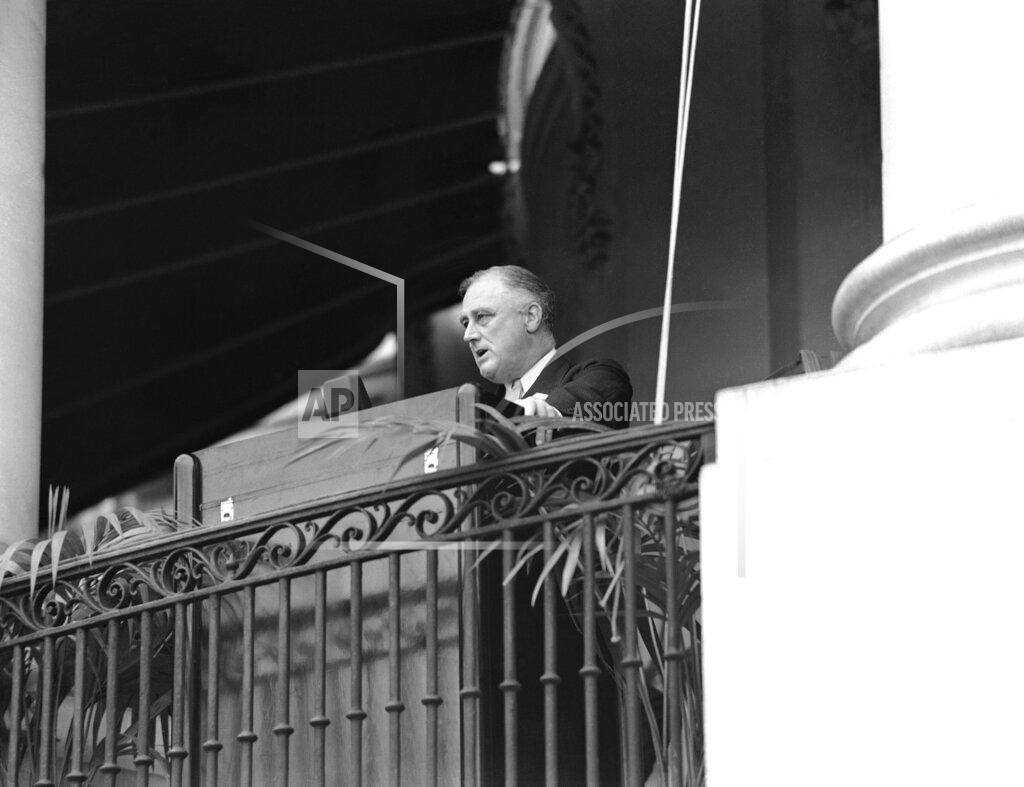
Inhumane acts which have shocked the conscience of a world menaced by war were contrasted today by President Roosevelt with the spirit and work of the Red Cross, and war itself was declared by Secretary Hull to be as unnecessary as it is cruel, in addresses delivered before 3,000 delegates to the Red Cross convention. The President spoke at 5 PM from the portico of the White House to the members and friends of the Red Cross assembled on the south lawn in the late afternoon sunshine of a warm spring day. Mr. Hull was the guest of honor and speaker at tonight’s banquet session.
Both addresses emphasized the need of preparedness to meet relief requirements greater than any with which the Red Cross previously has been called upon to deal. In his address to the organization of which he has been national president since 1933, Mr. Roosevelt paid tribute to the generous activity of the Red Cross throughout its fifty-eight years. “The spirit of the Red Cross does not wane,” the President declared. “The task before us is enormous. Our work, by reason of its very nature, never is done. Our work never can be done while human misery exists.”
The amendments to the National Labor Relations Act proposed by the American Federation of Labor and others permitting removal of cases from the board to the Federal district courts or dividing its work among several agencies would result in nullifying the act, Charles Fahy, general counsel of the National Labor Relations Board, asserted today. Addressing the Senate Committee on Education and Labor on the act’s administration after J. Warren Madden, chairman of the NLRB, had concluded his summary of the board’s work, the general counsel defended the administration of the labor law as vigorously as the chairman had stood by the board’s accomplishments. Mr. Fahy addressed himself first to Senator Burke’s amendment, which would permit any person against whom a proceeding has been instituted to remove the case to the United States district court. This proposal, he said, would throw overboard the progress already made by the board in carrying out the intent of Congress to obtain uniform interpretation of the labor law under a single Federal agency and it would “scatter responsibility among 200 district judges.”
Britain’s Scotland Yard and the United States Secret Service silenced Mrs. Franklin D. Roosevelt today when she started to tell reporters about living quarters that would be provided for King George VI and Queen Elizabeth during their June visit to the White House. When her secretaries reminded her that there were restrictions, the First Lady cut short a review of tentative plans she formerly had announced. She said that she would be unable to carry out a previous agreement to show newspaper women the royal suites.
She explained that Scotland Yard and the Secret Service had rules on the care of visiting dignitaries, adding that she would have to find out what they considered dangerous to give out before further describing plans for White House entertainment. She said that she could not confirm tentative plans that the King and Queen would have the Pink Room and Lincoln study on the east side of the second floor because “they” might change the plan. By “they,” she explained, she meant the State Department and the people over there (apparently the English officials responsible for the monarchs’ safety).
Senator Theodore G. Bilbo of Mississippi [Ed: a venomous little man, open racist and an active member of the KKK] asks for federal aid so that U.S. Blacks can form colonies in Liberia in Africa.
President Roosevelt created the Federal Security Agency.
Lou Gehrig shows a final flash of brilliance with a two-hit game for the New York Yankees in a 8–4 win over the Philadelphia A’s. Five days later, on April 30, Gehrig played the final game of his career. No one had known what was wrong as Gehrig rapidly seemed to lose his coordination and strength through 1938 and the Spring of 1939.
Soon, the whole world would know, as one of the great tragic stories of sports unfolds.
The Amko Simko massacre or Amco Simco firing took place, when Lt. E. W. Marger ordered troops of the British Indian Army to open fire on a crowd of tribal peasants resisting the arrest of their leader Nirmal Munda in Simko village, Gangpur estate (now Birmitrapur, Sundergarh, Odisha). The crowd was protesting high taxes and denied land rights. Rani Janaki arrived at Simko village with a political agent, Lieutenant E. W. Marger, with the sole intent to arrest Nirmal Munda on the grounds of holding seditious meetings and assaulting a village chowkidar. The crowd was warned to hand over their leader, Nirmal Munda, and disperse. However, the crowd of tribals armed with lathis, axes, and other crude weapons resisted the arrest of their leader. Consequently, scuffles broke out and the police resorted to firing their weapons. After they fired their weapons into the crowd, Nirmal Munda and his associates were arrested and jailed. This marked the end of the Munda agitation in Gangpur against the exorbitant taxes. About 49 people were killed (various accounts say 28 to 300) and some 86 wounded.
The Chinese counter offensive toward Nanchang, Jiangxi Province, China reached the outskirts of the city. The Chinese threat to Nanchang was intensified today with the recapture of Tacheng, thirty miles northeast, and the simultaneous advance toward Nanchang by three Chinese columns from the south. The official reports say Tacheng was retaken this morning. Nanchang, formerly a Chinese stronghold in Kiangsi Province, is about seventy miles south of Kiukiang, Yangtze River port. Tacheng is on the FenghsienNanchang highway northwest of Kaoan which was reoccupied a few days ago. The Chinese troops threatening Nanchang from the south were said to be twenty to thirty miles away.
Another Kiangsi report says Chinese planes bombed Japanese troops, barracks and military stores at Kiukiang on the Yangtze River for “more than two hours” Saturday and that the damage was extensive. The Chinese military spokesman admitted the Chinese had abandoned Yicheng and Fowshan in Shansi Province and Tsengcheng in Kwangtung Province. These important cities had recently been retaken.
Japanese military circles assert that Chungking’s “declarations that the major Spring Chinese offensive is not yet launched are not true.” The offensive has been launched, they assert, “has been checked and is nearly spent and will probably end with the end of April.” This was the position of the highest official spokesman of the Japanese Army in Shanghai.
The spokesman further partly explained the Japanese strategy, declaring that the reason there had been no large Japanese offensives for many months, except that ending in the capture of Nanchang, was that the Chinese were keeping their forces thinly distributed on a front of almost 3,000 miles and that therefore the Japanese did not think it worth attacking. He said they would always be ready to attack when the Chinese forces were massed in large enough numbers to make possible an important reduction in their manpower.
China bans panda hunting to save the dwindling species.
Momentous deliberations are going on without intermission in the inner circles of the Japanese Government. The first signal of momentous developments was Sunday’s meeting of the “Inner Cabinet” — the Premier, Baron Kiichiro Hiranuma; Foreign Minister Hachiro Arita; the War Minister, General Seishiro Itagaki; the Navy Minister, Admiral Mitsumasa Yonai; and Finance Minister, Sotaro Ishiwatari. The five Ministers met yesterday and again this afternoon. Before they assembled Mr. Arita conferred with the Premier for an hour.
It is still permissible to expect that whatever Chancellor Adolf Hitler may promise his audience on Friday he will be unable to say that Japan will fight for the Rome-Berlin Axis in the Pacific. So many internal forces oppose the projected alliance that until the weekend it was possible to anticipate the government’s decision with confidence. The continued consultations force. the conclusion that the decision is being reviewed, presumably under pressure from Berlin, supported by powerful elements here, for some tangible strengthening of the Axis with which Herr Hitler can bring in Asia to shift the balance in Europe.
The opponents of a military alliance include nearly all civilian elements and most of the Cabinet. The attitude of Parliament was shown unmistakably by its refusal to allow the introduction of a resolution demanding strengthening of the Axis. Most of the friends of the alliance proposal are found in the army, which is influenced by the army in China. The difficulties encountered in China are ascribed to British support of Generalissimo Chiang Kai-shek. Extreme nationalist newspapers declare Britain has become no better than an enemy and should be regarded as such.
On the other hand, the navy, despite its anxiety to preserve harmony while Japan is at war, can hardly countenance a policy that might align the naval powers as well as Russia against Japan. The influence of President Roosevelt’s actions can hardly be exaggerated. He has made clear where America’s sympathies lie and he sent the United States Fleet back to the Pacific. The visit of the United States cruiser with the ashes of Ambassador Hiroshi Saito evoked a national demonstration of the Japanese people’s desire for friendship with the United States that could not be ignored.
Dow Jones Industrial Average: 127.36 (+0.02).
Born:
Ted Kooser, poet (U.S. Poet Laureate), in Ames, Iowa.
Died:
John Foulds, 58, British composer (“World Requiem”; “Three Mantras”), in Calcutta of cholera.
Georges Ricard-Cordingley, 66, French painter.
Naval Construction:
The Вое́нно-морско́й флот СССР (ВМФ) (Soviet Navy) “S” (Stalinec)-class (2nd group, Type IX-modified) submarine S-13 is launched by Krasnoye Sormovo (Gorkiy, U.S.S.R) / Yard 112.
The Вое́нно-морско́й флот СССР (ВМФ) (Soviet Navy) “S” (Stalinec)-class (3nd group, Type IX-modified-2) submarines S-14, S-103, and S-104 are launched by Krasnoye Sormovo (Gorkiy, U.S.S.R) / Yard 112.


 History Diaries