A week after the right‐wing coup in Vientiane, confusion and squabbling continue to dominate the Laotian situation. The generals who seized power in that city are making no secret of their distaste for Western efforts to reconstitute the coalition government under Prince Souvanna Phouma. With utmost reluctance the rightist leaders have agreed to let him stay at the head of a government reorganized along lines that would greatly increase their influence. But the pro‐Communist Pathet Lao has rejected a reorganization on such terms.
The one encouraging aspect is the cooperation of the United States and the Soviet Union in seeking restoration of the old balance. The United States can press the right‐wingers with the threat of cutting off American aid. Whether the Soviet Union has equal influence over the Pathet Lao is more doubtful. The Laotian leftists are much closer to Peking than to Moscow.
Admittedly, the coalition has not worked perfectly. The right‐wingers are understandably resentful at the Pathet Lao’s nibbling away at their positions in a period of supposed stability. But restoration of the coalition — under conditions of more firmly supervised neutrality — is infinitely better for Laos than the resumption of full‐scale internal war.
The right‐wing revolutionary junta refused today to yield its administrative control of Vientiane until the neutralist Premier, Prince Souvanna Phouma, formed a new coalition government. Troops of General Siho Lamphoutacoul, the security chief, patrolled the city and remained on guard outside the official residence of Prince Souvanna Phouma. The Premier accepted yesterday the junta’s demand for reorganization and enlargement of his coalition Government. In a communique broadcast by the Vientiane radio, the Revolutionary Committee said it would “retain its administrative powers” until a new government was formed in line with its recommendations.
It was evident that Prince Souvanna Phouma and United States officials might have underestimated the determination of General Siho Lamphoutacoul, the strong man of the Revolutionary Committee. They were surprised and dismayed by the latest communiqué. General Siho Lamphoutacoul and General Kouprasith Abhay, who is nominal head of the Revolutionary Committee, had attempted in the initial stage of their coup d’etat last Sunday to overthrow the Souvanna Phouma government. When this failed because of strong opposition from the major powers, especially the United States and Britain, the two generals agreed to the reorganization of the coalition Government under their supervision, with Prince Souvanna Phouma at its head.
President Johnson announces that General William Westmoreland will replace General Paul Harkins as head of the U.S. MACV (as of 20 June). General Westmoreland, a 50‐year‐old paratroop commander, was named deputy to General Harkins last January. President Johnson said at his news conference that General Harkins’s duty was being extended beyond his normal retirement date of May 15, when he will reach the age of 60. The President praised General Harkins for “distinguished and outstanding” service in South Vietnam. This was clearly intended to counter occasional reports from Saigon that General Harkins was being eased out.
South Vietnamese forces rout a Việt Cộng battalion at Bình Chánh. Striking with a vigor praised by their United States advisers, Vietnamese troops routed the Communists’ hardened 514th Battalion today from one of the most complex defense positions ever seen in South Vietnam. Bodies of seven Việt Cộng guerrillas were found in bunkers when government forces overran the entrenchments, foxholes, tunnels and machine‐gun nests that had been dug into the rock‐hard terrain of this Mekong Delta district. “They must have been mighty unhappy to give these up,” an American officer said: “We sure are giving the 514th hell.”
The Communists, who have roamed the northern part of the delta for years, pulled back under harassment by government units that moved on quickly to other targets. A Việt Cộng attack yesterday on two government outposts set off the battle near Binh Chanh, about 35 miles southwest of Saigon. Lieutenant Roger W. Zaliskas of Waterbury, Connecticut, an adviser with a Vietnamese reconnaissance company, was hit in the face by a shell fragment yesterday. He returned to duty today. Attached to the same company is Sgt. Clarence Bath of Savannah, Georgia, who described as “beautiful” an initial charge by 200 whooping and yelling troops across fields, behind a line of 24 armored personnel carriers. They attacked in the direction of coconut trees sheltering the guerrillas’ entrenchments.
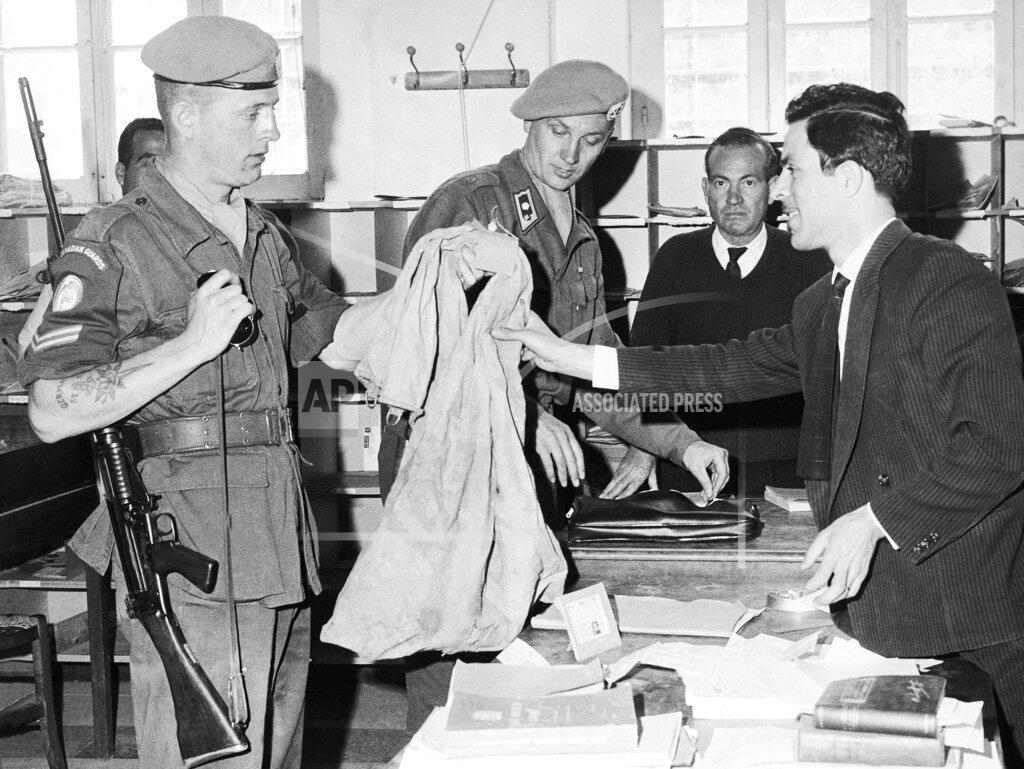
Greek Cypriote security forces overran Turkish Cypriote mountain positions early today and seized vital terrain just west of the Turkish Cypriote strongpoint of St. Hilarion Castle above the Kyrenia Pass. A United Nations spokesman said at least six Turkish Cypriotes had been killed and six wounded and two were missing in the surprise night assault high in the Kyrenia Mountains. He placed the Greek Cypriote casualties at one dead and one wounded. It was the most serious military challenge yet to Turkish Cypriote control of the strategic Kyrenia Pass and the Nicosia-Kyrenia Road. Greek Cypriote forces are now in strength on both the western and eastern spurs of the range above the pass. A Turkish Cypriote official estimated the Greek Cypriote strength at 1,500 men armed with rifles, automatic weapons, machine guns, bazookas and mortars. The Greek Cypriote move against the ancient castle also threatened five Turkish Cypriote villages and an airstrip at the foot of the southern flank of the range just west of the Nicosia‐Kyrenia road. Evacuation began this evening of Turkish Cypriotes living in the village of Aghirda. They were taken southward along the road to Guenyeli, where the main body of the 650‐man Turkish Army contingent is based.
A Turkish Cypriote spokesman said that the village had come under fire during the day and that one man had been wounded. This evening he said the Greek Cypriotes were dropping mortar shells on the village from their new mountain positions. The Greek Cypriotes overran several Turkish fortified positions, including the small Greek Orthodox church of Ayios Prophitis Elias, during a four‐mile advance eastward along the mountain crest toward the castle. The Greek Cypriote advance stopped a half‐mile in a direct line and almost two miles by road from the castle. Newsmen who drove westward along the dirt road from the castle in search of the Turkish Cypriotes’ forward positions suddenly found themselves within the Greek lines without having sighted a Turkish Cypriote. The Turkish Cypriote positions now stretch three miles eastward from St. Hilarion Castle, which Walt Disney used as his model for the castle in the cartoon movie “Snow White and the Seven Dwarfs,” down to the pass and then up the western spur of the range to the peak the United Nations peace force calls “Whisky.” It was not known how many Turkish Cypriote fighters were in the area, but military observers estimated that their strength was much lower than that of the Greek Cypriotes.
Meanwhile, near the south coast of the island, heavy firing was exchanged for the third consecutive day between the hostile communities in the village of Ayios Theodhoros. Lieutenant General Prem Singh Gyani, commander of the United Nations force, visited the village this morning and remarked that “the law of the jungle persists here.” He complained that there were no responsible Cypriote police authorities in the village. British troops of the peace force sought to assure the safety of Turkish Cypriote women and children gathered in the Turkish school building. A United Nations post was established in the school. Turkish Cypriote fighters had been firing on Greek Cypriote positions from the school. The British troops sought to persuade the Turkish Cypriotes to surrender their arms so the Greek Cypriotes would stop firing at the building. This effort was unsuccessful, but while it was in progress the heavy firing died down. Sporadic shooting continued through the day, however.
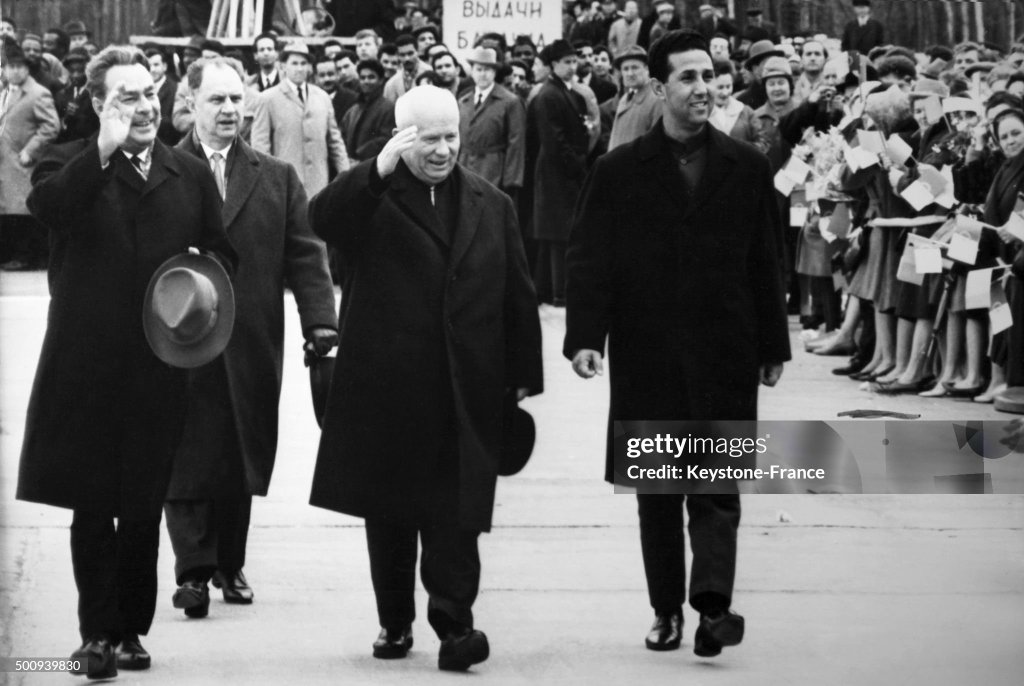
President Ahmed Ben Bella of Algeria received a rousing welcome in Moscow today on his first visit to the Soviet Union. Premier Khrushchev and most of the other top leaders were standing at the bottom of the ramp as the Algerian leader descended from his Soviet-built aircraft. Guns boomed a salute, an honor guard paraded and a formation of jets swished low overhead. Mr. Khrushchev set the tone of the visit with his first words of welcome. “Comrade President,” he began. Then he added, with great deliberation: “It is precisely with this designation that l want to address you, Comrade President.” Mr. Ben Bella, who refers to himself frequently as a staunch Socialist but does not permit the Communist party to operate in his country, addressed the Premier as “Mr. President, dear friend.”
Then, as Moscow traffic froze into immobility, the Premier and his guest rode downtown at the head of a long motorcade, through streets decorated with Algerian and Soviet flags, paper lanterns and bunting in Algerian colors and glowing inscriptions in Arabic and Russian. Tens of thousands of Muscovites lined the route, some of them were waving tiny paper Algerian flags. The usual Saturday afternoon crowds had been enlarged by thousands of school children and factory workers who had been requested give up their free afternoon to welcome Mr. Ben Bella. The Algerian leader’s visit is believed to be of great importance to the Soviet leadership its bid for influence in Africa.
Parliamentary elections were held in Malaysia for the then 159-member Dewan Rakyat for the second time since independence, and for the last time in Singapore prior to its secession from Malaysia. The Alliance Party (Parti Perikatan), a coalition of Malayan, Chinese and Indian politicians, increased its overwhelming majority in the lower house, taking 89 of 104 contested seats, but future Singaporean prime minister Lee Kuan Yew won a seat for the new People’s Action Party.
The future of French naval cooperation in command groups of the North Atlantic alliance is in doubt, allied diplomats said tonight. This was a consequence of an article in the West German newspaper Die Welt and equivocal French reaction. Adm. Georges Cabanier of France did not attend a North Atlantic Treaty Organization high command meeting at The Hague. The French are not expected by the other allies to participate in any further exercises by the English Channel Command, headed by a British Admiral, Sir Wilfrid Woods. Die Welt, quoting alliance sources in Paris, said that the French Government was considering withdrawing all its naval officers form North Atlantic Treaty Organization headquarters and that if this transpired the 14 other members of the alliance would be forced to protest President De Gaulle’s “hostile” attitude toward the alliance.
President Johnson will send to Congress Monday a plan to spend nearly a billion dollars to help the poverty‐stricken Appalachian region. The President, who announced the program today at news conference, said the plan would provide $220 million in the coming fiscal year. It will include proposals for new power plants, based on the experience of the Tennessee Valley Authority. It will include a variety of work projects, presumably similar to those of the New Deal era. It will also include a road building program and efforts to find new uses for coal. It will provide for food stamps, retraining of workers, re‐education and medical care.
The President gave a detailed preview of his plan for which, he said, legislation was urgent. He spoke of the need to help the people of the area, stressing that “the full impact” of their plight had been brought home to him in his inspection tour yesterday. The President, who returned late yesterday from a 14‐hour tour of five states afflicted with pockets of poverty, said he had worked “all through the night and this morning” on his Appalachia legislative proposals. At the same time, the President spoke with confidence and pride of the country’s general economic outlook. He gave new figures on various economic indicators to show that business was booming and prices were stable.
A Southern Senator who voted for the civil rights bills of 1957 and 1960 assailed provisions of the pending measure today as “seriously defective and potentially dangerous.” Albert Gore of Tennessee, long a member of the Democratic party’s liberal wing, declared in a Senate speech that he could not support the bill in its present form. He concentrated his attack on Title VI of the bill. This authorizes the withholding of Federal funds from programs in which racial discrimination is practiced. The Senator said it might be used as a form of political reprisal. From the nature and extent of his criticism, it seemed unlikely that the bill would be revised sufficiently to satisfy him.
His position disappointed civil rights advocates who had hoped that he might provide a much‐needed vote to apply closure — limitation of debate — in the current fight. A two‐thirds majority of Senators present and voting is required to invoke closure, and the bill’s managers have so far been unable to line up the necessary votes. If all 100 Senators participated, 67 votes would be required. The bipartisan managers as yet have been unable to count as many as 60 advocates of closure. Until today, their list of possible recruits had included Senator Gore. His name, however, had a question mark affixed.
Mr. Gore opposed closure when an unsuccessful attempt was made to limit debate on the 1960 bill, which was passed when Southern opponents voluntarily stopped talking. Despite this, the civil rights forces thought he might have been receptive to arguments for limitation of debate on the pending bill. The Senate’s fourth consecutive Saturday session produced another discouraging development for the bill’s managers when Senator Richard B. Russell, Democrat of Georgia, discounted the prospect of any votes next week. Mr. Russell, leader of the 19‐man bloc of Southern opponents of the bill, indicated that his forces would insist on at least a week’s debate of a compromise jury‐trial amendment.
Speculation over Senator Gore’s motives in opposing the bill centers on the fact that he is seeking re‐election this year. Tennessee includes large areas of segregationist sentiment despite its overall record of liberalism. However, no serious opposition to his candidacy has arisen and his election is widely regarded as virtually assured. He and President Johnson have often clashed over the years on various issues, and their personal relationships have been anything but cordial. It is no secret that the President would like to see Senator Gore replaced by a Democrat on whom he could rely more frequently for support of Administration programs.
President Johnson said today that he would welcome all proposals for more trade with Communist countries. He promised to weigh them as carefully as the recent wheat sales to the Soviet Union. The President was noncommittal about the prospects for doing more business with Moscow or its allies in Eastern Europe. He said at a news conference that he awaited with interest a study of the problem now being conducted by the Senate Foreign Relations Committee, but he made no reference to similar studies and considerable disagreement within the Administration.
“It isn’t too bad. We can live with it. We had been figuring on a $50 million package. This will cost us $74 million a year.” That was one railroad executive’s quick summation of the settlement that last week averted a nationwide railroad strike. This cheerless prospect will add little sweetness to the already mediocre profit performance of the railroad industry in a booming economy. It thus provided an ironic contrast to the optimism with which the stock market initially received the news of the settlement of the five‐year old dispute between rail management and labor over work rules that date to World War I. In Wall Street rail stock prices soared and the Dow‐Jones railroad stock average pushed above 200 for the first time in history. But the average backed off on Friday.
The campaign against Governor George C. Wallace in the Maryland Presidential primary has become a concerted drive by the Democratic party to crush the Alabama segregationist leader in the state where he is expected to have his greatest support. It was learned today that President Johnson was expected to campaign in Maryland in support of Senator Daniel B. Brewster, who is making a favorite‐son race against Mr. Wallace under the President’s banner. Mr. Johnson is expected to speak for Mr. Brewster at a statewide luncheon of Democratic Women’s Clubs in Silver Spring, Maryland, on May 14, five days before the primary.
Students from at least 12 U.S. colleges and universities are among 87 young men of draft age who have signed an advertisement saying they would refuse to fight in South Vietnam if called. The advertisement, which was patterned on one that French students once signed opposing the Algerian war, asserted that the youths accepted “our obligations to, defend our country and to serve in the armed forces.” It appeared yesterday in the leftist weekly The National Guardian after several liberal publications allegedly refused to carry it. “Believing that United States participation in that war is for the suppression of the Vietnamese struggle for national independence,” the advertisement said, “we see no justification for our involvement.” The colleges and universities represented include Columbia, New. York University, City College, Harvard, Yale, Haverford, the University of Connecticut, Wisconsin, Clark, Carleton Wesleyan University and San Francisco State.
The dispute over civil rights in Cleveland’s public school system is beginning to have deep effects on community life. Since last fall, civil rights groups operating together under the title of the United Freedom Movement have been trying to get the Cleveland Board of Education to adopt an official policy of promoting racial integration in classrooms. The dispute, which generated one crisis in January, quieted down until early this month when a white Protestant minister, the Rev. Bruce W. Klunder, was killed in a demonstration at the construction site of a new school. Despite the intensity of the civil rights drive, which culminated in a highly successful boycott of schools by Black students last Monday, the board has remained intransigent.
The “New Phil Silvers Show” last airs on CBS-TV.
Tom Tresh hit a two‐run homer in the second inning at Yankee Stadium yesterday and the Yanks went on to gain a 4–1 victory over the Baltimore Orioles.
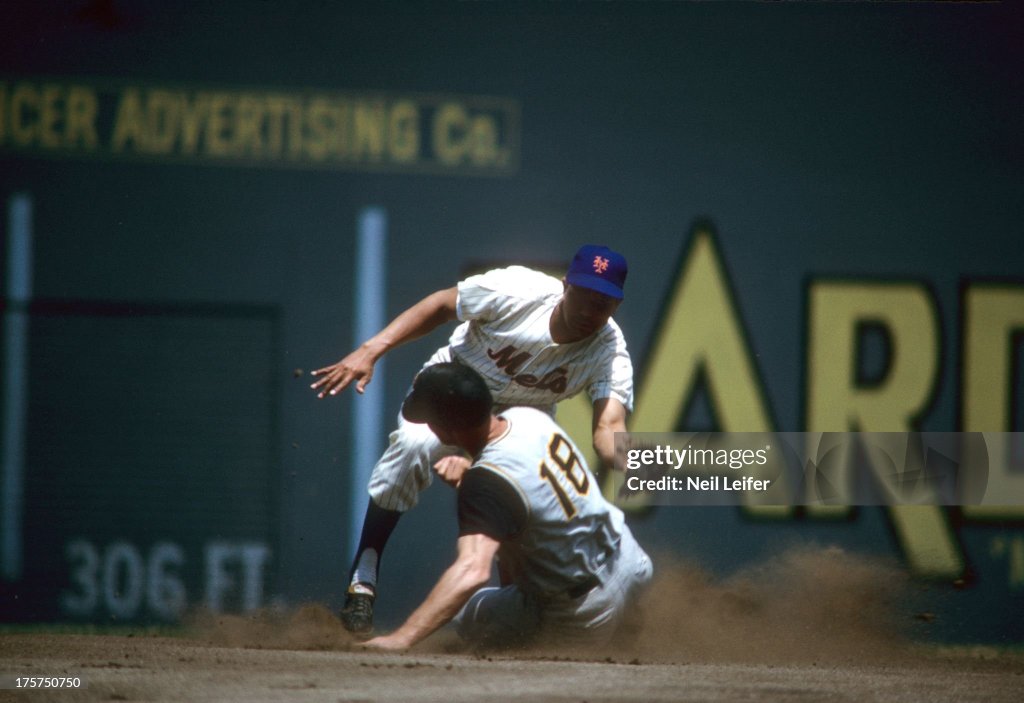
The Pirates got four runs in the first inning but needed one more to beat the New York Mets at Pittsburgh, 5–4.
At Milwaukee, Warren Spahn defeated the Los Angeles Dodgers, 5–1, with a four‐hitter. Three Dodgers — Johnny Podres, Tommy Davis and Ron Perranoski — were hurt in the game.
The Toronto Maple Leafs beat the visiting Detroit Red Wings, 4–0, to win Game 7 of the 1964 Stanley Cup Finals and their third consecutive championship in the National Hockey League.
Born:
Hank Azaria, American film and TV actor, six-time Emmy Award winner; voice behind many characters in “The Simpsons” (Moe, Apu, Chief Wiggum, Comic Book Guy, Carl Carlson); in Los Angeles, California.
Andy Bell, English singer (Erasure – “Oh L’Amour”), in Dogsthorpe, Peterborough, England, United Kingdom.
Yves Courteau, Canadian NHL right wing (Calgary Flames, Hartford Whalers), in Montreal, Quebec, Canada.
Blaine Beatty, MLB pitcher (New York Mets), in Victoria, Texas.
Billy Witt, NFL defensive end (Buffalo Bills), in Russellville, Alabama.

 History Diaries