
The “Carnation Revolution” (in Portuguese, Revolução dos Cravos) began at 12:20 a.m. throughout Portugal after a pre-arranged signal — the playing of the song “Grândola, Vila Morena” — was broadcast on the Lisbon radio station Rádio Renascença. The Movimento das Forças Armadas (MFA), a group of Portuguese military officers led by recently-fired General António de Spínola, carried out a coup d’état to end 41 years of dictatorial rule by the Estado Novo. Thousands of Portuguese civilians joined the military insurgents in a popular revolution. Prime Minister Marcelo Caetano relented at 6:00 in the morning and he fled the country for political asylum in Brazil.
A group of army officers, proclaiming their desire to bring democracy to Portugal, seized control of the government amid scenes of popular rejoicing. After capturing a radio station and key ministries, the Movement of the Armed Forces announced that Premier Marcello Caetano had surrendered. General Antonio de Spinola and General Francisco da Costa Gomes, who were dismissed last month as heads of the defense staff for their criticism of the war in Portugal’s African territories, emerged as leaders of a junta that would hold free elections.
The takeover in Portugal followed a steady demoralization produced by the country’s effort to preserve its overseas territories. The demoralization, marked by erosion of the country’s political and social stability, was aggravated by frustration over the government’s inability to end the fighting in the African territories or to enlist the help of Portugal’s North Atlantic allies in the effort.
Günter Guillaume, an aide to West German Chancellor Willy Brandt, is exposed as a Stasi spy (East German secret service) The aide to Chancellor Willy Brandt of West Germany was arrested in Bonn on suspicion of being a spy for East Germany. He was a political assistant in the Chancellor’s Bonn office. The chief federal prosecutor said Mr. Guillaume had admitted being an officer in the East German army.
Prime Minister Harold Wilson took the heat out of a political uproar by reaffirming that British troops will definitely be staying in Northern Ireland. He was responding to an outcry in both Britain and Northern Ireland following a speech by Defense Minister Roy Mason, who said pressure was mounting on the government to withdraw from the troubled province.
A bomb planted in an automobile exploded in the Northern Ireland town of Roslea, near the Irish Republic border, wrecking the home of a Roman Catholic doctor, a police station and a school. One man was injured by flying glass. The explosion came hours after a blast in a stolen post office truck in Castlederg, near Londonderry. Several buildings were damaged.
Leo Tindemans forms a new Belgium government. Flemish Social Christian Leo Tindemans was sworn in by Belgian King Baudouin as head of a new minority government, three months after the collapse of a coalition of Social Christians, Socialists and Liberals. The new 25-member cabinet — composed of centrist Social Christians and right-wing Liberals — commands only 102 votes in the main legislative body, five short of a majority in the 212-seat house. The Socialists have vowed a tough line in opposition.
The United States and West Germany signed an agreement under which Washington will receive $2.22 billion to offset foreign exchange costs of stationing troops in Germany. The agreement extends to June 30, 1975, indicating U.S. troops will remain at their present 200,000 level until then.
After seven months as Secretary of State, Henry Kissinger has succeeded in restoring the morale of the State Department and restoring its traditional place at the center of foreign policy. A review of his tenure indicates that Mr. Kissinger has accomplished this by the force of his personality, the transfer of his main operations from the White House to the department and the appointment of highly motivated, individualistic, loyal aides to high posts.
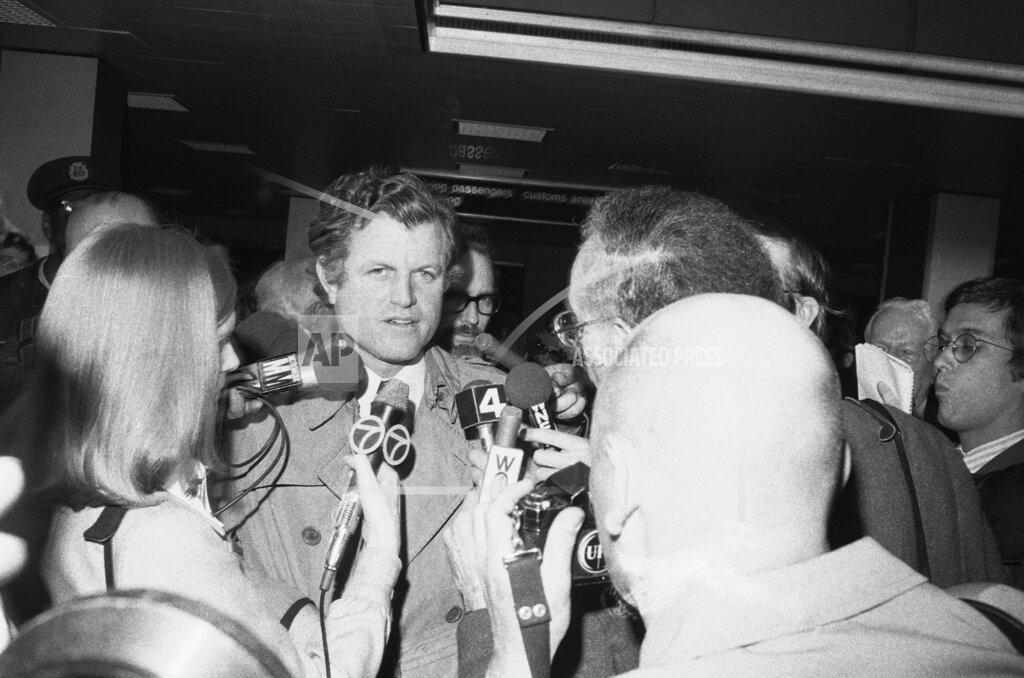
Senator Edward M. Kennedy ended a six‐day visit to Moscow today after a post‐midnight meeting with a group of Jews who have been seeking unsuccessfully to emigrate to Israel. The Massachusetts Democrat told reporters at Sheremetyevo Airport before his departure that his visit had not changed his views about cosponsoring the amendment, which ties the extension of credits and other trade concessions to a Soviet policy of free emigration. Senator Kennedy said he had raised the emigration issue in his conversations with Soviet leaders, among them a four‐hour Kremlin meeting with the Communist party chief, Leonid I., Brezhnev. But he declined to offer details of his discussions on this or other, issues until after he had returned to the United States.
Egypt has all but openly accused Libyan President Muammar Qaddafi of plotting to overthrow President Anwar Sadat. In a statement by the Egyptian chief prosecutor, the government stopped just short of directly linking Qaddafi to the recent attack on the Egyptian military technical academy in Cairo. The statement said the conspirators, who failed to seize the school and its armory, also had planned to take Sadat prisoner and declare a new government in Egypt.
President Anwar el‐Sadat named a new Cabinet last night, retaining for himself the Premiership but appointing the Finance and Economy Minister, Abdel‐Aziz Hegazi as First Deputy Premier, a post that did not exist before. Mr. Hegazi’s promotion was intended to stamp the Cabinet as a “Government of reconstruction and development.” Mr. Hegazi, who has held the post of Finance and Economy Minister for about a year, has been a strong advocate of an “open‐door” economic policy and has often underlined Egypt’s urgent need for massive foreign investment, both from the West and the Arab world. He is known to be advocating strong guarantees for investments against nationalization and expropriation.
Iraqi armor pushed forward under harassing fire toward the relief of a government garrison besieged by Kurdish rebels in the border town of Zakho. For five days the Kurds have intermittently pounded the surrounded 1,000-strong garrison. Many of the town’s residents reportedly fled to join the rebels. The vice president of Iraq’s Revolutionary Command Council said Bagdad would have to consider liquidating the Kurdish forces if they did not surrender.
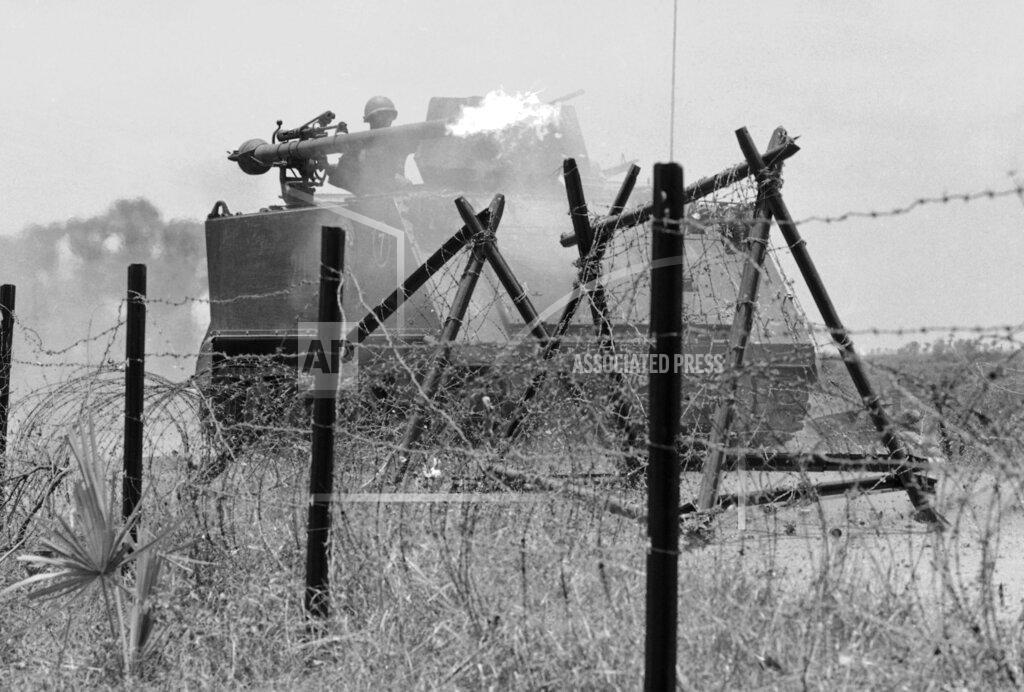
Communist gunners bombarded an auditorium packed with South Vietnamese army draftees in a mortar attack that killed 17 recruits and wounded 118 others. South Vietnam’s military command said about 380 men were gathered for a night class when five mortar rounds smashed into the hall, less than nine miles north of Saigon.
The Korean Central Intelligence Agency (KCIA) carried out the arrest, without warrants, of 1,024 dissidents throughout South Korea on charges of violation of the National Security Act. Of those, 253 would be imprisoned and eight would be executed on April 9, 1975.
A landslide killed more than 450 people in the valley of the Mantaro River in Peru, including at least 43 near Huancayo. After burying the village of Mayunmarca, the landslide dammed the river and formed a lake that would reach a depth of 107 meters (351 ft) and a length of 31 kilometers (19 mi) after submerging the towns of Pururo and La Esmeralda, as well as numerous large farms.
The value of the Canadian dollar reached its highest point ever on exchange markets, becoming worth slightly more than $1.04 in United States dollars (US$ 1.0443); the U.S. dollar was worth slightly less than 96 cents (C$ 0.95758). The value of the Canadian dollar would reach its low point on January 21, 2002, worth US$ 0.6179 but would briefly surpass the U.S. dollar again on September 28, 2007.
Prime Minister John Vorster’s governing National Party coasted to its sixth successive election victory in South Africa since World War II but had to acknowledge a surprise show of strength from white liberal elements. With two seats undeclared, the Nationalists had captured 122 seats in the 171-member Parliament, or five more than they held in the previous assembly. The party won 55.4% of the vote and interpreted the victory as an endorsement of Vorster’s separatist racial apartheid policies.
The House Judiciary Committee plans to submit written questions to President Nixon to determine if “criminal fraud” was involved in the preparation of his income tax returns. The plan was disclosed in a staff report that recommended setting aside a number of allegations against the President in order to concentrate on the most serious matters, such as the Watergate cover-up and the President’s taxes.
Joan Doar, the committee’s lead counsel, told the members that his staff was concentrating on seven broad areas of allegations against the President. These include the Watergate cover-up, the activities of the secret White House unit known as the plumbers, and the President’s personal finances, primarily his tax returns.
A jury of nine men and three women began deliberations in the case against former Attorney General John Mitchell and former Commerce Secretary Maurice Stans. The case went to the jury after federal judge Lee Gagliardi read a 136-page charge, which stressed that “all parties stand as equals before the bar of justice.”
The President received a rousing welcome before an overflow audience of 10,000, and words of welcome from the Democratic Governor of Mississippi as Mr. Nixon delivered a speech promising peace and prosperity for a generation. The President’s appearance at the Mississippi Coliseum in Jackson drew the largest and most enthusiastic reception to date in the President’s public campaign against impeachment.
A federal judge ruled that the San Francisco police violated the Constitution by stopping and questioning some 600 black men in their investigation of the murders of 12 white persons over the past few months. The ruling and an injunction requires the police to abandon a vague physical description of the killer as the sole ground for stopping a man for questioning.
The Federal Aviation Administration proposed that all shipments of radioactive isotopes be tested for radiation leakage before they are carried on passenger or cargo jetliners. The suggested rule was announced as a House subcommittee opened hearings on the air transportation of radioactive materials and other hazardous cargo. There have been two reported instances in the last three years where passengers on regularly scheduled aircraft were exposed unknowingly to radiation from an improperly packed shipment of radioactive material in the cargo hold.
Luther Holcomb asked that his nomination for a seat on the Federal Communications Commission be withdrawn. Holcomb, a Democrat, had come under fire from consumer groups because of his denial that he had urged the reelection of President Nixon. Documents supplied to the Senate Commerce Committee indicated that he had been involved in Republican causes. The political issue is an important one because the law bars either party from holding more than four of the seven FCC seats. With three vacancies, Republicans now hold a 3-1 majority.
It was Patricia Hearst’s strongest language yet, but her tape-recorded message yesterday again failed to convince her family and law enforcement officials that she had joined the underground group purportedly responsible for kidnapping her. She termed ridiculous any idea that she had been brainwashed. She said that consciousness was terrifying to the ruling class. And, at the end she said that she saw no reason to defend her position further. “I am a soldier in the people’s army,” she said. But doubts as to whether this was true persisted today. After Miss Hearst was kidnapped last February 4, tape recordings began to become public in which she and other persons contended that she was being held by the Symbionese Liberation Army. That name was also used by a group that claimed responsibility for the killing of Dr. Marcus A. Foster, superintendent of Oakland public schools.
The Board of Regents of the University of Colorado voted 8 to 1 against the non-tenured appointment of a controversial Marxist to the school’s English Department, a board spokesman said. H. Bruce Franklin, 40, of Menlo Park, California, was fired by Stanford University in 1972 for allegedly inciting violence during anti-war demonstrations. He was recommended by both the U.C. English Department chairman and the U.C. dean of the school of arts and sciences. Franklin, considered an expert on author Herman Melville, is the only tenured professor ever fired at Stanford and has filed a court appeal against that dismissal.
A research group told the Environmental Protection Agency that there was a “fearful possibility” that persons in at least three industrial areas — Houston, southern Louisiana and western Kentucky — were being exposed to airborne vinyl chloride, a chemical linked to liver cancer. The Center for Science in the Public Interest said state agencies should immediately make measurements to determine the extent of the hazard. A CSPI spokesman told The Times that the Los Angeles Air Pollution Control District had been aware of vinyl chloride studies and soon would begin a computer search to locate plants emitting the chemical.
The Texas Panhandle’s dryland wheat crop is lost, the victim of a severe drought, bugs and several weeks of hot, blustery winds. The loss was set at $160 million. Agriculture Department officials said the impact nationally was minimal. They said that with the exception of some drought areas of New Mexico and western Texas, this year’s crop was “generally good in all areas of the nation.”
Senator Hubert H. Humphrey (D-Minnesota) entered Bethesda Naval Hospital in Washington, D.C., for a checkup after earlier treatment for a possibly malignant tumor. The former Vice President was hospitalized at Bethesda in January for recuperation after a series of X-ray treatments late last year for a pinhead-size tumor on his bladder. The tumor was described as “borderline” because it was too small to determine its state.
The United States Geological Survey has agreed to discontinue its practice of privately consulting a committee of oil industry representatives before establishing regulations for offshore drilling on the continental shelf of the United States. The decision came after Representatives Henry S. Reuss and Guy Vander Jagt, the chairman and ranking minority member of the House Subcommittee on Conservation and Natural Resources, sent a letter to Interior Secretary Rogers C. B. Morton. They charged that the current “secret procedure deprives the public of knowing what the Survey proposed initially, and what, if any, objections the industry may have had to a proposed order at the early stages.” Under current procedures, the Representatives said, the Geological Survey, which is responsible for inspecting and regulating oil and gas operations on the shelf, circulates its proposed regulatory orders to the Offshore Operators Committee, composed entirely of industry representatives, before making them public in the Federal Register.
A court hearing on the Cincinnati Bengals’ request for a preliminary injunction against the World. Football League will be held Monday as scheduled, a federal judge ruled today. United States District Judge David Porter refused to rule on a Bengals’ request that the hearing be postponed and a temporary restraining order be extended indefinitely past its Monday expiration date. Porter issued the temporary restraining order last week after the Bengals filed suit against the WFL and Bengal linebacker, Bill Bergey. Bergey, April 17, signed a contract with the WFL’s Virginia Ambassadors, agreeing to begin play for them in 1976. The temporary restraining order now in effect prohibits the WFL from trying to attract any Bengal players while their contracts with the National Football League team remain in effect. The suit seeks a permanent injunction against the WFL and asks that Bergey’s contract with the WFL be rescinded.
National Football League owners voted to make nine changes to NFL rules, including sudden-death overtime for regular season games tied at the end of regulation, moving the goal posts, returning missed field goals to the line of scrimmage, after the new World Football League (WFL) had announced that it would have similar rules. One WFL owner told reporters, “It looks like they went right down the line and copied our book.”
Dow Jones Industrial Average: 827.68 (-104.69, -11.23%).
Born:
Libor Procházka, Czech National Team hockey defenseman (Olympic gold, Team Czech, 1998), in Vlašim, Czechoslovakia.
Tricia Dunn, Women’s Team USA ice hockey forward (Olympics, gold medal, 1998; silver medal, 2002; bronze medal, 2006), in Derry, New Hampshire.
Twan Russell, NFL linebacker (Washington Redskins, Miami Dolphins, Atlanta Falcons), in Fort Lauderdale, Florida.
Grant Achatz, American chef and restaurateur; in St. Clair, Michigan.
Ivonne Montero, Mexican television actress, star of the telenovela “¡Anita, no te rajes!;” in Mexico City, Mexico.
Died:
Pamela Courson, 27, former companion of singer Jim Morrison and heir to his fortune, was found dead of a heroin overdose, less than three years after his death.

 History Diaries