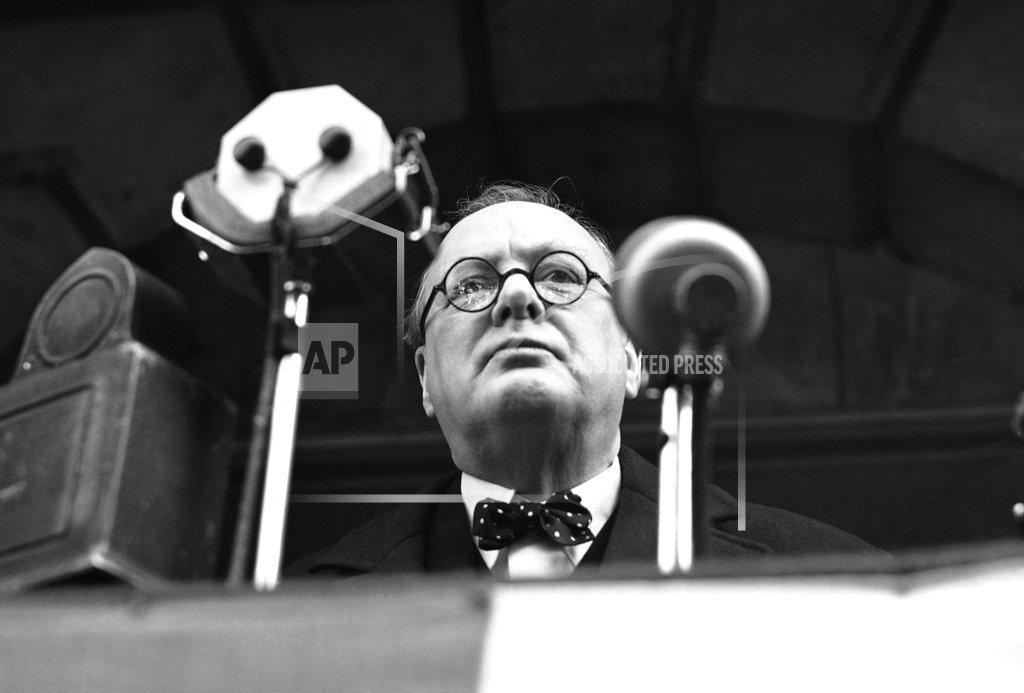
The British Cabinet agrees unanimously on conscription. A truce deal by Hitler may be in the works. Britain was on the verge last night of taking the momentous step of introducing conscription. The Cabinet unanimously approved compulsory service in principle. And to reinforce the impression that the country means business, the budget, to be introduced today, is expected to provide increased surtaxes.
The introduction of compulsory military service, entailing the most tremendous change in British life since the World War, was approved in principle by a unanimous Cabinet tonight as the surest way of proving Britain’s determination to prevent further aggression in Europe. This decision followed by twenty-four hours, the mysterious return to Berlin of Sir Nevile Henderson, the British Ambassador there, with, it is understood, a warning that conscription was being contemplated and assurances that Britain had no intention of “encircling” Germany.
Paris expects the London Cabinet to press compulsory military service. France feels that Britain must increase its manpower.
As the returning British Ambassador to Berlin carried with him assurance that Britain planned no encirclement but also a warning that the weapon of conscription was ready, neutral diplomats in the German capital believed that pressure on Chancellor Hitler to be conciliatory might not be necessary. They thought he might be preparing to offer a period of truce and perhaps a conference to settle outstanding issues.
In the diplomatic race to acquire teammates in the Balkans, Rumania was the object of insistent overtures. The British talked to her Foreign Minister in London at the same time as a mission arrived in Bucharest to discuss trade. There was even hope that the British might get a naval base on the Black Sea.
On the other hand, Italy, feeling that Yugoslavia was virtually lined up with the Axis, prepared to put pressure on Rumania. But Premier Mussolini, like his Axis partner, was understood to have a conference plan. The retiring British Ambassador left Rome reportedly with an Italian proposal for a parley of a few powers. The Balkan peninsula, for which a great diplomatic battle is now. being fought, has often been compared with a chessboard. Certainly, a complicated series of moves is now under way. Yugoslavia wants a friendly Rumania on her eastern frontier and does not want to break the close ties that have bound the two countries since their formation. Both were members of the Little Entente and are still members of the Balkan Entente. The treaties that bind the two nations are still in force. In other words, a Yugoslavia affiliated with the Axis would like to see Rumania linked up partly or wholly. That is where Italy and Germany enter, for they likewise want nothing better.
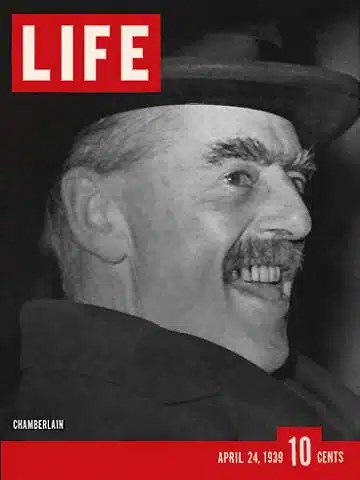
So, what appears to be coming now is concerted pressure against Rumania by the three powers along her western frontier — Czecho-Slovakia, which is actually Germany, Hungary and Yugoslavia, through which Italy will work. Rumania could not hope for support from the south since Bulgaria is friendly to the Axis and always has her eyes on Dobruja. Bucharest’s position is at best weak and it is believed in Rome that if her frontiers were guaranteed she would ultimately make economic concessions, which are all the Axis really wants. Prime Minister Neville Chamberlain’s guarantee would then become a dead letter, the Italians feel.
In Moscow it was not felt that Yugoslavia was definitely aligned with the Axis, but that a bold project of collective security could still win her as well as other states to a coalition. Russia still was not making commitments, however, and Turkey’s final attitude was believed to depend largely on the Soviet’s.
The Reich Government has now received replies from virtually all the States addressed by it on the question posed by President Roosevelt’s message, it was announced today. It will not, however, publish either its own questions or the replies to them, as its action was in the nature of a confidential diplomatic step. The fact that several smaller States have already made their answers public will not influence the government’s decision to withhold publication of the answers received. It is not improbable, however, that they may be disclosed in the course of Chancellor Adolf Hitler’s speech before the Reichstag Friday. So far as could be ascertained today, the contents of the replies are wholly satisfactory and it was suggested that they might even supply to Herr Hitler useful ammunition when he comes to grips with the democracies Friday.
The “propagandistic message” of the American President, it would appear, inadvertently gave Herr Hitler an advantage, as it was based on the allegation that “small States” were being menaced by the so-called aggressor powers. “In addressing the States cataloged in the President’s message Herr Hitler meets Mr. Roosevelt on the same level of propaganda, it is contended here. As the President’s message was appraised as purely a propagandistic undertaking, it was naturally decided to exploit it along the same lines. The replies received from the States in “jeopardy” not only justified the German questionnaire, it was stated, but incidentally contributed a useful clarification to the subject broached by Mr. Roosevelt. An answer was not requested from the Polish Government, it is learned, and that received from Rumania was negative in the sense that, lacking a common frontier with the Reich, Rumania did not consider herself “menaced.” Rumania was reported to have declared frankly that she did not see “how anyone can feel secure in Europe at the present time.”
Speculation over Herr Hitler’s forthcoming Reichstag speech receives scant encouragement in official and party circles. There appears to be concurrence on one point only-he will avail himself of the opportunity afforded by Mr. Roosevelt’s message and the “encirclement” campaign by the world’s democracies to come to grips with the opponents of the Axis powers over the question of political morals and, more specifically, the responsibility of the democracies, including the United States, for the Versailles treaty. It was hinted that he was even grateful that so ample an opportunity actually should have come from overseas.
The Reich defines how to teach religion, which must stress duty to the state.
A new Slovakian decree dismisses Jews from the civil service and corporation staffs.
When the British discover that blackout lamps, used for air raid practice drills, are made in Germany, the drill is called off.
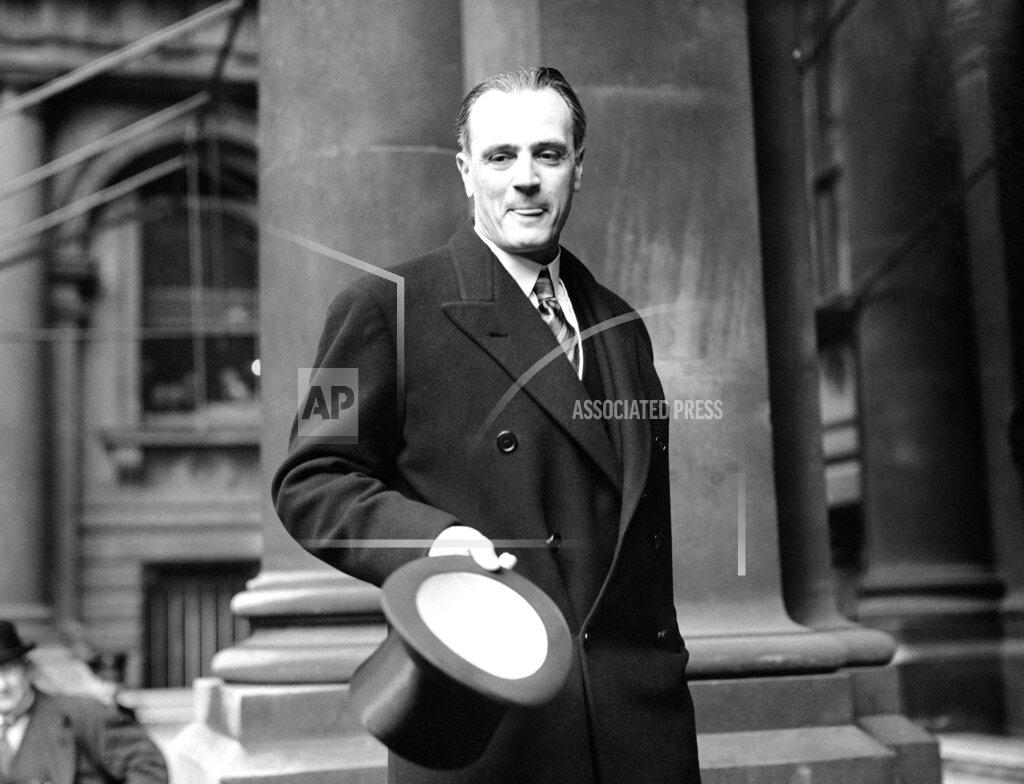
Prime Minister Chamberlain, seeking to strengthen his ties with the United States, selected as the new Ambassador to Washington the Marquess of Lothian, who will be virtually his personal envoy. The Marquess of Lothian, a leading member of the so-called “Cliveden group” and until recently a whole-hearted believer in the “appeasement” policy, was appointed British Ambassador to Washington today to succeed Sir Ronald Lindsay, who will retire this Summer. Thus, for the first time in fifteen years the British Government has gone outside the ranks of its career Ambassadors in filling a post often regarded as the plum of the entire diplomatic service. In the normal course the choice might have fallen upon a seasoned professional like Sir Miles Lampson, former Ambassador to Egypt, whose name has been mentioned frequently as the next occupant of the big embassy on Massachusetts Avenue.
But these are not normal times and in addition Prime Minister Neville Chamberlain has shown himself to be distrustful of professional diplomats at home and abroad. In Lord Lothian Britain will have an ambassador who happens to belong to the Liberal party but who understands Mr. Chamberlain’s views on foreign policy as perfectly as if he had been a lifelong Conservative.
It is reliably reported in Gibraltar that the German fleet is now off Bilbao, Spain, and will arrive at Cadiz Thursday morning. It is expected at Algeciras the same evening but the date is not yet definite, according to Algeciras authorities. The exact date of the Germans’ visiting to Tangier is not yet decided. An unconfirmed report from Algeciras states that the battleship Deutschland will possibly visit Gibraltar. That is believed improbable here because of the presence of many French warships in the harbor.
The Governor of Gibraltar today banned the export of vital foods to insure. adequate reserves for any wartime emergency.
During its first summer cruise starting Wednesday, the Royal Navy’s Mediterranean Fleet will visit ports in Greece, Cyprus, Palestine and Egypt and then carry out exercises in the Eastern Mediterranean.
The British Home Fleet has been ordered to assemble at Portland on Friday and Saturday and will hold gunnery exercises near there after the departure of King George and Queen Elizabeth for Canada. Four battleships, part of the Second Cruiser Squadron, and a flotilla of destroyers will fire a royal salute and cheer the sovereigns as they sail down the Channel on May 6 aboard the battlecruiser HMS Repulse. The Admiralty insisted tonight that the concentration of the Home Fleet was purely a routine measure, but in some quarters a possible connection is seen with the present international situation. Meanwhile the campaign against allowing so powerful a warship as the Repulse to be lost to service continues.
It is pointed out that neither of Britain’s two other battle cruisers are available for action, since the HMS Hood is docked at Portsmouth for general overhaul and the HMS Renown is being extensively reconstructed. These are the only warships in the British Navy that could handle the three German “pocket battleships” of the Deutschland class, which are now cruising in Spanish waters. Britain’s battleships are powerful enough, but are too slow to catch up with Germany’s, which can do twenty-six knots. British cruisers, though fast enough, are outgunned and could be heavily shelled before they could bring their own weapons into play.
263 Jewish refugees are ordered to leave Palestine’s harbor at Haifa on the Greek cattle boat, SS Assimi, they arrived on. Another 218 illegal immigrants are arrested in Jaffa.
President Roosevelt plans to use tomorrow the powers granted him by the Reorganization Act to realign about a dozen major organizations into three independent agencies handling public works, public lending and welfare activities. He worked late tonight on the final drafts of three executive orders in order to have them ready for transmittal to Congress only a little more than twenty-four hours after Congressional leaders were apprised of his intention.
An immediate result of the announcement of his plans was withdrawal by Senator Byrnes, Senate marshal of relief legislation, of measures on which a Senate committee had worked for months. These were designed to recast public works and social welfare administration. The bills will lie in abeyance until the executive orders are studied, but informed Congressional leaders asserted that no action the President can take will be able to forestall a legislative struggle over the actual form in which relief funds shall be dispensed after July 1, beginning of the next fiscal year.
It appeared definite tonight only that, among other things, the WPA would disappear in name. It seemed probable also that the eventual form of Federal relief would end the policy of “made work” which has characterized both the WPA and its predecessors. As understood in Congressional circles, regrouping of New Deal agencies and two or three which antedated the Roosevelt Administration appeared in prospect as follows: A public works agency would take over the PWA, WPA, the United States Housing Authority, the Public Roads Bureau and the Public Building Section of the Treasury Procurement Division. A credit or lending agency would absorb the Reconstruction Finance Corporation, the Home Owners Loan Corporation, the Federal Housing Administration and possibly the Farm Credit Administration.
A public welfare agency would include the Social Security Board, the Public Health Service, the Bureau of Public Education and possibly the Civilian Conservation Corps and the National Youth Administration, with probably some provision for continued relief for white-collar unemployed through assistance to State-sponsored programs. It was expected that the President would send to Congress a fourth order providing for minor reorganization of agencies without involving their movement from departments of which they are now a part. A fifth possibility was that the President would transmit, if not with these orders, within a short time, a formal recommendation that $1,500,000,000 be appropriated to continue federal relief activities in the next fiscal year.
Today in Washington, President Roosevelt nominated Leon Henderson as a member of the Securities and Exchange. Commission, conferred with his legislative chieftains, and worked tonight on Executive Orders to realign the principal New Deal emergency agencies.
The Senate confirmed the nominations of William E. Lee and J. H. Alldredge as members of the I.C.C., listened to various speeches, and adjourned at 4:21 PM until noon tomorrow. The Foreign Relations Committee heard General Hugh S. Johnson testify on neutrality; the Education and Labor Committee continued hearings on the Wagner act amendments; the Banking and Currency Committee heard testimony opposing continuation of Presidential authority over the stabilization fund, and an Immigration subcommittee heard opposition to a proposal to admit German child refugees.
The House approved a conference report on the War Department Appropriation Bill, considered local bills, and adjourned at 1:45 PM until noon tomorrow. The Foreign Affairs Committee resumed hearings on revision of the Neutrality Act; the Labor Committee heard Elmer Andrews, Wage-Hour Administrator, and agreed to report tomorrow amendments to the Wages and Hours Act; the Rules Committee gave right-of-way to a bill authorizing accumulation of strategic war materials and approved a bill authorizing commissioning of aviation cadets in the navy and Marine Corps reserves.
The House approves a large Army bill. The Senate still needs to approve $508 million.
A charge that the Labor Department is “honeycombed” with Communists, many of whom occupy “key positions,” was made in the House today by Representative Cox, Democrat, of Georgia. Mr. Cox made the charge during a speech by Representative Brooks, Democrat, of Louisiana, who declared a Communist witness had recently sought to advise the House Military Affairs Committee on patriotism.” “The fact that Communists appear as witnesses before committees of Congress does not disturb me,” Mr. Cox said, “but it does disturb me when I find Communists in key positions in the departments of the government. “You will find the Labor Department honeycombed with Communists. You’ll find them in the National Labor Relations Board and as assistants in the administration of the Wage and Hour Law.”
Asked about his program to change the tax law as an incentive to business, Secretary Morgenthau said at his press conference this afternoon that he had “waited, a month or six weeks for an invitation” to testify before Congressional committees. “I am still ready for the invitation,” he said. He said that he understood the Social Security hearings had delayed the committee hearings on general taxation. He would not discuss his tax program, saying that its disclosure must await his testimony. He said he would read “very carefully” the tax revision recommendations made yesterday by the Brookings Institution.
Dr. William M. Leiserson, chairman of the National Mediation Board, will be named by President Roosevelt to succeed Donald Wakefield Smith as a member of the National Labor Relations Board, it was reported today. Dr. Leiserson conferred with President Roosevelt this afternoon and later it was announced that the ‘talk had been on “personnel matters.”
However, it was learned that President Roosevelt will send Dr. Leiserson’s name to the Senate for confirmation in a day or two and thus settle the long uncertainty which has prevailed since Mr. Smith received an interim appointment last Summer. The President has not sent Mr. Smith’s name to the Senate because of the situation created by attacks upon him by the American Federation of Labor. The AFL has maintained that Mr. Smith was partial to the Congress of Industrial Organizations and has insisted that its canvass of the Senate indicated that it had enough votes to reject his confirmation.
Pope Pius XII names an auxiliary Boston bishop, Francis Joseph Spellman, as the new Archbishop of New York. Bishop Spellman was one of three American prelates whose names the American Bishops submitted to the Holy See several months ago. He is widely known in Vatican circles because from 1925 to 1932 he was attached to the Papal Secretariat of State, where, among other duties, he made the official translations of the Papal Encyclicals and broadcasts. During the controversy between the Vatican and Italy over Catholic Action, which was finally settled in September, 1932, Pope Pius XI, fearful that Premier Benito Mussolini might forbid the publication of an encyclical charging the Italian Government with violating the 1929 concordat, entrusted to Mgr. Spellman and other prelates the task of smuggling the document out of the country for publication.
[Ed: From 1939 to his death, Spellman served as the sixth Archbishop of New York. He was created a cardinal in 1946.]
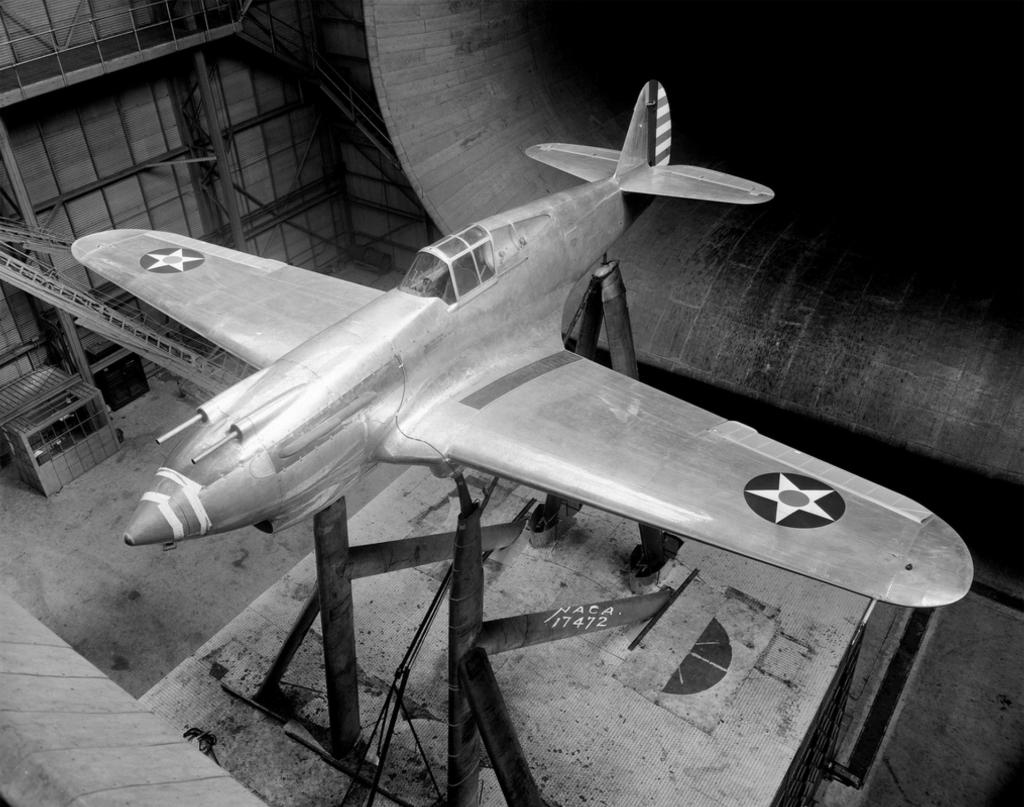
Curtiss-Wright’s prototype fighter, the XP-40 (Model 75P), was evaluated by the National Advisory Committee for Aeronautics (NACA) at the Langley Memorial Aeronautical Laboratory, Langley Field, Virginia, in March and April 1939. NACA engineers placed the XP-40 inside the Full-Scale Wind Tunnel, which was capable of accepting airplanes with wing spans of up to 40 feet (12.2 meters). The airplane was a production Curtiss P-36A Hawk, serial number 38-10, which had been modified by replacing its original air-cooled Pratt & Whitney Twin Wasp S1C1-G (R-1830-17) 14-cylinder radial engine with a Harold Caminez-designed, liquid-cooled, supercharged, 1,710.597-cubic-inch-displacement (28.032 liter) Allison Engineering Co. V-1710-C13 (V-1710-19).
Over a two-month period, NACA engineers made a number of improvements. The radiator was moved forward under the engine and the oil coolers utilized the same air scoop. The exhaust manifolds were improved as were the landing gear doors. When they had finished, Lieutenant Benjamin Scovill Kelsey flew the modified XP-40 back to Curtiss at Buffalo, New York. Its speed had been increased to 354 miles per hour (570 kilometers per hour), a 12% improvement. Other improvements were recommended which may have increased the XP-40’s speed by an additional 18 miles per hour (29 kilometers per hour). By December 1939, the airplane had been further improved and was capable of 366 miles per hour (589 kilometers per hour).
The Bolivian President, Germán Busch, declares totalitarian rule. As a dictator, he will do away with congress and basic law. He announced the dissolution of the Constituent Assembly and assumed dictatorial powers. He issued a manifesto stating that he believed it his duty to maintain the republic’s welfare. He declared the country was facing an economic crisis and strong measures were needed. “The country needs order, work and morale to fulfill its destiny,” he asserted. He concluded his statement with guarantees for investors of capital and gave assurances that “Bolivia has no place for extreme tendencies.” His proclamation was received favorably. The public was surprised but attempted no demonstration. There was no visible effect on the normal life of the capital, La Paz.
After the death of Prime Minister Joseph A. Lyons, Robert G. Menzies forms a new government, dedicated wholeheartedly to Australian rearmament.
Dow Jones Industrial Average: 127.34 (-1.21).
Born:
Elsie Leung, Hong Kong politician and solicitor (Secretary for Justice of Hong Kong from 1997 to 2005), in British Hong Kong.
Naval Construction:
The U.S. Navy Cimarron-class oiler USS Neosho (AO-23) is launched by Sun Shipbuilding & Drydock Co. (Chester, Pennsylvania, U.S.A.).



 History Diaries