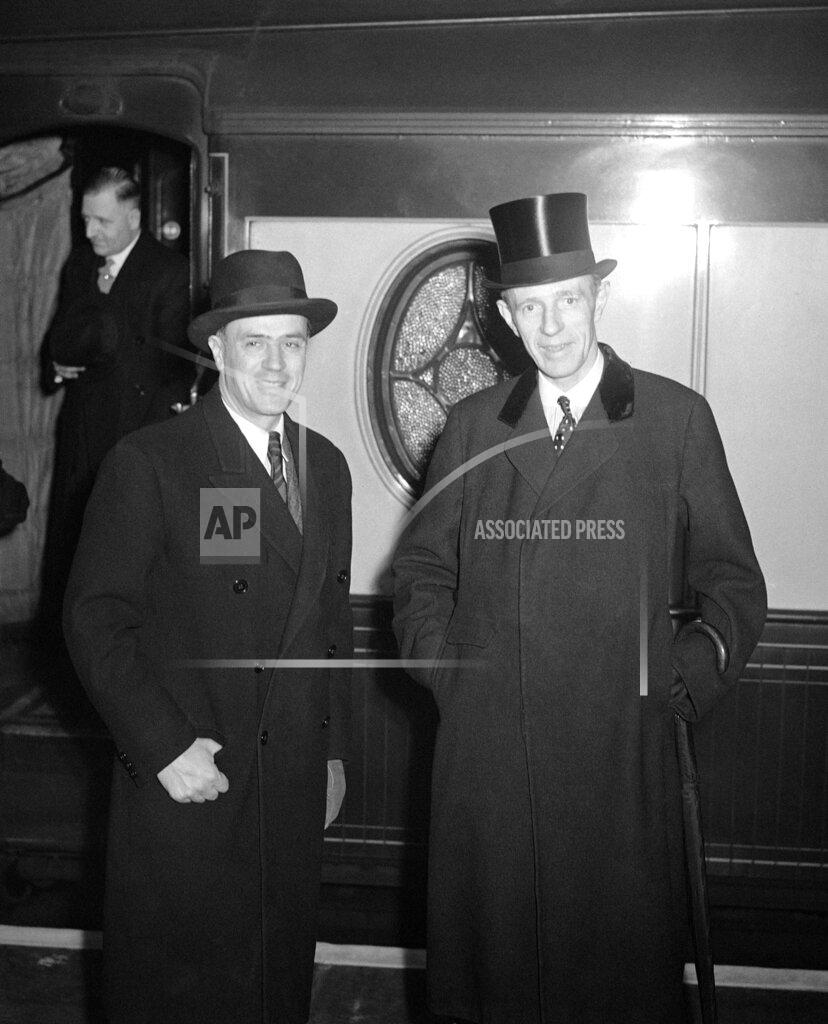
Surprisingly, Britain decided yesterday to send back to Berlin the Ambassador she had recalled when the Reich took Prague. As the recall had heralded forsaking of the “appeasement” policy, the new move caused speculation over whether it might not make Moscow suspicious again and hamper the efforts to form a coalition. But with the arrival of the Rumanian Foreign Minister these efforts were going forward. Sir Nevile Henderson, British Ambassador to Berlin, who was recalled “to report” last month, unexpectedly left London this evening to resume his duties. The recall of the Ambassador, announced March 17, was the first sign of Prime Minister Neville Chamberlain’s abandonment of the “appeasement” policy, and that same night the Prime Minister denounced Chancellor Adolf Hitler’s broken pledges in a powerful speech at Birmingham.
Sir Nevile’s return to Berlin, therefore, after the recent feverish British activity in building up a “grand alliance” against fascist aggression, took London by surprise, and the question asked everywhere tonight was whether, after all, Mr. Chamberlain might not intend to make one more effort to satisfy Chancellor Hitler, as he did last September at Munich. The decision to send back Sir Nevile, who is reported to be carrying a special message to be delivered to Chancellor Hitler before his Reichstag speech next Friday, was said in some quarters tonight to have been strenuously opposed by Viscount Halifax, the Foreign Secretary.
Once more the issue of British conscription was being agitated, and although some London circles were wary of predictions Paris expected the British Cabinet to make some move toward compulsory service today. For months past the French Government’s military authorities have been urging on London that France could not alone; with her population of just over 42,000,000, bear the brunt of a land war against Germany with 86,000,000 and Italy with 40,000,000, plus possibly Spain, without the compensating weight of manpower and armaments in Eastern Europe. France also, it has been urged, will need her colonial troops in Africa and Asia for the defense of her possessions there. The result of this situation has been that both here and in London pressure upon Prime Minister Neville Chamberlain to accept military service has been incessant. Premier Edouard Daladier has urged it repeatedly. Foreign Minister Georges Bonnet did so during the recent London visit of President Albert Lebrun. Long memoranda supporting the French argument have been poured into London and there have been many conversations in which both official and unofficial representatives of the British Government have presumably allowed themselves to be convinced.
The British attitude toward dictators hardens. Public indignation may force the government’s hand.
The main strength of the British Mediterranean Fleet — thirty-two vessels — was ordered to sail Wednesday from Malta to the Eastern Mediterranean. The battleships HMS Warspite, HMS Malaya and HMS Barham, the modern 10,000-ton cruisers HMS Shropshire and HMS Devonshire, together with twenty-six destroyers and the aircraft carrier HMS Glorious, will participate.
The battleship HMS Ramillies, which was recommissioned in February will not make the cruise as she left for Gibraltar last Thursday for exercises, while the cruiser HMS Sussex was omitted from the orders, but with these exceptions the units taking part in the cruise make up the first battle squadron, the first cruiser squadron, the first destroyer flotilla (new 1,870 tonners), the second destroyer flotilla, and third destroyer flotilla of the Mediterranean Fleet.
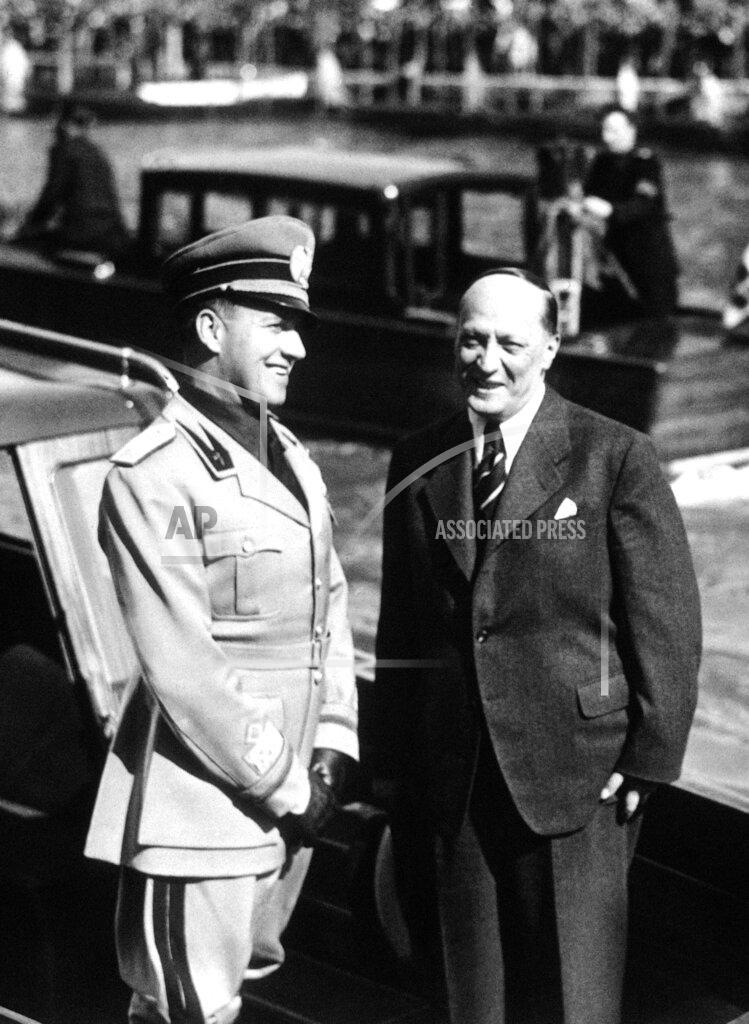
In the diplomatic sparring attending the crisis period, continued Yugoslav-Italian consultations were believed to have brought Belgrade closer to adherence to the Rome-Berlin Axis and there were forecasts that Yugoslavia would quit the Balkan Entente. The Belgrade Foreign Minister is now going to Berlin, where the Nazis professed to see signs of victory in their moves to prevent “encirclement.” Foreign Minister Galeazzo Ciano and Alexander Cincar-Markovitch, Yugoslav Foreign Minister, ended their conversations this morning after bringing Yugoslavia another step toward inclusion in the Axis. Everything went smoothly, according to Venice reports, and it is still expected that Yugoslavia and Hungary will sign a non-aggression pact next month and that Belgrade in other ways will completely enter the Axis policies. Count Ciano returned to Rome and M. Cincar-Markovitch, after reporting to Belgrade, continued to Berlin.
The only point on which any difficulty is seen covers Hungarian demands regarding her nationals in Banat. Hungary is apparently willing to guarantee Yugoslav frontiers but she wants Hungarians inside Yugoslav territory to receive special concessions. Since Belgrade is revising the minority statutes it is felt here that there should not be difficulty in granting Hungarian wishes.
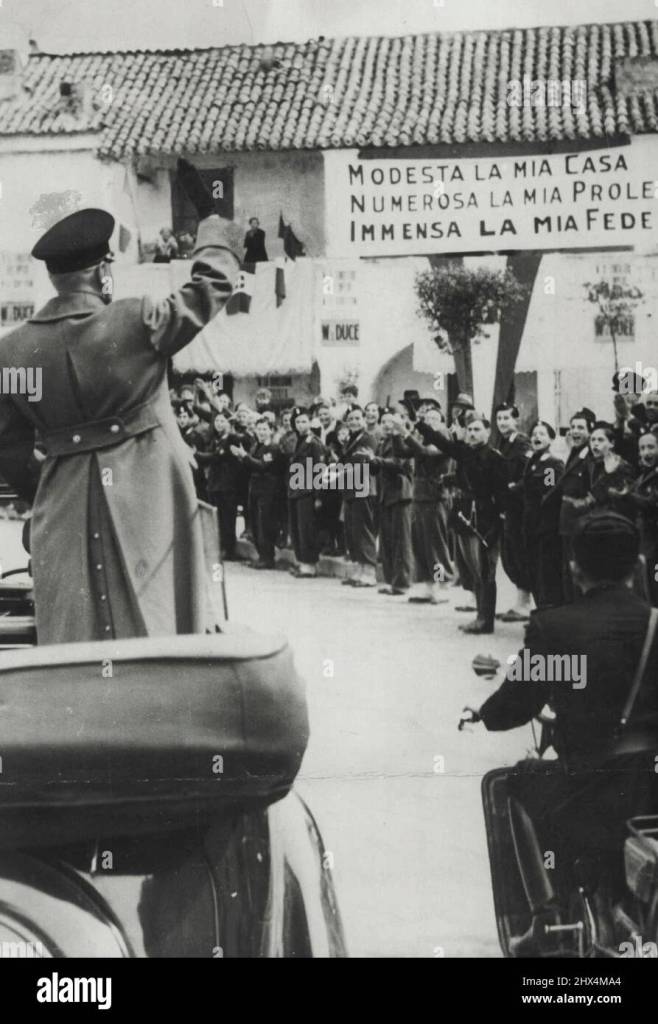
Prince Paul’s forthcoming visit to Rome would seem to indicate that even he has become reconciled to throwing in his fate with the Italian end of the Axis. When former Premièr Milan Stoyadinovitch was pursuing his pro-Italian policy, he had Paul’s opposition. Now M. Cincar-Markovitch is getting the Regent’s personal support. Achille Starace, Secretary-General of the Fascist party, arrived in Tirana today to found an Albanian Fascist party. The entire population will be organized along party lines as in Italy. Thus, will end the controversy which as much as anything led to the expulsion of King Zog and the Italian occupation.
A communiqué issued today at the close of the conversations between Foreign Minister Galeazzo Ciano and Alexander Cincar-Markovitch, Yugoslav Foreign Minister, declared: “It has been agreed to deepen the faithful collaboration existing between the two States and between Yugoslavia and Germany in the political as well as in the economic sphere” for “maintenance of peace” and improvement of Danubian stability.
Regarding relations with Hungary, the communiqué said: “The two Foreign Ministers examined the situation resulting from the most recent manifestations and noted with satisfaction how these have opened the way to a useful understanding between the governments of Belgrade and Budapest.”
A decree from the Spanish Ministry of Finance restored the property of Alfonso XIII and all his relatives within four degrees of lineal blood relation.
An estimated 100,000 Spanish children are housed in French refugee camps and await adoption.
Twenty aviators die in three separate French military crashes. General Vuillemin, air minister, orders inquiries.
Egyptians are stirred by the recent visit of Nazi Propaganda Minister Joseph Goebbels. Rumors say he discussed war steps with Germans living there.
The Greek cattle boat Assimi, which attempted twelve days ago to land 263 Jewish illegal immigrants, was ordered to leave Haifa harbor last night. The captain was sentenced last week to nine months’ imprisonment and a £100 fine. When a police officer announced the government’s order for the steamer to leave, the passengers tore off their clothing and screamed that they would rather be killed than be sent back to sea. Some prayed and recited psalms.
When the Jewish residents of Haifa heard the screams and prayers aboard the Assimi they proclaimed a strike that was enforced throughout the city. Women and students marched carrying banners reading, “Open the gates to the Jewish illegals” and “Down with the barbaric attitude toward the illegals.” Augmented police and military patrols guarded the city and dispersed the demonstrators. No arrests were made but three students were reported beaten by policemen.
The Haifa Jewish community telegraphed an appeal to the National Council of Palestine Jewry [Vaad Leumi] for immediate intercession with the Palestine government at Jerusalem. It also appealed to the High Commissioner and cabled to Prime Minister Neville Chamberlain a plea that the “sufferers from Hitler’s barbaric regime” be not sent “to inevitable death at sea in an unseaworthy sailing vessel.”
Chancellor Hitler will avoid a major war and Great Britain ultimately will find it possible to get back to a “reasonable” appeasement program with Germany, Senator Borah, ranking Republican member of the Senate Foreign Relations Committee, predicted today as government officials looked to Hitler’s reply Friday before the Reichstag to President Roosevelt’s appeal for peace.
“I am not anticipating that Hitler’s speech will have any considerable effect on neutrality legislation,” Senator Borah said. “I am not anticipating that his speech will have any considerable effect on the situation at all. A month or two ago it would have had a very considerable effect, but it has been discounted by the vast amount of discussion that has been going on.”
“At best we will go on pretending to be neutral, and Hitler will go on sidestepping just enough to avoid a major, or world, war. Great Britain ultimately will find it possible to get back to a reasonable appeasement program with Germany. We are in a position where we will feel we must do something about neutrality legislation. But whatever we do will be determined largely not by what is written in the law but what it is found expedient to do outside the law.”
In some quarters favorable to the Administration, however, the opinion was expressed today that if Herr Hitler’s reply proved to be a flat “no” to President Roosevelt’s request that the integrity of now independent nations in Europe be guaranteed for at least ten years, the hands of those in Congress who desire to provide aid for the democratic nations in case of war would be greatly strengthened.
The Senate Foreign Relations Committee, which is scheduled to end its hearings on neutrality legislation Friday, is expected to vote first upon the Thomas amendment, calling for the lifting of embargoes on war supplies for victims of aggression. A poll indicates that only three Senators on the committee favor this measure, and it is expected that the second vote will be upon the Pittman bill to extend the cash-and-carry provisions of the present Neutrality Act to munitions and instruments of war.
A detailed program of tax modification as one of the steps necessary to industrial expansion and increased employment was urged today by the Brookings Institution in a report on an extensive study. It proposed, among other modifications, elimination of the capital stock and excess-profits taxes, repeal of the undistributed profits tax, substantial reduction in the surtax rates in the upper brackets, reduction of social security taxes and a “pay-as-you-go” basis for financing old-age annuities.
The institution declared that the nation was confronted with a situation where a clear-cut choice must be made, whether “to continue the present tax system, which arrests the flow of funds into capital enterprises, or to modify the system in the interest of industrial expansion, greater employment and higher standards of living.” The report stated that should its recommendations bring at first a considerable net reduction in tax revenues “the gains resulting from the stimulus to the expansion of private enterprise would in the near future much more than offset any probable revenue losses.”
An expansion of capital enterprise, it added, was the only means. of solving the unemployment problem, lifting the oppressive burden of relief and increasing progressively the nation’s standard of living. Schedule of Recommendations. The Institution’s schedule of recommendations was as follows:
Corporation income tax:
- Small corporations should be. allowed a credit of $3,000.
- Operating losses should be deductible from income for a period of two years.
- Capital gains and losses should be disregarded in calculating the tax. However, if the Congress insists on taxing capital gains as income, capital losses should be deductible.
- The tax on inter-corporate dividends should be abolished.
- Greater flexibility should be permitted in the handling of depreciation charges, the percentage to be varied in relation to the volume of business.
Capital stock and excess profits taxes:
Both taxes should be eliminated. If it be deemed necessary to maintain the existing volume of revenue from corporation levies, the result should be gained by an increase in the rate on corporate income. Social security taxes:
- The old age annuities should be financed on a pay-as-you-go basis rather than by the accumulation of a huge reserve.
- The rates for the old age annuities should be temporarily reduced from 1 to ½ of 1 percent, and be subsequently increased only as benefit payments necessitate.
- The modest contingent reserves should be invested in outstanding government bonds at current rates; and the financial administration of the system should be segregated from the fiscal operations of the Treasury.
Undistributed profits tax: This tax should be abolished.
Personal taxes and tax-exempt securities:
- The surtax rates in the upper brackets should be substantially reduced.
- The normal income tax on corporate dividends should be eliminated.
- Capital gains and losses should be disregarded. However, if this is not done, deductions for capital losses should be allowed.
- The Federal income tax should be made to apply to State employees and Federal employees should similarly be subjected to State income taxes.
The Rev. Charles E. Coughlin today reiterated previous pleas that the United States avoid foreign entanglements and strive for peace, asserting that if the signatories in Europe of the Treaty of Versailles were “interested in preserving the status quo of injustice which resulted from it, that is their business — it is none of ours.”
First Lady Eleanor Roosevelt attends the funeral services of her nephew, who died in a plane crash.
The U.S. Army will enlist 370 cadets for air training every six weeks. Cadets must be unmarried U.S. citizens.
Chicago’s Marv Owen equals a Major League record with 4 doubles, as the White Sox trounce the Browns 17–4.
Against the A’s Bud Thomas, Boston Red Sox outfielder Ted Williams connects for his first Major League home run while going 4-for-5. The A’s win 12–8, but Thomas will be waived to the Senators in a week.
The Chilean Navy is attempting to place orders for two 8,000-ton cruisers to modernize her navy, and is taking bids from various western shipbuilders.
16th Division, 79th Division, and 5th Reserve Division of Chinese 32th Army crossed the Fu River near Nanchang, Jiangxi Province, China.
Chinese military headquarters reported the recapture of Kaoan today for the second time since its fall to the Japanese a month ago. Kaoan is an important town on the highway to Changsha, about thirty-five miles southwest of Nanchang. In reoccupying the town, the Chinese took advantage of the depletion of the Japanese strength in the Nanchang region, troops having been shifted northward to Wuning, Tungshan and Tungcheng, apparently for a big Changsha offensive. The Japanese were said to have evacuated Kaoan after the Chinese broke into the town this morning, the small garrison not attempting to oppose the Chinese in street battles. The Chinese said they inflicted only 200 casualties.
Simultaneously, the Chinese struck at centers controlled by the Japanese in every invaded province. Another reported important gain was the recapture of Tungshan in East Hupeh. A new assault on Kaifeng was reported in messages from Honan Province. The Chinese were said to have again briefly recaptured the western suburbs and the Lung-Hai railway station. After setting fire to valuable Japanese stores the Chinese retreated. In Shansi Province the Chinese said they had gained control of fifteen miles of the Tatung-Puchow Railway between Chaocheng and Hwohsien and were continuing assaults on Japanese centers flanking the railway between Taiyuan and Puchow. Yicheng and Fowshan, east of the railway, were reported definitely in Chinese hands.
The Japanese were said to have halted all passenger traffic on the Peiping-Hankow and Chengting-Taiyuan railways so as to speed troop and supply trains in connection with the moving in of reinforcements through Peiping to repulse the Chinese attacks in Shansi and Honan. In Central Hupeh minor engagements marked the struggle along the east bank of the Han River. In Kwangtung the Chinese reported they were strengthening the cordon that is being drawn around Canton. New guerrilla forays near Hangchow, south of Shanghai, and near Chinkiang and Wutsin, west of Shanghai, were reported.
Japanese warships were said to have shelled the south shore of Tungting Lake in Hunan, sixty miles north of Changsha, and attempted to land troops. The Chinese now admit the Japanese have captured Kuling, but announced that the guerrillas there had “vanished” to join comrades on neighboring Mien Mountain. Japanese planes yesterday bombed towns along the Chekiang Railway. In bombing Chihkiang Friday the Japanese destroyed half the city and hit an orphanage supervised by Madame Chiang Kai-shek, according to a telegram from H. Becker of the China Inland Mission whose church also was hit. None of the orphans was killed, all having fled when the bombers appeared.
Japanese planes in renewed bombings of Focchow, Fukien Province port 435 miles south of Shanghai, today blasted government buildings and residential areas. Casualties were reported to be few because most of the population had been removed from the city.
Chefoo, North Shantung port more than 500 miles north of Shanghai, reported tension had increased there following the arrival of Japanese reinforcements and greater restrictions on the movements of civilians because of guerrilla onslaughts. Foreigners, who form a considerable colony in Chefoo, were described as being virtually prisoners in their homes.
Japanese pressure against the Catholic mission in Chefoo, which included closing of the cathedral and the arrest of numerous Chinese converts, ceased suddenly. Some of the prisoners were released but a few, accused of anti-Japanese activities, were executed.
Kuling, mountain resort south of Kiukiang, has been converted into a Japanese resort, military reports said. American missionaries had developed the place.
North of the Yangtze, along the Lunghai Railway, the Chinese asserted their forces were threatening Suchow and Kaifeng.
The Japanese asserted they had killed 5,000 Chinese soldiers in Shansi since April 1.
According to Japanese circles in Shanghai, all of Chungking’s claims of successes in China’s Spring offensive must be taken with utmost reserve and full realization that Chungking always exaggerates Chinese gains and does not acknowledge losses. An example cited of the unreliability of Chinese military communiqués is the fact that Chungking refused to admit the Japanese capture of Kuling until yesterday, whereas the Japanese say the capture was completed at dawn Tuesday.
It is admitted that on all fronts, particularly in Shansi and in the vicinity of Kaifeng, the Chinese forces have been attacking stubbornly despite repeated heavy losses, but it is contended that nowhere have important inroads been made into Japanese-occupied territory. These attacks serve to keep the Japanese forces on the qui vive and inflict important losses upon them but so far have had no other important military results, according to the Japanese.
Japanese command of the air, coupled with overwhelming superiority in artillery, machine guns and mechanized forces, have made the Chinese attacks seem only a greatly accelerated form of guerrilla warfare. The Japanese say they are not worried by the Chinese offensive and that they are not changing the disposition of the major forces that have been distributed in precautionary positions in case the European situation results in a Russo-Japanese war.
Japanese forces on the mainland are posted as follows: Nineteen divisions in Manchukuo, one division in Korea, eleven divisions in North China, Suiyuan and Chahar, eleven divisions in the entire Yangtze River Central China zone, and three divisions between Canton and Hainan Island. Foreign military observers say each division has 20,000 men, augmented by 5,000 additional in each division’s special services, artillery, anti-aircraft, engineers, hospital, machine guns and communications.
Born:
Lee Majors [born Harvey Lee Yeary], American actor (“The Six Million Dollar Man”, “The Fall Guy”), in Wyandotte, Michigan.
David Birney, American stage and screen actor (“Bridget Loves Bernie”; “St. Elsewhere”), in Washington, District of Columbia (d. 2022).
Bill Hagerty, British editor (People), born in Ilford, London, England, United Kingdom.
Patrick Williams, American composer, arranger, and conductor, in Bonne Terre, Missouri.
Ray Peterson, American singer (“Tell Laura I Love Her”), in Denton, Texas (d. 2005).
Dave Amadio, Canadian NHL defenseman (Detroit Red Wings, Los Angeles Kings), in Glace Bay, Nova Scotia, Canada (d. 1981, of a heart attack).
Naval Construction:
The Вое́нно-морско́й флот СССР (ВМФ) (Soviet Navy) “ShCh” (ShChuka)-class (6th group, Type X-modified) submarines ShCh-407 and ShCh-408 are laid down by A. Marti (Leningrad, U.S.S.R.) / Yard 194.



 History Diaries