The right‐wing Laotian revolutionary junta called today on Prince Souvanna Phouma, the neutralist Premier, to enlarge and reorganize his coalition Government. In a communiqué issued after a meeting of the junta with military commanders summoned from the provinces, the junta declared that Prince Souvanna Phouma had been asked to remain as head of a government of national union “in consideration of external policy.” The United States, the Soviet Union and other major powers have insisted on restoration of the authority of the coalition Government set up under the leadership of the Prince by the Geneva conference of 1962.
The junta called on the prince yesterday to form a new government, but it indicated then that he must resign as Premier before organizing another coalition. The junta is headed by General Sibo Lamphouthacoul, security chief whose troops control Vientiane, the administrative capital, and General Kouprasith Abhay, nominal head of the Revolutionary Committee. The junta seized control of the capital last Sunday and attempted to overthrow the Souvanna Phouma Government. Today’s communiqué was read to newsmen by General Kouprasith Abhay at the National Defense Ministry, where the generals’ conference took place. Beside him stood General Siho Lamphouthacoul. The Vientiane radio, which is controlled by General Siho Lamphouthacoul’s troops, announced that Prince Souvanna Phouma had agreed to form a new government.
Observers doubted that the pro‐Communist Pathet Lao would find the Revolutionary Committee’s proposal satisfactory. The Pathet Lao, the rightists and the neutralists make up the coalition that the junta sought to overthrow. The communiqué asserted that the army’s Permanent Committee of National Defense would “recommend personalities qualified to participate in the government.” This presumably would mean members of the Revolutionary Committee, who would constitute the rightist representation within a new coalition. The statement made no mention of General Phoumi Nosavan, who commanded right‐wing troops before the coup and who served as Vice Premier in the coalition government. When Western ambassadors met with General Phoumi Nosavan today he said he continued to support Prince Souvanna Phouma.
In a clash between two companies of Vietnamese rangers and the Việt Cộng in Trung Lập, South Vietnam, 25 miles north of Saigon, one American is killed and three are wounded. Seven rangers were killed and eight were wounded in the battle near the Trung Lập ranger training center.
Major General Richard G. Stilwell was named today to be next chief of staff of the United States Military Assistance Command in South Vietnam. The appointment, announced by General Paul D. Harkins, continues the organizational overhaul of the military command, which is headed by General Harkins. General Stilwell replaces Major General Richard G. Weede of the Marine Corps, who returns to Washington next month to become Assistant Chief of Staff for Operations and Plans at Marine Corps headquarters. The appointment of General Stilwell will take effect about May 9. He has been assistant chief of staff for operations in the Military Assistance Command here since April of last year. He is 47 years old and is a West Point graduate.
French Premier Georges Pompidou reemphasizes his country’s desire to see Vietnam neutralized and says that this will require that United States and Japan deal with Communist China. Pompidou suggested today that France would favor settlement of Taiwan’s political future by self‐determination. His statement projected France’s interests into another Far East area where the United States is deeply involved. The two Governments already are at odds over means to end the guerrilla war in South Vietnam. Taiwan’s present situation was described by the Premier as an “abnormal” one that should be regularized. The island is the stronghold of Generalissimo Chiang Kai-shek’s Nationalist Chinese Government, which contends it is the only legitimate Government of China. The United States supports this claim.
President Johnson scanned the world at his garden news conference today and found the situation brighter in most places. The President said things were looking up again in Laos with the reinstatement of the neutralist Premier, Prince Souvanna Phouma. He expressed hope for more support from other nations for the war in South Vietnam. He foresaw no instant peace with the Russians, but described himself as nonetheless optimistic. While there is “nothing to throw your hat in the air about” in Latin America, he sensed steady progress on that front, too. An encouraging report from Laos, Mr. Johnson said, indicated acceptance by all factions of the neutral coalition regime that was superseded by a military junta last weekend.
On South Vietnam, the President reiterated earlier statements that there would be “stepped‐up activity” against the Communist guerrillas, requiring additional United States assistance. He predicted some further movement of American troops to and from Vietnam and said he hoped to see “some other flags” there, symbolizing greater contributions by other Western nations.
Tanganyikan President Julius Nyerere made the surprise announcement that he and Zanzibar’s President Abeid Karume had agreed to merge their two nations. Nyerere and Karume had signed the agreement at a meeting at the State House of Zanzibar while Sheik Mohammed Babu, a Communist “regarded as the real power in Zanzibar”, was out of the country on a tour of Asia. President Nyerere unexpectedly visited Zanzibar yesterday. The announcement, which coincided with a Moslem feast day, came as a surprise. It was generally welcomed. Dr. Nyerere would be President and Mr. Karume and Vice President R. M. Kawawa of Zanzibar the Vice Presidents of the new state, said a Reuters report.
Details of the proposed union are expected to be announced at a special session of the National Assembly in Dar Es Salaam tomorrow. The union is subject to ratification by both Parliaments. Reports here said the announcement had been greeted with great relief in Zanzibar, where President Karume’s position is generally regarded as precarious in the face of strong Communist influences. The feeling now is that union will create greater economic and political stability in the island, and prevent Communist infiltration. Signing of the agreement is the culmination of frequent exchanges between the two governments during the absence on a Far Eastern tour of Zanzibar’s Foreign Minister, Abdul Rahman Mohammed, known as Babu, who is considered to have strong pro‐Chinese sympathies.
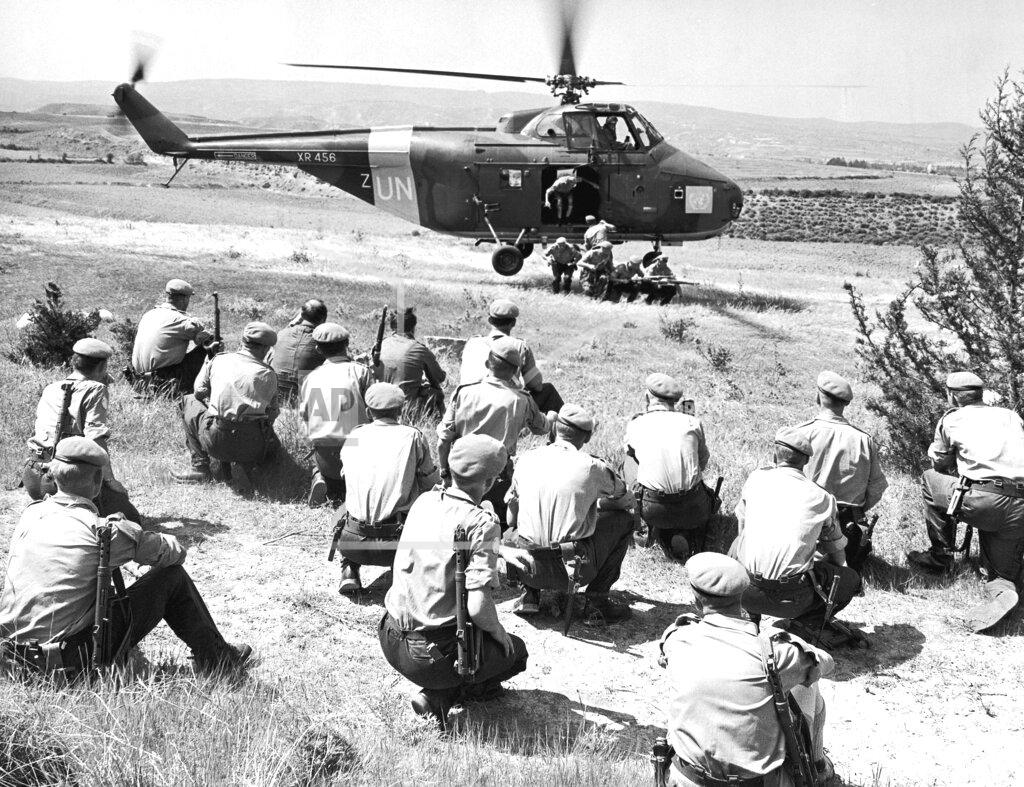
Firing today shattered an uneasy truce in the mixed village of Ayios Theodhoros in southern Cyprus. One Turkish Cypriote fighter was wounded in the leg during the shooting, which lasted with extended lulls from 11 A.M. until sunset. With Greek and Turkish Cypriote forces keeping positions outside the village, the British feared further trouble tomorrow. Three platoons of British soldiers of the United Nations peace force were rushed here in the morning and reinforced a platoon that had been here for two months. Since fighting here in mid‐February, both Turkish and Greek Cypriote police had been withdrawn and the town has been patrolled by the British. Near Nicosia’s main square, about 50 British soldiers who had rented a club for a party got into a free‐for‐all with Greek Cypriotes. The brawlers were separated by military police.
President Gamel Abdel Nasser of the United Arab Republic flew to Yemen today on a surprise visit. In a speech to a crowd of thousands President Nasser declared: “We swear by God to expel Britain from all parts of the Arab world.” The speech was broadcast by the Yemeni radio. President Nasser, referring in his speech to the “occupied south” (Aden and the neighboring British protectorates) and “British aggression” on Yemeni territory, said: “Britain, which looks upon your revolution with hatred and disgust, must take up its staff and leave Aden and the south.” Authoritative sources said the visit was for the purpose of a first‐hand study of the 19‐month‐old war between the Yemeni revolutionary forces. supported by Egyptians, and followers of the deposed Imam of Yemen.
An East German Communist accused Communist China today of having demanded that East Germany break with the Soviet Union and thus help split West Germany from its alliance with the United States. The accusation was made by a Politburo member, Herman Matern, and was reported by the official East German press agency, A.D.N. It reflected Soviet fear that the Chinese, trying to break out of their isolation, seek to set up what the Russians call an “intermediate zone” in competition with both the Soviet Union and the United States. This “third world,” the Russians have been saying, would by Chinese calculation include West European nations.
Georgi Traykov, who had occupied the post of “first deputy prime minister” of Bulgaria since 1949, was selected by the National Assembly to be the new President of the Presidium, replacing the late Dimitar Ganev as Bulgaria’s head of state.
Sir Garfield Barwick resigned as both Minister for External Affairs in order to accept appointment as Chief Justice of Australia. Barwick was selected by Prime Minister Robert Menzies to replace the retiring Chief Justice, Sir Owen Dixon.
President Johnson stopped in Chicago tonight, on his way to a four-state tour of poverty‐stricken areas, to pledge his Administration to “build a great society” in America. To a record crowd of about 6,000 Democrats in McCormick Place, the lakefront convention hall, Mr. Johnson said he would continue to attack discrimination, unemployment, the waste of natural resources, the problems of the aging and a “second-class system of education.” In addition, he said, his Administration will “go as far as is prudent and as fast as is possible to bring peace to the world.”
For the first time since debate on the civil rights bill began 38 days ago, there was a feeling in the Senate today of real forward movement. Toward the close of a day crowded with strategy conferences and drafting sessions, Senator Hubert H. Humphrey of Minnesota, the Democratic floor manager of the bill, said to reporters: “Things are looking great. All last week’s stomach aches are gone.”
The forward motion took two forms. On the one hand, the civil rights forces in both houses began an aggressive counterattack against what they feel are false charges against the bill being circulated in newspaper ads, pamphlets and flysheets sent through the mails. Thus, Representative William M. McCulloch of Ohio, ranking Republican member of the House Judiciary Committee, who was a principal architect of the bill, issued a statement specifying what the bill would not do. And Senator Kenneth B. Keating, Republican of New York, offered evidence that many of the printed petitions he had received in opposition to the bill bore forged signatures.
On the other hand, the party leaders, the floor managers of the bill and several of the “captains” in charge of its various titles were moving toward a consensus on some of the more controversial provisions in the House version. Thus, Senators Mike Mansfield of Montana and Everett McKinley Dirksen of Illinois, the Democratic and Republican leaders, agreed on an amendment to permit limited jury trials in cases of criminal contempt arising from willful violation of the various antidiscrimination provisions. Senator Leverett Saltonstall, Republican of Massachusetts, submitted an amendment to give more opportunity for voluntary compliance with the ban on discrimination in public accommodations before the Attorney General resorts to court action.
Finally, the leading Republican advocates of the bill in both the Senate and the House met with Senator Thomas H. Kuchel of California, the minority whip, in an effort to find common ground with Mr. Dirksen on the enforcement procedure for the ban on job discrimination. Neither Mr. Mansfield nor Mr. Dirksen would give details of their jury trial amendment because it still had to be cleared with several key Senators. However, Mr. Humphrey said it approximated the compromise worked out in 1957 for criminal contempt on voting suits.
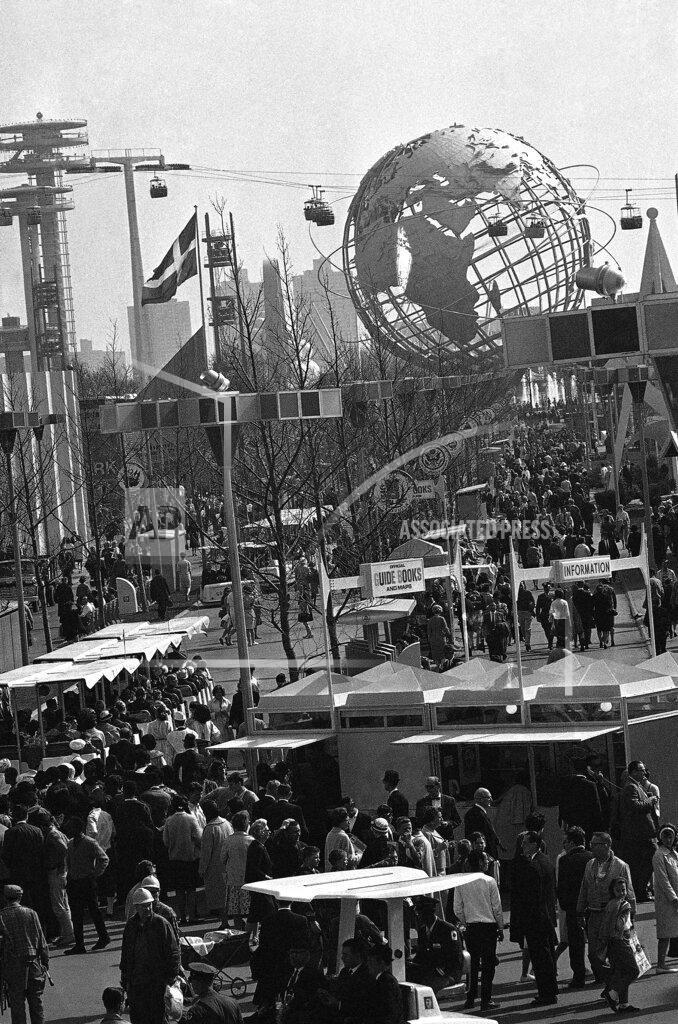
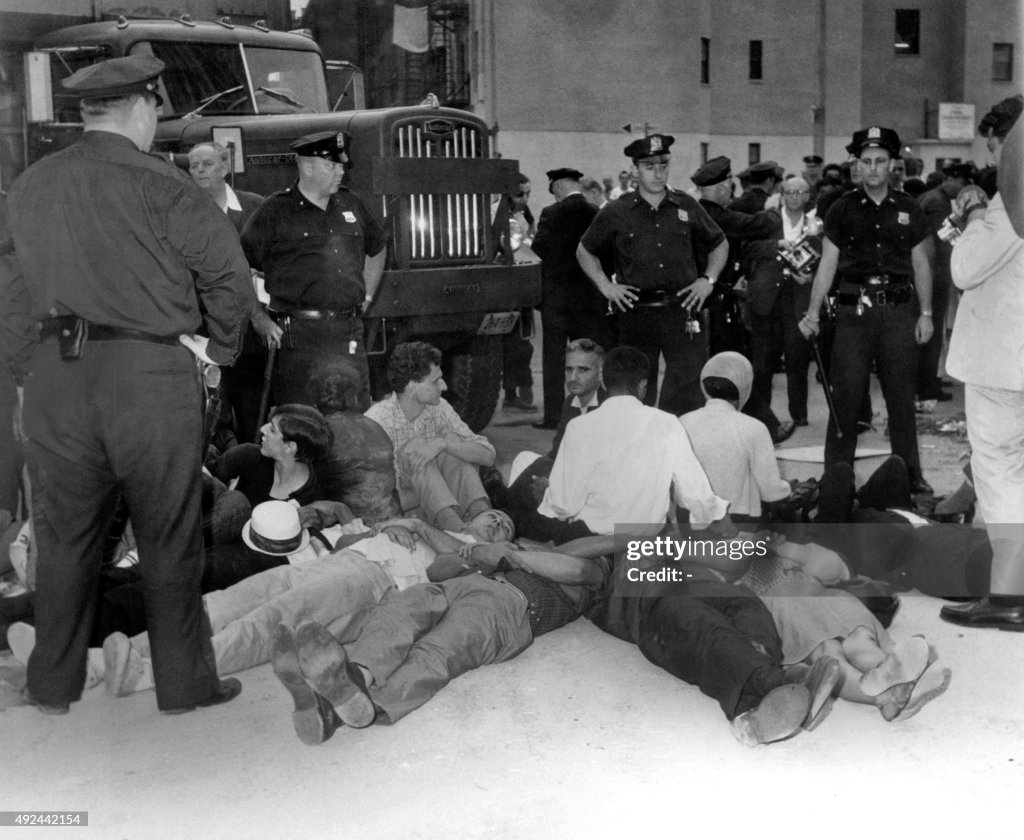
President Johnson, Governor Rockefeller and Mayor Wagner all spoke out yesterday against the civil rights demonstrations that marred the opening of the World’s Fair. They were joined by Senator Jacob K. Javits, Police Commissioner Michael J. Murphy, foreign visitors and religious leaders. Their characterizations of the demonstrators ranged from “unpardonably rude” to “fanatic” and “disorganized.”
President Johnson, whose remarks at the Federal Pavilion on the fairgrounds were drowned several times by jeers and shouted civil rights slogans, gave his reaction yesterday during a news conference in Washington. In response to the first question of the meeting, Mr. Johnson said that such “rude” demonstrations “serve no good purpose — either of promoting the cause they profess to support or of disrupting that cause.”
Senator Barry Goldwater denounced civil rights demonstrations tonight, and asserted that “justice will not be served, nor justice won in the streets.” Near the end of a speech at a Republican fund‐raising dinner at the Statler Hilton Hotel here, the Senator summed up his program for halting the demonstrations: “Let our people go — let them go away from violence and struggle, from divided citizenship, from declining responsibility and increasing regimentation. Let our people go, instead, ahead together in the great and moral works we have to do at home and in the world. Let our people — the people of your state and the people of all America — go in faith in honesty and in humility!” Mr. Goldwater has often won applause from conservative audiences this spring with his stated opposition to the public accommodations and fair‐employment sections of the civil rights bill. But this is the first time he has carefully summed up his criticism of civil rights demonstrations.
Governor George C. Wallace of Alabama faced a hostile audience at Indiana University tonight when he argued that Blacks had a better chance in his home state than in the North. The reaction was unexpected. The meeting for the Governor, who is running in the Indiana Presidential, primary to balk the civil rights bill, was arranged by the campus Young Conservative League. Contrary to expectations a large contingent showed up in the largest auditorium on the campus, to which the meeting had been moved. Midway in the evening session several hundred students walked out.
Many of the remaining students pressed Governor Wallace, an avowed segregationist, to a point where he mopped his face with a handkerchief. He was booed and jeered, and although he also won some cheers from more conservative students as he did at an afternoon meeting, he was pressed harder to explain why he had been quoting the civil rights bill before it was amended instead of the bill that passed the House. Hostile students laughed with derision when Governor Wallace said there were better racial relations in Alabama than in many places in the United States. In answer to a question, he also said that he did not know how to define discrimination. He said, when asked, that his alternative to the civil rights bill was a program of “massive education.”
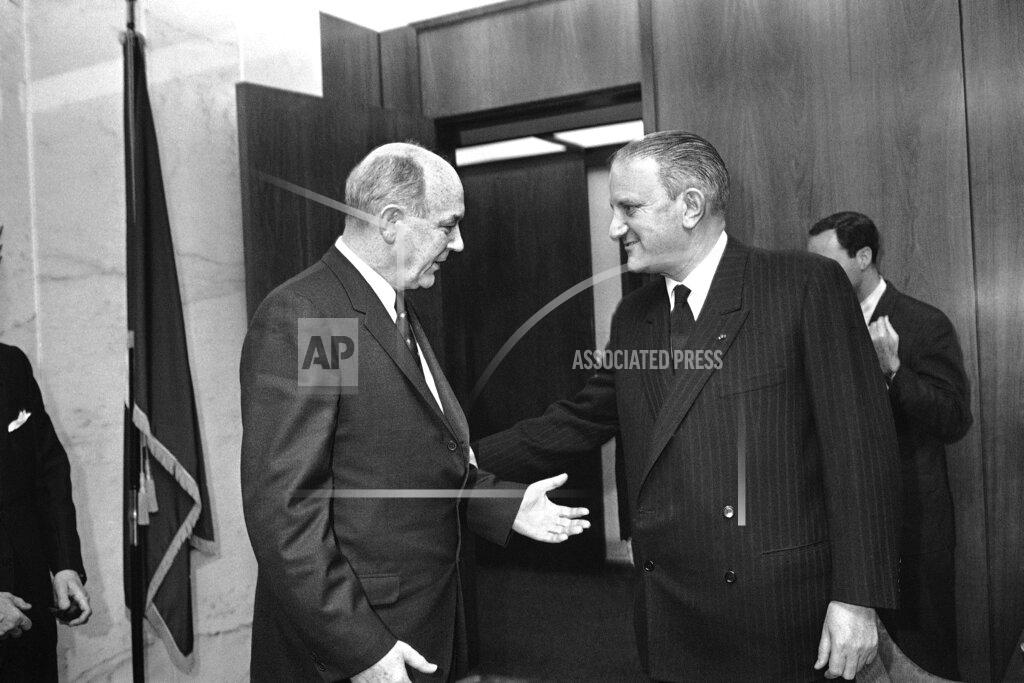
Brimming with ebullience, President Johnson threw a few light jabs at the Republicans today in a spring prelude to the fall political campaign. The President also said his recent public invitation to Presidential possibilities to come in and share his information on foreign intelligence had been made formal by Secretary of State Dean Rusk. Those invited included Governor George C. Wallace of Alabama, a Democrat. In the past Presidents have offered such information to party nominees for the Presidency. Mr. Johnson was the first to offer it to candidates for the nominations. Senator Barry Goldwater quickly rejected the offer as “an off‐hand political gesture” that was “basically unwise.” The Arizona Republican said that if he became the Presidential nominee of his party he would then expect to be briefed. The office of Senator Margaret Chase Smith, Republican of Maine, said she would accept.
President Johnson promised a sympathetic hearing for the railroads on a costly tax problem to win their acceptance of an accord with five operating unions. The accord in the five‐year-old work‐rules dispute was announced yesterday, after 12 days of negotiations. It averted a nationwide rail strike. The tax benefit to the carriers could amount to $25 million to $30 million a year. At a meeting yesterday morning, J. E. Wolfe, chief negotiator for the railroads in the dispute, detailed for the President the burden that some of the carriers found in the Internal Revenue Service’s refusal to allow them to depreciate for tax purposes a $4 billion investment they have in tunnels and grading. The President offered to arrange a meeting of Mr. Wolfe and Daniel P. Loomis, president of the Association of American Railroads, with Douglas Dillon, Secretary of the Treasury. According to a participant in the meeting between Mr. Wolfe and Mr. Johnson, the President told Mr. Wolfe that if there was “justice” in the railroads’ claim, “You are going to be treated right”
Laboratory tests conducted by the Federal Bureau of Investigation show that Robert G. Baker signed his accountant’s name to some personal and business tax returns, Mortimer M. Caplin, Commissioner of Internal Revenue, said today. Mr. Caplin, in a letter to the chairman of the Senate committee that has been investigating Mr. Baker’s affairs, said that the FBI tests also showed that the returns with the disputed signatures were those originally filed by Mr. Baker and that they had not been tampered with in any way. Questions concerning the tax returns were raised last month by Mr. Baker’s accountant, Milton L. Hauft, who was called in by the Internal Revenue to discuss some aspects of the returns. He said that the signatures were not his.
The possibility of using what is known as a stationary communications satellite to bring United States audiences limited live television coverage of the Olympic Games in Tokyo next fall was demonstrated here yesterday. The test was conducted jointly by the National Aeronautics and Space Administration the National Broadcasting Company. Officials of both organizations adjudged the pictures not of standard commercial quality but adequate for brief broadcasts of important events. “Let’s say we’re talking about broadcasting 10 to 15 minutes of sufficiently significant material,” Don Meany, NBC director of news programs, explained. The one‐hour test made use of the Syncom II satellite, which was put into a 22,300‐mile‐high orbit in July and was hovering near the West Coast.
James Baldwin’s stage drama “Blues for Mister Charlie”, directed by Burgess Meredith, opens at the ANTA Playhouse, NYC; runs for 148 performances.
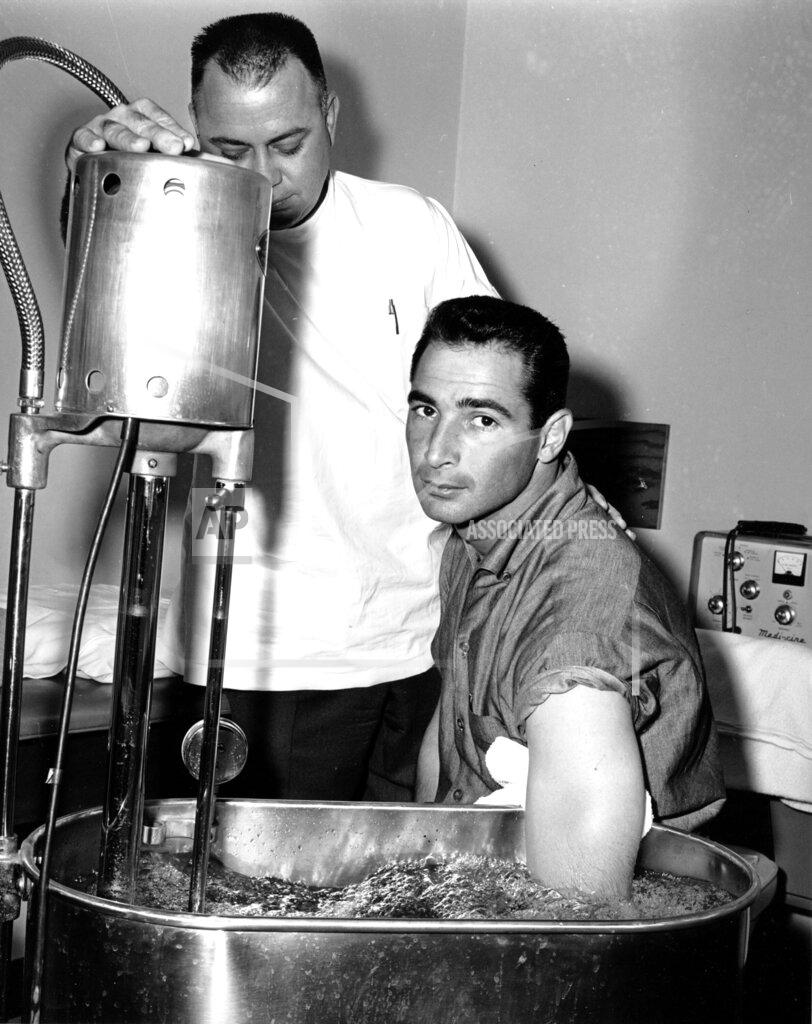
Houston’s Ken Johnson becomes the first pitcher ever to hurl a 9-inning no-hitter and lose as Cincinnati wins, 1–0. Two errors in the 9th, the second by second baseman Nellie Fox on Vada Pinson’s grounder, allows Pete Rose to score the only run. Joe Nuxhall wins with a 4-hitter.
The Mets swap Chico Fernandez and minor leaguer Bobby Catton to the White Sox for Charley Smith.
Dow Jones Industrial Average: 821.66 (-1.91).
Born:
Dan Frischman, American actor (Arvid Engen – “Head of the Class”), in Whippany, New Jersey.
Gen [Simon Matthews], British pop drummer (Jesus Jones – “Right Here, Right Now”), in Wiltshire, England, United Kingdom.
Gianandrea Noseda, Italian conductor (National Symphony (D.C.), 2017-27; Zurich Opera, 2021-28; BBC Philharmonic, 2002-11), in Sesto San Giovanni, Italy.
Albert Bell, NFL wide receiver (Green Bay Packers), in Birmingham, Alabama.
Shawn Halloran, NFL quarterback (St. Louis Cardinals), in Gardner, Massachusetts.
Died:
Karl Polanyi, 77, Austro-Hungarian economic anthropologist (“The Great Transformation”).
 History Diaries