
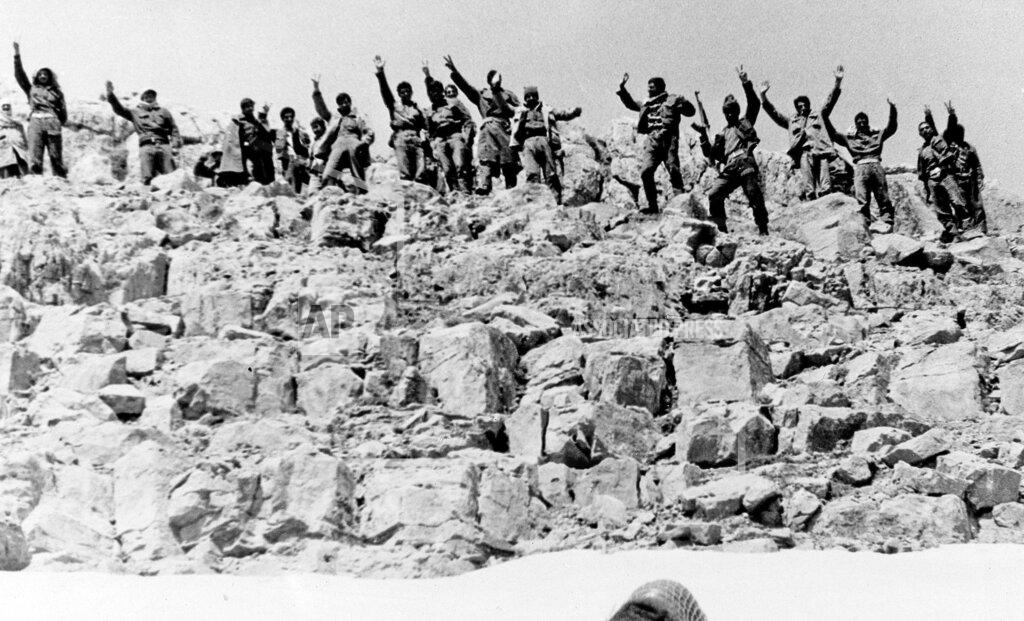
Israeli Air Force planes strafed Syrian positions near Mount Hermon today as dense clouds settled over the peak, concealing from Israeli eyes whether the Syrians were attempting once more to push construction of a road, higher up the bitterly contested mountain. “You can’t see anything,” said an Israeli soldier, peering over a cliff that overlooks the unfinished Syrian road. He leaned into near‐gale‐force winds that tore his words away. A number of Israeli tanks were in place a few hundred yards from the 9,200‐foot summit of this tactically important mountain, but there was nothing to see or to aim their 105‐mm tank cannons at. It is, to put it simply, bitterly cold and uncomfortable on this mountain, with its now dirty and shrinking snow fields.
On the whole, fighting everywhere along the Israeli‐Syrian lines was very light today, and there seemed little reason to believe that anything approaching full‐scale warfare would resume between the two enemy forces. However, most Israeli soldiers here believe that the Syrians may try to reach limited, but symbolically important, objectives before or during the forthcoming Middle East visit of Secretary of State Henry, Kissinger, who is seeking to promote a negotiated military disengagement. The Syrians have also made clear they will not stop their harassing military action, at the least, until such a disengagement is achieved. The harassment is a bitter thing for Israel, already numbed by the high death toll of the October war against the Arabs and about to commemorate her dead on the Israeli independence day.
Since Sunday four men have been killed and two wounded on the Syrian front by Syrian shelling. In the last 43 days of renewed hostilities in the area 13 Israelis have been reported killed and 59 wounded. “We are getting a shell about every 15 minutes today —just to remind us there is still a war on,” an Israeli officer on the mountain remarked. While it is certainly not impossible, it is not considered likely that the Syrians would launch a major ground attack in the flat, low ground of the large salient — or “bulge,” as Israeli soldiers call it — that Israel took during the October war.
Instead, a battle is being fought on the slopes of Mount Hermon, which towers over the bulge to the north. Ironically, even the lowest‐ranking Israeli soldier realizes that Israel will have to give up some of the mountain in any disengagement fashioned by Secretary Kissinger. But the Israelis are determined not to give any ground in the face of Syrian probes. The Israelis hold a string of positions running up the southwest ridge of the mountain and recently took the summit. A crude, back‐jolting road to the very top permits them to supply their men all along the way and to employ tanks, armored personnel carriers and self‐propelled heavy mortars. The Syrians, who appear to want to retake the summit and other positions, used four days of heavy fog recently to begin to construct a road of their own that would permit their armored vehicles to cut behind the Israeli position on the peak. When the fog lifted, bombs from Israeli planes and fire from Israeli tanks ended the construction work 300 yards short of the goal.
Following the resignation of Golda Meir as Prime Minister of Israel and as leader of the ruling Israeli Labor Party, the Labor Party’s 552-member central committee chose between Labor Minister Yitzhak Rabin and Information Minister Shimon Peres. Rabin won the election, 298 to 254, and would take office as Prime Minister on June 3.
The Nixon administration is preparing to give Egypt over $250 million in economic assistance beginning July 1, a senior United States official said. Another official said that the assistance would be part of a new foreign aid program to be discussed with congressional leaders tomorrow by President Nixon, and that the administration also planned to offer economic aid to Algeria and Syria.
The American helicopter carrier USS Iwo Jima lays anchored six miles off Port Said, at the northern end of the Suez Canal — a sign of the growing association between Egypt and the Western world. Twelve helicopters from the carrier started to sweep the canal for acoustic and magnetic mines. The operation is being carried out by the United States in cooperation with British minesweepers and the Egyptian armed forces and without the Soviet Union, which has been supplying Egypt with all her arms for 18 years.
On the political front Chancellor Willy Brandt of West Germany wound up three days of talks with President Anwar el‐Sadat in a blaze of newfound amity. At a news conference the Chancellor spoke of “the wave of friendship and affection that had engulfed him and his delegation since his arrival Sunday. He paid tribute to President Sadat’s “realistic policy” in the Middle East.
Defense Secretary James R. Schlesinger is considering a relatively small reduction in United States forces in Europe, through elimination of some Army and Air Force support personnel. The reduction being contemplated by Mr. Schlesinger is small, considering the 197,000 ground and air forces in Europe. At this point the Defense Secretary is known to be thinking of a reduction of about 20,000 support personnel, with perhaps half withdrawn from Europe and the remainder converted into greater combat strength on the central European front.
Mr. Schlesinger broached the idea of “streamlining” United States forces in Europe during his visit last week to West Germany to confer with European and American military officers as well as with the West German Defense Minister, Georg Leber. Mr. Schlesinger’s intentions, at least as expressed publicly in news conferences, are somewhat veiled. Repeatedly he emphasized that there would be no reduction in United States strength in Europe except as part of an agreement with the Soviet Union on mutual reductions. But he would then go on to suggest that he was talking only about combat forces and that he was not excluding “efficiencies” leading to reduction in support personnel.
The Soviet Union today hailed the acceptance of one of its cardinal principles, the recognition of existing frontiers, by Westen participants at the European security talks in Geneva. The adoption of the principle at the 35‐member conference which resumed today after a recess, was described by Pravda as an “important new step’ toward a summit meeting to wind up the discussion. Western participants in the Geneva conference have underscored another point — the need for freer movement of people and information — and Moscow’s resistance to that provision was underscored today by Leonid I. Brezhnev, the Soviet party leader, in a speech at the 17th congress of the Komsomol, the Young Communist League.
The Communist party chief warned that people in the West have not abandoned “hopes of subverting Soviet art and literature” and were trying to “tear away” artists and writers from “our ideals” of communism. “Individual renegades and people astray in our country have tried as well to echo our ideological and class enemies,” Mr. Brezhnev said, in what was taken as an allusion to Aleksandr I. Solzhenitsyn, the exiled author, and other dissident intellectuals. “But all their endeavors proved futile,” Mr. Brezhnev told the delegates in the Kremlin. “Ours is an utterly unfit soil for the growth of such weeds.”
The Senate Foreign Relations Committee voted to require the Nixon Administration to seek specific congressional approval for building a naval base on the island of Diego Garcia in the Indian Ocean. The requirement was one of several amendments attached to a budget bill of $786 million for State Department operating expenses and $238 million for the U.S. Information. Agency as part of the committee’s continuing efforts to reassert a congressional role in framing foreign policy.
The U.S. State Department reversed itself by ordering Ambassador to South Vietnam Graham A. Martin to return this spring for routine consultations and likely congressional appearances on aid commitments. Martin recently made remarks critical of persons opposing U.S. Vietnam policy. Asked why less than a week ago the State Department said Martin would remain in Saigon indefinitely, press officer John F. King said, “Things change. He is now expected to come.”
South Vietnamese forces backed by artillery reported killing 101 Communist troops who tried to block key Highway 1 just 30 miles northwest of Saigon. The military command said that 400 Communists had been trapped on the road and that 40 weapons and 10 prisoners were captured.
The head of the French Communist Party said that if Socialist Party leader Francois Mitterrand wins the French presidency the Communists will get one-third of the cabinet posts. “They will be in the minority,” Georges Marchais added. “Therefore, there is no risk that tomorrow the Communists would establish dominance.” The latest opinion polls showed Mitterrand running away from his Gaullist rivals and indicated he was only six percentage points from victory on the first ballot May 5.
A spokesman for Japan’s ruling Liberal Democratic Party said an election for the upper house of parliament would probably be held on July 7. The Liberal Democrats, with a slim majority of eight seats, will be placing their ability to control parliament on the line.
Canada’s immigration minister reminded foreigners who want to settle in Canada that they must apply for landed immigrant status before they arrive in the country. Before March of last year immigrants could apply for the landed immigrant visas after arriving in Canada. The number of deportations has increased 50% since last March, apparently because people fail to understand the new rule, the minister indicated.
Gunmen in a passing car sprayed the automobile of Acapulco police chief Wilfredo Castro with bullets, seriously wounding the official and his driver, authorities said. Castro’s wife, also in the car, was not hurt. The shooting occurred only two blocks from the city’s police station and half a mile from the downtown area and luxurious tourist hotels.
The Senate Foreign Relations Committee called for a new U.S. policy toward Cuba that could lead to recognition of Premier Fidel Castro’s regime. The committee approved a resolution to end the U.S. trade embargo and restore relations with Cuba. The vote was 12 to 0.
President Nixon apparently won five more days to respond to a House Judiciary Committee subpoena for tape recordings related to the Watergate case. The delay in the subpoena’s date — from Thursday to next Tuesday — was requested by James St. Clair, Mr. Nixon’s special counsel for Watergate matters. Representative Peter Rodino, the committee’s chairman, said he was confident that the committee would agree to the request.
Vice President Ford has confided to associates in recent weeks that he is perplexed by what he senses to be a feeling that he is attempting to undercut Mr. Nixon.
The Internal Revenue Service, in an abrupt reversal, has agreed to provide the Senate Watergate Committee with politically sensitive tax returns from its files on one of the President’s brothers, Donald Nixon, and the President’s closest friend, Charles ‘Bebe’ Rebozo, well-placed sources said.
Using sarcasm and solemnity, evangelistic fervor and laughter, Walter Bonner, the lawyer for Maurice Stans, summed up his defense in an oration to the jury that lasted nearly five hours. Its thrust was to create the impression that it was preposterous to suppose that “that honorable man” — Mr. Stans — would commit a crime.
The Supreme Court, dividing 5 to 4, refused to decide whether professional schools can constitutionally give preference in admissions to members of racial minorities at the expense of white applicants. At stake but not mentioned by the Justices in their decision, was the broader issue of “reverse discrimination,” whether giving special treatment in education and employment to blacks unfairly deprives whites of their right to be judged on their own merits.
The Federal Bureau of Investigation must expunge a person’s arrest record from its criminal files if the arrested person was exonerated and released without charges, a federal court of appeals ruled today. In a 27‐page opinion, a three‐judge panel of the Court of Appeals for the District of Columbia said the FBI had “no authority to retain” the record of a California man, Dale B. Menard, who was arrested on suspicion of burglary but never charged with a crime. Mr. Menard was a 19‐year‐old college student when he was arrested in Los Angeles in August, 1965. He was booked, fingerprinted and held in police custody for more than two days. The appellate court said no information was found “that tied Menard to any crime.” A fingerprint card was subsequently forwarded to the FBI that read, “Released — unable to connect with any felony or misdemeanor at this time.”
In June, 1971, Judge Gerhard A. Gesell of the United States District Court here did not order the removal of Mr. Menard’s arrest record from the FBI files, but he did limit the distribution of such records. Today, the court said that the “FBI has the responsibility to expunge the incident from its criminal identification files.” Records must be removed, the court said, “when the FBI is apprised that a person has been exonerated after initial arrest, released without charge and a change of record [is made] to ‘detention only,’” as in the Menard case. The court said it was not preventing the bureau from keeping fingerprints “in its neutral noncriminal files, provided there is no reference of any kind to indicate that the prints originated in a source for criminal files.”
The Senate brushed aside delaying tactics and passed a bill compensating the Mississippi poultry industry for the destruction of millions of pesticide-contaminated chickens. The bill was sent to the House, which is working on its own version of the legislation. With the backing of Senators James O. Eastland and John C. Stennis, both Mississippi Democrats, and Sen. Russell B. Long (D-Louisiana) passage was never in doubt. Routine testing disclosed that 7.6 million birds were contaminated with Dieldrin, a pesticide of the DDT family known to cause cancer on prolonged exposure. Producers estimated their loss at $10 million. The Senate version would repay the poultrymen about $1 a bird.
The explosion that ripped off a side of a commercial building on New York City’s East Side and injured 100 persons and caused $10 million in damages has been traced to a massive gas explosion touched off by the rupture of a pressure tank storing water for an industrial tenant. The water tank, one of four stored in the basement of the blast scene, took off “like a jet” and severed a 6-inch gas pipe directly overhead, according to Fire Commissioner John O’Hagan. Escaping gas poured into the 25-story building for up to an hour before the blast occurred, O’Hagan said.
The chairman of President Nixon’s Council on Environmental Quality, Russell W. Peterson, urged that the United States work through the United Nations for a goal of worldwide zero population growth. Peterson, addressing an international water quality symposium in Washington, D.C., said, “The greatest threat to the future well-being of humanity is, in my opinion, population growth.” He said the solution to most other world problems-malnourishment, poor housing, unemployment, pollution and resources depletion “is dependent upon solving the population problem.”
John C. Sawhill, administrator of the Federal Energy Office, said the nation can expect gasoline shortages this summer. After the rationing, “People are going back to their old driving habits,” he said in an address to the American-Arab Association of Commerce and Industry in New York City. “There are as many people on the road now as there were in September before the embargo.” He said he would continue the policy of minimal interference and would only encourage motorists to hold to the 55-m.p.h. speed limit and to form car pools. He said his office would not hold down prices, which could increase if imported oil prices should go up.
The Federal Bureau of Investigation said today that the latest message purportedly sent by the self‐styled Symbionese Liberation Army appeared to be a hoax. Charles W. Bates, who is in charge of the bureau’s 11‐week investigation of the kidnapping of Patricia Hearst, said that the message did not appear to have “any connection with previous communications” from the revolutionary group, which took responsibility for the kidnapping. The message threatened that five California law‐enforcement officers would be slain for every member of the radical group killed by the authorities. It made no mention of Miss Hearst.
The scientists’ Institute for Public Information condemned today as “frivolous and shallow” the Atomic Energy Commission’s draft assessment of the environmental hazards of the breeder‐reactor development program. The organization of more than 900 scientists and laymen asserted that the environmental impact statement, on which the commission will hold hearings starting Thursday, should be withdrawn and wholly rewritten. Barry Commoner, the institute’s chairman, and David Inglis, former senior physicist at the A.E.C.’s Argonne National Laboratory in Illinois, released at a news conference a summary of the testimony they and others will give at the hearing. They alleged that the commission’s statement discussed inadequately or not at all the radiation and explosive dangers of plutonium, the fuel that breeder reactors make from uranium, and “the feasibility of solar energy.”
The Exxon Corporation and Texaco, Inc., two of the largest multinational oil companies, reported sharp first quarter gains in profits, continuing their outstanding performance in late 1973. Exxon estimated its net income at $705 million, up nearly 39 percent over the first quarter of 1973, and Texaco had a 123 percent rise in net income, from $264 million to $589.4 million.
The Consolidated Edison Company, plagued by soaring fuel costs and the effects of energy conservation by consumers, suspended payment of its quarterly dividend, something the company had never previously done since it started paying them in 1885. This started a selling wave of its stock on the New York Stock Exchange.
Mrs. Billie Jean King defeated 17‐year‐old Diane Fromholtz of Australia, 6‐4, 6‐3, tonight to advance to the second round of the $50,000 Virginia Slims tennis tournament at the Palestra in Philadelphia. Miss Fromholtz, Australia’s top‐ranking junior, a left‐hander, took a 2‐1 lead in the first set and broke service once in the second. Others who advanced were Rosemary Casals and. Virginia Wade of Britain. Miss Casals beat Pat Bostrom of Seattle, 6‐2, 6‐4. Miss Wade defeated Val Ziegenfuss of San Diego, 6‐3, 6‐2. Kerry Melville of Australia overcame Betty Hansen, a Californian, 6‐3, 7‐5.
Dow Jones Industrial Average: 845.98 (-12.59, -1.47%).
Born:
Sam Madison, NFL cornerback (NFL Champions, Super Bowl 42-NY Giants 2007; Pro Bowl, 1999-2002; Miami Dolphins, New York Giants), in Monticello, Florida
Joey Kent, NFL wide receiver (Tennessee Oilers-Titans), in Huntsville, Alabama.
Barry Watson, American actor (“What About Brian”), in Traverse City, Michigan.
Carlos Dengler, American musician (Interpol), in Queens, New York, New York.
Died:
Cy Williams, 86, American baseball outfielder (4 x NL HR leader; Chicago Cubs, Philadelphia Phillies).



 History Diaries