
Yitzhak Rabin, the commander of Israel’s armies in the 1967 war with the Arabs, won the Labor party’s nomination to succeed Premier Golda Meir. Despite an 11th-hour attempt by his opponents to brand him as emotionally unfit for the job, Mr. Rabin won 54 percent of the votes of the party’s 614-member central committee. He is 52 years old and a former Israeli Ambassador to Washington.
While Soviet‐made armor and missiles have continued to arrive to bolster the defenses of Damascus, Western military observers say they see no evidence that Syria is concentrating forces for a full‐scale attack against Israeli positions on the Golan Heights front. Western diplomats said that high Syrian military and political leaders appeared genuinely hopeful that when Secretary of State Kissinger arrives next week, he will be bringing proposals that could lead to military disengagement in the Golan area and Withdrawal of Israeli forces from territory occupied since the 1967 war as well as that seized last October. Meanwhile, Syrian officials said they were determined to keep up daily artillery and infantry harassment of Israeli positions to improve the Syrian position on Mount Hermon, which rises above the heights. “If the Israelis are sincere about disengagement and withdrawal,” a Syrian military officer said, “why are they trying to build concrete fortifications and open new roads on the front?” He said such engineering work violated the standstill cease‐fire and had to be halted by shell fire.
The window‐rattling concussion of distant artillery and the sound of MIG fighters leaving bases around the capital are reminders that the cease‐fire has broken down. After more than a month of daily violations, the fighting intensified Friday into an air battle around Mount Hermon. The. Western military attachés said the engagement indicated that Syria had strengthened her missile defenses right up to the front, which is about 25 miles southwest of Damascus. For two months large quantities of new Soviet tanks, armored personnel carriers, and other heavy equipment have been seen moving from the Mediterranean ports of Tartus and Latakia along highways toward Homs and the capital. The Western military observers say they believe that perhaps 500 Soviet tanks have arrived, along with missiles, planes and other equipment, to replace Syrian losses during the October war. Syrian sources said that President Hafez al‐Assad returned from an official visit to Moscow last week with a promise from Leonid I. Brezhnev, the Soviet party leader, that the Russians would send combat troops if necessary to protect Soviet‐made missiles against Israeli ground attack.
Operation Nimbus Star, the U.S. Navy’s assistance in clearing the Suez Canal of explosive mines, began with minesweeping helicopters dispatched from amphibious assault ship USS Iwo Jima (LPH-2).
More than 700 Cambodian government troops were missing after government forces withdrew from the Kompong Luong beachhead under a withering rebel assault, military sources in Phnom Penh said. About 1,500 men with 12 armored vehicles managed to fight their way 1½ miles north to another government camp at Longvek. The beachhead, 23 miles north of the capital, was established in an attempt to retake Phsar Oudong, the 17th century capital of the Khmer empire, from the Reds.
A ragged cluster of South Vietnamese women and children stood in the settling dust of the embankment as the helicopter blades rotated to a stop. Two women with dazed infants hanging on their arms sucked ices that had been passed out by a soldier. The group of 15 women, 11 children, two wounded rangers and an old man had just been evacuated from an encircled government outpost across the muddy Vàm Cỏ Đông River. They waited more than two weeks to get out, but only today were the copters able to penetrate the intense North Vietnamese antiaircraft and machine‐gun fire. “We had to circle two times before we could land!” cried a ranger supply officer, his body quivering in fear and his eyes wet with tears.
After the circling had drawn off the ground fire the copters cut their throttles and darted down out of the milky sky to the edge of the camp; they were on the ground for two minutes and, miraculously, no one was wounded. A woman named Nguyễn Thị Huệ, whose husband, a ranger, remained behind to defend the camp, said that today was the 16th day she had run for the helicopters. “Every day,” she said, adjusting her 4‐year‐old daughter in her arms, “two or three people in there are killed because of the shelling. The children cry all the time because there is not enough to eat, because of noise, because of the shelling.”
The siege at Đức Huệ by elements of the North Vietnamese Fifth Division is but one pocket of violence in flat, unlovely Hậu Nghĩa Province, which is less than half an hour’s drive from Saigon. The province is a vital one, running from the outskirts of the capital to the Cambodian border. The French fought for it, the Americans fought for it and today Communist and anti‐Communist Vietnamese continue to fight among themselves for it. These days, on both sides of Route 1, which slices across the northern end of the province, squads of government soldiers, armored personnel carriers and tanks can be seen plunging into the woodlands on sweeps. The government’s idea is to push the Communists away from the road, which roughly marks the area of its control; the Communists, meanwhile, are trying to seep down toward the road and, farther east, at Đức Huệ, to wipe out a watch point for infiltration. So far, the results seem inconclusive.
Japan agreed tentatively to lend the Soviet Union $1 billion at relatively low interest to finance three projects involving the development of coal, gas and timber resources in Siberia. The deal would pour Japanese funds into the extraction of coal and gas resources and the felling of timber from the forests of Far Eastern Siberia. Japan, which is poor in natural resources, would share in some of the output.
Northern Ireland gunmen ambushed an auto near the border with the Irish Republic, shooting to death the driver-a Pakistani cook attached to the British army. The attack that killed Mohamed Abdul Khalid, 18, identified by police as a canteen worker at the British army post at Crossmaglen, South Armagh, came soon after three gunmen ambushed the car of a Roman Catholic government minister and wounded his bodyguard in Belfast. The official, Health Minister Paddy Devlin, was in Dublin at the time.
Jacques Chaban-Delmas, official Gaullist candidate for the presidency of France, urged voters in a nationwide television address to rally to his support against Communist-backed Socialist contender Francois Mitterrand, saying a Mitterrand victory could mean the end “to our freedoms.” Mitterrand is running ahead of Chaban-Delmas and the other leading candidate, Finance Minister Valery Giscard d’Estaing, in opinion polls but needs an absolute majority to win without the runoff vote Chaban-Delmas expects.
Greek security authorities arrested retired generals George Desipris and Constantine Papageorgiou and six civilians over the weekend, sources said in Athens. There was no official comment on the reported arrest of the two generals, who are regarded as pro-royalist. Papageorgiou had been arrested in 1970 and banished to a remote village following the discovery of a coup involving royalist officers. He was later released.
All 107 passengers and crew on Pan Am Flight 812 were killed in a crash in Bali, Indonesia, 600 miles east of Jakarta, when the Boeing 707 crashed into the side of a mountain while approaching Denpasar as a stop on a flight from Hong Kong to Sydney in Australia. The remains of all the non-Asian victims were cremated, while those of Westerners, including 28 Americans, were buried in a mass grave. It was the fourth crash of a Pan American Boeing 707 in nine months, and the third in the South Pacific.
The trial of 57 Chilean air force officials and 10 civilians accused of sedition and Marxist sympathies has led to the first public debate here over the legality of the military Junta’s overthrow of the elected Marxist coalition Government last September and its conduct since. The air force court‐martial has been far more open than both supporters and opponents of the junta and foreign legal observers expected. Defense attorneys have been permitted to raise as many issues and call as many witnesses as, they have wished. The prosecution has also broadened the legal and political scope of the trial by arguing that the Marxist Government, though legally elected, had lost its legitimacy and become “the enemy” of the armed forces and the nation.
Heavy rains and flooding in northeastern Brazil have destroyed thousands of homes and forced the evacuation of Aracati, a city of 20,000, authorities reported. An estimated 50,000 persons have been forced from their homes in Ceara state. Police said hundreds of poisonous snakes had invaded Teresina, the state capital.
Air Canada announced it had laid off 1,650 employees at Toronto International Airport — the nation’s largest — and reduced its flights there by about 50% because of the strike by airport firemen. An agreement has been reached on a new contract for the strikers but they have not voted on it yet. Canada’s mail sorters also are on strike and the U.S. Postal Service has halted deliveries to that country.
Floods in Western Canada eased a bit and residents of Moose Jaw and Lumsden in Saskatchewan started cleanup operations while continuing to work to keep the water at bay. At Vegreville, a town in Alberta 50 miles east of Edmonton, a massive clean-up was under way but the northeastern section of the community was still under water. The Prarie Provinces have been under flood warning for several days and officials say that much snow is left to melt.
Lieutenant Colonel Seyni Kountche, chief of state of Niger’s week-old military government, announced today the formation of a commission to investigate what he described as the “illegal activities” of former government leaders. The officials, including former President Hamani Diori, whom the new military leaders deposed April 15, are reported under arrest. In a 20‐minute address, Colonel Kountche gave no details on the make‐up of the commission, when it would begin or what possible penalties might be meted out. He did not mention any of the officials by name.
The House Judiciary Committee has reportedly asked President Nixon for additional tape recordings and documents dealing with Watergate and alleged political influence in government antitrust and milk price support decisions. Well-placed sources said that the impeachment inquiry’s new request was sent to the White House after its vote April 11 to subpoena tape recordings of Watergate-related conversations involving the President and former key aides.
Investigators for the Senate Watergate Committee now believe that the White House played a major role in coordinating the Internal Revenue Service’s investigation of a controversial $100,000 campaign contribution from Howard Hughes, well-placed sources said. The investigators, they said, recently questioned Fred Buzhardt, President Nixon’s counsel, for more than three hours and decided to order him back for further questioning because his testimony was found to be “evasive”.
Testimony in the criminal conspiracy trial of John Mitchell and Maurice Stans ended. The case is expected to go to the jury Wednesday night. John Dean, the President’s former counsel, who twice before had testified at the trial for the government, was among the last witnesses.
Robert S. Strauss, the chairman of the Democratic National Committee, urged Democratic Governors today to stop calling for President Nixon’s resignation. “Let us remember what this President was and did when he perceived himself a hero,” said Mr. Strauss, an exponent of the theory that the most effective partisanship on the Watergate issues is at least the appearance of nonpartisanship. “I ask you what horrors await this nation if he is able to portray himself as a resigned martyr.” The caucus of 15 Democratic Governors, just under half of their full strength, emphasized issues other than Watergate in preparing resolutions for the National Governors’ Conference in Seattle in June. Informally, they embraced such things as extended price controls on health care, postcard voter registration and a moratorium on railroad abandonments. But they clearly shared with Mr. Strauss the assurance that Watergate and what they regarded as the likely impeachment of President Nixon are tending to help all Democrats this year, even when they do not address those matters directly.
Donald Johnson, embattled head of the Veterans Administration, announced tonight his intention to resign “in the near future.” The announcement followed reports by well-informed sources the Mr. Johnson had been dismissed, and that General Alexander Haig, President Nixon’s chief of staff, called five congressional leaders to the White House in the afternoon to tell them of Mr. Johnson’s dismissal.
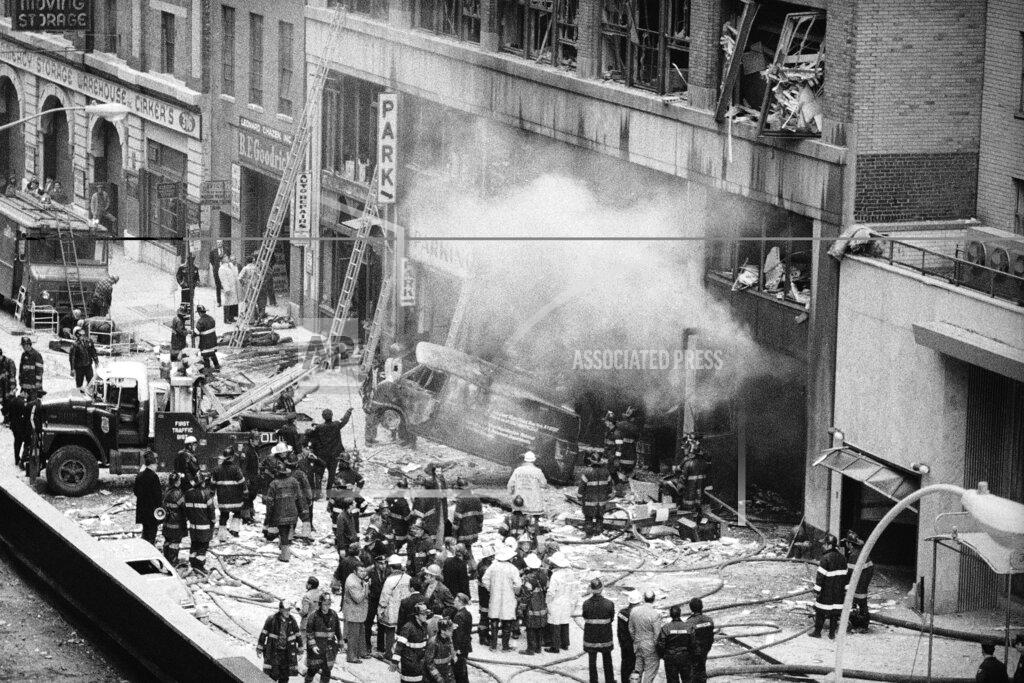
A powerful explosion ripped through a 24-story office building near the United Nations in New York City, injuring 70 people and leaving hundreds of tenants in an adjoining apartment house homeless. The blast occurred shortly after 7 A.M., raining tons of brick, glass and mortar on the streets around the office building at 305 E. 45th Street, which extends through the block to 46th Street just east of Second Avenue. Many of the injured were from Envoy Towers, the adjoining apartment house at 300 East 46th Street.
A group of five employees at “The Hi-Fi Shop”, a home audio store in Ogden, Utah, were taken hostage by six robbers and tortured. One man and two women were brutally murdered. Three active-duty airmen of the U.S. Air Force would be arrested, while three others would never be identified. Two of the arrested would be convicted of murder and executed, while the third would be convicted of robbery and spend 13 years in prison. The story would become the basis of a best-selling book, “Victim: The Other Side of Murder,” by Gary Kinder, published in 1982 and later adapted to a television film, “Aftermath: A Test of Love.”
Thomas J. Mackell, former Queens district attorney, was sentenced in New York City to six months in prison on his March 2 conviction for blocking prosecution of a get-rich-quick scheme operator. “This court cannot blind itself to a betrayal of a public trust,” said state Supreme Court Justice John M. Murtagh in pronouncing the sentence. He also imposed six-month sentences on James D. Robertson, former deputy chief district attorney and Mackell’s son-in-law, and Frank R. DePaola, a former county detective. All three remained free pending appeal. They were found guilty of conspiring to thwart the prosecution of Joseph Ferdinando, architect of a $4.4 million pyramiding loan-investment scheme.
Katharine Graham, publisher of the Washington Post, became the first woman to be elected to the 18-member board of the Associated Press. Three incumbents and three new directors were elected in balloting at the AP’s annual membership meeting in New York City. The incumbents were J. Kelly Sisk of the Greenville, South Carolina, Piedmont, Richard C. Steele of the Worcester, Massachusetts, Telegram and Evening Gazette, and Robert M. White II of the Mexico, Missouri, Ledger. The new members, with Mrs. Graham, were James F. Chambers Jr. of the Dallas Times Herald and William H. Cowles III of the Spokane, Washington, Spokesman Review.
Virginia’s Supreme Court ruled. that a reporter has a limited privilege to withhold information about a crime received in confidence. It said reporters can be compelled to disclose their sources only when the information is essential to a fair trial. The case involved the refusal of a reporter, Helaine Patterson of the Fredericksburg Free-Lance Star, to identify a source in a county sheriff’s office who had provided her with information about a murder.
A two-state trial of killings and terror ended in a residential neighborhood of Flint, Michigan, when two escapees from a Michigan prison farm surrendered meekly to police. The two, identified as Gordon L. Stockenauer, 26, and Joseph A. Molonare, 29, were wanted in connection with three killings-two in Wisconsin and one in Michigan. Authorities said they were captured near the home of Molonare’s girlfriend without a shot being fired. They escaped Saturday from the prison at Marquette, and abducted Charlene Beaudin, 33, mother of five and William Klingenmaier, 21, who was unharmed as he escaped from the car. Mrs. Beaudin was killed in her attempt to flee. The two men also are suspects in the deaths of a Milwaukee service station attendant and a Troy, Michigan, policeman.
Oklahoma Attorney General Larry Derryberry called for consideration of impeachment of Governor David Hall, saying he is convinced that Hall “was involved” in fund-raising schemes that led to kickbacks on state building projects. Derryberry said as a result of his investigation into alleged collusion and kickbacks on construction projects, federal antitrust suits were filed in Oklahoma City against the 12 firms that bid for contracts on three jobs. Derryberry is a potential candidate for the Democratic nomination for governor against Hall, who could not be reached for comment.
A Japanese-American student was ordered held in lieu of $1,000 bond in Lansing, Michigan, on charges of attempted arson. Katsushi W. Yamanoha, 25, a Michigan State University junior from Hawaii, was arrested after campus police charged he dumped a can of gasoline in the lobby of the school’s music building during a protest of a student performance of Gilbert and Sullivan’s operetta “The Mikado.” Police said Yamanoha made no attempt to light the gasoline. Seven students were picketing the show at the time to protest what they considered its unfair portrayal of 19th century Japanese life.
Cesar Cedeno drills two homers and drives in five to pace Houston past Atlanta, 7–0. Claude Osteen, who was dealt by the Dodgers over the winter, scatters seven hits. “I’m a growing boy,” said Cedeno. “I’ve got some power, and I’m going to get some more. I’m only 23. 1 think my power will be to all fields when I get my full strength.” He is batting .373, also leads both leagues in base hits, with 23, and leads them both in stolen bases with 10. His 15 runs scored trail only Lou Brock of St. Louis and his 6 doubles are only one off the major-league pace in that department.
Dow Jones Industrial Average: 858.57 (-1.33, -0.15%).
Born:
Shavo Odadjian, Armenian-American heavy metal bassist (System of a Down), in Yerevan, Armenian SSR, Soviet Union.
P.C. Drouin, Canadian NHL left wing (Boston Bruins), in St-Lambert, Quebec, Canada.






 History Diaries