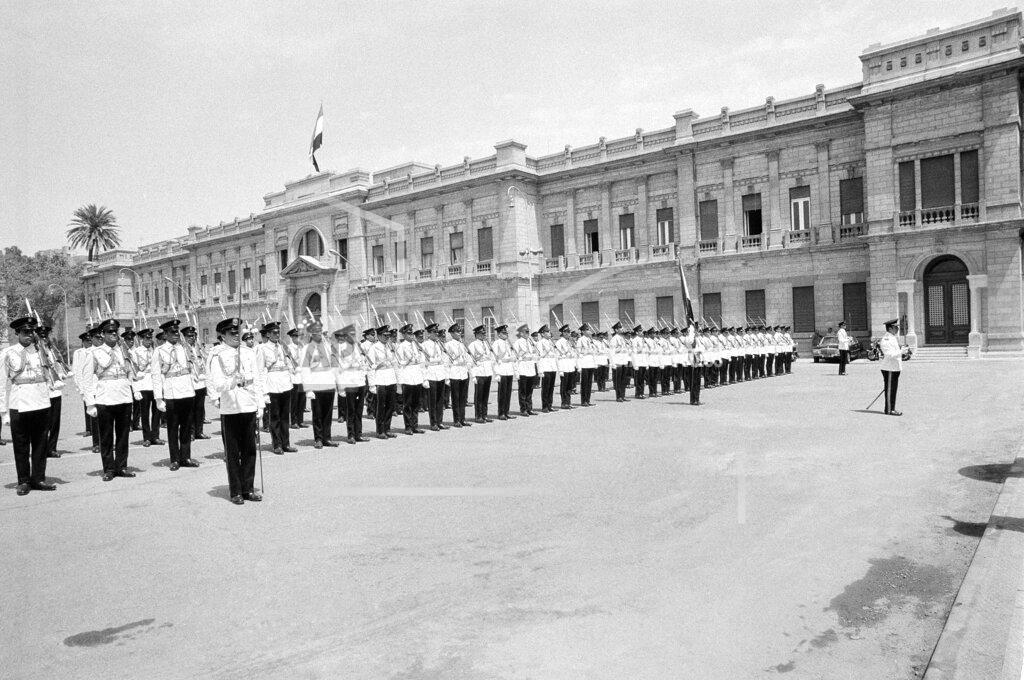
President Anwar Sadat of Egypt praised President Nixon in strikingly warm terms in a ceremony in which he accepted the credentials of Hermann Eilts as the American Ambassador. The president’s office in Cairo quoted Mr. Sadat as having said that the efforts of President Nixon and Secretary of State Kissinger “have made peace possible in this area for the first time in 26 years” and that “this is an opportunity to open a new page between our two countries.” Diplomatic relations between the United States and Egypt were resumed March 1 during Mr. Kissinger’s visit to Egypt. They were broken off during the Arab-Israeli war in 1967.
The Popular Front for the Liberation of Palestine, the guerrilla group that claims responsibility for an April 11 raid on the Israeli settlement of Qiryat Shemona, warned that tourists visiting Israel would not be spared in future attacks, a Kuwait newspaper reported. Exceptions would be made only at the holy places of Jerusalem, Bethlehem and Nazareth, the report said.
Israeli Labor Minister Yitzhak Rabin boosted his chances of succeeding outgoing Prime Minister Golda Meir by winning the endorsement of Finance Minister Pinhas Sapir, the leading kingmaker in their ruling Labor Party. The party central committee meets today to consider Rabin, Information Minister Shimon Peres and Foreign Minister Abba Eban as candidates to form a new caretaker government.
Defense Minister Moshe Dayan said today that Syrian assaults in the Golan Heights were an effort to soften up Israel for approaching disengagement talks rather than a prelude to another full‐scale war. But as Israeli and Syrian gunners exchanged fire across the front lines, Mr. Dayan said on the Israeli radio that he did not exclude the possibility of a major conflict. The fighting today appeared to be confined to one sector of the front — the southern part of the salient occupied by Israel during the October war. The scale of fighting had evidently decreased significantly from yesterday’s air and ground battles.
The South Vietnamese command said today that Communist troops poured hundreds of shells yesterday into government positions northwest and east of Saigon in two engagements. The officials said that 33 Communist soldiers had been killed and that one government soldier died and 20 were missing. North Vietnamese and Vietcong troops slammed about 300 rounds of heavy‐weapons fire into two government infantry position just outside the besieged district town of Đức Huệ, 30 miles northwest of the capital, then followed up with a ground assault, the command said. Forty miles to the east of Saigon, Communist‐led troops oar the provincial capital of Xuân Lộc fired more than 100 mortar rounds and rockets at government positions, the command said. Far to the north, saboteurs blew up a pontoon bridge along national route 1, the second time in a week that the road has been cut. A larger bridge was blown up near Quy Nhon on the central coast.
Communist-led insurgents pushed through the northern flank of a Cambodian Government beachhead 18 miles north of Phnom Penh today, killing six of the defenders and wounding 70 others, according to reports from the field. The position at Peam Chum Nik, which had been under heavy attack throughout the night, was overrun at dawn, the reports said. The outpost was established to protect Government beachhead at Kompong Luong on the Tonle Sap river.
Former South Korean President Yun Posun was secretly arrested at his home for donating more than US$1,000 to a Christian minister for delivery to a student group calling for a return to democracy. Yun, who had been president from 1960 to 1962, had run as a candidate against President Park Chung Hee in elections in 1963 and 1967, was detained without any announcement of his arrest from the government or in the government-regulated South Korean press, and his arrest would not be discovered by the Western press until June 10.
After months of controversy, Japan signed an aviation agreement with China, establishing flights between the two countries. But in retaliation, the Chinese Nationalist government in Taiwan immediately banned Japanese planes from its airspace and terminated their right to land in Taipei. Taiwan’s swift response, which had been publicly threatened for weeks but was still unexpected in Tokyo, appeared to seriously jeopardize the political standing of Premier Kakuei Tanaka and Foreign Minister Masayoshi Ohira, one of Mr. Tanaka’s closest supporters.
China officially disclosed for the first time today plans said to have been drawn up by former Defense Minister Lin Piao to overthrow the Chinese Government by coup d’état. Hsinhua, the official Chinese press agency, quoting an article from the influential Chinese journal Hung Chi, said the coup was to have taken place on September 8, 1971. The magazine accused followers of Lin Piao, believed to have died in a plane in Mongolia in 1971 following the failure of his plans, of having printed pamphlets in the southern province of Fukien in preparation for the coup. The article said that the pamphlets “openly lauded Lin Piao as the commander, a rare genius and a wise leader who has always been correct.”
More than 30,000 young Muslims and nearly 50,000 Christians joined in a demonstration in Addis Ababa, Ethiopia, urging the government to give Muslims equal rights. The demonstration was held in defiance of Muslim elders who had earlier met with Prime Minister Endalkachew Makonnen to present their demand for “equal opportunity for all Ethiopians regardless of faith.” Half of Ethiopia’s 26 million people are Orthodox Christians. An estimated 40% are Muslims.
Kurdish guerrillas claim to have killed at least 70 Iraqi government troops in northern Iraq during the past week, the Iranian newspaper Kayan International reported.
Two American women in Turkey who were sentenced to life terms for drug smuggling asked an appellate court to reverse their convictions on the ground that they did not know hashish was hidden in their vehicle. The court in Ankara said it will rule next Friday on the appeals of Joann McDaniel, 29, of Oregon and Katherine Zenz, 28, of Wisconsin.
A man shot through the head in a Roman Catholic suburb of Belfast was the 1,000th victim of the terrorist violence, “The Troubles,” that has gripped Northern Ireland since the summer of 1969. The official total of 1,000 is confined to those whose death has been directly attributed to terrorist action. The violence has increased steadily since the introduction of emergency regulations allowing the detention without trial of suspected terrorists in August, 1971. Today much of the terrorist activity is aimed at forcing the withdrawal of the British Army garrison.
Soviet industrial production for the first quarter of 1974 was 8.3% higher than the same period last year, Moscow announced. The industrial growth rate was far ahead of the overall 6.8% rate planned for 1974. But in light industry, the principal component of the consumer sector, the growth rate was only 4 percent, compared with the 7.5 percent growth promised to consumers.
Occidental Petroleum Corp. signed an $8 million design contract with the Soviet Union for an international trade center in Moscow. Occidental’s president, Armand Hammer of Los Angeles, said the Russians agreed to buy about $80 million worth of equipment and services for the $110 million center from the United States. He has recently negotiated agreements with Moscow for ammonia and urea fertilizer plants and gas field development in Siberia.
King Baudouin of Belgium asked Premier-designate Leo Tindemans to continue his efforts to form an administration and end a seven-week government crisis. Tindemans reported to the king after failing earlier in the day to bring his Social Christian Party and other regional parties into a coalition.
More Canadian families were forced from their homes in Saskatchewan and Manitoba as swollen rivers continued to rise. The entire town of Lumsden, Saskatchewan, and the Qu’Appelle River valley was ordered evacuated and 400 families were moved out of Moose Jaw, a city of 35,000 about 40 miles upstream. Some parts of Moose Jaw were under 21 feet of water. Scores of homes and a hospital were evacuated at Carmen, 40 miles southwest of Winnipeg in Manitoba.
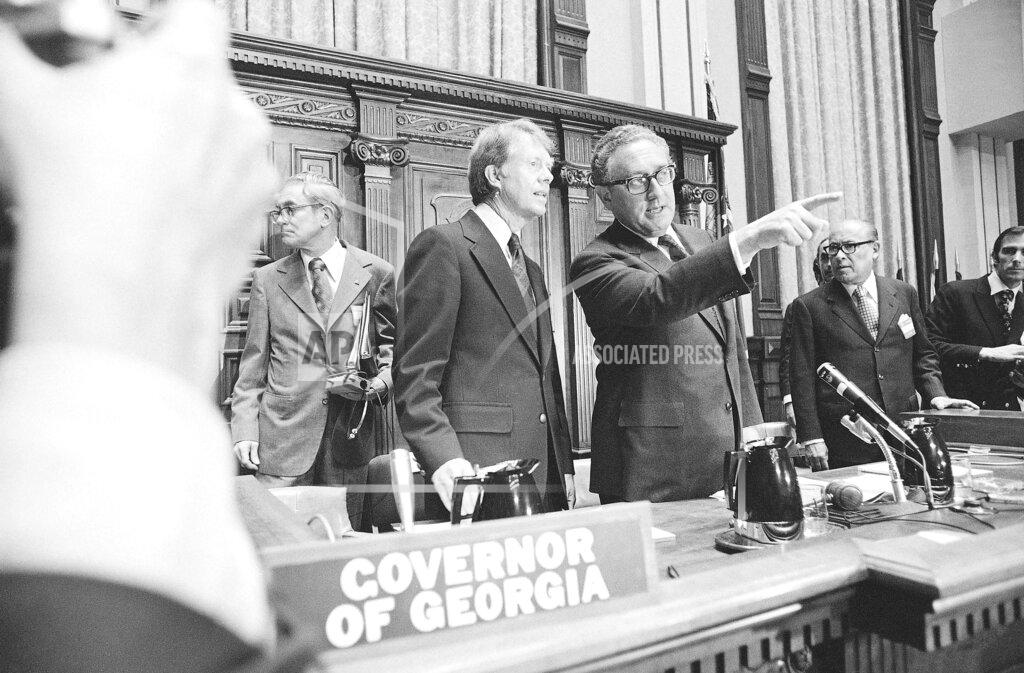
Secretary of State Kissinger declared that “the policy of the good partner” would be the new United States approach to Latin America and the Caribbean. Addressing the General Assembly of the 23-member Organization of American States in Atlanta, Mr. Kissinger said that “we in the United States have come to realize that a revolution has taken place in Latin America.” As a result, he said, “we convene as equals.”
French archaeologist Françoise Claustre was taken hostage by rebels led by future Chadian president Hissène Habré in the north African nation of Chad, at the town of Bardaï, beginning an ordeal that would last almost three years. Captured with her was Dr. Christophe Staewen of West Germany (who would be released on June 11 following payment of a ransom), and Frenchman Marc Combe, who would escape his captors. Françoise’s husband Pierre would be captured by the same rebels 16 months later while trying to negotiate his wife’s release. The two would finally be released on February 1, 1977.
Vice President Ford cautioned Republicans today against allowing the Democrats to turn the fall elections into a national referendum on President Nixon. “The issue is not, R. M. N.,” the Vice President told delegates to the California Republican State Convention. The issue, he said, is whether. “Republicans can mobilize a return to the A.B.C.’s of politics on a personal, and precinct level.” The Vice President said at a news conference that he thought that John M. Boar, chief counsel for the House Judiciary Committee, should a party to deciding what parts of the subpoenaed White House tape recordings were relative to the panel’s impeachment inquiry. The Vice President said just two days ago that the committee should rely on the good faith of the White House in deciding what parts of the tapes were relevant.
Mr., Ford’s comments one the campaign appeared to indicate that he now recognized that President Nixon has been and may continue to be a political liability to Republicans, in Senate and House races this November. Until this week the Vice President had expressed confidence that the impeachment inquiry into President Nixon’s possible involvement in the Watergate cover‐up would not adversely affect Republican candidates this year.
Former Treasury Secretary John Connally denied reports that an indicted Texas lawyer, Jake Jacobsen, was prepared to implicate him in a $10,000 political payoff from a dairy cooperative. He denied that he had received the $10,000 as he arrived in Bangor, Maine, to deliver the keynote address to 1,800 delegates at the Maine state Republican convention.
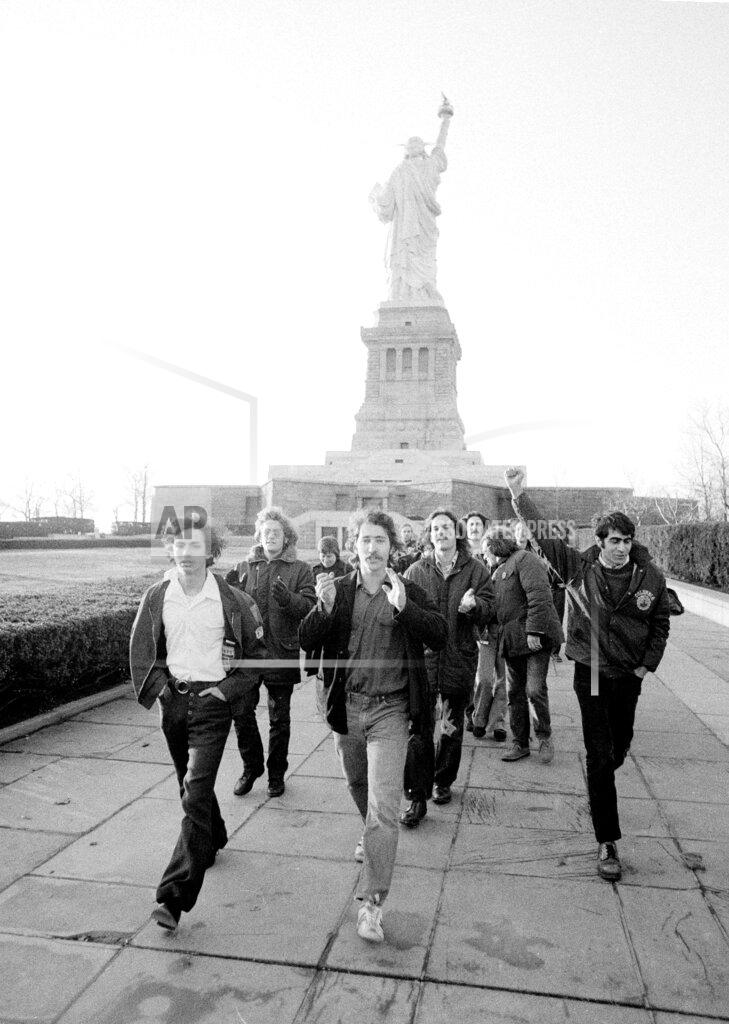
Twenty-one protesters calling for the ouster of President Nixon, who had barricaded themselves inside the Statue of Liberty for 14 hours, ended their occupation after officials obtained a court order evicting them as trespassers. The youths, who left the statue chanting “On to Washington” and “Throw the bum out,” had earlier identified themselves as members of the Attica Brigade, an organization founded to promote anti‐Nixon rallies on campuses next Wednesday and a march in Washington next Saturday. The demonstrators marched out in single file after National Parks Service officials read a court order evicting them as trespassers.
President Nixon and his wife were alone today at Camp David, the Maryland retreat where the President has gone regularly in the past to make his most difficult decisions. A White House spokesman said the President was “reviewing some material prior to Congress’ return Monday from its Easter recess, and did not expect any significant visitors over the weekend. Gerald L. Warren, the deputy press secretary, refused to say whether Mr. Nixon was working on his response to the House Judiciary Committee subpoena for 42 tapes of Presidential conversations last spring that might relate to the Watergate cover‐up.
The slow ripening of the white table grapes in the vineyards of the Coachella Valley in southern California is bringing the beleaguered United Farm Workers Union closer to a crucial test of its ability to remain a potent force in the American labor market. The grape harvest that will be ready in about six weeks will open a new round in the chronic labor disputes, at whose center once again is Cesar Chavez. He hopes to repeat the success of the 1968-69 boycott that won major concessions for California’s 300,000 farm laborers and forced the state’s vegetable and fruit producers to agree to union representation.
A Federal District Court in Minneapolis ordered the Reserve Mining Company to shut down immediately its huge plant in northeastern Minnesota. The court said the company’s discharges of industrial wastes into the air and waters of Lake Superior “substantially endanger the health of the people” in five communities, including Duluth. The plant, at which 3,100 persons are employed, was ordered closed until it complies with all state and federal anti-pollution laws.
The U.S. state of Louisiana adopted its 11th state constitution since attaining statehood, upon a 58 percent approval by voters in a referendum. Louisiana voters approved a new state constitution, a concise 35,000-word document that replaces a 250,000-word constitution adopted 53 years ago and amended more than 500 times. The new constitution sets tax limits on homes and business property. Governor Edwin Edwards said of the document, which took a year to write and cost $2.4 million, “… I think we reached a great milestone in our state’s history and have removed from the backs of the people a great burden, that is, an old, cumbersome constitution that just would not have served us in the last quarter of the 20th century.”
One black trooper must be hired to fill every second vacancy on Alabama’s 650-man state highway patrol until the force is 25% black. The ruling by the 5th U.S. Circuit Court of Appeals upheld a 1972 order by a district judge on a suit filed by the National Association for the Advancement of Colored People and Phillip Paradise Jr. The patrol, which was all white when the suit was filed, now includes 14 black troopers, and 11 more are to join next month.
The lead guitarist of the Sha-Na-Na rock singing group, which achieved national fame by parodying rock ‘n’ roll idols of the 1950s, was found dead in a Charlottesville, Virginia, motel room. Police said Vinnie Taylor, 25, whose real name was Chris Donald, had been found unconscious in his room by members of the group after a performance at the University of Virginia Friday night. A police spokesman said he understood drugs had been found in the room but investigators refused to comment. An autopsy was scheduled.
Public opinion on amnesty for Vietnam war draft resisters appeared to be softening, according to a recent Gallup Poll. A 58% majority opposed unconditional amnesty, down 9% from a year ago; 34% approved it, up 5% from 1973; and 8% expressed no opinion. Among those who favored some form of punishment, 80% suggested some form of military or volunteer service. Six in 10 persons polled said they believed the men who left the country did so out of moral objections to U.S. involvement in the war.
Peter Mauchlin, the convicted bank robber and bomber who escaped from the Federal House of Detention in New York last Sunday, was captured last night in Myrtle Beach, South Carolina, the F.B.I. announced. Mr. Mauchlin was captured after a six‐day manhunt that began in New York, continued through Philadelphia and Washington, and ended in South Carolina.
Three persons were known dead and 50 homes, several businesses and about 100 cars damaged in floods caused by heavy rains in Hawaii. The dead included Olympia Bachiller, 36, and her 5-month-old daughter, Leimomi, whose Quonset hut home in Oahu Island’s north shore was washed away. Mrs. Bachiller’s son, Eugene, 10, was missing and presumed dead. Elsewhere on the island, Frank Balius III, 18, drowned when mud-sliding with friends. And on the island of Kauai, authorities searched for Marie Mendonca’s 3-week-old son, Sataa, who fell from her arms when she was clinging to a tree in floodwaters.
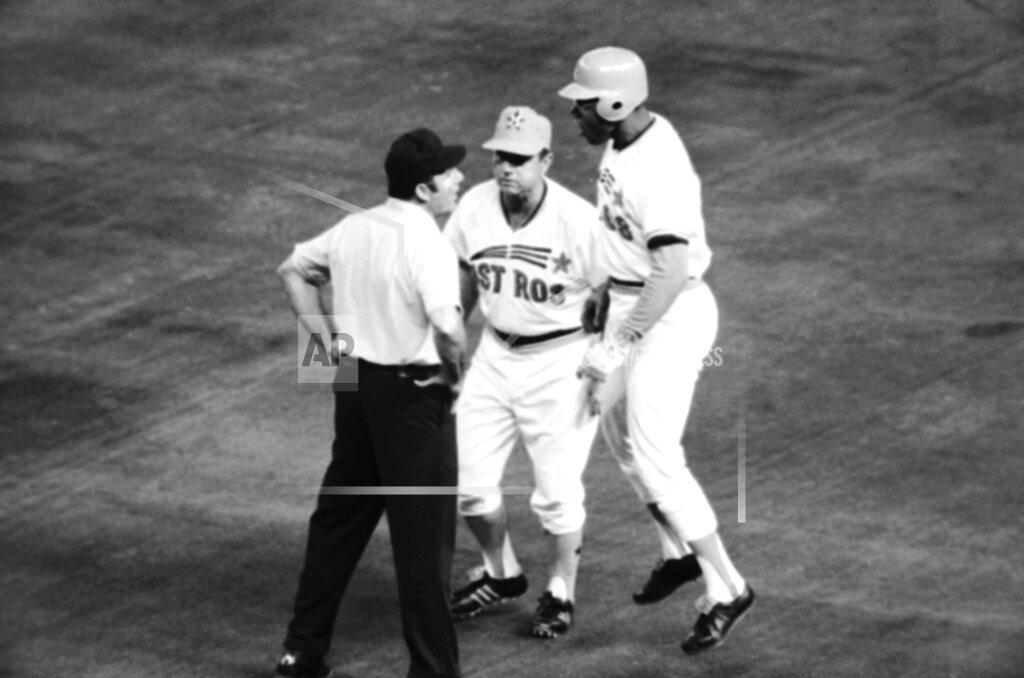
At Riverfront Stadium, the Big Red Machine rolls over the Padres, 11–0. The Reds will win the opener tomorrow over the Padres 10–1, before losing the nightcap.
Born:
J.J. Johnson, NFL running back (Miami Dolphins), in Mobile, Alabama.
Paul Bradford, NFL cornerback (San Diego Chargers), in East Palo Alto, California.
Died:
Mohammed Ayub Khan, 66, Pakistani general and politician (1958 coup, President of Pakistan 1958-1969).
Peter Lee Lawrence (stage name for Karl Hyrenbach), 30, German film actor known for spaghetti western films, including “Fury of Johnny Kid,” died of glioblastoma following surgery.
 History Diaries