A bomb exploded Friday night at London’s Heathrow Airport, injuring about 20 people, as the police siege around the Libyan Embassy in the center of London ended its fourth day with no resolution in sight. There was no known link between the airport explosion and the embassy siege, police sources emphasized, but the explosion led to speculation that Libyan terrorists may have been responsible. By late Friday, no organization had claimed responsibility for the blast.
Airport officials said the bomb went off about 7:55 pm. (London time) in an area where unclaimed luggage is stored in Heathrow’s Terminal 2, which handles flights to and from Europe and North Africa, including Libya. Air France, which takes care of luggage at Heathrow for Libyan Arab Airlines. said a flight arrived at midday from the capital of Tripoli, but police refused to speculate on whether the bomb came from the Libyan flight. A police officer at the scene said other airport buildings were cleared and bomb-sniffing dogs were used to search the area for other explosive devices. Two of the injured were reportedly in serious condition.
The blast came shortly after British government officials, searching for a compromise solution to the tense standoff at the Libyan Embassy in London’s St. James’s Square, said they had sent counter-proposals to Libya in answer to an offer received from officials in Tripoli earlier in the day. A special government group, including Home Secretary Leon Brittan, Sir Kenneth Newman, head of the metropolitan police, and Minister of State Richard Luce of the Foreign Office, analyzed the Libyan proposals, contained in a confidential report by British Ambassador Oliver Miles in Tripoli. After two meetings Friday, however, the high-level British security group was said to have decided that the proposals fell short of what the British government wants to solve the crisis.
The Soviet Union today called the United States proposal for a treaty banning chemical weapons absurd and unacceptable. It said the proposal to verify compliance with the treaty by inspecting only government-owned factories discriminated against the Soviet Union. A commentary by the Communist Party daily Pravda, distributed by the Soviet press agency Tass before its appearance in the newspaper, said: “In other words, in socialist countries every factory, even ones producing shoe polish, would be subject to verification. As for the United States and other capitalist countries, their huge chemical corporations could produce whatever they like, including chemical weapons, quite uncontrollably because they are private property.”
Six Eastern European Governments were told by the Reagan Administration that they could not hope for improved relations with the United States if they continued to support Palestinian and other “international terrorists,” carried out espionage and sought to evade American export laws. State Department officials said the warnings were given last month to the ambassadors of Bulgaria, Czechoslovakia, East Germany, Hungary, Poland and Rumania.
A U.S. Army helicopter was fired on but not hit by two Soviet-made planes of “unknown nationality” while it was on an observation mission along the West German-Czechoslovak border, the Pentagon said. Officials said it was not known whether the helicopter had flown into Czechoslovak airspace or whether the MIG’s had entered West German airspace.
An end to virtually all gunfire was reported in Beirut as 1,500 Lebanese gendarmes moved in between the warring militias. The presence of the gendarmes in the capital and in nearby Shuf mountains seemed to have an immediate effect in bringing an end to hostilities.
A Soviet offensive begins in the Panjshir Valley of Afghanistan. In February 1984, Konstantin Chernenko replaced Yuri Andropov as General Secretary of the Communist Party of the Soviet Union. While Andropov had supported the ceasefire, Chernenko, a disciple of Brezhnev, believed that the guerrillas should be rooted out through military action, an opinion which he shared with Babrak Karmal, president of the DRA. As a result, a new offensive was planned, which, in Afghan leader Babrak Karmal’s words, should be decisive and merciless, and in order to destroy the Panjshir valley bases, all those living there should be killed. It was the largest offensive in the region to date.
However, some Soviets, who were supporters of Andropov, disagreed with this policy, and they gave rebel leader Ahmad Shah Massoud advance warning of the attack. Through this channel, and thanks to his agents in the DRA government, Massoud had a precise idea of the Soviet plans, and he was able to counter them. To avoid civilian casualties, all 30,000 inhabitants of the Panjshir (from a population of 100,000 before the war) were evacuated to safe areas. Only ambush parties were left to delay the Soviet advance. All the roads, villages and helicopter landing zones were heavily mined. All these preparations were carried out in secret, and a token activity was maintained near the Soviet base at Anava, to deceive the Soviets into believing that a conventional defense was being prepared.
11,000 Soviet and 2,600 Afghan soldiers, under Marshal of the Soviet Union Sergei Sokolov, participated in the offensive, supported by 200 airplanes and 190 helicopters. On April 22, after a two-day bombardment of the region by Tu-16, Tu-22M and Su-24 bombers, they advanced rapidly into the Panjshir. Several battalion-strength forces were placed at key passes leading out of the Panjshir Valley while at the same time large helicopter troop landings were made in tributary valleys connected to the Panjshir. By blocking the mujahideen’s withdrawal routes and securing the high ground, the Soviets forced them higher into the mountains than they had previously ventured and scattered their strength as they attempted to avoid being trapped by the helicopter landings. Once the strength of Massoud’s forces were dealt such a deadly blow, rather than withdrawing from the valley as they had previously done, the Soviets began setting up a system of forts and posts throughout the main valley, while relinquishing control of the side valleys.
These tactics proved more effective at rooting out insurgents and breaking up their fighting forces during the offensive, but had limited long-term success. The forts and outposts along the Panjshir Valley were unable to protect roads and convoys as well as they had hoped and these installations proved attractive targets for the mujahideen to harass. Much of the valley was occupied, but the Soviets paid a heavy price; many soldiers were killed by mines and in ambushes. During one battle, on April 30 in the Hazara Valley, the 1st Battalion of the 682nd Motor Rifle Regiment was decimated: the losses of Soviet troops were estimated at 60 killed. Eventually, in September, the Soviet-DRA forces once again evacuated the Panjshir Valley, leaving occupying forces only in the lower Panjshir.
The British Foreign Secretary, Sir Geoffrey Howe, said here today that Britain would not maintain any administration in Hong Kong after it relinquishes sovereignty to China when the British lease expires in 1997. Sir Geoffrey is the first British official to say Britain does not intend to maintain some sort of administrative presence when the 99-year lease expires. Sir Geoffrey said at a news conference, which was televised, that after more than a year and a half of negotiations Britain and China were still “some way” from reaching a final agreement on the future of Hong Kong, which has been under British dominion since 1898. But he said it “would not be realistic to think of an agreement that provides for continued British administration in Hong Kong after 1997.”
Separatist guerrillas in Sri Lanka said today that they carried out a car bombing April 9 in the northern part of the island in which 15 government soldiers were killed, the United News of India reported. The Sri Lankan Government has said nine soldiers were wounded in an explosion in the island’s northern Jaffna region, but has not mentioned fatalities. News reports of the guerrilla claim came from Madras, a city in southern Indian believed to be a base for several Tamil groups seeking an independent homeland in northern Sri Lanka. Sri Lanka is dominated by the Sinhalese, who are in the majority nationwide. Tamil-speaking Sri Lankans are a majority in the Jaffna region.
In widespread ethnic rioting on the island last summer, nearly 400 Tamils were killed and 100,000 left homeless. The rioting was set off by the ambush slaying of 13 government soldiers by Tamil guerrillas in Jaffna. A broadcast today by the Tamil rebels said the Jaffna car bombing was in retaliation for the killing of “innocent people” by air force troops outside Jaffna City on March 28. The government said the troops opened fire after they were ambushed by terrorists, but witnesses and victims said the shooting was unprovoked. At least eight people were reported killed.
Jose Napoleon Duarte said he would seek negotiations with Nicaragua if he is elected president of El Salvador, according to two United States Senators. The Senators, J. Bennett Johnston of Louisiana and Lawton Chiles of Florida, both Democrats, had recently visited El Salvador, Nicaragua, Honduras and Panama.
Nicaraguan Government troops retook a remote jungle outpost in Nicaragua from Costa Rican-based rebels led by Eden Pastora Gomez, a hero from the days of Nicaragua’s Sandinista revolution. The rebels attacked the military garrison, San Juan del Norte, on April 10 and captured it three days of fighting. The successful Sandinista counterattack was supported by aerial bombing.
The Swaziland police said today that they shot dead two suspected members of the African National Congress after a long gunfight Thursday night. The police said the battle occurred in a suburb of the central town of Manzini, near the place where a policeman was killed a week ago in a similar battle. Members of the rebel group, which is fighting South Africa’s apartheid policy, are being pushed out of Mozambique and Swaziland as a consequence of South African security treaties with the two countries. Police Commissioner Titus Msibi said the police, acting on a complaint by neighbors, surrounded a house in the Manzini suburb. Occupants of the house fired on police and army units were called in to help. During the battle two men were shot dead as they tried to escape, Mr. Msibi said, and five others, two of them wounded, surrendered. One policeman was shot in the foot, he said.
Two Ugandan Army units hunting for rebels clashed with each other at Kirolo, about 40 miles north of Kampala, and more than 10 people, including civilians, were killed, the newspaper Munno reported today. The Government had no immediate comment on the report and no motive for the clash was given. The newspaper, operated by the Roman Catholic Church, said the incident took place in the middle of last week. It said a 75-year-old man, his two wives and a grandchild were among those killed in the fighting.
The area in which the clash was reported is one in which guerrillas seeking to overthrow President Milton Obote have been active. The main rebel group is the National Resistance Army of former Defense Minister Yoweri Museveni. The insurgents accuse Mr. Obote of having rigged the 1980 elections with the aid of Tanzanian soldiers who had driven Idi Amin from power.
A bombing severely damaged the officers club at the Washington Navy yard. No one was in the building at the time of the early morning explosion. A group that said it opposed United States policy in Central American took responsibility. The Federal Bureau of Investigation said a group that called itself the Guerrilla Resistance Movement had taken responsibility for the bombing and had said it was “in solidarity” with the Farabundo Marti National Liberation Front, one of five leftist guerrilla groups fighting Government forces in El Salvador’s civil war.
The liberation front itself, often referred to as the F.M.L.N., denied any connection with the bombing. A spokesman in Washington, Francisco Altschul, said the F.M.L.N and the Frente Democratico Revolucionario, or F.D.R., the political arm of the guerrilla movement, “categorically denies any involvement or responsibility in today’s bombing of a U.S. Navy facility in Washington or in any other similar incident in the U.S.”
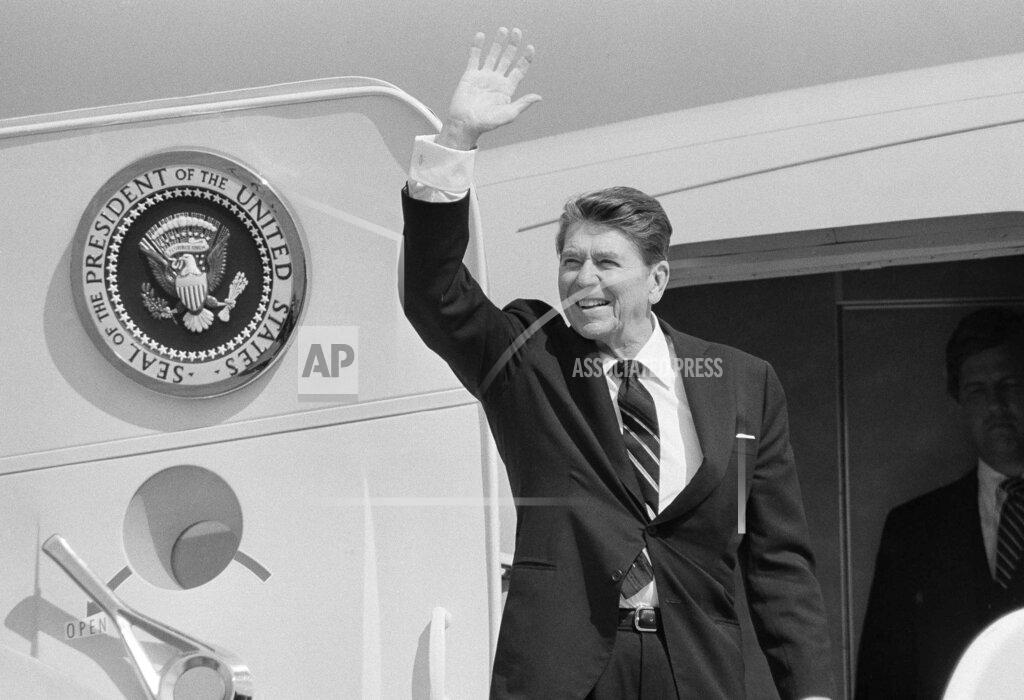
President Reagan meets the First Lady at Rancho del Cielo.
Former Secretary of State Alexander M. Haig Jr. said today that President Reagan must reassess the people closest to him. Mr. Haig said such top White House advisers as James A. Baker and Michael K. Deaver were isolating Mr. Reagan and concentrating more on what made him popular rather than what was right for the country. Mr. Haig was interviewed on ABC News’s “Good Morning America” program to discuss his new book, “Caveat.” Mr. Reagan is a good President, Mr. Haig said, but he added: “Like all Presidents, he must constantly reassess. He must be sure he has the best people around him.”
Colorado today filed a suit to stop deployment of MX missiles, arguing that the project would affect the state’s environment even though the missiles were to be placed in Wyoming and Nebraska. Governor Richard D. Lamm’s office issued a statement saying the Air Force had “refused to hear or consider Colorado’s concerns or to hold hearings in Colorado on the effects of the MX.” Governor Lamm was on vacation in the Caribbean, but in the statement, he said he believed the Air Force had “violated Congress’s mandate to prepare a full environmental impact statement because of the absurd assumption that the siting of MX missiles just across Colorado’s border would have virtually no effect on Colorado.” Air Force officials have said that hearings conducted in Wyoming and Nebraska were in accordance with Federal law, and that no hearings were necessary in Colorado.
Richard Helms, a former Director of Central Intelligence, does not have to submit to questioning on videotape for the CBS network’s defense in a lawsuit brought by General William C. Westmoreland, retired, a federal district judge ruled today. Judge Thomas Penfield Jackson also said the Central Intelligence Agency did not have to produce a report done by its Office of the Inspector General and Review Board in their investigation of alleged intelligence failures in Vietnam in 1960’s, which General Westmoreland and CBS both sought. Judge Jackson said, too, that the agency did not have to give CBS a “draft history” of Mr. Helms’s tenure as Director from June 1966 through February 1977.
General Westmoreland, former commander of United States forces in Vietnam, has filed a $120 million libel suit in a Federal District Court in New York City against CBS Inc. for its documentary, “The Uncounted Enemy: A Vietnam Deception,” which was broadcast on January 23, 1982. In the 90-minute documentary, CBS News said United States military leaders had purposely underestimated enemy troop strength in Vietnam to present a rosier picture of the war. General Westmoreland called the program “vicious, false and contemptible.”
A spokesman for 32 struck Las Vegas hotel-casinos said today that further talks with union leaders might be “pointless” after a 12-hour session failed to end a three-week-old walkout. Occupancy continued to drop at many struck resorts as the city headed into the Easter weekend. Some major resorts reported weekend bookings of 80 percent to 90 percent, as against sellouts on normal weekends. The bleak outlook followed a 12-hour bargaining session Thursday, the first long talks since 17,000 members of four unions walked out April 2. The talks opened with a hotel spokesman promising new proposals to “excite everyone” and ended with union leaders saying hotels were “stonewalling” the negotiations. The spokesman, Vince Helm, executive director of the Nevada Resort Association, said no decision had been made on whether to resume talks.
A tractor-trailer rig loaded with liquefied petroleum gas smashed into a freight train near Westville, Indiana today and exploded, killing the truck driver and injuring seven others, the authorities said. The authorities said that 12 railroad cars had been derailed, including several that caught fire, and tracks in both directions had been torn up. The Grand Trunk Railroad line in the area, as well as a stretch of U.S. 241, were closed for repairs. The dead man, Kenneth Yoder, 50 years old, of Elkhart, drove his rig around a line of vehicles waiting for a passing train at the fog-shrouded crossing on U.S. 241 in the tiny town of Haskell Heights, two miles south of Westville in northwestern Indiana, the police said. His truck rolled into the side of the train, exploding and sending a shower of flames down on at least five other vehicles waiting in line at the crossing.
The estate left by Christopher Wilder, a suspect in sex-slayings who was shot to death a week ago after a cross-country crime spree, has been estimated to be worth as much as $1.8 million. Internal Revenue Service investigators made the estimate when they attempted to freeze his assets after he disappeared March 16 from his Boynton Beach home, The Miami Herald reported. Mr. Wilder’s will was admitted to probate Thursday by a Palm Beach County judge. Mr. Wilder was killed April 13 in a struggle with state troopers in rural Colebrook, N.H., after an 8,000-mile cross-country trip of terror. The Federal Bureau of Investigation reported that Mr. Wilder was linked with the murders or abductions of at least 11 women, four of whom were still missing.
In a tape recording played today at his drug trafficking trial, John Z. DeLorean was heard telling an undercover agent that he no longer had the money he needed to buy into a multimillion-dollar drug deal. Defense attorneys asserted he was telling the agent to “get lost.” On the tape, Mr. DeLorean also named his purported contact in the Irish Republican Army. Mr. DeLorean’s attorney said after today’s session that the person he named, Robin Bailie, was not an I.R.A. operative at all but rather a Protestant member of Parliament from Northern Ireland with an anti-I.R.A. record. The attorney said his client had merely been tricking the agent.
The taped meeting occurred September 15, 1982, between Mr. DeLorean, head of the financially failing DeLorean Motor Company, and Benedict J. Tisa, an agent of the Federal Bureau of Investigation who was posing as a dishonest banker who could help Mr. DeLorean get money for the auto company. Today was the third day of testimony in the trial of Mr. DeLorean, who is charged with conspiring to distribute $24 million worth of cocaine.
Change is coming to Silicon Valley. People are beginning to worry about pollution and crime and the loss of manufacturing jobs. But analysts say that while other areas are serious rivals as electronics and computer centers, the 25-mile-strip of California is likely to keep its preeminence as a research and corporate headquarters.
Prospective developers of land owned by the Federal Government have won the support of the Reagan Administration in a contest with preservationists. For the moment, the contest for control of the acreage managed by the Bureau of Land Management is at a standoff, but a recent inspection of lands in several Western states indicates that Administration policies are already changing the landscape in some places.
Congress changed its drug supplier in 1982 to ensure that the medication records of its members remained secret. The Navy had supplied Congress with drugs and was required by law to divulge the drugs it sold until Congress changed to commercial drug suppliers two years ago, according to court records. Commercial suppliers are not required to divulge their sales. Government lawyers said Congress made the change to ensure the confidentiality of the medical care provided for Congressmen.
Samuel F. Hinkle, the Hershey company’s chief chemist, died Thursday in Hershey, Pennsylvania. He was a key figure in the development of Hershey’s Syrup, Krackel, Mr. Goodbar and the nutritionally fortified chocolate bars known as K, C and D rations issued to American troops in World War II. He was 83 years old.
The Angels use 3 consecutive doubles and a single to score 4 runs in the top of the 13th to beat the host Blue Jays, 10–6. The Angels collect 20 hits in the game. Lloyd Moseby has a 6th inning grand slam for the Jays.
Born:
Anthony Fasano, NFL tight end (Dallas Cowboys, Miami Dolphins, Kansas City Chiefs, Tennessee Titans), in Verona, New Jersey.
Tyson Griffin, American mixed martial artist (UFC Fight of the Night x 5; Fight of the Year 2007), in Sacramento, California.
Jamie Hunt, Canadian NHL defenseman (Washington Capitals), in Calgary, Alberta, Canada.
Died:
Mabel Mercer, 84, British jazz and cabaret singer whose style and phrasing influenced Frank Sinatra (“Fly Me to the Moon”).


 History Diaries