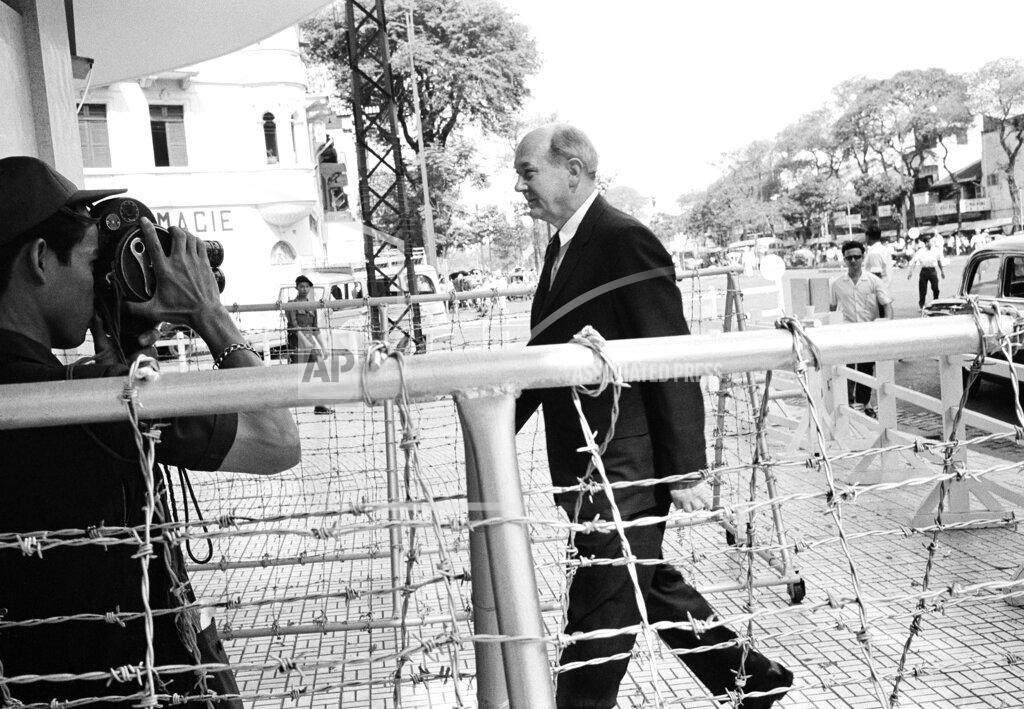
In Laos, the coalition government of Prince Souvanna Phouma was deposed by a right-wing military group, led by Brigadier General Kouprasith Abhay. Souvanna and other cabinet members were placed under house arrest, and the Geneva Accords that had kept an uneasy peace with the left-wing Pathet Lao were on the verge of collapsing while U.S. Ambassador to Laos Leonard S. Unger was out of town. Unger rushed back to the Laotian capital of Vientiane and rushed to Souvanna’s residence where, as one historian would later note, a “‘Romeo and Juliet’ scene took place, as Souvanna Phouma stood at a balcony on the second floor and expressed his desire to discontinue premiership, while Ambassador Unger stood on the ground begging him to continue to head the government.” Assured of U.S. support for his government, Souvanna resumed his duties as Prime Minister and would remain Prime Minister in office until 1975.
The United States moved swiftly today to organize opposition to the military junta that seized power in Laos. The Administration won quick support from London and Paris for an effort to reinstate the neutralist Premier, Prince Souvanna Phouma, and thus to head off civil warfare between right‐wing forces and the pro-Communist Pathet Lao. Initial moves toward that end were diplomatic and verbal, but economic and even military pressure was under consideration. There was not enough information here this evening to appraise the West’s chances of overturning the coup d’état.
Much depended on the unexplained role of the principal right‐wing leader, General Phoumi Nosavan, a Deputy Premier in the ousted neutralist government. His home in Vientiane, the capital of Laos, was said to be surrounded by guards. No one was sure which way their guns were pointed. General Phoumi Nosavan was silent or silenced during the first day of the coup. President Johnson reviewed the situation at an unscheduled White House meeting this morning with Secretary of Defense Robert S. McNamara and Under Secretary of State George W. Ball. They left early direction of diplomatic efforts to Secretary of State Dean Rusk, who has been visiting South Vietnam.
Việt Cộng guerrillas strike in four provinces, in one place within 14 miles of Saigon, but the South Vietnam forces halt their advance. Communist guerrillas struck boldly within 14 miles of Saigon today while Secretary of State Dean Rusk conferred with officials on the course of the war in South Vietnam. Two Việt Cộng companies attacked an outpost on the capital’s outskirts with mortars and heavy weapons. It was one of a series of attacks apparently launched to throw the government forces off balance in four provinces south of here. Mr. Rusk left for Washington today with a promise to the South Vietnamese people that the United States would remain at their side until Communist aggression was rooted out.
The first hint of trouble yesterday came when five outposts around Ba Tri in the Mekong River Delta province of Kien Hoa reported that they were under heavy Việt Cộng attack. Later, a Communist company slipped to within 800 yards of a United States military compound at Mỹ Tho, a city 50 miles southwest of Saigon. Another company then launched an attack against the Tân Hòa post on the main highway between Saigon and Cần Thơ. Cần Thơ is about 100 miles southwest of Saigon. The attack in Saigon’s outskirts followed these.
At all points government forces quickly assembled to meet the Communist attacks and halted their advances by nightfall. Officials said a handful of South Vietnamese troops had been killed in the attacks and several others had been wounded. The officials said several Việt Cộng troops were killed. The South Vietnamese met the attacks with heavy firepower. Along a highway running south of Saigon, artillery units were firing into the countryside. At the United States compound at Mỹ Tho, firing was heard nearby and a helicopter took off to fire rockets into the suspected Việt Cộng position.
American advisers in Mỹ Tho said the Communist attacks might indicate a build‐up in fighting as May Day, the international labor holiday, nears. Some advisers felt that there may have been some general coordination of attacks. Certainly, simultaneous attacks on five outposts at the tip of Kiến Hòa were coordinated, the advisers said. United States advisers said they were pleased with the way the South Vietnamese had met the attacks. “We are fighting night and day now, but that’s because we are getting fast to where the Việt Cộng are,” one adviser said. “A year ago, half of those posts would have fallen. Today none of them did.” Most advisers expressed surprise at the increasing numbers of Việt Cộng attacks in daylight, when they are most vulnerable
Mr. Rusk, in a parting statement at the airport, said he had discussed with Premier Nguyễn Khánh various ways in which American aid to Saigon might be strengthened. During his three‐day visit the Secretary was briefed by top United States and Vietnamese officials. Tight security covered Mr. Rusk’s departure. The airport area was cleared and no unauthorized civilians were permitted inside. A large red and yellow banner across the airport entrance said: “So long Secretary Rusk. Please tell the American people we shall not give.” He said his visit had been “most interesting and heartwarming.” “I am very much impressed by the military, economic and social programs instituted by General Khánh,” he said.
Pursuit of the war against the Communist Việt Cộng faces the basic obstruction of inertia and low motivation of the South Vietnamese Army, in the judgment of American military advisers. These advisers believe that no amount of aid or social and economic planning can inspire an army to do its job against highly purposeful insurgents unless there is a will to win, or at least a will to fight. Dozens of American advisers to Vietnamese field units were interviewed in recent weeks in different parts of South Vietnam. Theirs is the view of the war as it is actually being fought.
They report isolated improvements of morale where the government has implemented reforms, such as pay raises for certain units and new uniforms for the paramilitary forces. But old abuses — promotions too often granted for political reasons, discipline and punishment applied erratically — remain to sap the army’s spirit. These criticisms find echoes in high official quarters, both American and Vietnamese. In his two and a half months in power the Premier, Major General Nguyễn Khánh, has shown that he is fully aware of the problem.
The Greek and Turkish Cypriots agreed today to permit the United Nations peace‐keeping force to neutralize a sensitive contested area along the truce line west of the old walled city in Nicosia. The area includes the Ledra Palace Hotel, the United Nations force’s headquarters and the British High Commission. The agreement will go into effect Tuesday. It was the second time that the United Nations had succeeded in neutralizing a contested area since the peace force became operational March 27. The first involved a ridge overlooking the fortified Turkish Cypriote village of Kokkina on the Tylliria area of northwest Cyprus.
Under today’s accord, all Greek and Turkish Cypriote positions in the one‐square‐mile area. will be removed except two official police stations, both of which are under Greek Cypriote control. Although the positions involved were not enumerated, it appeared that considerably more Turkish Cypriote than Greek Cypriote fortifications would have to be dismantled. Yesterday, after a visit to the area, Archbishop Makarios, President of Cyprus, ordered one Greek Cypriote gun post in front of the hotel removed. The sandbag post had been erected the day before despite efforts of British troops in the United Nations force to prevent it. Today’s agreement authorized United Nations troops to take over the vacated positions or to establish new ones for their own use. They will also be responsible for preventing, by force, if necessary, the erection of new Cypriote positions or the attack or advance of armed Cypriotes into the neutralized area.
Officials of the Johnson Administration expect the last large group of Soviet troops in Cuba to be withdrawn in two or three weeks. The number to leave is authoritatively estimated at 3,000 officers and men. The withdrawal, officials here understand, will leave in Cuba only a Soviet military mission with advisory and training duties. This will number several hundred officers and men, perhaps 600 to 800. The Soviet forces have been reduced slowly in 18 months from an estimated strength of 22,000 at the time of the nuclear missile crisis in October, 1962. While cutting back their own forces, the Russians have steadily built up Premier Fidel Castro’s military power. One of the final acts of the Soviet troop commands in Cuba, officials understand, will be to turn over to the Castro forces the operation of 24 anti-aircraft missile bases.
The bazaars of Damascus went on strike today to protest against socialism in Syria and to support the rebellion that broke out last Wednesday in the city of Hama. Hundreds of merchants, disgruntled over business restrictions and repeated declarations by the Baathist regime that Syria would become a democratic socialist state, put up the shutters on their shops. The capital was quiet and the entire business section was deserted. Tanks and the barbed wire that have ringed military headquarters here since last summer are still in position, but no troops were seen in strength and there were few signs of tension.
Members of the rightist Muslim Brotherhood put pressure on small shopkeepers to protest the army’s fight against the rebels in Hama, 130 miles to the north. Security forces there have been trying to end the insurrection led by the Muslim Brotherhood and what the government called “reactionaries and feudalists” opposing land reform and socialist measures. The Baghdad radio, broadcasting from neighboring Iraq, where the government opposes the Syrian regime, declared that strikes had been proclaimed in other cities and that Syrian planes had bombarded the city of Abu Kemal in northeastern Syria, near the Iraqi frontier.
The Dutch royal family will not attend the wedding of Queen Juliana’s 24-year‐old daughter, Princess Irene, to a Spanish Prince, Carlos Hugo of Bourbon‐Parma. The Prince’s parents, Prince Xavier of Bourbon‐Parma and Princess Madeleine, announced in Paris today that the wedding would take place in Rome on April 29. A spokesman for Queen Juliana issued a communiqué tonight stating that the royal family had declined an invitation. Prince Xavier informed the Queen of plans for the ceremony this afternoon.
Annual defense spending of more than $50 billion will not go down appreciably in the next five years, according to authoritative estimates at the Pentagon. This predicted trend runs contrary to recent hints of cutbacks in spending, which have prompted speculation on the defense industry’s conversion to production for peace and some concern over job losses, a high official said today. There may be a slight drop in military spending at the end of the next five years, the official went on, but this would not amount to more than 4 or 5 percent. The official said he was “nonplussed” by rumors and “forecasts” of a 25 per cent reduction in defense spending in the foreseeable future.
A sudden dramatic disarmament agreement with the Soviet Union could alter the prospect, but no such agreement is expected, the official pointed out. The budget for the fiscal year, starting next July 1, which is now before Congress, estimates military spending through June of 1965 at $51.2 billion. This is $1.1 billion less than estimates of military spending for the current fiscal year and marks the first decline since 1960, the last year of the Eisenhower Administration. The military spending level has risen since then from $42.8 billion a year to the $52.3 billion estimated for the current fiscal period, a peacetime record.
Administration officials have explained repeatedly that they have increased the military budget to accelerate the production and installation of nuclear‐armed, long‐range missiles on land and aboard submarines and to expand the capacity of the ground forces in limited warfare. They now believe they have reached the peak annual spending level required to maintain the armed forces. But, contrary to some expectations, a defense official stressed that the spending plans did not envisage a drastic reduction.
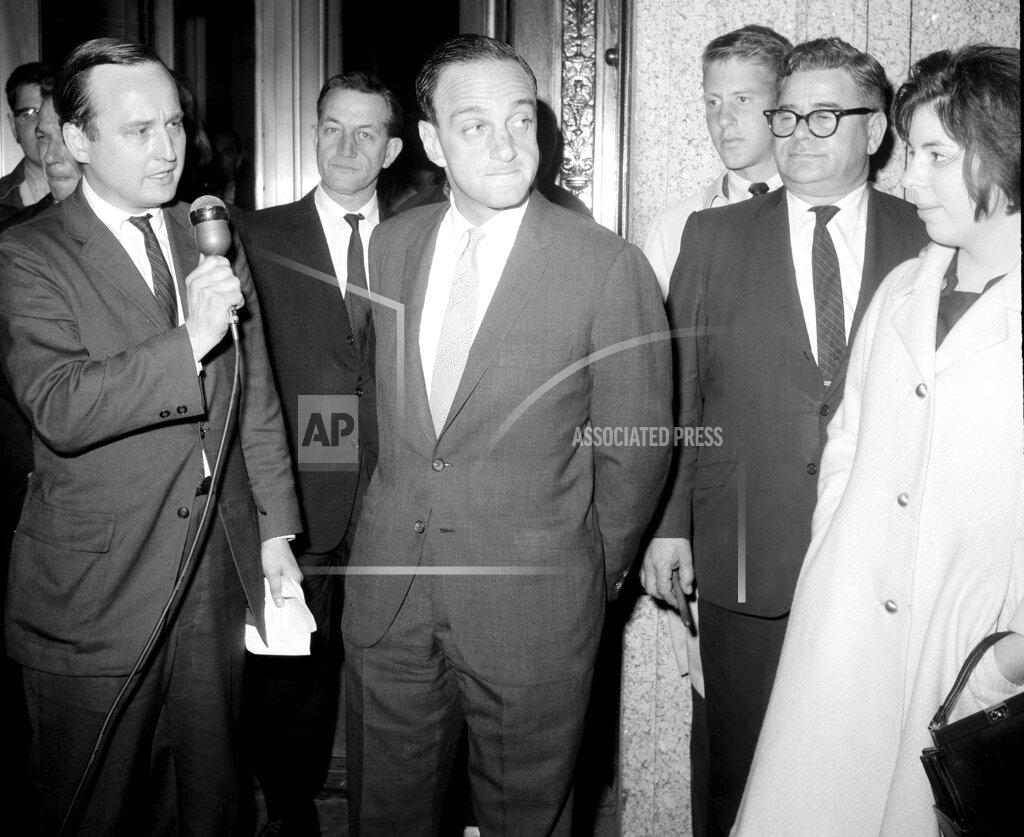
The perjury trial of Roy M. Cohn ended in a mistrial last night because of the death of a juror’s father. Federal Judge Archie O. Dawson declared a mistrial at 9:25 P.M. after the juror, Mrs. Arielle Mabrey, was told that her father, James Gaston, had died during the day. The motion for mistrial was made by Frank Raichle, lawyer for Mr. Cohn, who said that his client would not waive his constitutional right to a jury of 12 persons. United States Attorney Robert M. Morgenthau said last night that the Government would move for a new trial “as soon as possible.”
He noted that Judge Dawson’s decision to tell Mrs. Mabrey of her father’s death was a moral decision and was not based on legal precedent. He added that once Mrs. Mabrey was told of her father’s death, she could have chosen to remain on the jury, but instead had asked to go home. The case had gone to the jury Thursday morning. After four days of deliberation the jury had seemed near a verdict as it went to dinner last night. The jury’s foreman, Harold T. Bertha, of Pearl River, N. Y., a soft drink salesman, had told Judge Dawson: “We are making good progress.” But while the jury was at dinner, the Police Department called the Federal Building with news of the death.
A canvass of many of the country’s newspaper publishers yesterday indicated that most thought Senator Barry Goldwater would be displaced as the front‐runner for the Republican. Presidential nomination, leaving the race wide open. Most predictions were that the Senator’s delegates eventually would support former Vice President Richard M. Nixon. But President Johnson, who it is assumed will be the Democratic candidate, was widely reported to have greater strength than President Kennedy would have had. Concern about racial problems was expressed among executives arriving here for the city’s annual Press Week meetings. Marshall Field Jr., publisher of The Chicago Sun-Times, said he had “a sort of awesome feeling that the wrong type of leadership is starting to take over in the Negro movement, a more radical type of leadership that could lead to chaos and bloodshed.”
Civil rights leaders have made plans to tie up rail as well as road traffic on Wednesday, the opening day of the New York World’s Fair. They will also try to snarl ticket lines at the fair’s main gate, at the Willets Point Boulevard station of the IRT Flushing line. The civil rights leaders plan to deploy “nonviolent combat teams” on all bridges, tunnels, and parkways and on subways and Long Island Rail Road trains. Sit‐ins, lie‐ins and other types of demonstrations are planned for the Tri-borough Bridge, the Bronx‐Whitestone Bridge, Queensborough Bridge, Queens-Midtown Tunnel, Cross‐Bronx Expressway, Grand Central Parkway, Belt Parkway, Interboro Parkway, Brooklyn‐Queens Expressway and Van Wyck Expressway. Drawings showing the location of emergency cords and braking devices on IRT Flushing line trains were given to team captains. Key stations were also selected as picketing sites.
The new tactics were drawn up secretly Friday at a meeting of leaders of the Brooklyn, Bronx and Manhattan chapters of the Congress of Racial Equality. A CORE spokesman said details had been purposely kept from most members because a leak to the police and other law enforcement authorities was feared. The spokesman said the new tactics were necessary because many persons who wanted to assist in a massive traffic tie‐up did not own automobiles. “We have hundreds of foot soldiers who would like to participate,” the spokesman said, “and we must find something for them to do.”
Governor Rockefeller proposed today revising the Social Security system and increasing its payments. The New York Governor led into his statement by noting that his opponent in the California Presidential primary, Senator Barry Goldwater, has urged that the Social Security program be made voluntary. “That would bankrupt the system,” Governor Rockefeller said. “I strongly oppose making Social Security voluntary as does everyone who has studied the matter.”
Senator Clifford P. Case, Republican of New Jersey, cautioned today against weakening the civil rights bill in the hope of increasing its changes of passing the Senate. He said he and other liberals might turn against the measure if too much of it were sacrificed. He specifically opposed the elimination or serious weakening of Title VII, forbidding discrimination in employment by unions or management. Mr. Case’s words seemed to be directed at the Republican leader in the Senate, Everett McKinley Dirksen of Illinois. Senator Dirksen has put forward a group of amendments to Title VII that he believes would make it more acceptable to Republican conservatives.
Security arrangements for President Johnson’s visit to the World’s Fair on opening day on Wednesday have been complicated by threats of civil rights demonstrations. It was learned yesterday that at least 1,000 New York policemen would be deployed inside the fairgrounds during the President’s appearance at the formal inauguration ceremonies. They will supplement the fair’s private police force of 836 men and women. In addition, a sizable contingent of Secret Service officers will guard the Singer Bowl, where Mr. Johnson is scheduled to address fair officials and 16,000 specially invited guests.
Roger Sessions’ opera “Montezuma” premieres in West Berlin, Germany.
One day after Koufax fans the side on 9 pitches, Bob Bruce strikes out the Cardinals in order on 9 pitches in the 8th inning of a 6-1 Houston loss. Bob Gibson is the winner allowing 4 hits and striking out 8.
Born:
Harris Barton, NFL tackle (Super Bowl 1988, 1989, 1994; All-Pro 1992, 1993; Pro Bowl 1993; San Francisco 49ers), in Atlanta, Georgia.
Scott Kamienicki, MLB pitcher (New York Yankees, Baltimore Orioles, Cleveland Indians, Atlanta Braves), in Mount Clemens, Michigan.
Luc Gauthier, Canadian NHL defenseman (Montreal Canadiens), in Longueuil, Quebec, Canada.
Dr. Kimberly A. Weaver, American astrophysics astronomer and professor, in Morgantown, West Virginia.




 History Diaries