Syria and Israel fought their first air battle over the Golan Heights front since the October war. Artillery duels continued on the ground for the 39th day. Both sides sent planes on bombing runs. The Syrian command reported that one of its planes was lost today. The Syrians said seven Israeli jets were downed in dogfights and 10 others by antiaircraft fire. In Tel Aviv, the Israeli command said two of its jets Were lost to Syrian antiaircraft fire while on bombing raids in the Mount Hermon area and other parts of the front. It said Israeli planes shot down two Syrian jets.
The air battle today appeared to mark further intensification in military action on the Syrian front in advance of Secretary of State Kissinger’s next peace Mission to the Middle East. He is due to arrive, in a week to 10 days to continue his efforts to obtain a separation of Israeli and Syrian forces. A Syrian military spokesman said the air battle erupted late in the afternoon as some 50 Israeli fighters and fighter-bombers sought to penetrate Syrian air space. He did not say how many Syrian planes were involved in the action, which reportedly was centered over the Mount Hermon area and southern Lebanon. According to the spokesman, 10 Israeli planes were downed by antiaircraft fire earlier in the day. One of them was said to be a pilotless drone craft.
Defense Minister Moshe Dayan said today that Secretary of State Kissinger might encounter a full‐scale war if the Syrians continue to increase the fighting in the Golan Heights area. In an interview on Israeli television, Mr. Dayan said Israel would continue to reply in kind to Syrian attacks but would not herself step up the fighting. The two jets that Israel reported losing today were the first officially announced losses. Syria has reported downing 25 Israeli planes since the struggle for Mount Hermon began nine days ago. Israeli leaders believe Syria wants to gain control of Mount Hermon before Secretary Kissinger arrives.
Four Israeli soldiers were reported wounded today on the Golan Heights front. An Israeli spokesman also reported eight Israeli airmen were killed in collision of two army helicopters while they were trying to land at a Galilee airfield today. The Israeli spokesman said Israeli planes today struck at Syrian positions on the northern flank of one of Mount Hermon’s three highest peaks. Israel says her forces hold the three peaks. The spokesman said Israeli planes also struck at Syrian positions at the southern end of the salient Israel seized in October. All eight Israeli Defense Force members on a Sikorsky CH-53 Sea Stallion helicopter were killed when it collided with another CH-53 over an airport in Rosh Pinna, a town located near the Golan Heights and the border with Syria. The other helicopter was able to land safely.
A senior American official said that while the United States was interested in President Anwar Sadat’s stated intention to end Egypt’s total reliance on Soviet arms, Washington had no current plans to begin selling military equipment to Cairo. Privately, officials in Washington said that Mr. Sadat’s statement fortified Washington’s view that Egypt was seeking to play a more independent role in world affairs and to build closer ties with the West to end its dependence on Soviet help.
The Egyptian prosecutor general said today that 11 persons were killed and 27 others injured when a group including students and leftists attacked the Egyptian Military Technical College here yesterday. The prosecutor said that the group of about 20 had broken into the college with guns firing. Guards and cadets of the college fought the intruders, and in the gun battle six guards, one cadet, one of the attacking students and three unidentified civilians were killed. The prosecutor general said in a statement that the alleged leader of the group visited Libya last year at the invitation of the Libyan Government “to discuss the formation of resistance units in Arab countries and to organize their financing.”
Leaders of the seven Communist nations comprising the Warsaw Pact organization have gone home after a two‐day meeting at which they declared themselves ready to continue seeking peace while remaining militarily vigilant. The meeting of the organization’s political committee included not only two days of general deliberations, but also two‐way talks between most of the East European Communist party chiefs and Leonid I. Brezhnev, head of the Soviet Communist party. The communiqué issued last night after the final toasts at a dinner was couched in conciliatory language and nowhere mentioned or attacked the United States.
The meeting, the first in more than two years, appeared intended to set a collective seal on policies of improving relations with the west that have been pursued during that time by the Soviet Union. The program and discussions of the meeting were presumably worked out in advance so as to cause no surprises to any participants. People in the Polish capital showed little interest in the sessions at the flag‐decked Council of Ministers Building. There were no announcements or motorcades and no public functions connected with the conference, so few Poles saw any of the Communist luminaries except on television screens.
Political commentators in the Communist press said that they felt the communiqué should be read as an optimistic document that pointed to some remaining problems in achieving détente but that basically approved the present course of international negotiations. The communiqué said that the Warsaw Pact organization was created as a counterforce to the “aggressive” North Atlantic Treaty Organization, and was ready to dissolve itself simultaneously with the dissolution of NATO. Meanwhile, “military security in Eastern Europe must be maintained,” it added.
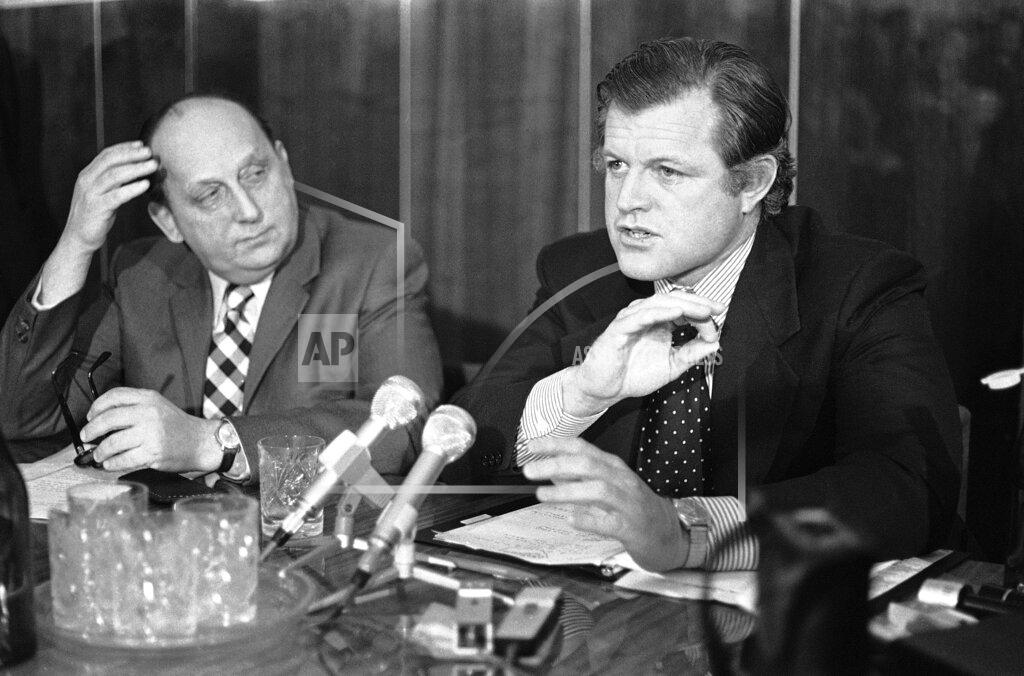
Senator Edward M. Kennedy called upon the Soviet leadership today to explain the implications of the latest testing and deployment of sophisticated nuclear missiles. “Today, without announcement, the Soviet Government is building new missiles and testing still others,” the Massachusetts Democrat said, addressing a select audience at the U.S.A. Institute, which does research on the United States for the Soviet Government. “What does this mean? Does it mean preparations for the next round of arms competition? Or does it merely represent the momentum of research, pursued without intention to deploy?”
“In the United States we would be greatly aided in assessing Soviet developments that do not threaten us if we could hear clear and public statements of your intentions,” said the Senator who arrived yesterday. Mr. Kennedy, reflecting wariness among the Democrats in Congress over Moscow’s nuclear arms build‐up, also proposed that the United States and the Soviet Union agree to halt underground nuclear testing the only category not covered by the present test‐ban treaty. When Senator Kennedy tried to draw his audience into a public dialogue on the merits of his proposals, it met his remarks — among the strongest delivered publicly on the arms topic by an American visitor — with polite but apparent skepticism.
The two major Gaullist candidates for the French presidency went before the nation Friday, each warning voters against electing leftwing candidate Francois Mitterrand. Finance Minister Valery Giscard d’Estaing and former Prime Minister Jacques Chaban Delmas made seven-minute television talks on the first evening of official campaigning. “French policies must adapt to change,” Giscard d’Estaing said. “Frenchmen know this but they worry about the consequences of change. That’s why I propose to you change without the risk.”
The government of Sri Lanka, led by Prime Minister Sirimavo Bandaranaike closed down 13 newspapers in the Asian nation under the Emergency Defence Regulations, after their editors had criticized the government. Shut down until further notice were Chinthamani, Dawasa, Dinapathi, Gitanjali, Iranama, Rasakatha, Riviresa, Sawasa, Sundari, The Sun, Thanthi, Tikiri, and Visitura, all printed in Colombo. Most of the papers would remain closed for almost three years.
The 23-nation Organization of American States began its general assembly in Atlanta, Georgia today with Secretary of State Kissinger calling for progress toward “new horizons” of hemisphere cooperation and understanding. In his brief opening remarks in the Chamber of Georgia’s House of Representatives, Mr. Kissinger noted that the session to last until the end of the month, was the first in any United States city other than Washington.
In his opening address, Foreign Minister Alberto J. Vignes of Argentina alluded to Cuba, which has been excluded from the O.A.S. since 1962. Noting eased tensions in the world, he said: “In the search for a new international equilibrium no nation may be left on the sidelines and Latin America is ready to carry forward a policy of clear, effective and immovable solidarity which will allow achievement of a new order in international relations.”
Argentina is a principal proponent of moves to invite Cuba to attend an informal hemisphere foreign ministers meeting in Buenos Aires next March as a step toward ending Havana’s isolation. This proposal, made at such a foreign ministers’ meeting in Washington yesterday, was not opposed by the United States, which said other countries involved should be polled for their view. However, United States officials said they did not expect Cuba to win enough backing to get an invitation to Buenos Aires.
A military court today rejected a challenge from defense attorneys that it had no authority to try 57 Air Force men and 10 civilians charged with aiding Marxist parties and with sedition. The attorneys maintained that the Chilean Constitution and military code of justice empowered military courts to try individuals for crimes committed only after a state of siege has been put into effect. A state of siege has existed in Chile since the military coup that overthrew the Marxist coalition Government last September 11, but all 67 defendants are charged with acts committed months earlier.
In rejecting the challenge, the court did not specifically take up this point, but asserted that both the Constitution and the military code of justice provided ample powers to military courts in time of war or during a state of siege. Military courts have tried hundreds, of civilians in the last few months and continue to operate throughout the country. But the air force court‐martial, in which six defendants face death sentences and the rest prison terms ranging from 18 months to life, is the first to try military officials since the coup. It is also the only one that has been open to both the national and international press and to foreign legal observers.
Canadian postal services were brought to a virtual standstill today by union members protesting the effects of automation on job classification and pay. The postal dispute is part of the spreading industrial unrest that has also disrupted national air travel and ship traffic on the St. Lawrence Seaway. Walkouts, sit‐ins and slowdowns have halted or seriously hampered postal services in key cities. The trouble began in Montreal last week, when officials suspended 20 workers who wore T‐shirts that urged a boycott of the automated postal‐code system, the Canadian equivalent of the American zip code.
A survey by the New York Times indicates that many foreign leaders now believe that President Nixon will have to leave office because of his Watergate-related problems. This marks a significant switch in attitudes since last year when Mr. Nixon was believed likely to ride out the political storm.
A Federal judge ordered the Watergate special prosecutor today to give him and the defendants in the Ellsberg break‐in case any evidence the prosecutor might have about President Nixon’s possible personal involvement. District Judge Gerhard A. Gesell ordered Leon Jaworski, the prosecutor, to respond by April 29 on the question wheeler Mr. Nixon might have authorized or known in advance of the burglary attempt at the office of Daniel Ellsberg’s former psychiatrist. Six members of the White House “plumbers” investigative unit were indicted last month on charges of conspiring, to violate the civil rights of the psychiatrist, Dr. Lewis J. Fielding. Three other persons were named an unindicted co-conspirators.
Judge Gesell noted that Charles W. Colson, the former White House special counsel who is one of the defendants, has contended that the 1971 break‐in was justified because it was “authorized by the President pursuant to his power to protect national security.” Judge Gesell ordered Mr. Jaworski to provide the following:
Any “instructions” from Mr. Nixon to any of the defendants or unindicted co-conspirators relating to the secret White House investigation of Dr. Ellsberg.
Any transcripts of tapes “containing all instructions” by the President to members of the plumbers team.
Any press releases or other statements by Mr. Nixon subsequent to the break‐in relating the “authority or lack of authority” for the raid.
A statement of any information known about the “amount and source about of any funds or materials” given the burglary team.
Judge Gesell said that Mr. Jaworski would not he asked to divulge any further “national security” evidence unless the court later decided it was necessary. The material requested today would be delivered under seal and made available to defense lawyers in Mr. Jaworski’s office, he said.
A group of college‐age militants barricaded themselves inside the Statue of Liberty at closing time yesterday in a protest against the Nixon Administration. The youths, identifying themselves as members of the Attica Brigade, a student movement, said they would remain overnight “to demonstrate the import, of having President Nixon removed from office.” Early this morning officials of the Parks Service said they were seeking a federal judge to issue an injunction ordering the demonstrators to leave the statue. A spokesman explained that could not be removed forcibly without such an order, but it was not known when it would be obtained.
Common Cause urged today that the Senate hold an open, televised trial of President Nixon if the House votes to impeach him. The national citizens’ lobbying group also called for Senate rules to avoid heavy political pressure in such a trial. It declared the issues should be decided on evidence brought before the Senate and not on what was described as “naked partisan pressure” applied to the Senators in their lobbies and offices. John W. Gardner, chairman of Common Cause, and the group’s national staff presented their position today at an emergency session of the board of governors of the 323,000‐member organization. Forty of the 60 governors took part in the meeting and endorsed the recommendation with only one dissenting vote.
The rapid rate of inflation of consumer prices continued in March, the Labor Department reported. The rise in the Consumer Price Index was 1.1 percent, both before and after adjustment for normal seasonal increases in some prices. While this was a shade less than in February — because food prices rose less rapidly — the March increase was still the third largest for a month in 25 years. From January to March, consumer price inflation in the first quarter of this year was at an annual rate of 14.5 percent, a rate that Arthur Burns, chairman of the Federal Reserve Board, recently termed a “Latin American kind of inflation.”
The defense rested in the Mitchell-Stans trial with Maurice Stans badly shaken and ashen faced, conceding that there were discrepancies between his grand jury and trial testimony. But in an emotional plea to the jury, he attributed the discrepancies to “my state of mind and anxiety over my wife’s (illness) condition.”
Randolph A. Hearst said today that he had proof that his daughter did not conspire in her kidnapping. A Federal Bureau of Investigation spokesman said, however, that the evidence cited by Mr. Hearst was not conclusive. Mr. Hearst used as his evidence a notebook that was found by the authorities in a headquarters of the self‐styled Symbionese Liberation Army last January 7. According to Mr. Hearst, the notebook mentioned “guns” and “action” against his 20‐year‐old daughter, Patricia, who at the time was a student at the University of California at Berkeley. Since the notebook was found almost a month before the kidnapping on February 4, Mr. Hearst was distressed that he had not been notified by the authorities. “If they knew her name was in the book and knew it was an S.L.A. hideout, of course they should have notified us,” he said. Mr. Hearst, chairman of the board of the Hearst Corporation and editor and president of the San Francisco Examiner, said that if he had been notified by the authorities the kidnapping might have been prevented.
The dispute over the police procedure of stopping and searching young black men in San Francisco in an investigation of at least 12 murders intensified today. Police officers began handing out identification cards that were in effect passes for those they had examined and released in the search for the killers of the 12 white persons. The Rev. Cecil Williams, pastor of Glide Memorial Church, who is a liberal black spokesman, said he feared racial war might begin because, he contended, “the black community is under a police state.” A vicious murder was committed today by a black man who was said to have maintained he was the mass killer. But investigators doubted the assertion, which was made to a woman he raped. A group of young black men picketed briefly at City Hall this morning but had left by early afternoon.
The television networks next fall will cut back on programs that deal with violence and stress series concerned with family life and personal relationships. This is evident from the new prime-time schedules for September disclosed by the National Broadcasting Company and CBS, Inc.
Restrictions on fetal research that have been instituted in the last few weeks are seriously impeding doctors in several medical centers in the United States in their efforts to develop potential cures and preventions for a wide variety of diseases. These curbs are now affecting research on cancer, birth defects, aging, the common cold and other major health problems, according to leading medical investigators.
While their parents are planning vacations closer to home this year, young Americans — undeterred by the abolition of special youth fares by international airlines — are still finding relatively inexpensive ways to go abroad this year, even though their transportation options will be less convenient and more expensive than they were last year.
TMI-1, the first of three units of the Three Mile Island Nuclear Generating Station near Harrisburg, Pennsylvania in the U.S., came online and would begin supplying electrical power on September 2. The second unit, TMI-2, would begin operating in late 1978 but become involved in a nuclear accident on March 28, 1979.
The Yankees obtain Walt ‘No Neck’ Williams and pitchers Ed Farmer and Rick Sawyer from the Tigers for catcher Gerry Moses. Moses had come to New York in the Graig Nettles trade.
Baltimore Oriole Al Bumbry hits an inside-the-park home run against the New York Yankees
Dow Jones Industrial Average: 859.90 (-10.02, -1.15%).
Born:
José Cruz, Puerto Rican MLB outfielder (Seattle Mariners, Toronto Blue Jays, San Francisco Giants, Tampa Bay Devil Rays, Arizona Diamondbacks, Boston Red Sox, Los Angeles Dodgers, San Diego Padres, Houston Astros), in Arroyo, Puerto Rico.
Dameyune Craig, NFL quarterback (Carolina Panthers), in Mobile, Alabama.
G. R. Indugopan, Indian Malayalam novelist; in Valathungal, Kerala state, India.
Akara Amarttayakul, Thai film actor; in Bangkok, Thailand.
Died:
General Ayub Khan, 66, President of Pakistan from 1958 to 1969.
Vinnie Taylor [stage name for Christopher H. Donald], 25, guitarist for the group Sha Na Na, was found in a motel at Charlottesville, Virginia, dead of an accidental heroin overdose, two days after a concert at the University of Virginia.
Major Stephen Price, 80, British Royal Air Force officer and flying ace in World War I.







 History Diaries