Prime Minister Neville Chamberlain was ready tonight to assure the House of Commons tomorrow that the British effort to organize a united front against Germany and Italy is proceeding satisfactorily. Ivan M. Maisky, the Soviet Ambassador, had a long talk today with Viscount Halifax, the Foreign Secretary. The Ambassador expects to leave for Moscow tomorrow.
There was no indication of the tenor of this talk and no indication of the progress made in the negotiations between Britain and Turkey. But it was gathered that both sets of negotiations — those with Russia and those with Turkey — were going on satisfactorily from the British point of view. Indeed, it is still hoped that the British guarantee to Greece may be followed up by a similar guarantee by Turkey. Turkey and her efforts in the Balkans seem to hold the key to the present diplomatic conversations with Russia, since, apparently, these have passed the stage of whether Russia will help build up the British wall against Germany and have reached the point of discussing how Russia can best help any threatened State.
Obviously, Turkey is most important to any cooperation between Russia and the Western powers, for she holds the Dardanelles, through which Russia’s wheat, oil and other commodities can come to the West. But Turkey holds an even more important position today because of her prestige in the Balkans and her influence with the other Balkan States. It is not beyond the bounds of possibility that the Prime Minister can meet the Commons tomorrow with an announcement that Turkey has backed up the British guarantee to Greece and Rumania with a similar statement. At any rate, the British note with satisfaction that Turkey is using all her diplomatic influence with the other Balkan nations. According to the British, Turkish influence could be exerted only to the advantage of their empire.
Britain and France reject a Soviet offer to form an anti-Nazi alliance. In response, Soviet Ambassador Alexei Merekalov calls on Ribbentrop’s chief subordinate, Baron von Weizacher and offers unmistakable signals that Russia is now willing to develop better relations with Germany.
Poland’s and Rumania’s attitude toward Russian participation in the system to prevent aggression now being constructed by Great Britain and France is understood to have been discussed this morning by Foreign Ministers Josef Beck and Grigore Gafencu in a meeting at Cracow on the train carrying M. Gafencu from Bucharest to Berlin. It is understood the same question was considered in conversations between Marshal Edward Rydz-Smigly and the Estonian commander-in-chief, General Johan Laidonner, who arrived here today.
The Polish view is that all countries between Russia and Germany from the Baltic to the Black Sea should decide on a common attitude toward the projected Anglo-Soviet pact. The Poles do not object to a tripartite agreement among Britain, France and Russia, but they deem it inadvisable to include countries of Eastern Europe whose borders are directly exposed to the German menace, since the Reich probably would look on such a coalition as hostile. They fear such action would bring war rather than prevent it.
Poland, however, opposes any military cooperation with Russia and declines to accept any obligations permitting her territory to be used for the passage of Russian troops. The Anglo-Polish guarantee, official in Poland’s view, must remain bilateral and must not lead to a system of collective security.
[Ed: By excluding Russia, Chamberlain has ensured that containment of Germany is impossible, whatever delusions he has about some broad alliance. The Poles do not trust the Soviets; and so, the die is cast.]
Germany sent out messages to 30 of the 31 countries named by U.S. President Roosevelt on 14 April 1939 (the exception being Poland), asking them whether they felt threatened by Germany. Many countries responded in the negative, while the others were coaxed into responding in the negative.
Chancellor Hitler decided to answer President Roosevelt’s peace message and convoked the Reichstag for April 28 to hear the reply. It was believed he would produce another of his sweeping worldwide revisionist programs. It was reported that in the meantime there might be some kind of demonstration of solidarity by the anti-Comintern powers.
At the other end of the Axis, the Italian press spoke of “hypocrisy” and “an outrage” in describing the President’s message, and war preparations were bolstered by an allotment for the army of an additional 500,000,000 lire a year for the next ten years. The Italian reply to President Roosevelt’s message began today with a concerted and wrathful blast from the entire press, which brands the message as everything from hypocrisy to an outrage. A formal answer will be sent directly to Washington from Rome and Berlin, probably in identical terms, and while it will undoubtedly be couched in more diplomatic phraseology, the essence will be equally firm and negative.
War preparations received a new impetus today with the publication in the Official Gazette of a decree authorizing an addition to the War Ministry’s allotment of 500,000,000 lire annually for the next ten years, beginning with the budget for 1938-39, [The lira was quoted in New York yesterday at 5.26 cents.] No doubt was left as to the state of emergency that is felt to exist, for the provision was made “in view of the urgent and absolute necessity of further measures for strengthening the wartime efficiency of the army.”
Only the future will tell whether the message by Mr. Roosevelt is going to have the desired effect, for there are two phases to an exchange of this nature. The present battle of words has carried the Roosevelt attack to public opinion, in particular in the totalitarian countries, but in general to the whole world. The counter-attack of the Italian and German press has the same objectives, yet behind the front lines it is realized that the battle is not over. The fact that American opinion has been so moved by recent developments that it has led the President to make so vigorous and pointed an attack has come as a profound shock to this country. That the world’s most powerful nation should come out so openly in opposition to any activity disturbing European peace obviously provides food for serious thought in totalitarian circles, and whatever words are being said now cannot disguise that fact.
But commendation of Mr. Roosevelt’s step continued to be received in Washington, where Secretary Hull declared that world opinion was mobilizing against war as a result of the President’s appeal.
Meanwhile Britain, persisting in her diplomatic efforts, hoped she would be able to announce military guarantees to Turkey today.
There was no relaxation of her precautions. As fourteen French warships took up stations at Gibraltar the British concentrated their naval units at Malta and in the Eastern Mediterranean
No detail was overlooked. It was disclosed that 80,000,000 ration cards had been prepared as part of a vast British food control plan for & war emergency. The ration cards, printed on special paper to prevent forgery, are under lock and key in various parts of Britain. They will be distributed as soon as the government imposes food control in wartime. The new plan for food control, picking up where Britain left off in 1918 after four years of bitter war experience, entrusts the direction of retail food supplies to 1,400 local committees, with whom shopkeepers will have to register. The government, acting through a wartime Ministry of Food, would be the sole importer and the sole purchaser from domestic producers. Wholesalers would get their supplies from the ministry and distribute them to retailers for sale to consumers at fixed prices.
Pope Pius XII hopes that Spain applies justice to crimes, but offers ‘kindness to those led astray.’
Four French warships arrive at Gibraltar while British speed defenses. Rumors of Spanish troop masses cause feverish activity.
President Roosevelt’s proposals to Chancellor Hitler and Premier Mussolini continued today to receive no press comment in Athens, favorable or otherwise, which is to say that the official attitude toward them has not yet been formulated. It is likely that other governments will have to be consulted before any announcement can be made. However, popular appreciation is obvious, and the proposals appear to have been welcomed heartily by all the people in a country that feels itself to be menaced. Today the Greek Government announced a kind of postscript to the story of the last few days of tension — a word of thanks to France for her guarantees, identical to those of Great Britain. An announcement of thanks to Britain was made on Saturday.
King Tut’s trumpets echo across the world. The soldier playing the trumpets from his tomb is broadcast on radio to the United States and Britain.
Three U.S. Senators of more than ordinary prestige aligned themselves today with the growing group fighting any form of intervention by the United States in the affairs of Europe.
Three floor speeches, delivered by the veteran Senators Walsh and Ashurst, Democratic chairmen respectively of the important Naval Affairs and Judiciary Committees, and Senator Barbour, Republican, expressed the deepest alarm lest public statements or acts involve this country before Congress has a chance to assert the popular will by means of a vote. To the general effect of their speeches was added a statement in similar vein by Senator Adams.
Senator Adams alone specifically mentioned President Roosevelt. He remarked that a “fear-torn world” awaits the answers of Hitler and Mussolini to the President’s message of last week, but he joined with the speakers by decrying “impetuous steps that could involve us in conflict.”
The foreign affairs debate, occupying the Senate for about an hour, during which time no spokesman arose to defend intervention, was clearly inspired by publication of the President’s appeal to the dictators, which became known only after the adjournment of Congress last week.
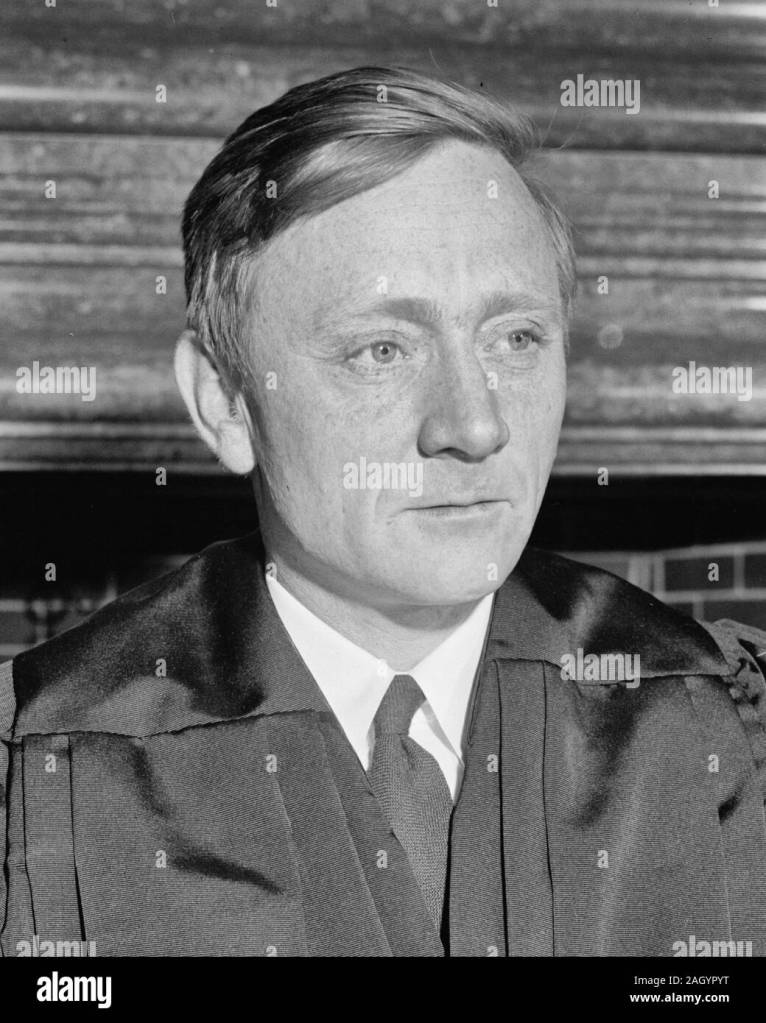
William O. Douglas begins his Supreme Court duties, following his swearing in today. William Orville Douglas, the youngest man in more than a century and a quarter to become a justice of the Supreme Court of the United States, took his seat in that tribunal today. His black leather chair was the furthest to the left of the Chief Justice, 77-year-old Charles Evans Hughes, who returned to preside for the first time since March 4, when he was stricken with the grippe. Crowds assembled in the ornate chamber and in the corridors, all eager to see the 40-year-old newcomer inducted. Soon before he appeared at the court’s $11,500,000 marble building the White House released correspondence in which President Roosevelt addressed Mr. Douglas as “Dear Bill.” The coming of Justice Douglas filled the nine-place bench for the first time since December 13, 1937, with the exception of one week just before Justice Brandeis retired. The long illness of Justice Cardozo left his chair vacant for many months.
The new Agricultural Adjustment Act, and with it the Administration’s theory of planned agriculture, won a sweeping victory in the Supreme Court today when that tribunal covered within the protection of the Constitution the marketing quotas applied to the tobacco crop of 1938.
The decision was by a six-to-two division, affirming a decree of a lower court in Georgia, with Justices Butler and McReynolds dissenting. By it the largely revised Supreme Court nullified the practical effects of the six-to-three decision in the Hoosac Mills case of January, 1936, by which it struck down the original Agricultural Adjustment Act on the ground that it aimed, through the employment of processing taxes, at control of production. Production, the court held then, was a local matter and not within the province of the Federal Government to regulate.
The ground upon which the practical reversal was made today was a distinction drawn by the court’s new majority between “production” and “marketing” — a distinction which the two dissenters refused to accept as valid. Even though the controls embodied in the new act were upon marketing, the aim was regulation of production, the dissenting justices held. “Mere inspection of the statute and Secretary’s regulations unmistakably disclose purpose to raise price by lessening production,” said the minority opinion, which was delivered by Justice Butler and concurred in by Justice McReynolds.
The majority opinion was written by Justice Roberts, who was the author of the decision that undid the original AAA in 1936. Today he upheld the government on all grounds raised by the attackers of the tobacco quota sections, in a case known as Mulford vs. Smith, in which the Administration had intervened.
Chief Justice Hughes, who concurred in the majority ruling which uprooted the old AAA, joined with the majority to uphold the new one today. The two other justices who participated in that previous adverse decision — Van Devanter and Sutherland — have since retired and have been replaced by Justices Black and Reed, who voted with today’s majority.
Past membership in the Communist party is not sufficient ground for deportation of an alien, and so Joseph G. Strecker, the Austrian-born restaurant keeper of Hot Springs, Arkansas, cannot be forced to leave the country, the Supreme Court ruled by a six-to-two division today. Speaking for the majority, Justice Roberts held that a 1918 law providing for deportation of non-naturalized aliens belonging to organizations advocating overthrow of this government by force or violence was inapplicable to Strecker.
Justice McReynolds, in a sharp dissent shared by Justice Butler, vigorously contended that the order of Secretary Perkins to deport Strecker should have been agreed to by the court. These two justices insisted that membership in the Communist party at any time was reason for deportation, and that a member should not be allowed to resign conveniently a day or a month before proceedings are brought against him.
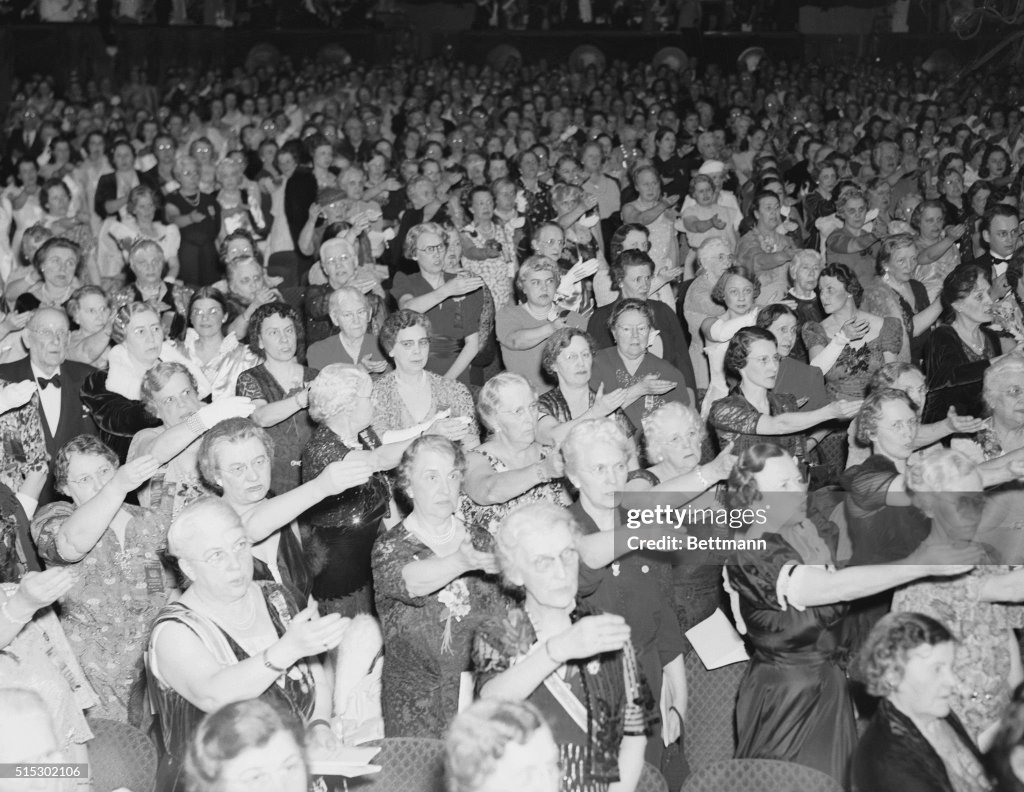
A group may picket the Daughters of the American Revolution’s 48th continental congress unless they begin renting their facilities to Blacks.
SN Behrman’s “No Time for Comedy” premieres in NYC.
The 43rd Boston Marathon is won by Ellison Brown in 2:28:51.8; it is his second victory in the event.
Opening Day of the 1939 major league baseball season took place. To celebrate the 100th anniversary of the mythical invention of baseball by Abner Doubleday, every major and minor league team wore a special centennial patch on their sleeves all season.
On the morning of Opening Day in Washington, DC, U.S. President Franklin D. Roosevelt and the New York Yankees visit Abner Doubleday’s grave at Arlington National Cemetery. Roosevelt is also scheduled to throw out the first pitch at Griffith Stadium, but the game is rained out and Vice President John Nance Garner will do the honors four days later when the team opens the season against the same opponents, but after the Bronx Bombers return from New York having played Boston to start their campaign.
The Reds drop their 7th Opener in a row, as the Pirates score 4 runs in the 8th for a 7-5 win. Frank McCormick homers for the Reds.
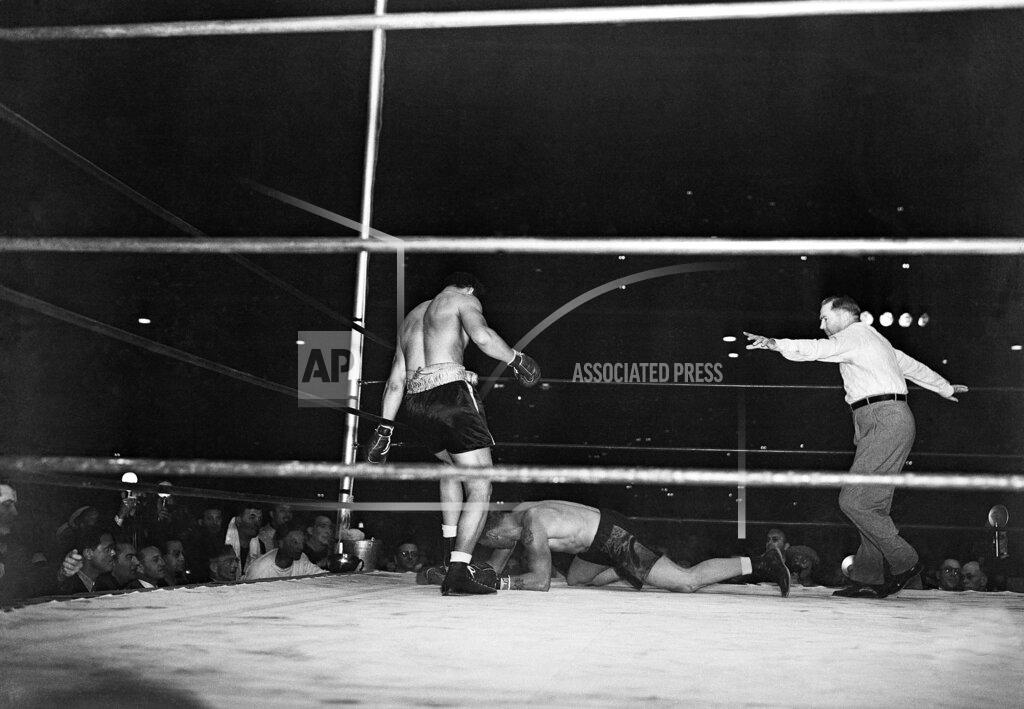
Joe Louis retained the world heavyweight boxing title by knocking out Jack Roper in the first round at Wrigley Field in Los Angeles.
Chinese forces today continued to press their attacks on the Japanese at many points on the China war front. At Kaifeng the Chinese claim to have placed themselves across the right of way of the new rail line that the Japanese have been building northwest from Kaifeng to Sinsiang by capturing Machwang, just north of Kaifeng. Half of the Japanese garrison of about 500 is said to have been wiped out during the occupation.
The city of Yingshan in Northern Hupeh is stated to be under siege by encircling Chinese forces. Japanese reinforcements, 2,000 strong, from Kwangshui and Anlu are reported to have been intercepted at Hochlatien, where an intense battle is going on.
In Shansi the Chinese recapture of Tsinglo is reported, while attacks are said to be continuing at Yicheng and Siahsien.
In Kwangtung it is asserted that the Chinese are in possession of Tsengshing and Huahsien and thus within striking distance of the Canton-Kowloon and Canton-Hankow railways and seriously threatening the Japanese in Canton.
Japanese official reports continue to describe additional victories over Chinese forces operating throughout Southern and Southwestern Shansi, claiming that the Chinese general offensive has been definitely broken. Reports of an anti-guerrilla action against a varying number of Chinese forces in Southern Shansi mention engagements at half a dozen points, and in all such clashes the Chinese are declared to have been routed, leaving their dead as well as arms and munitions. South and east, also Japanese reports state that guerrilla forces are being encountered.
The Japanese air force is reported to have raided Chinese positions twenty-five miles south of Kaifeng, bombing military concentrations. According to Japanese military officials, the activities of Chinese mountain-gun batteries in Southern Shansi — placing of guns and methods of firing — point to the possibility that the guns are manned by Russians. The probability, however, that Chinese crews have been trained by Russian instructors is not entirely discounted.
The North China Communications Company was formally inaugurated today to take over all the transportation duties formerly administered by the North China Bureau of the South Manchuria Railway. The new company will be concerned with truck, water and railway transportation and engineering policy. The inauguration ceremony was attended by all high Japanese and Chinese officials here.
Numerous clashes were reported today in South Shansi Province where thousands of Chinese troops were massing for assaults on Japanese-held towns. Japanese commanders said that their forces had made heavy inroads on the Chinese concentrations that were believed to be aiming especially at dislodging the invaders from the towns of Wensi, Fencheng, and Linfen. Additional heavy fighting was reported near Yutze, twenty miles south of Taiyuan, Shansi Province capital, and in the vicinity of Lishih, in Western Shansi. Chinese troops engaging in the clashes were said to include the famed Eighth Route Army and veterans’ divisions from Szechwan Province.
In Honan Province, where the Chinese last week launched a drive against Kaifeng, provincial capital, the Japanese said quiet prevailed today.
Accompanied by the Japanese destroyers Hibiki, Sagiri, and Akatsuki, the cruiser USS Astoria (Captain (later Admiral) Richmond K. Turner, commanding) steams slowly into Yokohama harbor, with United States ensign at half-staff and the Japanese flag at the fore, bearing the ashes of former Japanese Ambassador to the United States, the late Hiroshi Saito. The warship fired a 21-gun salute which was returned by the light cruiser Kiso. American sailors carried the ceremonial urn ashore that afternoon, and funeral ceremonies took place the following morning. Astoria also makes an unsuccessful attempt this week to photograph the battleship Yamato which the Japanese are building at Kure.
Japan claims part of the China Sea. The strategic area is 300 miles long and touches holdings of France, Britain, and the United States. Japan laid claim to the entire China Sea group, including the Spratly Islands, recently occupied.
The Roosevelt plea gave pause to those in Tokyo advocating military alliance with Germany.
The Japanese minimize Roosevelt’s peace appeal, calling it a “mere circular diplomatic telegram.”
Dow Jones Industrial Average: 127.34 (-2.27).
Born:
Bill Wood, AFL defensive back (New York Jets), in Allentown, Pennsylvania.


 History Diaries