The Ministerial Council of the Southeast Asia Treaty Organization (SEATO) holds its 10th annual meeting in Manila. France challenged today the United States view that the South Vietnamese Government of Major General Nguyễn Khánh was capable of defeating the Communist Việt Cộng guerrillas. Foreign Minister Maurice Couve de Murville contended that the Khánh Government was crippled by a lack of popular political support and national authority. He praised the United States contribution to Saigon’s war effort, but expressed doubt that military victory could be achieved. Henry Cabot Lodge, United States Ambassador to South Vietnam, said in a magazine article that proposals for neutralizing South Vietnam were “woolly and deceptive.”
At the ceremonial opening, the Foreign Minister of Thailand, Thanat Khoman, unexpectedly made a thinly veiled denunciation of the proposal made last August by President de Gaulle that Southeast Asia be neutralized in agreement with Asian Communists. Mr. Thanat implied that France should abandon that stand and contribute to the Southeast Asian alliance or leave it. Mr. Couve de Murville lisened glumly at Mr. Thanat said neutralization of Vietnam would be “tantamount to delivering that country with hands and feet bound to its northern aggressors.” French Foreign Minister Maurice Couve de Murville argued on behalf of De Gaulle’s plan for ‘neutralization’ of Vietnam, but the other delegates rejected this and agreed on the final communique’ that stated ‘that defeat of the Communist campaign is essential not only to the security of Vietnam but to that of Southeast Asia.’
Lodge also said that it might take more than one year or two, but that he “would not be surprised to see the Mekong Delta totally cleared of Communist guerrilla forces by the end of 1965.”
Premier George Papandreou announced tonight that Greece would strive for Cyprus’s right to self‐determination. His statement came after three days of talks with Archbishop Makarios, President of the island state.
Mr. Papandreou stood next to Archbishop while outlining a 10‐point policy on the Cyprus problem. Archbishop Makarios declared: “I endorse everything the Greek Premier says.” Greece’s policy, as outlined by Mr. Papandreou, is based on the following assertions:
- Full and unreserved solidarity for the “just struggle” of the Greek Cypriotes.
- “Greece’s policy is peace but in case of attack we shall defend ourselves.”
- The international accord that established Cyprus as an independent state proved inapplicable and led to an impasse. This was recognized internationally by the presence of a United Nations peace force in Cyprus and the appointment of a mediator to seek a new political formula for the island.
- The denunciation by Cyprus of her alliance pact with Greece and Turkey was merely the formal confirmation of a reality.
- “We have full trust in the international military force in Cyprus and have promptly agreed to bring the Greek army contingent under the orders of its commander. The Government of Cyprus has officially assured me that it will cooperate in a spirit of goodwill with the international peace force to avert any arbitrary action or violence and to impose law and order and pacification in Cyprus.”
- “We shall support the mission of the United Nations mediator who is seeking a new form for the Cyprus state.”
- “In our opinion there is only one possible and viable solution to the Cyprus problem: the application in Cyprus of the principles of international justice and true democracy.” A regime in which “the small minority of 18 percent imposes its will on the majority of 80 percent is a provocation to the spirit of our times. This is not democracy. It is a conquest.” To prevent the majority from abusing its rights, the prerogatives of the Turkish minority can be safeguarded with the help of the United Nations organization.
- The only solution for Cyprus is full and unrestricted independence allowing the Cypriote people to determine freely and in a sovereign manner their own destiny.
- If the United Nations mediator fails, the Cyprus issue will be taken before the United Nations General Assembly.
- “Our keen desire is to preserve excellent relations with our neighbor Turkey.” The Greek Government has avoided any provocation likely to disturb relations between the two countries. “We regret deeply anti‐Greek measures adopted by the Turkish Government which have aroused the indignation of the Greek people.”
Mr. Papandreou declared: “It is not wise that we should allow the Cyprus issue to poison our relations with Turkey permanently. If we cannot agree to a solution of the Cyprus problem ourselves, as would be desirable, we should let it be solved by international justice. We, Greece and Turkey, should restore our friendly relations which are dictated by our common interests.”
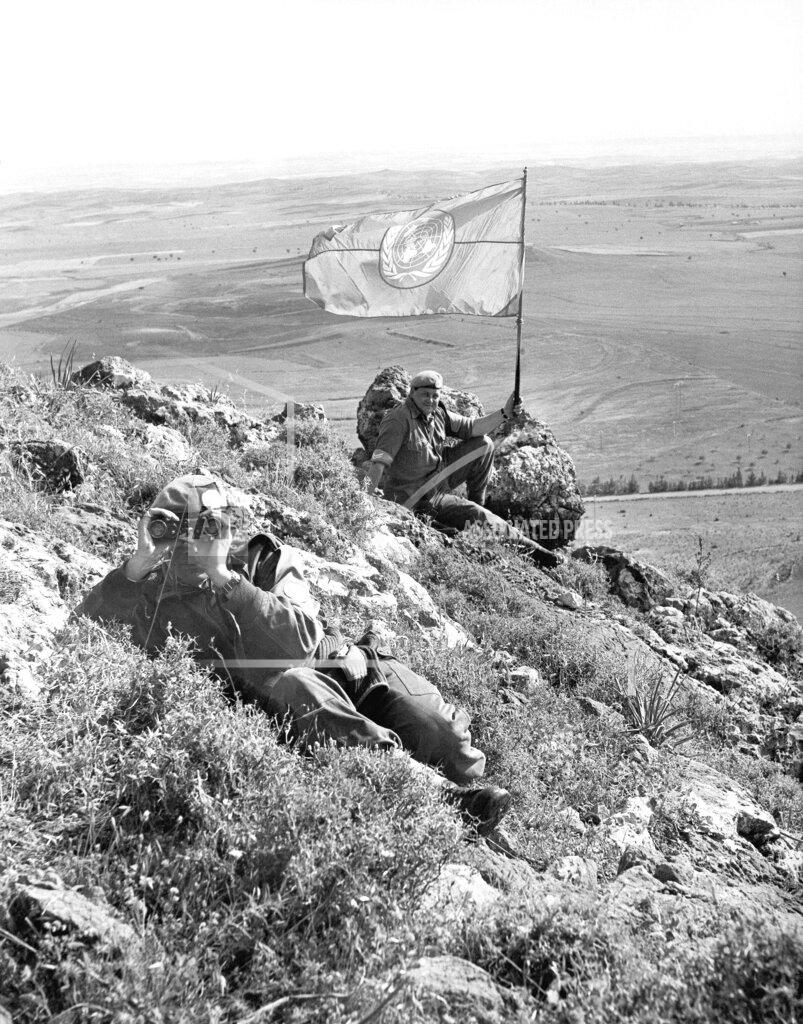
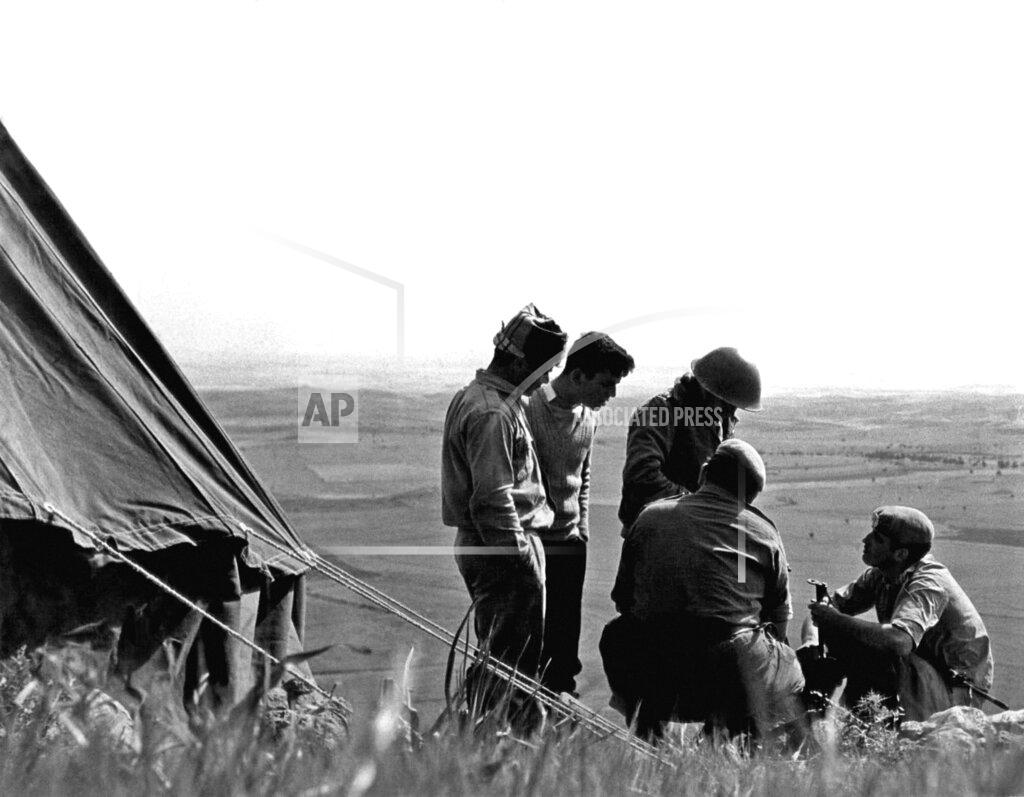
On Cyprus, the Turkish Cypriotes seized a strategic unoccupied hill today and defied Greek Cypriote ultimatums to get off it. The hill hugs the base of the southern slope of the Kyrenia range below the Turkish Cypriote positions on the crest of the range guarding the Kyrenia Pass and the Kyrenia‐Nicosia Road. The Turkish Cypriotes moved onto the hill during the night. At dawn they began to exchange fire with Greek Cypriote positions to the east of the hill near the Greek village strongholds of Pano (Upper) and Kato (Lower) Dhikomo. To the west of the hill lies the Kyrenia‐Nicosia road as it begins to twist upward to the pass. Farther west of the road are five Turkish Cypriote villages.
Thus the hill is in a commanding position to prevent any movement westward from the Dhikomo villages that would outflank the Turkish positions on the mountain and endanger Turkish possession of the road and pass. Sporadic shooting continued on the crest of the range. However, two United Nations patrols of Canadian soldiers were dropped on the crest by helicopter to try to stop the fighting. The shooting was considerably less than yesterday, when the Canadians did not intervene. Canadian patrols also approached the hill in an effort to remove it from contention by placing United Nations forces on its summit. The Turkish Cypriotes refused to let the Canadians up.
When the Canadians failed to budge the Turkish Cypriotes, the British paratroopers were called in. This was based on the theory that Turkish Cypriote respect for the British is greater than for the Canadians. But the Turkish Cypriotes were equally adamant with the British despite the ultimatums from the Greek Cypriotes that they would use mortars and attack the hill if the Turks did not leave it. Despite pleas by Major John Burgess of Britain, a member of a United Nations truce team, to let United Nation troops take over the hill, the Turkish Cypriotes still occupied it at nightfall.
Premier Khrushchev predicted tonight that members of the Communist community would close ranks against Red China’s leaders and that the Communist parties of the world would “reject” the dissident line offered by Peking. Mr. Khrushchev spoke at a Kremlin dinner for a visiting Polish delegation headed by the party secretary, Wladyslaw Gomulka, and Premier Jozef Cyrankiewicz. His remarks, as quoted by Tass, the Soviet press agency, appeared to imply an intention on the part of the Soviet leader to ask the members of the Communist international movement to take a formal stand for or against Moscow in its ideological dispute with Peking. So far the Kremlin has avoided a formal poll of foreign parties. But the Soviet leaders have said they favor a world conference, perhaps in late fall or early winter, at which the various party leaders presumably would have to take sides.
Ian Smith was elected as the new leader of the Rhodesian Front political party and became the new Prime Minister of Southern Rhodesia. Smith would guide the declaration of independence of Rhodesia from the United Kingdom in order to establish a white-minority government that would exclude black Africans from participation.
France supported today a Soviet‐bloc contention that Communist China, instead of Nationalist China, should be seated as an observer at the United Nations Economic Commission for Europe. No official action was taken on the Soviet‐bloc stand. However, the French delegate, Guy de Lacharriere, dissented when the bloc’s delegates asserted that Communist East Germany should be a member of the commission, which began its 19th session today. U Thant, the United Nations Secretary General, said the “normalizing and expanding of East‐West trade should remain a major task” of the commission.
Leaders of Belgium’s striking doctors were accused by Mayor Joseph de Saeger of Mechlin tonight of attempting to sabotage an agreement between Mechlin doctors and city officials for ending the strike there. According to national health authorities, the Mechlin agreement, which the doctors overturned in a vote today, would have been a model that other communities would surely have adopted as their own program for ending the 13‐day nationwide strike. Belgium’s doctors called off a system of emergency treatment maintained since the strike began, The Associated Press reported.
The Pietà, sculpted by Michelangelo in 1498 and 1499, arrived in the United States from the Vatican for display at the New York World’s Fair. The 6,700-pound statue was brought in on the Italian Line ocean liner SS Christoforo Colombo.
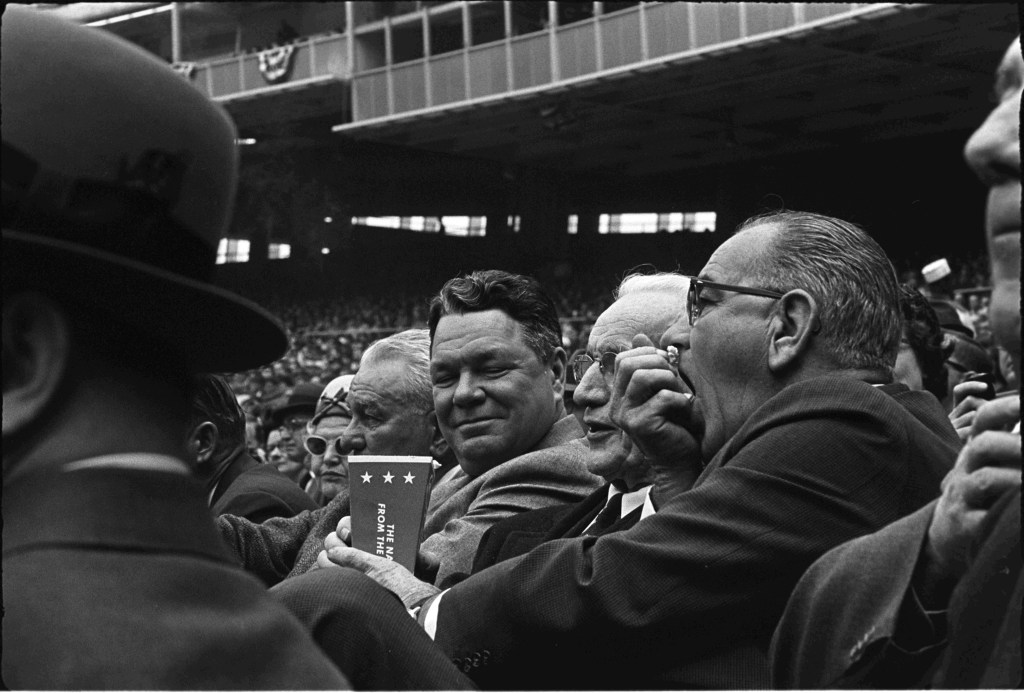
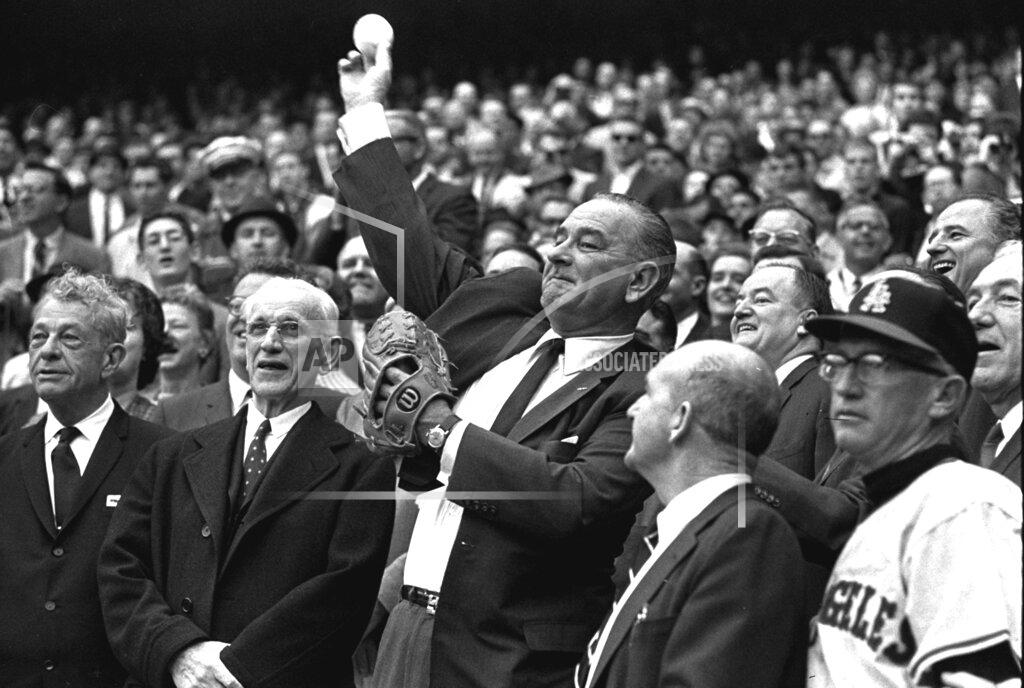
President Johnson again proved his experience in government today with a polished performance in one of the most ancient rituals of the Presidency—throwing out the first baseball of the major league season. So adept was Mr. Johnson at this traditional chore — his first throw landed squarely among the players and sent them scrambling on their faces — that he scarcely let the game interfere with business. He put in two solid innings of nonstop talk with Ev and Charlie, the Republican Congressional leaders — known formally as Senator Everett McKinley Dirksen of Illinois and Representative Charles A. Halleck of Indiana.
An untimely quorum call on the Senate floor cut short Mr. Johnson’s lobbying. When the call came at 2:20 PM, Senator Dirksen and 14 colleagues departed for the Capitol amid a chorus of boos and laughter from the fans. The President showed his proficiency in other small, meaningful ways. He threw out two balls, one high and short, one long and hard.
But meanwhile, back in the Senate, a gentlemen’s agreement put together by Senator Hubert H. Humphrey, Democrat of Minnesota, was collapsing. Senator Humphrey thought he had arranged a lull in the civil rights filibuster in which there would be no quorum calls, and he had promised to provide a couple of what he called “longball speakers” to fill in the time. But when word got around that the Senator had scheduled a night session of the world’s greatest deliberative body, the Southern filibusterers struck back. Senator Spessard L. Holland, Democrat of Florida, ended a speech at 2:10 PM and demanded that a quorum be rounded up. By 2:18 PM, it was apparent that the necessary 51 Senators were not available at the Capitol.
A telephone call went to D.C. Stadium, a mile east. At 2:20 PM, the public address system boomed out the bad news. Senator Humphrey rose and threw up his arms, whether in dismay or jubilation it was impossible to learn. Senator Dirksen escaped the embrace of the President, shook his hand and walked out, cloaked in his ineffable dignity. Other Senators followed, while the spectators jeered. The Senators raced back to the capitol, making it in just 8 minutes.
The baseball Senators, meanwhile, in mid-season form, lost to the Los Angeles Angels, 4–0.
Senator Frank J. Lausche warned civil rights leaders today that their cause was being imperiled by “violence and threats of violence” in many American cities. “We should make it our goal to provide equality of opportunity under the Constitution for every human being within our land,” the Ohio Democrat said. But the achievement of this goal, Mr. Lausche declared, “must come within the processes of law and not by trespass, riot and flagrant defiance of the rights of others.” Last Tuesday, a young white minister, the Rev. Bruce William Klunder, was killed in Cleveland when he lay down in an effort to stop a bulldozer during a demonstration against the construction of a school in a predominantly Black area.
Civil rights groups in Cleveland have contended that school board plans for three new schools in that area would continue de facto segregation. Senator Lausche, a former Mayor of Cleveland and Governor of Ohio, said: “The evidence is convincing that in our city we have persons learned in the technique of creating chaos and disorder. and indifferent to the future life of the United States.” These persons, he said, are not the Black leaders of Cleveland who have been making “their fight for the acquisition of equality of treatment within the law.” On the contrary, he said, they are “foreign elements having no roots in the community” to which they have brought “unjustified shame.”
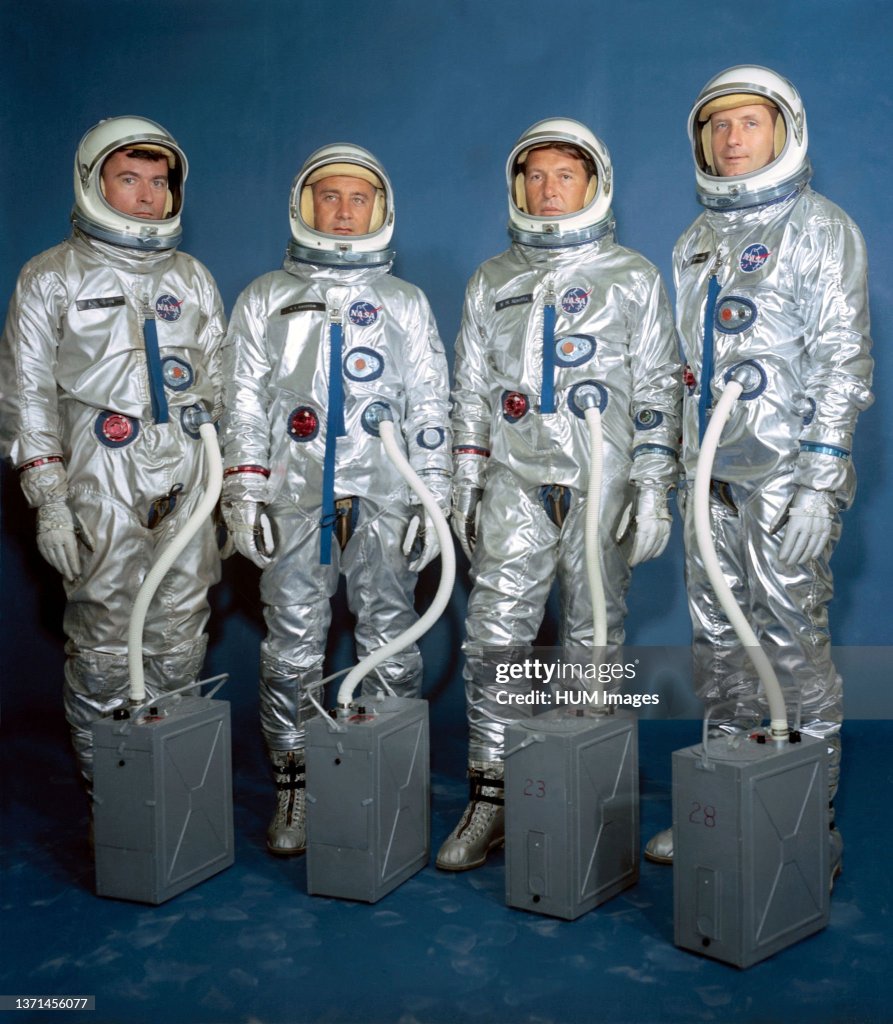
Director Robert R. Gilruth, Manned Spacecraft Center, announced Astronauts Virgil I. Grissom and John W. Young as the prime crew for the first crewed Gemini flight. Astronauts Walter M. Schirra, Jr., and Thomas P. Stafford would be the backup crew. Major Grissom, who will be command pilot, flew the second manned Mercury capsule on a 254‐mile suborbital trip down the Caribbean on July 21, 1961. That flight, otherwise excellent, was marred after the landing when the capsule’s hatch blew off prematurely. The capsule sank, and the astronaut narrowly escaped drowning before a helicopter was able to get a rescue sling to him.
Commander Young, named as second pilot or co‐pilot, is one of the newer astronauts. In 1962 he set two records for elapsed time in reaching specified altitudes in a Navy F‐4B Phantom jet.
Serving as back‐up crew for the first Gemini mission will be Lieutenant Commander Walter M. Schirra Jr., command pilot, and Major Thomas P. Stafford, second pilot. Current thinking is that they probably would be substituted as a team if either of the primary pilots was grounded for illness or other reasons.
Commander Alan B. Shepard Jr., who made the first Mercury suborbital flight on May 5, 1961, had been considered a favorite for the command seat on the first Gemini mission, but the space agency disclosed that he had been having trouble for months, probably an infection, with his left ear, and that this disqualified him from space flight for the time being. Robert R. Gilruth, director of the Manned Spaceflight Center, said at a news conference that physicians were confident that the trouble would clear up and that it would not “bar his chances for future Gemini missions.”
In one of the first recorded instances of a crowd shouting for a suicidal person to jump from a building, people in Albany, New York, chanted “Jump! Jump!” to a man on the roof of the 11-story DeWitt Clinton Hotel. A crowd of about 3,000 people had gathered to watch when boys in the crowd shouted to him to make the 125-foot plunge and even made bets on whether he would go through with his plan. The 19-year-old young man was eventually persuaded by police and his seven-year-old nephew to return to abandon his plan.
Malcolm X departed on the Hajj, the pilgrimage to Mecca. For the next seven months, he would tour the Middle East and Africa, returning to New York City on November 24.
Air Force Space Systems Division (SSD) recommended a Gemini Agena launch on a non-rendezvous mission to improve confidence in target vehicle performance before undertaking a rendezvous mission. Gemini Project Office (GPO) rejected this plan, regarding it as impractical within current schedule, launch sequence, and cost restraints. GPO accepted, however, SSD’s alternate recommendation that one target vehicle be designated a development test vehicle (DTV) to permit more extensive subsystems and systems testing, malfunction studies, and modifications at the Lockheed plant. Gemini Agena target vehicle (GATV) 5001 was designated the DTV, but GPO insisted that it be maintained in flight status until the program office authorized its removal. GATV 5001 was the first Agena for the Gemini program.
New Zealander Colin Bosher shears a record 565 sheep in 1 workday.
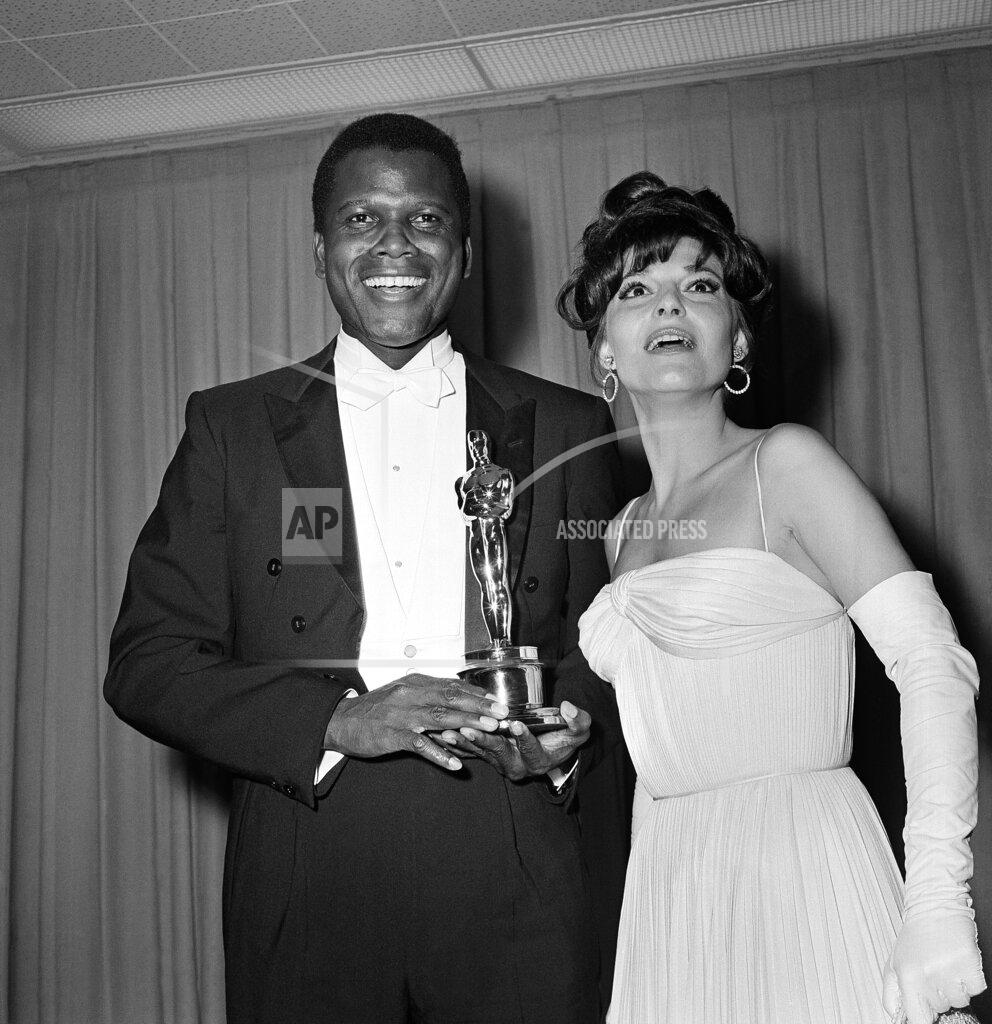
The 36th Academy Awards ceremony was held. Sidney Poitier became the first black person to win an Academy Award in the category Best Actor in a Leading Role, for his performance in “Lilies of the Field”, while Patricia Neal received Best Actress for “Hud”, and “Tom Jones” won the award for Best Motion Picture.
After beating the Cincinnati Reds, 6-3, in the traditional Opening Day game in Cincinnati, Houston is in first place for the first and only time as the Colt .45’s. Next season, the team will be renamed the Astros, reflecting Houston’s role in the nation’s space program.
Dow Jones Industrial Average: 821.31 (-0.44).
Born:
Davis Love III, American golfer (PGA Championship 1997; 21 PGA Tour titles), in Charlotte, North Carolina.
Doug Strange, MLB third baseman and second baseman (Detroit Tigers, Chicago Cubs, Texas Rangers, Seattle Mariners, Montreal Expos, Pittsburgh Pirates), in Greenville, South Carolina.
Phil Zevenbergen, NBA center (San Antonio Spurs), in Seattle, Washington.
John Tagliaferri, NFL running back (Miami Dolphins), in Orange, New Jersey.
Caroline Rhea, Canadian comedian, actress and first host of the TV show “The Biggest Loser,” in Westmount, Quebec, Canada.
Page Hannah, American actress (Kate Riley – “Fame”), in Chicago, Illinois.
Bill D’Angelo, American heavy metal guitarist (Femme Fatale), in Albuquerque, New Mexico (d. 2005).
Died:
U.S. Marine Corps General Melvin Maas, 65, former U.S. Congressman for Minnesota, 1927 to 1933 and 1935 to 1945, who fought in World War II during his time in Congress, and was blinded by a war injury.
Veit Harlan, 64, Nazi German film director and anti-Semitic propagandist.
 History Diaries