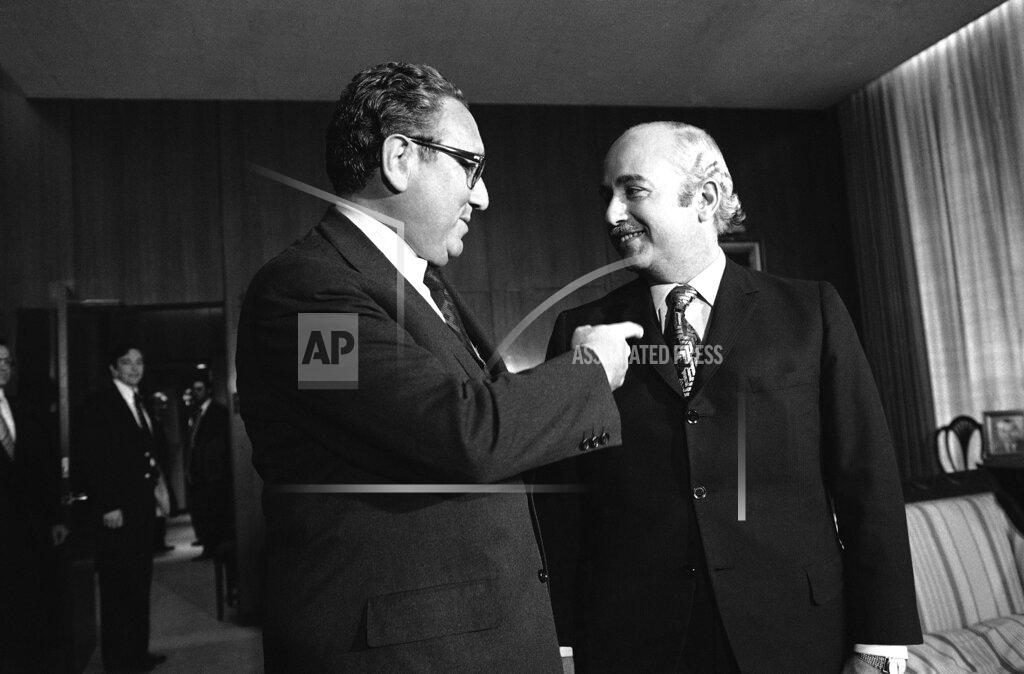
Secretary of State Kissinger virtually ruled out another comprehensive agreement on limiting strategic arms with the Soviet Union this year, but said “a more limited” accord curbing some offensive arms might be signed during President Nixon’s expected visit to Moscow in June. He told newsmen after a meeting at the White House with the President and Soviet Foreign Minister Andrei Gromyko that the strategic arms talks were so “complicated” that it was possible that not even the “limited” accord could be achieved by the time Mr. Nixon ends his visit to the Soviet Union.
The Senate Democratic leader, Mike Mansfield, said today that Present Nixon had told him he is considering going to Helsinki, Finland, to attend a final meeting of the East‐West Conference on Security and Cooperation in Europe. The Montana Senator had said earlier in the day that the President told him at a recent breakfast meeting that he planned to go to Helsinki next month. But a few hours later he corrected himself, saying that the President had not yet decided on the trip. “I went over my recollections of the breakfast meeting,” he told reporters. “I made a mistake.” There was no immediate White House comment.
Israeli forces raided several villages in southern Lebanon and blew up houses that were said to belong to Arab guerrilla sympathizers, the Israeli command announced in Tel Aviv. It said that the raid had been made in retaliation for the Arab terrorist attack Thursday on the Israeli town of Qiryat Shemona. A spokesman said that the raid which was completed in hours had been made in retaliation for the Arab terror attack yesterday on the Israeli town of Qiryat Shemona, in which 18 people were killed. The army identified the Lebanese communities attacked as Muhebab, Blida, Aitaoun and Ett Jaibe, a cluster of villages 10 miles west of Qiryat Shemona along northern stretch of the bolder. Also hit were Yaroun and Dahira, 10 miles north of the western end of the frontier and about 15 miles from the Mediterranean, the army spokesman said. No tanks or aircraft were employed, he added. The size of the Israeli force was not disclosed, and then was no mention of Lebanese casualties.
The Israeli spokesman said that Lebanese Army troops “did not run away in the face of our advancing forces. They just watched.” A communique, issued in Tel Aviv about two hours after the raiders returned, said: “An Israeli Army unit tonight raided several villages close to the cease‐fire line in southern Lebanon. This action followed upon the massacre in Qiryat Shemona perpetrated by terrorists who infiltrated from Lebanon. The action was intended to harm villages whose residents had been giving assistance to terrorists. Israeli forces destroyed several houses after evacuating their inhabitants an avoided hurting the civilian population. In the course of the action no resistance was encountered from the Lebanese Army, which had evacuated the area. The Israeli forces returned safely without sustaining any casualties.”
The residents of Qiryat Shemona poured out their grief and anger in an emotional and violent funeral for 16 of the victims of the attack. Their anger was directed equally at the terrorists who invaded their town and the government, which they felt had left them exposed to guerrilla attacks from across the nearby Lebanese border. The mass funeral took place in a small cemetery on a green hill overlooking the modern apartment blocks of Qiryat Shemona. The disputed Golan Heights could be seen to the east, and the Lebanese border atop a ridge of hills immediately to the west. Overhead, an army helicopter patrolled the area. The ceremony itself was sheer chaos. The families of the victims wept and shrieked as the flag‐draped coffins were carried into the town cemetery. The relatives, breaking past lines of reluctant policemen, hurled themselves on the coffins and beside the freshly dug graves.
A Syrian military spokesman announced that artillery and tank fire raged for hours between Syrian and Israeli forces on the Golan Heights today. Shelling has broken out daily on the front for the last month. Residents of Damascus heard the thud of the artillery this morning. The spokesman said that the Syrian gunners concentrated on “enemy gun emplacements, support positions and tanks in various areas of the front.”
Israeli President Ephraim Katzir today asked the ruling Labor alignment and the Likud opposition to send representatives to confer with him Sunday on the formation of a new Israeli Government. The President is required by law to consult leaders of the parliamentary factions before asking a member of the Parliament to form a government. But his action, coming only 24 hours after the resignation of Premier Golda Meir, drew expressions of displeasure from officials of the Labor Party today. They are not ready to nominate a successor to Mrs. Meir and the party has not yet decided whether to try to form a new government or to call new elections. Mrs. Meir has recommended new elections without delay. Dissension within her own Labor party caused her downfall and is likely to impede the establishment of a new government.
The Office of Management and Budget and the State Department are locked in a bureaucratic struggle over how much Israel should pay for the arms she 110 been getting since the October war. When Congress voted a $2.2‐billion aid package last December, it specified that Israel should repay $700‐million and that the President should decide how much of the remaining $1.5‐billion would be in credit sales and how much as a gift. The legislative history of the bill makes clear, according to a number of Congressional sources, that Congress expected all or most of the $1.5‐billion to be given free. Now, however, the Office of Management and Budget is arguing that Israel should pay for all of the aid, while the State Department is maintaining that most of the discretionary $1.5‐billion should be provided free.
Cambodian Government troops killed 115 Communist‐led insurgents and suffered six dead in three clashes in three provinces, a military spokesman said today. The spokesman said that 53 insurgents died in fighting yesterday around Svay Chek and Prey Khlar, five miles southeast of the provincial capital of Prey Veng, 32 miles east of Phnom Penh. Three Government soldiers were killed here and five guerrillas captured, the spokesman said. Near Kompong Tram, 30 miles west of Phnom Penh, government troops killed 50 insurgents and captured five others yesterday. Three government soldiers were reported killed and 18 wounded.
After a siege of more than a year by North Vietnam’s People’s Army of Vietnam (PAVN), the 92nd Ranger Battalion of South Vietnam’s Army of the Republic of Viet Nam (ARVN) surrendered the Tonle Cham Camp, only 60 miles (97 km) from the South Vietnamese capital, Saigon. The base, Tong Le Chan, situated on a small hill in unpopulated gently rolling terrain 55 miles northwest of Saigon, was one of three camps that have been attacked in recent weeks. The attacks on the outposts are part of a pattern of heightened activity in Military Region III, around the capital, where both sides have been probing and thrusting. Tong Le Chan, which was defended by a debilitated force of 259 men who had been supplied by air drops for more than a year, was overrun shortly after midnight by waves of North Vietnamese troops from the Ninth Division after a four‐hour barrage of 900 mortar and artillery rounds, according to the Command.
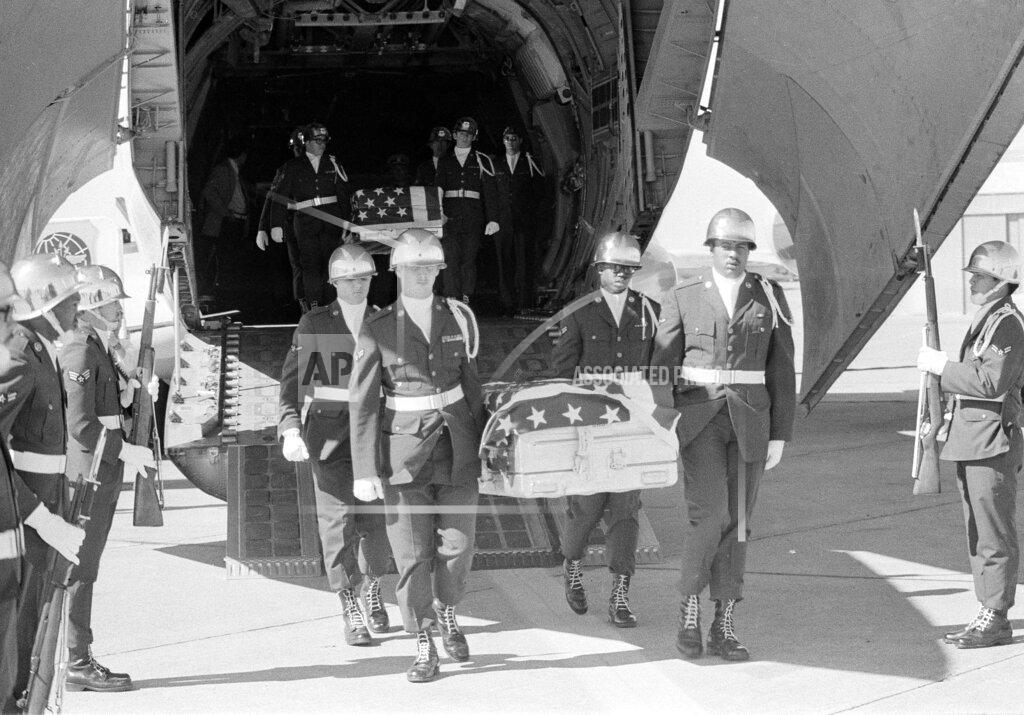
The last American prisoners of war from North Vietnam came home today without ceremony in 17 flag‐draped coffins. With only an honor guard on hand and no formal ceremony, the bodies were flown into Travis Air Force Base in Fairfield, California from Thailand. The Air Force would not release the identities of the men, saying identification procedures had not been completed. The coffins, carried by Air Force pallbearers, were loaded onto the same dark blue ambulance buses that carried the returning prisoners of war to hospitals a year ago. The 17 dead were the last of the 23 American servicemen the North Vietnamese said had died in North Vietnam while they were prisoners. The bodies of the other six men were returned here March 21.
The collision of the 999-ton South Korean freighter Hae Yung and the 21,467-ton American container ship President Pierce killed 15 of the freighter’s 24-man crew, when the vessel split in half and sank quickly in the Sea of Japan.
New military unrest broke out in Ethiopia today when troops stationed near the border with Somalia seized a number of officers and businessmen and demanded that profiteering in food grains be stopped. The incident at the town of Jijiga in eastern Ethiopia, while probably not of great significance itself, symbolized the persistently restless and at times nearly chaotic state of Ethiopian society since an army mutiny late in February destroyed the once absolute authority of Emperor Haile Selassie. Reports reaching Addis Ababa said that units of the mechanized brigade of the Third Division were demanding an end to hoarding of grain by merchants, high prices and profiteering and were also asking that courts move faster to prosecute grain dealers. The reports said that the soldiers’ demands had been given to Major General Nega Tegegn, Third Division commander. Some officers and merchants at Jijiga, about 300 miles east of Addis Ababa, were reportedly in custody.
An American diplomat who was kidnapped, by Marxist guerrillas today in Cordoba, Argentina’s second largest city, was found alive but seriously wounded tonight. The diplomat, Alfred A. Latin, 36 years old, is head of the United States Information Service in Cordoba, an industrial city, 430 miles northwest of Buenos Aires. He was found tonight in a river bed near the center of the city after the guerrillas had notified a local radio station of his release. Mr. Laun was suffering from wounds in the heady, abdomen and shoulder, according to a United States Embassy spokesman here, and was taken to a clinic where he received blood transfusions. His condition was reported to be “very grave.”
After considering the matter for more than 20 years, the United Nations finally came up with a definition of “aggression.” A ripple of properly subdued excitement ran through the meeting chamber where the Committee on the Definition of Aggression agreed on a hazy three-page definition of the concept, which has been a diplomatic issue since the Versailles peace conference of 1919.
A Harris Survey said yesterday that “by 43 to 41 percent, a narrow plurality of the American people is now prepared to agree that President Nixon should be impeached by Congress and removed from office, while 16 percent are unsure.” The poll, conducted by Louis Harris & Associates, inc., is the first to record a popular margin in favor of Congress’s removing Mr. Nixon from the Presidency, Mr. Harris said. The results came from interviews conducted between March 24 and 29 in 1,495 households that Mr. Harris described as a national cross section. They show that “it is fair to conclude that the American people now want the full procedures of the Constitution regarding impeachment to be invoked against President Nixon,” Mr. Harris said. “A clear majority agrees, by 55 to 33 percent, with the statement that if President Nixon, fails to turn over the information the House Judiciary Committee wants, then that committee should vote to bring impeachment charges against the President,” Mr. Harris said.
The United Steelworkers of America accepted — more than three months before their old wage contract expires — a new three-year agreement providing substantial increases in pay, cost-of-living allowances, pensions and other benefits. The agreement will increase hourly wages by 60.9 cents over the three-year period, with the first raise going into effect on May 1, and it includes a cost-of-living adjustment. It affects 386,000 workers.
The California franchise tax board, which recently ruled that President and Mrs. Nixon were not California residents for state income tax purposes, nonetheless levied an assessment of $4,342 for 1969 and 1970 on that part of their income earned in California. The assessment included a pro-rated portion of the President’s salary based on the time he was at his San Clemente estate on various ‘”working vacations.”
In Morgantown, West Virginia, a small college town on the northern rim of Appalachia, the federal government has invested more than $57 million to build a showcase rapid transit system and is now studying how to blow it up. What was meant to become a centerpiece of Nixon administration efforts to provide a renaissance in urban transportation has become a costly and embarrassing white elephant.
Dr. Kenneth Edelin, chief resident for obstetrics and gynecology at Boston City Hospital, was indicted for manslaughter in the death of a fetus in connection with a legal abortion, and four other physicians were accused of violating a 19th century grave-robbing law for using tissue from aborted fetuses for medical research. The indictments caused dismay and indignation in Boston’s huge medical research establishment.
A thin young man in California with blue eyes and a long, red moustache has emerged as key figure in the federal investigation of the kidnapping of Patricia Campbell Hearst. He is Steven A. Weed, a $400 a‐month teaching assistant in logic and philosophy graduate student at the University of California, Berkeley. He has been by his own definition, “the focus” and “the key” of the extensive inquiry by the Federal Bureau of Investigation into the girl’s kidnapping two months ago. He has been questioned relentlessly.
Mr. Weed is 26 years old. He likes to play touch football and frame pictures in his spare time. He used to have many radical friends and he was, at least until 67 days ago, the 20‐year‐old’s fiancé. His name, address and telephone number were found by the police in an address book belonging to a member of the group that calls itself the Symbionese Liberation Army, which kidnapped her. Mr. Weed said last night in a television interview that Miss Hearst’s captors should be allowed to take her to a foreign nation for eventual release. He said that he had been working on such a proposal for several weeks, in conjunction with the FBI.
W. A. Boyle, the former president of the United Mine Workers union who was convicted here last night on three charges of murder, faces not only a sentence of three consecutive life terms in prison at the age of 72, but also the prospect of bankruptcy. The Justice Department disclosed in Washington today that Mr. Boyle had been forced to pay a $130,000 fine imposed on him in a separate, earlier conviction for violating. federal election laws. The disclosure that the government had forced payment of the fine through a partial foreclosure on a $200,000 bank account of Mrs. Ethel Boyle, his wife as the former union leader’s chief defense counsel in his murder trial was himself convicted today on a technical charge of criminal contempt of court.
The Boyles have said the $200,000 comprises virtually their only assets, and there are other claims on them to come. The $130,000 fine, plus $49,250 in restitution by Mr. Boyle to the U.M.W. treasury, was imposed on the ousted coal miners’ president at his sentencing in Washington for illegally diverting union funds to political campaign contributions during the 1968 elections.
The lawyer for Dwight L. Chapin, the former Presidential appointments secretary, filed motions late today asking that his client’s conviction be set aside and that he be granted a new trial away from Washington. Mr. Chapin was found guilty in Federal District Court earlier this month on two counts of lying about the activities of political sabotage carried out by Donald H. Segretti in the 1972 Presidential campaign. The lawyer, Jacob A. Stein, said the trial “was tainted by the admission, of unduly prejudicial evidence,” specifically a fraudulent letter, accusing Senators Hubert H. Humphrey of Minnesota and Henry M. Jackson of Washington of sexual indiscretions, and a spurious news release saying that Representative Shirley A. Chisholm of New York City had mental problems. Mr. Stein also asked for acquittal on ground that the jury erred in concluding Mr. Chapin had said he did not recall giving instructions to Mr. Segretti about any particular candidate.
An examination of Internal Revenue Service tables for the fiscal year 1973 shows that taxpayers in Manhattan were twice as likely to be audited as those in Cleveland, and that Brooklyn taxpayers were twice as likely to have their returns audited as those in Boston. A research official in the agency contended, however, that sharp regional differences in auditing “does not mean tax enforcement standards are unequal.” The official, Albert Y. Sze, defended the I.R.S. enforcement program in an interview as millions of Americans worked to complete their federal returns before the filing deadline next Monday.
The wreckage of a twin‐engine tour plane and the bodies of the 11 persons aboard were found today on the side of a mountain on the island of Hawaii. Rescuers who made their way through rugged terrain to the site of the wreckage 31 miles southwest of Hilo reported that they had found 11 bodies. The search party was organized after the wreckage was sighted from the air at the 7,500‐foot level on the east side of the mountain. The twin‐engine Beechcraft vanished yesterday after taking off from the “big island” on a scenic tour of the volcano area and coast on the way to the island of Maui. The pilot, Vincent E. Morine, had filed a flight plan to arrive at Kahului at 11:13 AM, yesterday. His last radio contact was at 9:30 AM, 17 minutes after take‐off.
The latest results of the Mariner 10 television probe show that Mercury has a very battered, cratered crust like the moon and probably a massive iron‐rich core like the earth. “It’s like the moon on the outside but it may well be like the earth on the inside,” Dr. Bruce C. Murray said yesterday. “For that reason, it’s unique planet in the solar system.” Dr. Murray said in a report to the annual meeting of the American Geophysical Union that the most surprising discovery from the spectacular close‐up pictures returned two weeks ago was that many of the large basin‐like features on Mercury appeared flooded by lava. One such basin has been named Caloris from the Latin word “calor,” which means heat. Dr, Murray said that the 800‐mile-wide feature, just north of the planet’s equator, was one of the hottest places on the planet and in the entire solar system.
“Carrie” and “Coal Miner’s Daughter” actress Sissy Spacek weds art director Jack Fisk. [Ed: Remarkably for Hollywood, they are still together. Today is their 50th anniversary.]
Arthur Krock, one of the great figures of American journalism, died at his home in Washington tonight. He was 86 years old. He had been a Washington correspondent for 60 years and in 34 years association with the New York Times he had been a reporter, chief of the Washington bureau, and columnist. He had been in poor health for nearly six months, and death was attributed to natural causes.
Robin Yount, 18, collects his first Major League hit for the Milwaukee Brewers during a 5–3 loss to the Baltimore Orioles. Tomorrow, Yount will get his 2nd hit against the O’s — a game-winning home run.
In Atlanta, the Cincinnati Reds roll over the Braves, 14–2. Merv Rettenmund hits a 2nd-inning grand slam off vet Jack Aker.
Bernie Carbo belts a 1st-inning grand slam, off Lerrin LaGrow, as the host Boston Red Sox beat the Detroit Tigers, 6–3.
Born:
Roman Hamrlík, Czech National Team and NHL defenseman (Olympic gold medal, 1998; NHL All-Star, 1996, 1999, 2003; Tampa Bay Lightning, Edmonton Oilers, New York Islanders, Calgary Flames, Montreal Canadiens, Washington Capitals, New York Rangers), in Gottwaldov (today Zlín), Czechoslovakia.
Jason McBain, NHL defenseman (Hartford Whalers), in Ilion, New York.
Fred Weary, NFL cornerback (New Orleans Saints, Atlanta Falcons, St. Louis Rams), in Jacksonville, Florida.
Belinda Emmett, Australian actress (“Home and Away”), in Gosford, New South Wales, Australia (d. 2006).
Marley Shelton, American film and TV actress (“Eleventh Hour”), in Los Angeles, California.
Died:
Arthur Krock, 87, U.S. newspaper journalist known for his syndicated column “In the Nation”, and winner of two Pulitzer Prizes.
Carl Jaffe, 72, German actor (“1st Man in Space”, “Escapement”).







 History Diaries