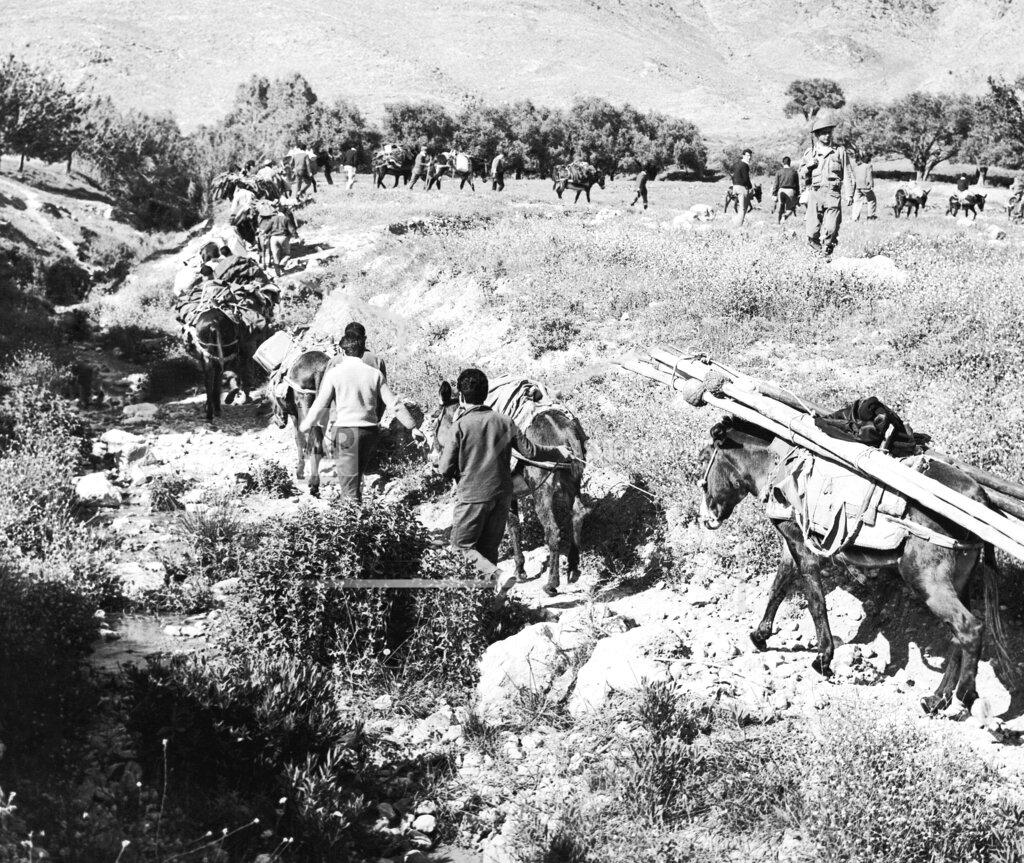
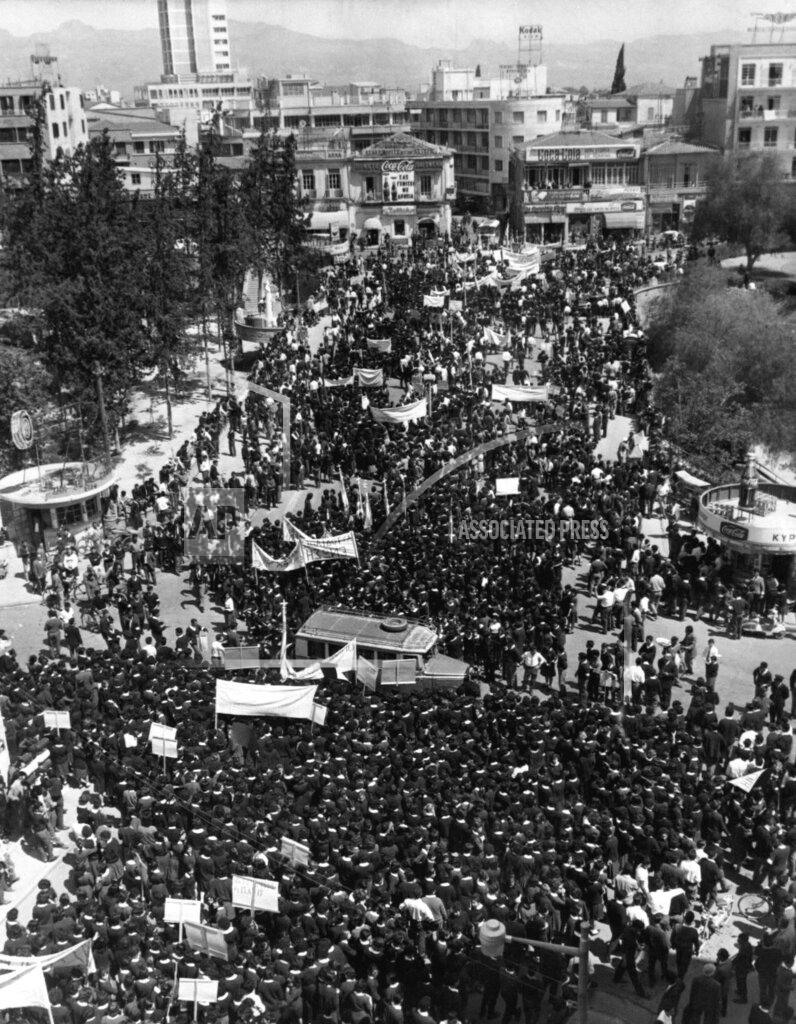
Archbishop Makarios, President of Cyprus, and Premier George Papandreou of Greece agreed today that self‐determination was the only permanent and just basis for a solution of the explosive Cyprus problem. This raised the possibility that the Greek Cypriote majority would again demand enosis, or union with Greece, a policy bitterly opposed by the Turkish Cypriote minority. The decision was announced by the archbishop, who is leader of the Greek Cypriotes, after a four‐hour meeting with Mr. Papandreou. The President said: “The basic line of common policy between Athens and Nicosia is self‐determination. This will be the essence of a joint communiqué to be issued at the close of our talks Monday night.” The policy represented a departure for both Archbishop Makarios and the Greek Government. Both have recently been advocating simply the maintenance of the island’s independence.
Archbishop Makarios does not believe that there is any difference between “full and unrestricted independence” and self-determination. He has said that if the Cypriotes were given full independence, they would be in a position to determine their destiny. Independent observers feel, however, that this is a return to the Greek Cypriotes’ pre‐independence call for self‐determination, which term was used then as a more acceptable word for union with Greece while the issue was pending before the United Nations. It is assumed that the application of the right of self‐determination would imply a referendum to determine the Cypriotes’ political future, at which the alternatives would be union with Greece and unfettered independence. In the arrangements for independence, the Greek Cypriotes agreed to proscribe enosis as a policy for the island.
Cyprus became independent of British control in 1960 after the Greek Cypriotes had retreated from demands for union with Greece. The current crisis, which began late in December, has been marked by recurrent clashes between the Greek and Turkish communities. A United Nations force is attempting to maintain peace. The change of approach coincided with reports from Cypriote sources that Archbishop Makarios would seek to secure self‐determination under the aegis of the United Nations. This would involve international guarantees for the security and well‐being of the island’s Turkish minority and the holding of the referendum. Sources close to Premier Papandreou disclosed that he had told President Makarios that a common Athens‐Nicosia policy could be founded only on the principle that their joint actions would be absolutely legitimate. “Greece must always be right,” was a remark attributed to the Premier.
President Makarios spoke by telephone with General Grivas today amid rumors that the Greek Cypriote leader would ask the former guerrilla chief on Cyprus to command the island’s security forces. However, usually well‐informed sources said General Grivas was reluctant to serve under Archbishop Makarios. They arranged to meet tomorrow at the general’s home.
The Brazilian Congress elected Field Marshal Humberto de Alencar Castelo Branco as President of Brazil. General Castelo received 361 of 438 votes. Seventy-two Congressmen from the Labor Party, whose leader João Goulart had been overthrown the week before, chose to abstain rather than to vote for any candidate. Branco would serve until March 15, 1967, and would be killed in a plane crash four months later.
South Vietnam is expected to urge the Southeast Asia Treaty Organization next week to denounce North Vietnam for aggression in Vietnam’s guerrilla war. Phan Huy Quát, the South Vietnamese Foreign Minister, may also call on individual alliance members to make greater contributions to the war effort against Communist guerrillas, qualified sources here said. The alliance conference opens Monday in Manila and will end Wednesday. Secretary of State Dean Rusk left by plane yesterday to attend the sessions. Officials here said that Dr. Quát and Malaysian representatives would attend the sessions only as observers. Although the Saigon regime sent observers to previous sessions of the alliance members, this will mark the first time the foreign ministers will have attended.
Officials said they expected Dr. Quát to address the conference and press for a strong denunciation of North Vietnamese aggression in the final communiqué of the meeting. It was emphasized that any appeal for help in the South Vietnamese war would be addressed to the individual countries and not to the alliance as a whole. It was pointed out that concerted action by SEATO would probably violate the 1964 Geneva agreement on Vietnam and run the risk of widening the war. Among other provisions, the Geneva agreement barred the sending of arms or foreign troops into that country. United States officials both here and in Vietnam are known to favor greater contributions from some members of the alliance, especially the Philippines and Australia.
Mohammed Ataur Rahman of India arrived today to take over from another Indian as chairman of the International Control Commission in Vietnam. Poland and Canada supply the two other members.
As Premier Khrushchev returned to Moscow tonight from Hungary, a joint Soviet‐Hungarian statement was made public denouncing “most emphatically” what were called factional, anti-Leninist and subversive activities of the leaders of Communist China. The statement was adopted by Mr. Khrushchev and Premier Janos Kadar of Hungary before the Soviet leader’s departure from Budapest after a 10‐day visit. Premier Khrushchev was greeted on his arrival by train by Leonid I. Brezhnev, the Soviet chief of state, by ranking members of the Government and party leadership and by the diplomatic corps. The railroad station was adorned with flags for the occasion. Mr. Khrushchev, smiling and plucking a bunch of flowers, waved to the applauding crowd of several hundred, then drove quickly away. He was accompanied by Mrs. Khrushchev and their daughter, Yelena.
Premier Theo Lefevre’s Belgian Government announced today that it would call up doctors with reserve army commissions. The decision was taken at an early‐morning emergency meeting of the Cabinet. The Cabinet met after Government ministers and strike leaders had failed in an all-night session to end a nationwide doctors’ strike that began April 1. A large number of Belgium’s 10,000 doctors are in the army reserves, since military service is mandatory in Belgium. Defense Minister Paul W. Segers announced the call‐up decision. Government spokesmen had said earlier that once doctors were in uniform and subject to military discipline they could be assigned to civilian hospitals.
The strike took on a grave note with word that scarlet fever, measles and mumps had broken out in three Belgian provinces. Premier Lefevre appealed over the heads of the strike leaders to the rank-and-file doctors and dentists to end their strike against the Government’s new medical payment law. The strike leaders maintained that Government ministers had not made it possible for them to call off the strike and had even qualified concessions that the doctors understood the Cabinet had agreed to earlier.
Winston J. Field was authoritatively reported tonight to be ready to resign as Southern Rhodesia’s Prime Minister. Mr. Field’s decision to step down was said to have been brought about by increasing pressure from the right wing of his Rhodesian Front party in this self‐governing British colony in Central Africa. The right wing is demanding independence from Britain under a white minority government. An extreme faction within the anti‐Field wing are understood to be prepared to seize independence if need be to head off a political emergence of the country’s black majority. Diplomats are openly fearful that the swing away from Mr. Field, a former tobacco farmer, means that Southern Rhodesia’s 221,000 whites are prepared to take a more “militant” line on the issue of independence.
A tornado in the Jessore District of East Pakistan (now Bangladesh) destroyed numerous villages and killed over 500 people, and perhaps as many as 2,000.
President Johnson and his mediators kept carrier and union representatives hard at work in the White House today, trying to settle major issues that threaten a nationwide railroad strike. “There is very active mediation going on,” George Reedy, the White House news secretary, reported. “We are very much in the mediation process.” Mr. Johnson himself sat in on one meeting this morning. “We are not trying to impose a solution,” Mr. Johnson said at a news conference, “we are just trying to be helpful in arriving at a solution by consent.”
The President also said that he was not now considering legislation that would take the matter out of the hands of the railroads and the unions. “I am not here to bury collective bargaining,” he declared. “I am here to preserve it. I am prepared to carry on negotiations with the thought that we are going to reach a settlement, and I hope and pray we will.” The mediating team met with the union representatives this morning and again tonight. They were in session with the management representatives this afternoon. Mr. Johnson’s news conference in the White House Cabinet Room was called without advance notice, as is his custom. It was covered by about 40 reporters and was filmed and recorded on audio tape. There was no live television or radio coverage.
President Johnson said today, in response to a question, that he was “glad to see” that Premier Khrushchev was “playing the role of peace and seeking to preserve peace in the world.” “That certainly is the desire of this country,” the president went on. “When he talks in peaceful terms, he will always have our ear.” The President made the observation at his news conference, when he was asked how he felt about the “complimentary things” the Soviet leader had said about him and Secretary of State Rusk. This was a reference to statements by Premier Khrushchev on his tour of Hungary, particularly on April 6. The Premier said then: “The United States is an imperialist country, but its government judges the world situation soberly.”
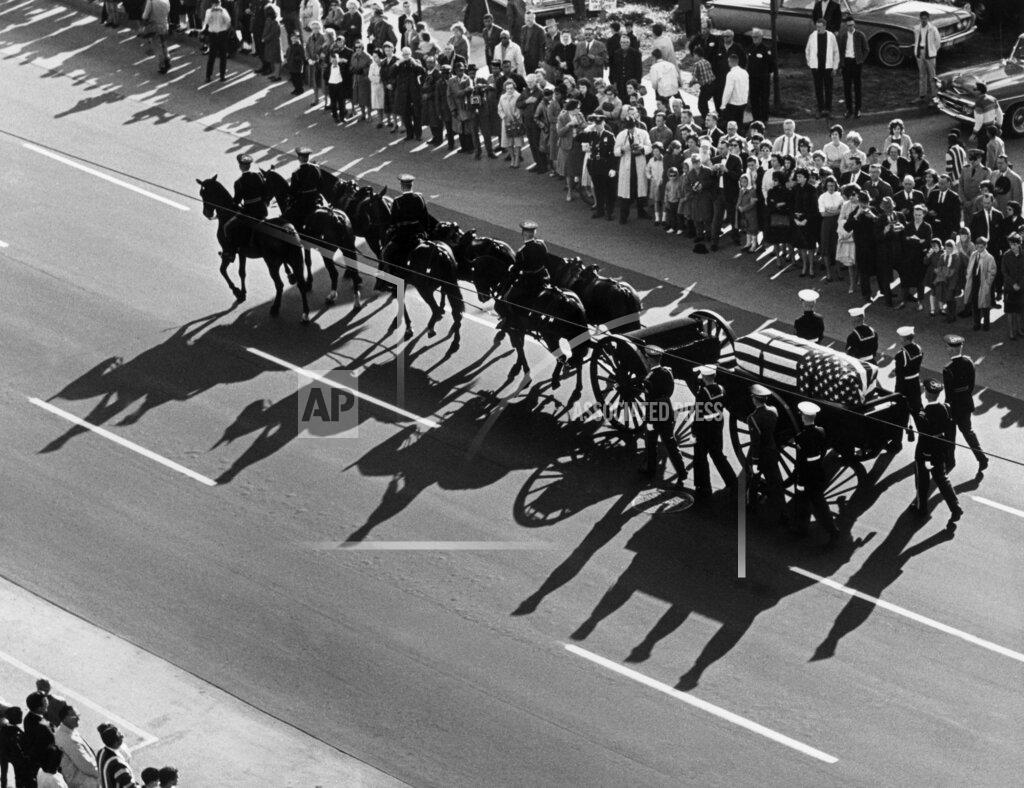
General of the Army Douglas MacArthur was interred in Norfolk, Virginia today with military pomp and ceremony befitting his role as the highest‐ranking soldier of his generation. In bright sunshine, with what Army officials called the greatest assembly of military men in, this century looking on, the funeral procession traveled the two blocks from the MacArthur Memorial to St. Paul’s Episcopal Church. There, prime ministers, ambassadors, governors, admirals and generals filled the high‐backed pews of the 323year‐old sanctuary. The body was then returned to the MacArthur Memorial for final military honors and interment. Attorney General and Mrs. Robert F. Kennedy, representing President Johnson, led the list of official mourners. They flew here from Washington this morning and returned this afternoon.
The 84‐year‐old general died last Sunday at Walter Reed Army Medical Center in Washington, after three major operations in 17 days. The interment ended six days of lying in state and military pageantry that began in New York last Monday, and continued in Washington Tuesday and Wednesday. It took place on the 13th anniversary of General MacArthur’s dismissal as Supreme Commander of the Allied Powers in Korea and the Far East.
President Johnson signed today a farm bill providing major changes in Federal wheat and cotton subsidies. The legislation “gives us some insurance against a depression on the farm,” the President said, adding: “It is on the farms of America where depressions begin. We are dealing with a depression before it begins and not afterwards.” The cotton‐wheat measure authorizes, for the first time, a federal subsidy to textile mills to enable them to compete with foreign mills and passes to wheat processors a part of the cost for supporting wheat prices.
It should result, the Administration’s farm experts contend, in a reduction for consumers in, the prices of sheets, shirts and other cotton goods. There should be no increase in the price of bread and other wheat products despite opponents’ contention that the bill imposes a “bread tax,” because the price of wheat will be the same as before the bill, they said. The new law will provide about $1 billion in payments to cotton and wheat farmers, but this amount will be about $218 million less than the programs it replaces, Department of Agriculture officials said. Further, they say the savings will be greater in future years when the surplus stocks of cotton and wheat are reduced to necessary reserve size.
President Johnson signed the bill that cleared the House early Thursday morning after a bitter partisan fight. The signing ceremony in the White House Cabinet Room was witnessed by Democratic Congressional leaders, some farm organizations and organized labor representatives, including George Meany, President of the American Federation of Labor and Congress of Industrial Organizations. The signing brought the first major change in the wheat program format since it was first conceived during the first Administration of President Franklin D. Roosevelt. The new cotton program is a triple‐subsidy plan, aiding textile mills as well as cotton farmers and exporters.
A neo‐Dixiecrat faction defeated today an attempt to assure President Johnson a place on the ballot in Louisiana if he is the Democratic nominee. The vote in the State Democratic Central Committee was 51—50. Leander H. Perez, the segregationist political boss of Plaquemines Parish (county), led the fight against the loyalists, who sought to repeal a resolution approved by the committee last September providing for unpledged Presidential electors. He had the apparent backing of the forces of the Governor-elect, John J. McKeithen, who takes office May 12.
The bottom isn’t falling out of the defense business, at least not yet, but the growth is, economists who have been studying the effect of recent cutbacks on the arms contractors report. This is forcing the country and the defense industry to think about the economics of a transition from an economy sparked by a munitions boom to one projected forward and upward by a newly strengthened civilian economy. The small group of economists who have been preparing for the transition laugh at the industry leaders who, as one put it, “approach the wailing wall, rend their garments, don sackcloths and ashes, and recite from the Book of Lamentations.” These economists have been reporting recently on their studies in a variety of places, to the Senate subcommittee on Manpower, before the Electronics Industries Association in Washington last month, in a symposium in the current issue of the Bulletin of the Atomic Scientists and in several economic reviews.
James R. Hoffa has been under investigation since September, 1962, by the Department of Justice on a charge of allegedly plotting the assassination of Attorney General Robert F. Kennedy. The charge against the Teamster president was made in 1962 by Edward Grady Partin, a Baton Rouge, La., Teamster official. He spoke to Justice Department officials and took a lie‐detector test given by the Federal Bureau of Investigation. Two months ago, Mr. Partin appeared at Hoffa’s jury‐tampering trial here as the Government’s star witness. During sharp cross‐examination by Hoffa’s defense attorneys, Mr. Partin made a cryptic reference to the alleged plot.
The Government objected, saying the defense was trying to inject matters “not related to this case.” The Government feared that references to the alleged plot would be ground for a mistrial. United States District Judge Frank W. Wilson then cleared the courtroom and held a closed session with defense and Government lawyers to settle the matter of what would be admissible in open court. Hoffa was also present.
A transcript of that closed session has now been revealed. It was ordered sealed at the time and became public when the judge filed a memorandum with the court record for the United States Court of Appeals for the Sixth Circuit in Cincinnati. Hoffa and three associates were convicted of jury tampering on March 4 and are free pending an appeal. The transcript of the closed session quotes James F. Neal, a special attorney for the Department of Justice, as saying that “this man [Mr. Partin] reported a threat by James R. Hoffa to kill the Attorney General.” Mr. Neal added: “He took a lie‐detector test and passed it with flying colors.”
Stephen Sondheim’s musical “Anyone Can Whistle” closes at Majestic Theater, NYC, after 9 performances.
Former Houston right-hander Jim Umbricht’s ashes are privately scattered from a small plane over Colt Stadium, his home ballpark with the Colt .45’s for the past two seasons. The popular 33-year-old reliever, the only pitcher to post a winning record during the expansion team’s first two seasons, lost his well-publicized battle to a malignant melanoma three days ago.
Born:
John Cryer, British politician who has served as Member of Parliament for Leyton and Wanstead since 2010; in Darwen, Lancashire, England, United Kingdom.
Bret Saberhagen, MLB pitcher (World Series Champions, MVP-Royals, 1985; Cy Young Award 1985, 1989; All Star, 1987, 1990, 1994; Kansas City Royals, New York Mets, Colorado Rockies, Boston Red Sox), in Chicago Heights, Illinois.
Wally Whitehurst, MLB pitcher (New York Mets, San Diego Padres, New York Yankees), in Shreveport, Louisiana.
Amalio Carreño, Venezuelan MLB pitcher (Philadelphia Phillies), in Chacachacare, Venezuela.
Rocky Trottier, Canadian NHL right wing (New Jersey Devils), in Climax, Saskatchewan, Canada.
Eric Cobble, NFL running back (Houston Oilers), in Austin, Texas.
Bill Callahan, NFL defensive back (Buffalo Bills), in Natrona Heights, Pennsylvania.
Steve Azar, American country singer and songwriter (“I Don’t Have to Be Me (’til Monday)”), in Greenville, Mississippi.
Johann Sebastian Paetsch, American cellist and musician, in Colorado Springs, Colorado.
 History Diaries