A terrorist attack killed 18 people, including women and eight children, as three members of the Popular Front for the Liberation of Palestine (PFLP) crossed from Lebanon into the town of Qiryat Shmona in Israel. The PFLP guerrillas had originally invaded the town’s elementary school, but the school was closed for the Passover holiday. The terrorists were themselves killed. It was the worst such attack since 1972, when 27 people were killed at the Tel Aviv airport.
Describing the attack as “murder for murder’s sake,” Premier Golda Meir declared that Israel was holding the government of Lebanon responsible for the deaths along with Lebanese “who collaborated with the terrorists.” Mrs. Meir issued the denunciation just three hours after she and her cabinet formally resigned from office. Mrs. Meir will head a caretaker government until a new government is formed, probably after new elections.
Bad news in Israel is usually regarded as good news in the Arab world, but today things were not so simple. Satisfaction over Israel’s political disarray was mingled with expressions of fear that the move toward a negotiated settlement will be hopelessly delayed and that hard‐liners may come to power in Israel. Arab newspapers from Casablanca to Qatar interpreted Premier Golda Meir’s resignation as a sign of growing internal weakness in Israel, as evidence that the balance of power has been shifting inexorably in favor of the Arabs since the October war and as confirmation that Arab strategy since last fall has been correct. Israel for the first time in 25 years is no longer seen by the Arabs as an impregnable American‐supported superman, against whom no possible Arab action could succeed.
Secretary of State Kissinger has reportedly given the Senate Foreign Relations Committee a gloomy report on the immediate prospects for a Middle East settlement, improved United States relations with Western Europe and a nuclear arms agreement with the Soviet Union. Sources close to the committee said that Mr. Kissinger told a closed session on Wednesday that despite progress made during his visit to Moscow, the Soviet position regarding the arms talks was “unacceptable” to the United States.
President Nixon and Secretary of State Kissinger will meet tomorrow with the Soviet Foreign Minister, Andrei A. Gromyko, to work out areas of agreement and to build public support for Mr. Nixon’s planned visit to Moscow in June. Although Mr. Kissinger, in three days of talks with Leonid I. Brezhnev, the Communist party leader, two weeks ago in Moscow was unable to achieve any major breakthroughs, the Administration wants to maintain a sense of momentum in Soviet‐American relations. It hopes to secure at least another partial agreement in limiting strategic arms while Mr. Nixon is in Moscow, along with a half‐dozen other, less significant accords to further cooperation.
Leonard I. Brezhnev, the Soviet leader, today warned the visiting Syrian President, Hafez al-Assad, that the United States and Israel might try to substitute a Syrian‐Israeli disengagement agreement, for a genuine peace settlement in the Middle East. Speaking at a dinner for the Syrian leader, Mr. Brezhnev said “ersatz plans” for disengagement would mean “replacing an over‐all settlement with partial agreements of different kind.” The Soviet leader’s warning, which came only a few days before Syria was to send a negotiator to Washington for talks with Secretary of State Kissinger, appeared intended to stiffen the tough bargaining position already taken by Damascus. Mr. Brezhnev, apparently reflecting the Kremlin’s sensitivity at having been eclipsed by the personal diplomacy of Mr. Kissinger, went on to thank Syria for recognizing “the importance of the Soviet Union’s participation” in any peace settlement.
The Kremlin leaders mounted an elaborate welcome for Mr. Assad, who arrived here today on a visit that appeared directly related to efforts to effect disengagement. Israeli and Syrian forces have been skirmishing for several weeks in the Golan Heights area. In his dinner speech, Mr. Brezhnev did not directly name the United States and Israel as conspirators trying to thwart complete settlement, but his implications were clear. “The danger lies in the fact that against the background of a certain decrease of tensions, the aggressor and its patrons may try again to avoid a radical all‐encompassing solution of the problem,” the Soviet leader said.
Saigon said its forces knocked out a Communist tank and killed eight rebels at Đức Lập in a series of scattered clashes throughout the country. In a major scandal, a military court handed down death sentences in absentia for five alleged leaders of a smuggling ring in which 51 military and civilian officials have been implicated. The five escaped capture when police seized military trucks carrying imported wine and cigarettes bound for the black market.
Commerce and industry came to a virtual halt in Japan as some 6.3 million workers walked off their jobs in the nation’s largest strike. The strikers included railway, airline, bus, subway and taxi workers, who crippled Japan’s transportation system, forcing many businesses to close. Negotiations to end the worst transportation strike in Japan’s history continued until late in the day but no progress was reported. Many people were forced to find their way to work in private cars, on bicycles or by walking-often down idle railway tracks. About two-thirds of Japan’s 110 million population were affected one way or another by the strike, the climax to the nation’s annual “spring labor offensive.”
Thirty-two seamen were reported missing after two separate collisions involving four ships off western Japan. One collision was between the 21,467-ton U.S. container ship President Pierce and the 999-ton South Korean vessel Kaiei-Ho. The Korean ship split in two and sank. Only eight of its crew of 26 were rescued. The other mishap involved the 11,144-ton Liberian-registered Ocean Sovereign and a Japanese tuna boat which keeled over with 14 of its 17-man crew believed trapped inside, Japanese officials said. There were no reports of major damage or casualties on either of the larger ships in the two collisions.
Police in The Hague arrested Jacobus P. Phillipps, a Netherlands native who had served as an officer for the Nazi German SS during World War II, after Phillips had spent more than 29 years hiding in his parents’ home. Since 1945, Phillips had stayed inside the home and had been given a death sentence after being convicted of war crimes in absentia in 1950. Phillipps was taken to Scheveninger Prison and then transferred to Assen, where his conviction had taken place.
British Prime Minister Harold Wilson’s longtime personal secretary, Marcia Williams, a central figure in a political storm over property deals, said her conscience is clear and she has no intention of resigning. Mrs. Williams said in a newspaper interview that she and her brother invested money in wasteland that was cleared of slag and sold for industrial development. There has been no suggestion that Wilson was involved personally in the land deals but the transactions have raised a furor because Wilson’s Labor Party has criticized large profits from land speculation.
A British soldier and a militiaman were killed in guerrilla bomb explosions in Northern Ireland, military headquarters reported in Belfast. The soldier was killed when a land mine blew the truck he was driving off the road near Lisnaskea on the border with the Irish Republic, a spokesman said. The militiaman was killed in a booby-trap explosion in Dungannon, 50 miles west of Belfast, the army announced.
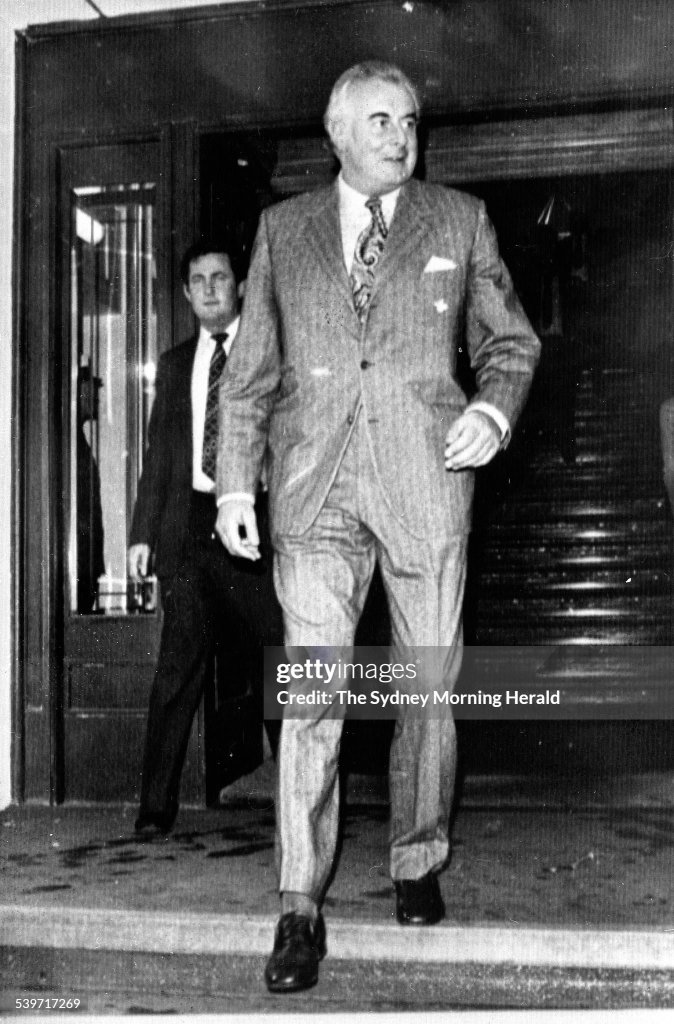
Australia will hold a general election May 18, according to an announcement by Prime Minister Gough Whitlam who said the main issue would be the frustration of his legislation by the opposition-controlled Senate. His Labor government’s three-year term still has 20 months to run.
Ten thousand chanting workers poured through the streets of Addis Ababa to demonstrate outside Ethiopian Emperor Haile Selassie’s palace for sweeping social reforms. The workers mainly municipal railway and bus employes-demanded the dismissal of the city’s mayor and shouted slogans including “Land to the Tiller,” “Liberty” and “Down with Feudalism.”
President Houari Boumediene of Algeria spent more than an hour today at the White House in talks with President Nixon. American and Algerian officials said that most of the discussion dealt with changes in the economic relations between rich and poor countries. Yesterday Mr. Boumediene said at a special session of the United Nations General Assembly convened at his request that the underdeveloped countries must take control of their resources from foreign domination. The two leaders also discussed the Middle East and Algerian‐American questions, including some joint economic projects and the possibility of resuming diplomatic ties. Those ties were severed by Algeria after the Arab‐Israeli war of June, 1967.
The bipartisan Judiciary Committee of the U.S. House of Representatives voted, 33 to 3, to subpoena U.S. President Nixon to submit the actual tape recordings of 42 specific conversations in the Oval Office, after the repeated refusal by the White House to comply with previous requests.
A jury in Pennsylvania convicted former United Mine Workers of America (UMWA) president W. A. “Tony” Boyle of the 1969 murder of his union rival, Joseph “Jock” Yablonski and Yablonski’s wife and daughter in 1969.
Rejecting a last-minute White House attempt at compromise, the House Judiciary Committee issued a subpoena ordering President Nixon to turn over all tapes and documents previously requested by the committee. The subpoena, which sets an April 25 deadline for compliance, is reportedly the first ever served on a President by a House committee. It was authorized by a 33-to-3 vote, with only a minority of the Republicans dissenting, after the committee had rejected a White House compromise offer to provide some of the material.
Shortly after receiving the committee subpoena, the White House said it would “have an answer” for the committee after Congress returns from its Easter recess on April 22. However, a presidential spokesman indicated that Mr. Nixon would not provide all the material sought by the committee.
The Watergate prosecutor has reportedly subpoenaed the income tax returns of two of President Nixon’s closest friends — Charles Rebozo and Robert Abplanalp — in connection with an investigation into a $100,000 cash campaign contribution from Howard Hughes. Prosecution investigators have been trying to determine if there was any misuse of the money before it was returned.
After 13 days of debate and 51 roll call votes, the Senate passed a sweeping campaign reform bill that would replace private donations with public financing for presidential and congressional campaigns beginning in 1976. Nevertheless, the bill, which cleared the Senate by a vote of 53 to 32, faces stiff opposition in the House and the threat of a presidential veto.
A Nixon administration program to spur domestic oil production by allowing price increases has failed to produce more oil. It has, however, led to price increases that are reportedly costing consumers $4.5 billion a year and providing oil companies with soaring profits.
Legislation to reinstate the death penalty, approved decisively by the Senate a month ago, appears unlikely to clear the House before this uneasy election‐year session of Congress adjourns. Unless the House passes its own version of a capital punishment bill and reconciles it with the Senate measure before the lawmakers close shop for the year, probably in autumn the legislation will die, and the entire process will have to be begun again in 1975. Casting a shadow over prospects for House action on the death penalty is the preoccupation of the Judiciary Committee there with impeachment, lack of leadership enthusiasm for tackling the sensitive issue and the relatively short time, by Congressional standards, that is left for action. President Nixon has been a major advocate of overruling by legislation the decision of the Supreme Court in 1972 outlawing capital punishment. If a bill does not reach his desk by campaign time, he can be expected to accuse Democratic Congressional leaders of failure to move against crime.
Steel industry contract negotiations hit a snag as industry and union bargainers failed to reach agreement. Both sides, however, continued talking into the night in hopes of reaching an accord before their self-imposed deadline today. Sources said a final agreement on contracts for 350,000 basic steel workers still might come before the actual deadline on Monday. After that, disputed issues would be sent to binding arbitration. There was no indication of the difficulty but the sources said that the problems centered around the industry’s pension plan. An agreement is expected to follow settlements in the aluminum and can industries, which included wage increases averaging 13% over 40 months and an improved cost-of-living escalator clause.
The House passed unanimously a substitute to the Senate’s disaster relief bill, killing any chance for final passage before a 10-day Easter recess. The substitute was introduced by Rep. John A. Blatnik (D-Minnesota), who said the House was unprepared to act on a measure that had passed the Senate only a day earlier. Before adjourning for the recess, the House appointed conferees to work out differences between the bills. The basic difference in the two measures is that the House, unlike the Senate, would allow the President to lend the states the 25% they must contribute to a $5,000 grant program.
President Nixon signed into law an emergency $750 million supplemental appropriation to pay fiscal year-end education benefit checks to 2.5 million veterans. The Veterans Administration had said it will run out of money without the appropriation because of a huge increase — from 1.9 million to 2.5 million — in veterans attending schools under the Vietnam-era veterans’ benefits bill. That bill required that benefits be paid in advance and that all eligible veterans be contacted and advised of their right to education funds.
Federal offices used by former Vice President Spiro T. Agnew since his resignation were closed Wednesday, it has been learned. The closing coincided with his loss of the franking privilege. Agnew moved into the offices at Jackson Place, one block from the White House, after he pleaded no contest to income tax evasion and resigned the Vice Presidency in October. He used the offices to organize his papers and clean up official affairs.
Governor John J. Gilligan ordered the Ohio attorney general to provide legal defense for the eight national guardsmen indicted in the 1970 Kent State University campus shootings incident in which four students were killed and nine wounded. The guardsmen have pleaded innocent. Gilligan cited a section of state law that he said permits him to order the attorney general to defend the state or cases where the state has an interest.
One of three federal offenders commits a new crime within two years after his release from prison, according to a new Justice Department survey just released. The rate of repeaters was slightly less than 10 years ago. Nevertheless, “the fact that it’s stayed the same or perhaps a little better means we are making progress, ” said Norman A. Carlson, director of the Bureau of Prisons. This was because federal prisons are getting a much higher proportion of “high-risk” inmates while “low-risk” offenders more often were being spared prison and put on probation.
The Federal Trade Commission took steps today to curb a string of Midwestern truck driver schools, alleging that they had taken up to $895 each from men who thought they were applying for on‐the‐job training. Proposed complaints and orders by the commission would require the schools to stop representing that they are offering employment and would require them to give back any money they had gained through deception. The move represents an expansion of an FTC effort that has already led to complaints against three computer and data‐processing school operations. An $80,000 educational campaign was initiated in August to steer people away from worthless vocational courses.
Dow Jones Industrial Average: 844.81 (+1.10, +0.13%).
Born:
Tricia Helfer, Canadian actress and model (Six – “Battlestar Galactica”, “Lucifer”), in Donalda, Alberta, Canada.
Zöe Lucker, English actress (“Footballers’ Wives”, “EastEnders”), in Huddersfield, West Yorkshire, England, United Kingdom.
Trot Nixon, MLB outfielder (World Series Champions-Red Sox, 2004; Boston Red Sox, Cleveland Indians, New York Mets), in Durham, North Carolina.
Àlex Corretja, Spanish tennis player and winner of the 1998 ATP Finals; in Barcelona, Spain.
Died:
Charles Curtis “Curt” Conway, 60, American actor (“Raw Deal”, “The Twilight Zone”), of a heart attack.


 History Diaries