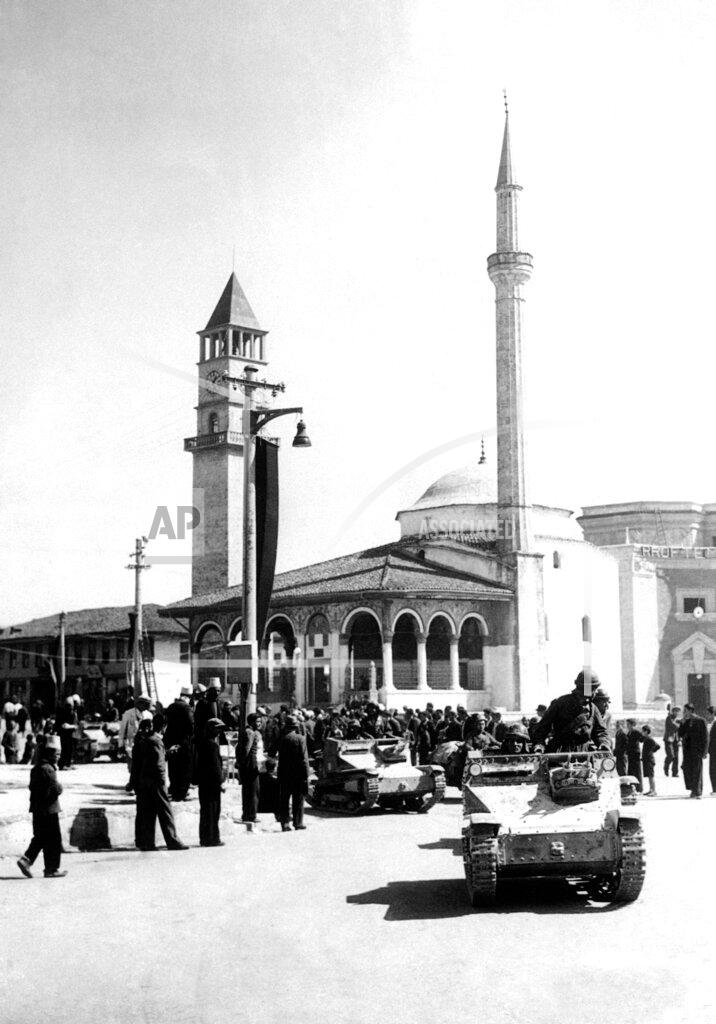
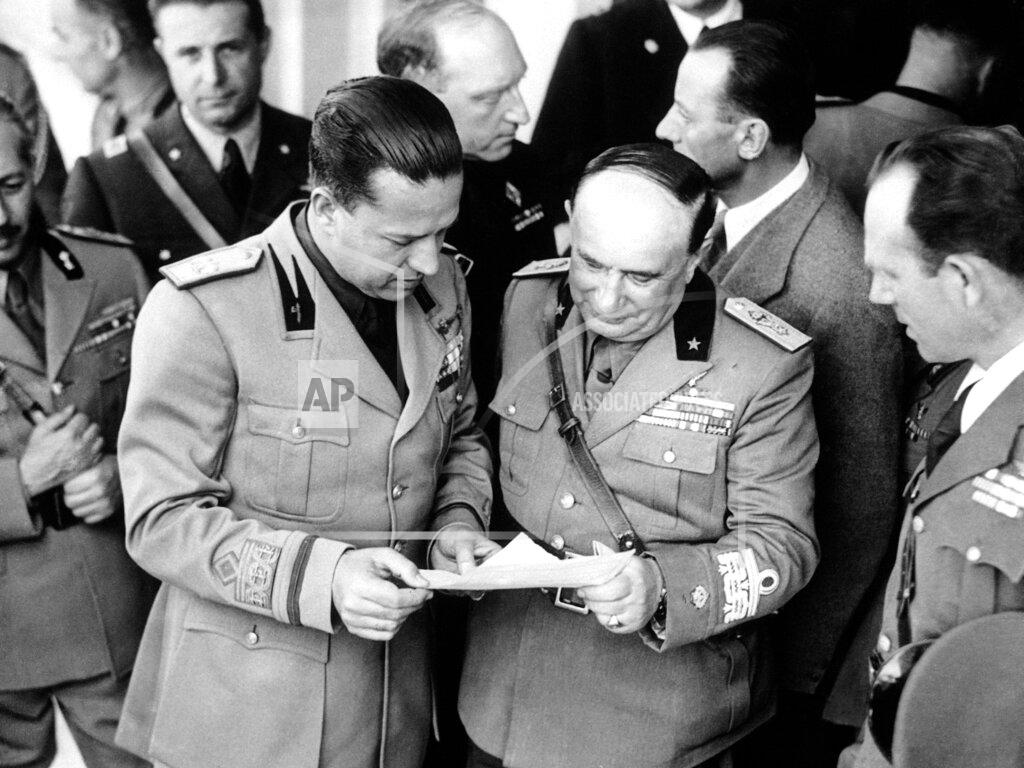
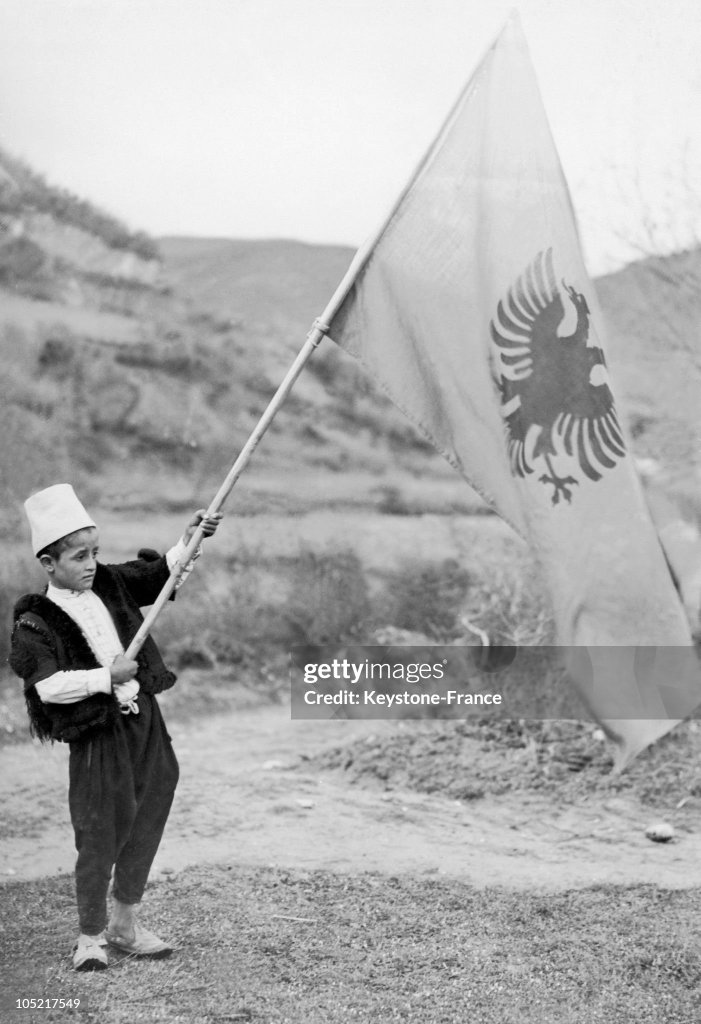
The downfall of independent Albania was completed yesterday when Italian troops entered Tiranë (Tirana) without resistance and continued on toward the eastern border of the little country. They were followed into the capital by Foreign Minister Ciano, who set up a provisional regime, and it was believed that Premier Mussolini might arrive by plane tomorrow. Rome announced appeals by various Albanians to King Victor Emmanuel to accept their country’s crown.
The Italian soldiers reached Tiranë after a night of looting following the flight of Albanian troops into the hills. Italian troops occupied Tiranë, the capital of Albania, bloodlessly at 9:30 this morning. Long before their arrival the town was under the control of an improvised police force, organized by an Albanian colonel of gendarmes with the help of members of the Italian Legation and Italian residents. After taking possession of the government buildings and garrisoning the town the Italian troops continued their march toward the eastern frontier of Albania. Shkodër (Scutari), the second largest Albanian town, situated in the extreme north, was occupied at 3 o’clock this afternoon by a force under orders of General Scattini, advancing from San Giovanni di Medua.
Another force, a mechanized column commanded by General d’Antoni, reached Elbasan this evening. It is believed the whole country will be firmly in Italian hands tomorrow evening. An hour after the arrival of the Italian troops Count Galeazzo Ciano, Italian Foreign Minister, landed at the Tiranë airfield, having been flown in a fast bomber direct from Rome. He was sent there by Premier Benito Mussolini to choose members of the provisional government.
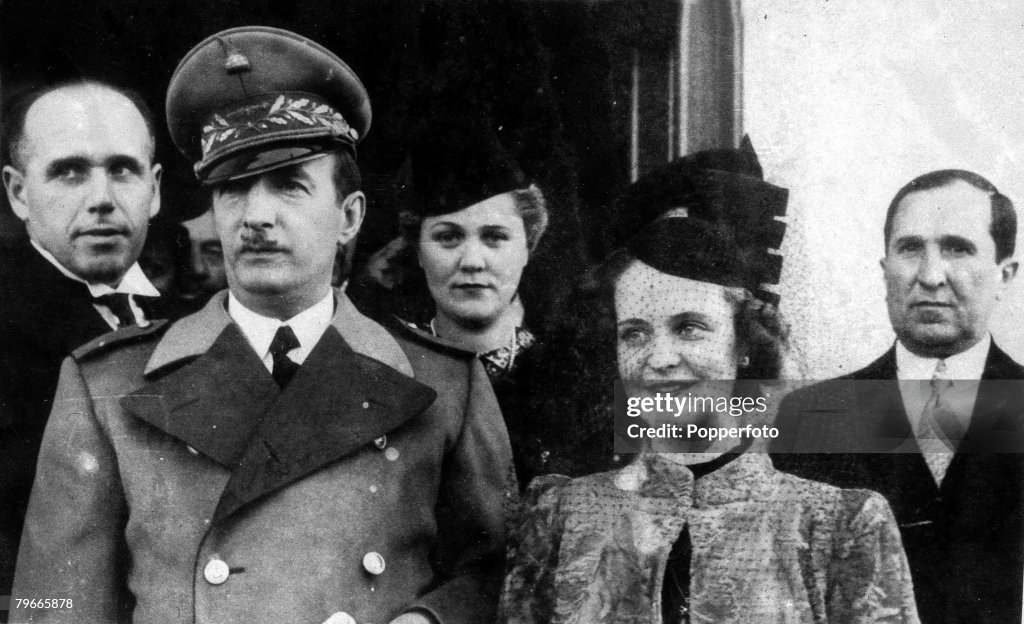
King Zog fled Albania to Greece as Italian forces entered Tiranë (Tirana). King Zog I of Albania, flees the country in the face of the continuing Italian invasion. King Zog fled to the Greek village of Florins, where he rejoined Queen Geraldine and their 3-day-old son. Before their reunion the Queen had issued an appeal to the world against the Italian aggression. Unshaven, and with his eyes red from lack of sleep, King Zog stepped from a mud-splashed automobile in the main square of the frontier village of Florina early today. After seeking directions, he hurried to the inn where his Queen was recovering from the strain of her own flight to safety with their 3-day-old baby. King Zog was accompanied on his wild night drive from Tiranë by a party of army officers, several government officials and his personal detectives. They had a few treasures piled in the backs of the autos.
Little news was to be gained from those accompanying King Zog. One of the Ministers, acting as spokesman for the party, said: “It was impossible. We could not have made a stand against those millions and all their ships and airplanes with our small force of gendarmerie which was acting as an army.”
Prime Minister Chamberlain hastened back to London for an Easter Sunday Cabinet session to consider an immediate pledge of assistance to Greece in case of aggression and possible denunciation of the Anglo-Italian treaty of friendship. An immediate pledge of British assistance to Greece in the event of aggression against her and possible denunciation of the Anglo-Italian friendship treaty are among the serious questions to be considered by Prime Minister Neville Chamberlain and his Cabinet tomorrow in consequence of the Italian invasion of Albania. The Prime Minister was speeding back to London by train tonight ready for decisions that may be as fateful as those provoked by the German march to Prague. Mr. Chamberlain decided to cut short his few days of much-needed rest after ten of his colleagues, under the chairmanship of Sir John Simon, Chancellor of the Exchequer, had passed an hour and a half today in inconclusive discussion of the Albanian problem.
It is possible that Parliament will be asked to reassemble the middle of next week instead of waiting for the end of the Easter recess on April 18. Clement R. Attlee, the Labor Party leader, visited Downing Street today to ask for the immediate summoning of Parliament; a similar request was telegraphed by leaders of the Liberal Opposition, who declared that “the shameful Italian invasion of Albania violates the Anglo-Italian agreement and constitutes a fresh and dangerous assault on the liberties of Europe by the Axis powers.” It is too early to say whether Mr. Chamberlain takes the same view, but there is no question that British officials and Ministers are stirred by what has happened to Albania. For one thing, it has dealt a blow to Britain’s plans for an anti-aggression front by putting military pressure on Yugoslavia and Greece along the Albanian frontiers.
In Istanbul, after a hurried conference between the Turkish and Rumanian Foreign Ministers, it was reported that Turkey had given assurances of assistance to Rumania if she were attacked.
Meanwhile, the German radio and press warned Poland that the Reich regarded the Anglo-Polish agreement as an unfriendly act. Germany, through diplomatic channels and by a press barrage, informed Poland today with the frankness on which totalitarian States pride themselves that the British-Polish defensive alliance is regarded as an unfriendly act toward the Reich. Giving the Polish Ministers the Easter holidays to think over whether they should actually sign the pact which Foreign Minister Josef Beck and Prime Minister Neville Chamberlain agreed upon in London, Chancellor Hitler kept to his Bavarian mountain home near Berchtesgaden to ponder his next move. Evidence mounted that while world attention was centered on the Italian invasion of Albania, German leadership was primarily considering Poland.
Herr Hitler had Foreign Minister Joachim von Ribbentrop talk for an hour yesterday to the Polish Ambassador, Josef Lipski, before Herr von Ribbentrop left on an Easter vacation. It was believed M. Lipski was told what may be some of the consequences of Poland’s final signature of the British alliance. Informed persons assumed that Herr Hitler’s first move, if Poland goes through with the alliance, would be to consider the ten-year Polish-German non-aggression pact, signed in 1934, as having been voided by Poland.
Next, it was believed, would come pressure to make Poland agree to cession of the Free City of Danzig to Germany and permit the building of an extraterritorial highway across the Polish Corridor to link the main Reich and East Prussia. If there is Polish resistance, it was believed here, precedents indicate that Herr Hitler’s demands on Poland might be increased.
Colonel Charles A. Lindbergh sailed today on the Aquitania for New York on an unexplained voyage. He was unaccompanied by members of his family or by other persons. To questions as to the reasons for his trip he simply answered: “I am sorry, but I have nothing to say.” Accordingly, there is neither confirmation nor disproof of recent reports that Colonel Lindbergh intends to report to American aviation authorities on the state of military aviation in various European countries or on prospects of transatlantic airplane service.
The effectiveness of Russian armaments and the striking power of the Red Army have been a matter of considerable speculation. The Red Army is numbered at more than 2,000,000, while it is estimated that in the event of a general mobilization 12,000,000 men could be placed in the field. The formidable. aspect of these figures has been. considerably diminished, however, by the great purge that swept over Russia like a swarm of locusts.
The purge cut a deeper swath through the army than perhaps any other branch of Soviet life. Military experts calculate that during the last two years 75 percent of the officers of the rank of colonel and above have been liquidated. The extent of this sweep becomes significant with the fact that, of the eight officers who court-martialed Marshal Tukhachevsky and his seven colleagues, six have since been shot; and that when the Red Army paraded past Mr. Stalin in November, 1937, officers were not allowed to carry guns in their holsters.
A White House spokesman at Warm Springs, Georgia, in an authentic statement of Administration policy, warned this country that each extension of Nazi-Fascist aggression further imperiled the political safety and economic well-being of the United States. In Washington Secretary of State Hull condemned Italy’s action as a “forcible and violent invasion” and “an additional threat to the peace of the world.” The President said he had personally approved Secretary of State Cordell Hull’s denunciation of the Italian invasion of the Balkan State.
The delineation of President Roosevelt’s estimate of this country’s vital interest in what takes place in Europe was offered to correspondents as a liberal paraphrase of what he told a recent conference of members of the Senate Military Affairs Committee out of which came information that the President had placed the American frontier “on the Rhine.”
The spokesman outlined the President’s position regarding the Nazi-Fascist aggressions as follows: “The continued political, economic and social independence of every small nation in the world does have an effect on our national safety and prosperity. Each one that disappears weakens our national safety and prosperity.” Although the outline of Mr. Roosevelt’s position was given without specific reference to Italy’s invasion of Albania and was applied more generally to the whole field of military aggressions by dictatorship powers, there was no doubt that it was provoked by the Italian conquest.
Eleven cotton state U.S. Senators, meeting today to discuss plans for handling the cotton surplus, agreed on a program which would raise the cost of Federal aid to agriculture next year to more than $1,300,000,000. Four Midwestern Senators who were present at the meeting added a qualified approval. Of the amounts which would be sought, $1,088,000,000 would be in outright subsidies, or about $300,000,000 more than has ever before been appropriated for this purpose. The rest consists of the $224,000,000 carried in the Agricultural Appropriation Bill as recently passed by the House to care for regular activities of the Department of Agriculture.
Meeting primarily to adopt a cotton program, the eleven cotton State Senators today decided to oppose an export subsidy, but agreed to seek new appropriations of $250,000,000 for parity payments on cotton, corn, wheat, tobacco and rice, or $150,000,000 for surplus purchases in addition to the $92,000,000 now contained in the House Agricultural Bill, and sufficient funds, estimated at $96,000,000, to pay cotton farmers who stay out of the loan plan three cents a pound on all they raise. $500,000,000 for Conservation Besides these subsidies, agriculture, under the House bill, also would receive $500,000,000 again next year for soil conservation payments.
The Senate also debated the Relief Appropriation Bill, agreeing to vote at 2:30 PM on Monday on an amendment to increase the appropriation to $150,000,000; confirmed the nomination of Frederick I. Thompson to the Federal Communications Commission, heard Senator Borah criticize American foreign relations policies, and adjourned at 4:52 PM until noon on Monday.
Secretary Perkins said today that she did not expect to enter the controversy over proposed amendments to the National Labor Relations Act, a statement regarded as an indication that the Administration intended to leave to Congress the decision in the matter. The Secretary stated that she was studying a request from the Senate Labor Committee for information with regard to the amendments but she expected merely to give an answer on how each amendment would function from an administrative viewpoint and not to enter into the controversy. Chairman Thomas of the Senate Labor Committee, which is opening hearings on the amendments Tuesday, revealed that Secretary Perkins had asked to be the last witness and that the request had been granted. He asserted that if an Attempt were made to “emasculate” the act, “of course the Administration will come to its aid.”
Miss Perkins asserted that the American Federation of Labor and the Congress of Industrial Organizations were “closer together” on a settlement of their long controversy as a result of negotiations during the past week. She added that the minds of the conferees “have met on one or two important items,” but refused to amplify upon this, remarking that she expected the committees of the two organizations to meet again within a week or ten days. With regard to bituminous coal labor negotiations in New York, Secretary Perkins charged that unnamed manufacturers and utility executives were bringing pressure upon Appalachian soft coal producers not to grant a closed shop to the United Mine Workers Union.
Accomplishments by the WPA on 200,000 projects in three years of operation were described today by Colonel F. C. Harrington, WPA Administrator. The report stated that the WPA had built or improved highways, roads and streets equal in aggregate length to 100 roads across the continent. New public buildings constructed by WPA workers were the equivalent of about six for each of the 3,000 counties in the United States. New school buildings and libraries and additions to existing educational facilities alone were of a sufficient number to place one in each of the country’s 3,000 counties. The educational buildings repaired or improved would provide nearly all of the 25,000 school districts with one improved educational facility each. The report covers work completed from the start of the program in July, 1935, through June 30, 1938. Actual project operations were not under way on a large scale before late November of 1935. So only thirty-one months of work went into most of the projects.
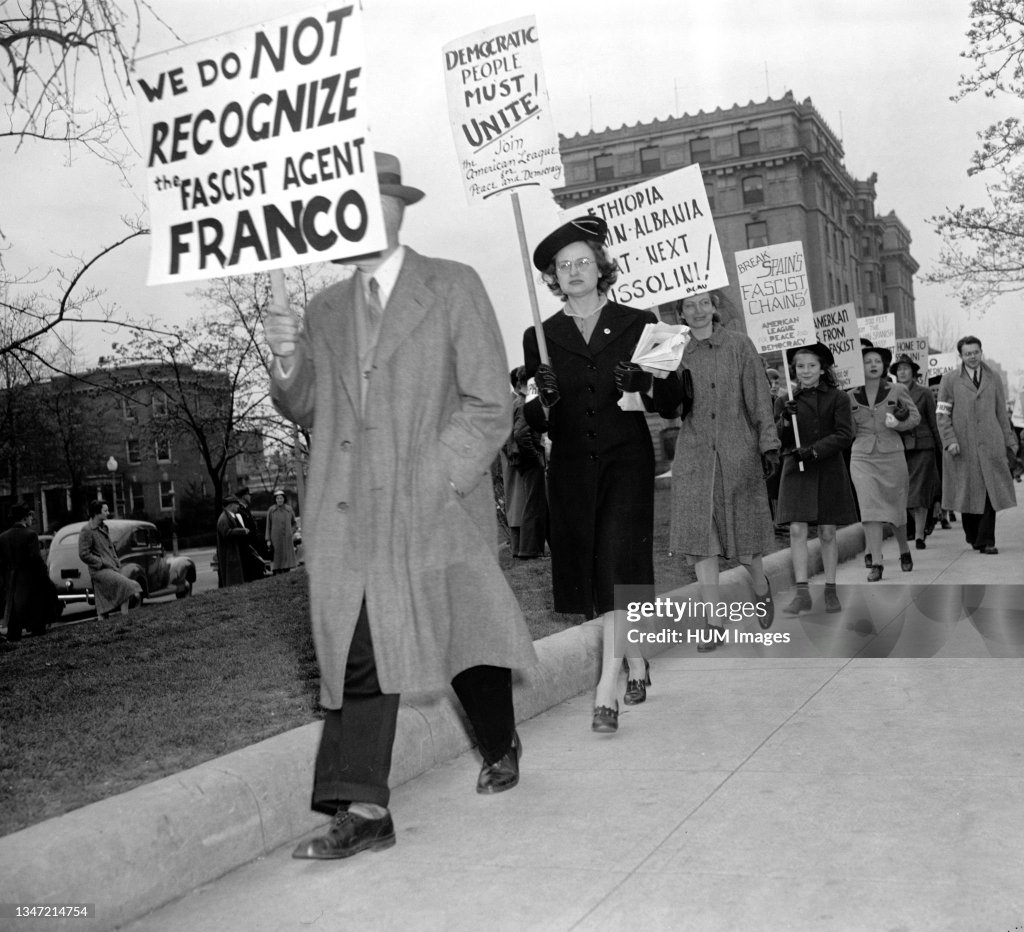
Carrying placards which read “Stop Franco butchering” of Spanish Republicans, 100 members of the American League for Peace and Democracy and the Washington Friends of Spanish Democracy picketed the Italian and Spanish Embassies today. The demonstration was orderly and the pickets took precautions to observe a law passed by Congress last year prohibiting such demonstrations within 500 feet of any foreign embassy or legation. They marched just across the 500-foot line, established at their request by the city surveyor. The police remained in the background. Each marcher wore a white armband bearing the words “Stop reprisals.” Legends on placards included, “Go home to Mussolini,” “Stop Hitler now,” “No American envoy to Spain.”
Dr. Wang Chung-hui, Chinese Foreign Minister, said in an interview at Chungking today that “China could win the war (against Japan) in a year if the United States would apply neutrality measures distinguishing between the aggressor and the victim.” Referring to the recent Russian-Japanese fisheries agreement, embodying Japanese concessions after long negotiations in which both Moscow and Tokyo had remained firm in dispute, Dr. Wang said that if the United States, Britain and France were to display “a firmness” similar to Russia’s it would not only not lead to war, but would serve to “call the Japanese bluff.” The Foreign Minister said that Japan was now backing anti-British agitation in Shanghai and Nanking and that this was proof that Japan was trying to eliminate non-Japanese foreign interests from the Far East.
The Japanese, continuing “cleaning-up operations” in Northwestern Kiangsu Province, asserted today they had killed 777 Chinese soldiers in an engagement today. In Kiangsi Province the Japanese said that their drive from Nanchang westward toward Changsha was progressing rapidly, with the Chinese retreating after heavy losses. Hundreds of Chinese dead littered the highways, the Japanese said.
The Japanese also announced heavy bombing operations against Chinese-held towns along the Yellow River west of the Peiping-Hankow Railway. Japanese planes demolished the residence and damaged other property of the Northern Presbyterian Mission at Hengyang, South Hunan Province, on Thursday, the American Embassy at Chungking announced today. American residents escaped injury. They were Raymond Kepler and his wife of New York City, Lucinda Gernhardt of Woodburn, Indiana, and Frank Newman of New York City.
A remarkable increase in the engagements of Japanese forces with guerilla detachments throughout central and southern Hopeh, Shantung, Shansi and northern Honan was registered this week, according to Japanese military reports received here. North of Tsinan, Shantung capital, Japanese forces say that they encountered 1,500 Chinese regulars and dispersed them after a pitched battle. Another Japanese force west of Tsangchow on the Tientsen-Pukow Railway says that it attacked other guerrilla positions.
In central Hopeh the greatest numbers of forces reported engaged were two columns of Chinese estimated at 3,000 or 4,000 each. Furious other engagements with Chinese forces numbering a few hundreds were also reported from central and southern Hopeh while Japanese reports from Shansi also enumerate several engagements, especially in the Hain River valley in southern Shansi. The Japanese reports declare that in each engagement the Chinese forces were scattered after varying intensity of fighting, leaving their dead as well as amounts of arms and ammunition on the battlefields. The Japanese air force is declared to be active against the Chinese guerrillas in cooperation with infantry and mechanized units.
For the first time this year Japanese planes this afternoon attacked Kunming (Yunnan). Twenty-five bombers that took part in the attack were challenged by Chinese pursuit ships. Meager reports here have not revealed the effectiveness of the pursuit planes or the result of the Japanese bombardment, though it is said that the bombs were dropped outside the city, presumably near the airdrome.
A Central News Agency dispatch from Kiangai claims that the Chinese today recaptured Kaoan, an important city forty miles west of Nanchang. This claim is net substantiated in other quarters.
Chinese planes on Friday raided the airfield outside Nanchang. Results of the raid have not been disclosed.
Dow Jones Industrial Average: 121.44 (-4.88).
Born:
Elizabeth Clare Prophet, New Age minister and writer, in Long Branch, New Jersey (d. 2009).
Naval Construction:
The Вое́нно-морско́й флот СССР (ВМФ) (Soviet Navy) Project 7U-class (Storozhevoy-class) destroyers Silny (Сильный, “Strong”) and Strashny (Страшный, “Terrible”) are launched by Zhdanov (Leningrad, U.S.S.R.) / Yard 190.
The U.S. Navy destroyer USS Sims (DD-409), lead ship of her class of 12, is launched by the Bath Iron Works (Bath, Maine, U.S.A.).
The Marine Nationale (French Navy) contre-torpilleur (large destroyer) Mogador (X 61), lead ship of her class of 2, is commissioned.

 History Diaries