
South Vietnamese troops kill some 75 Việt Cộng in capturing a guerrilla base in northern Kon Tum Province, 300 miles north of Saigon. The Communists call the region the Fifth Interzone Area and it is regarded as an important distribution center for weapons and personnel arriving from North Vietnam by way of the so‐called Hồ Chí Minh trail through Laos.
In Saigon the report of the success was called important politically as well as militarily. Observers believed that the news of the victory will help bolster the Khanh regime. The captured camp was described as the base for a regular battalion of Việt Cộng. It had 50 “comfortable” houses well concealed under foliage, a rifle range and grain storehouses. All the buildings and supplies were destroyed by the government forces before they pursued the enemy battalion. The government force moved were part of a regiment that had moved into the area to search for Việt Cộng strongpoints.
The South Vietnamese Government forces moved toward the base during the afternoon yesterday. Late in the afternoon the soldiers established a camp in a small valley. When some men were sent to get water, heavy firing poured into the camp. Sources said that according to United States military advisers, the government troops rallied quickly and fought back bravely. The battle lasted several hours, until darkness. With complete darkness the Việt Cộng withdrew into the jungle. Sixty dead Việt Cộng were discovered and photographed. The government casualties were said to be one man killed and 25 wounded. There was no opposition when government soldiers entered the base this morning.
Yesterday the Government said that the Southeast Asia Treaty Organization was running the risk of becoming a “paper tiger” because it considered its role limited to prevention of “open aggression” by Communists. A statement issued by the Government of Premier Nguyễn Khánh said that the subversive struggle being waged by the Chinese Communists “does not require frontal attack, uniformed soldiers, or even a battlefront.” The criticism of SEATO was a result of reports here that Konthi Suphamongkhon secretary general of the eight-nation pact, said Monday in Manila that there was no military aggression in South Vietnam and that the struggle there was only an internal quarrel between two factions.
A Communist guerrilla force wiped out a South Vietnamese Army training camp at Phước Lợi, 15 miles south of Saigon, on Wednesday, according to an Associated Press dispatch Thursday. A Saigon spokesman reported that 28 South Vietnamese, including two civilians, were killed.
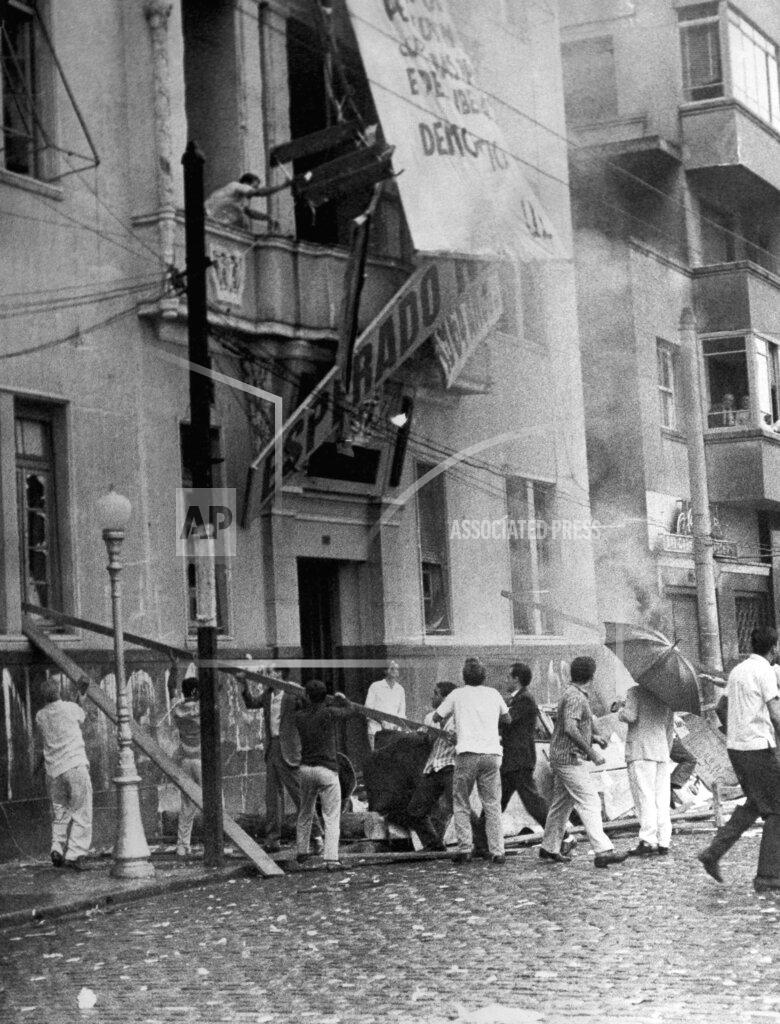
More than 7,000 arrests have been made in Brazil’s roundup of leftists following last week’s revolution, according to a compilation based on official and unofficial reports. The security police reported today a total of 900 raids and the detention of 3,000 people in the state of Guanabara since the overthrow of the Government of President João Goulart. Fifteen tons of Communist propaganda have been seized in the state, which has the same boundaries as the city of Rio de Janeiro. Justifying the number of arrests, revolutionary sources assert that Brazil has just been through a revolution that saved the country from a Communist coup. Carlos Lacerda, Governor of Guanabara, said in an interview that he thought the total of people arrested since the revolution was about 2,000. Guanabara is holding 300 such prisoners, the Navy about 1,000 and the states several hundred, he said.
Governor Lacerda, one of Brazil’s most influential politicians, declared that the military wanted the new regime to have the participation of Congress and other civil authorities. Speaking in English, Mr. Lacerda said that Congress had been reluctant to get on the bandwagon, but that quick action is now expected. Congress is understood to be ready to approve a resolution tomorrow granting the new interim President extensive powers in carrying forward a program of “decommunization” and financial rehabilitation. Mr. Lacerda and six other prominent governors, as well as most military leaders, are supporting the election of General Humberto Castelo Branco as interim President. Congress may vote on the matter Friday or Saturday. The interim President will serve until January, 1966.
The Prime Minister, Sir Alec Douglas‐Home, was said by reliable sources to have informed Queen Elizabeth today that the general election would be held in October. Sir Alec’s office at 10 Downing Street would not comment on the report, but the office indicated that an announcement would be made soon. The announcement is expected within 48 hours and possibly after the close of polling tomorrow night in the elections for the Greater London Council. Some Conservative officials cautioned that the report about what Sir Alec had told the Queen went too far, and that the possibility still could not be ruled out that he would select June if the Conservatives did well in the London voting.
Considerable pressure has built up on Sir Alec the past few days to end the uncertainty over the timing of the general election, partly because it has begun to hinder the work of Parliament and to affect business and industrial planning. The current Parliament ends November 7. It is unusual for British governments to carry on for the full five‐year term that they are entitled to as long as they are not defeated in the House of Commons. But there is nothing against doing so. Queen Elizabeth is scheduled to leave London October 6 for a one‐week trip to Canada. Because British elections are traditionally held on a Thursday — no one knows why — the likeliest polling day in October is considered to be the 15th. The Queen must be available on the day after an election to appoint the Prime Minister.
Sheikh Abdullah, the former head of government of the Indian state of Jammu and Kashmir, was released from incarceration by the government of India after more than ten years of confinement on accusations of seeking Kashmir independence. Abdullah returned to Srinagar to a hero’s welcome.
The Belgian Government said tonight that some of the physicians striking against a new health program were drifting back to work in rural districts. A spokesman for the medical men promptly denied the Government report. However, independent checks disclosed the first cracks in the doctors stand since the strike began eight days ago. An Interior Ministry spokesman, reporting the drift back to work, said: “Sometimes subterfuges are used. If, for example, there are two doctors in a given community, they may trade their list of patients. This makes it appear they are still striking, but in actual fact everyone is receiving treatment.
In Brussels, where the strike is being directed, a group of pediatricians decided to resume house calls. In the light of developments, Premier Théo Lefevre’s Government decided to wait for the doctors to make the next move. The spokesman said the Cabinet could not abandon the program, which provides standard — and lower — fees for medical services, without risking a general strike by labor. About 95 percent of the 10,000 doctors went on strike at the outset. They said the program was the first step toward socialized medicine.
Malaysia’s Prime Minister, Prince Abdul Rahman, said today that he considered the Borneo truce no longer effective and that Malaysian and British troops would strike into Indonesian territory if any big conflict developed. The Malaysian Government’s television station reported the remarks made by Prince Abdul Rahman in an interview concerning the cease‐fire. It has never been fully implemented since it was proclaimed January 26. Prince Abdul Rahman said he did not regard it “to be in operation anymore.” The cease‐fire was arranged by Attorney General Robert F. Kennedy after a tour of this new anti‐Communist federation of former British colonies and of its two neighbors, the Philippines, which is critical of the federation, and Indonesia, which is bitterly hostile to it.
The Government‐controlled Belgrade press has published two articles expressing indignation over attacks on Yugoslavia by Indonesian newspapers and Government figures. One article distributed Monday by the official Yugoslav press agency, Tanjug, spoke of the “possibilities of negative consequences for Yugo-Indonesian relations” and of the “flood of negative and malicious things” emanating from Jakarta. Politika, the largest Yugoslav newspaper, charged that “part of the Indonesian press and certain Indonesian circles” had opened “a cutting, unscrupulous and far-ranging” campaign against Yugoslavia and her foreign policies.
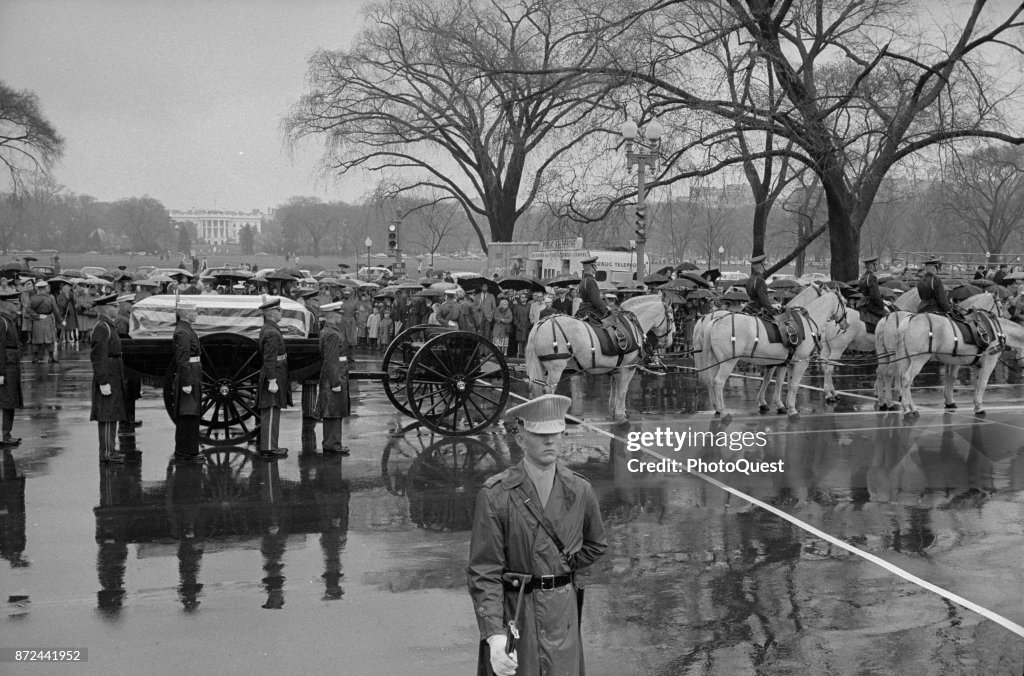
The Government of the United States, led by President Johnson and joined by thousands of ordinary citizens, rendered impressive state funeral honors today to General of the Army Douglas MacArthur. A steady rain added to the somberness of the elaborate mourning procession, in which the flag‐draped coffin of the general was carried with military ritual to lie in state in the Capitol Rotunda. The coffin was brought here by train from New York today. The President, who had met the funeral train at Union Station, placed a wreath of red, white and blue flowers at the foot of the coffin directly beneath the high Capitol dome. Stepping back a pace, he bowed his head and closed his eyes prayerfully.
The President’s jaws worked with emotion as he turned and accompanied the general’s widow, Mrs. Jean MacArthur, and her son, Arthur, out of the Rotunda, ending the day’s ceremonies. Then, as the public viewing began in the late afternoon, the rain stopped, and the sun came out brightly. It bathed the glistening wet monumental buildings of Washington in white spring light. The general public, eight abreast in a line that stretched several blocks east of the Capitol, thankfully folded umbrellas and began filing past the open coffin, under ceremonial armed guard of the uniformed services. Even after the first rush, a double line of viewers passed around the bier in a line that extended two blocks alongside the Supreme Court Building.
Opponents of the civil rights bill drew new strength today from the showing of Governor George C. Wallace in Wisconsin’s Presidential preferential primary. The reaction in the South, stronghold of these forces, indicated that his sizable vote would be used as a propaganda windfall nationally despite conflicting interpretations of the outcome. The Middle West in general was surprised and Democratic politicians were stunned by Mr. Wallace’s showing. A sounding of sentiment among political observers, public officials, civil rights leaders and newspaper editors found some evidence that the Alabama Governor’s feat had already brought some definite changes in the South.
In politics, Mr. Wallace appeared to have breathed at least temporary new life into the moribund drive by neo‐Dixiecrat factions for unpledged Presidential elector slates. The states affected in this respect are his own, Mississippi and, possibly, Louisiana. Some partisans of Senator Barry Goldwater argued that the Wallace vote substantiated their contention that a conservative tide was running. They asserted that the Arizonan’s bid for the Republican Presidential nomination had thus been enhanced. The sharpest reaction came from contending forces in the racial struggle. Segregationists hailed Wisconsin as a victory, a demonstration of their contention that the North, as well as the South, was opposed to racial change. White moderates and liberals expressed the feeling that they had been deserted and that their position had been undercut, at least for a time. Blacks voiced bitterness.
Four of five railroad-operating unions struck against the Illinois Central Railroad without warning, bringing to a head a 5-year dispute over railroad work rules. The surprise strike against the Illinois Central Railroad today brought the nation to the brink of a national railroad shutdown. The national walkout could occur at 12:01 AM Friday. Labor Secretary W. Willard Wirtz, after conferring with President Johnson at the White House, called representatives of the carriers and the five operating rail unions into a meeting with him at the Labor Department to attempt to devise a solution that would head off the walkout. The Secretary indicated to the officials of the unions and carriers that he planned to hold them in continuous bargaining up to the strike deadline in an effort to avert a shutdown.
“The ability or failure to reach agreement will determine whether there is or is not to be a major disruption in the nation’s present encouraging economic advance,” the Secretary said in a statement that he read to both sides and made public. “It will also affect materially the future of free collective bargaining in this country. There are 28 hours before the possible shutdown. This is time to resolve this dispute or to agree on a procedure for resolving it. I am going to continue the present session until this result is reached, and I request the full and complete cooperation of all parties in reaching it. The public interest demands that this dispute be settled, that it be settled immediately, and that it be settled by agreement.”
The House of Representatives gave President Johnson’s legislative program a lift early today by passing an election‐year farm bill and authorizing a nationwide food stamp plan to aid needy families. As the climax of a long, boisterous and bitterly partisan session, the House approved a wheat‐cotton bill aimed at bolstering farm income. The bill also adds a new subsidy to help American textile mills compete with foreign mills. The roll‐call vote was 211 to 203. Before midnight, Democrats beat down Republican attempts to scuttle the food stamp plan that the President had given priority in his “war on poverty.” It will enable needy families to buy a greater variety of foods for better diets. The roll‐call vote was 229 to 189.
The food‐stamp measure now goes to the Senate where it must await the end of the civil rights fight and hearings by the Senate Agriculture Committee. Democrats displayed rare unity in rejecting all Republican amendments to the food-stamp plan, including a key move to require states to share equally with the federal government in the cost of the program. Republicans sought to delay the food‐stamp bill by demanding an engrossed bill or a copy in its final typographical form. This rarely used members’ privilege delayed proceedings but failed to dim the Democratic leadership’s determination to finish both bills in one long session that started at 10 AM yesterday.
A fundamental revision in the rules that govern trading on the New York Stock Exchange, designed to make sure that public investors are served ahead of stock exchange members, was proposed today by the Securities and Exchange Commission. The exchange has agreed to accept the new rules, following a prolonged and bitter fight with the commission while the rules were being drawn up. The rules are scheduled to go into effect after a required 30‐day waiting period. The regulations will severely limit the circumstances in which exchange members will be allowed to make purchases and sales of stock for themselves, especially if they are also handling orders from the investing public. This buying and selling of stock, by stock exchange members for their own investment, is known as floor trading when it occurs on the exchange’s floor.
It is this floor trading activity that the new rules cover. They constitute the first major change in stock market regulations to grow out of the commission’s two‐year study of securities markets, which was completed last year. The rules are expected to reduce to about 20 or 30 the number of stock exchange members who will be able to engage in floor trading, and probably all of these will be individuals who do nothing else but floor trading. There are now 34 members who confine their activities to floor trading. The new rules do not specifically prohibit floor trading by individuals who also have other responsibilities on the exchange’s floor, such as the handling of public orders. But the commission believes that the practical effect for these persons, more than 400 of whom now engage intermittently in floor trading, will be to prohibit them from continuing this practice. The result, in the commission’s view, will be better and fairer service for the public and less violent swings in stock prices.
Roy M. Cohn took the witness stand in Federal Court yesterday and denied all the government’s perjury and conspiracy charges against him. Picturing himself as an innocent victim of a vendetta, Mr. Cohn said that his trial was an attempt “by a few people in the Department of Justice to get me.”
He denied that he had conspired with his co‐defendant, Murray E. Gottesman, also a lawyer, to prevent the indictment of four swindlers in a 1959 investigation of a$5 million fraud in stock of the United Dye and Chemical Corporation. He denied he had lied to a grand jury. He denied he had used threats or otherwise induced other witnesses to lie to a grand jury. And he denied with equal force a charge — not included in the indictment but voiced by government witnesses — that he had split a $50,000 payoff with a former Federal prosecutor. This charge had been assailed Tuesday by former United States Attorney S. Hazard Gillespie and by his chief assistant, Morton S. Robson, who was alleged by a prosecution witness to have received two-thirds of the payoff in a Las Vegas hotel elevator.
Mr. Gillespie, the first witness for the defense, took full responsibility for the 1959 indictment. He also said that the omission of the four men — who later pleaded guilty to the stock fraud — was a wise decision at the time. Mr. Robson denied he had ever been in Las Vegas. Supporting witnesses testified yesterday that they had seen him in New York on the day of the alleged payoff. The testimony of Mr. Gillespie and Mr. Robson was considered so effective by the defense that it was decided to put Mr. Conn on the stand without further delay.
New York Governor Rockefeller called on President Johnson today to abandon the Administration’s deadline of 1970 for landing a man on the moon, in the interests of the astronauts’ safety and the nation’s prestige. “Our exploration of space should be based on our own purposes, not on a mythical race with an opponent whom sometimes we race and other times we invite to participate,” the Governor told a student audience at The Johns Hopkins University. He asserted that President Kennedy’s setting of 1970 as the date for a successful moon flight had been “essentially a political decision.” He called for a return to “the deliberate expansion of man’s knowledge as was done in the Eisenhower Administration.” It was the first time in Mr. Rockefeller’s campaign for the Republican Presidential nomination that he had broadly criticized the Administration’s space program.
The United States launched its first Project Gemini spacecraft, capable of accommodating two astronauts and a successor to the one-astronaut Project Mercury capsules. The unmanned Gemini 1 ship lifted off from Cape Kennedy in Florida at 11:00 a.m. and, along with the second stage of its Titan II rocket, reached orbit six minutes later. Mission plans did not include separation of the Gemini spacecraft from stage II of the Titan II Gemini launch vehicle (GLV), and both were inserted into Earth orbit as a unit six minutes after launch. The planned mission included only the first three orbits and ended about 4 hours and 50 minutes after liftoff with the third orbital pass over Cape Kennedy. No recovery was planned for this mission, but Goddard continued to track the spacecraft until it reentered the atmosphere on the 64th orbital pass over the southern Atlantic Ocean (April 12) and disintegrated, burning up in the atmosphere on re-entry over the South Atlantic Ocean.
The James Bond film, “From Russia with Love” premièred in U.S. movie theaters, after its premiere in London six months earlier.
Houston pitcher Jim Umbricht dies of cancer at age 33. Five days before the start of the season, right-hander Jim Umbricht, the only pitcher to post a winning record in Houston’s first two seasons, loses his well-publicized battle with cancer when he succumbs to a malignant melanoma. He was 4-3 with a 2.61 ERA in 1963. His #32 will be the first uniform retired by Houston.
Dow Jones Industrial Average: 824.19 (+1.42).
Born:
Biz Markie (stage name for Marcel Theo Hall), American rapper and DJ (d. 2021); in Harlem, New York, New York.
Pat Ballage, NFL defensive back (Indianapolis Colts), in Fort Hood, Texas.
Frank Sacco, NFL linebacker (New England Patriots), in Yonkers, New York.
Died:
Jim Umbricht, 33, American Major League Baseball pitcher who had appeared in 35 games in 1963 despite being terminally ill with cancer. His last game had been on September 29, as a member of the Houston Colt.45s (later the Houston Astros).

 History Diaries