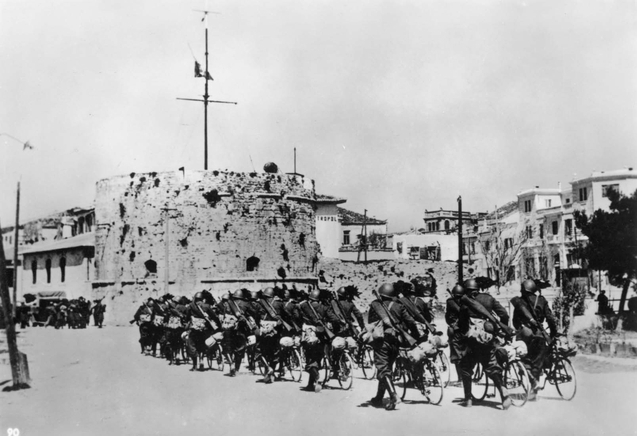
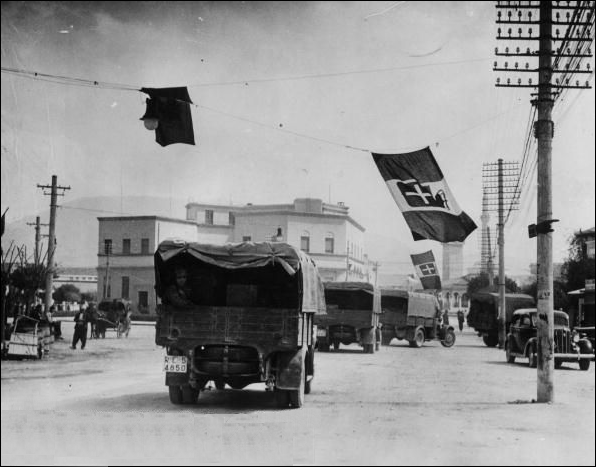
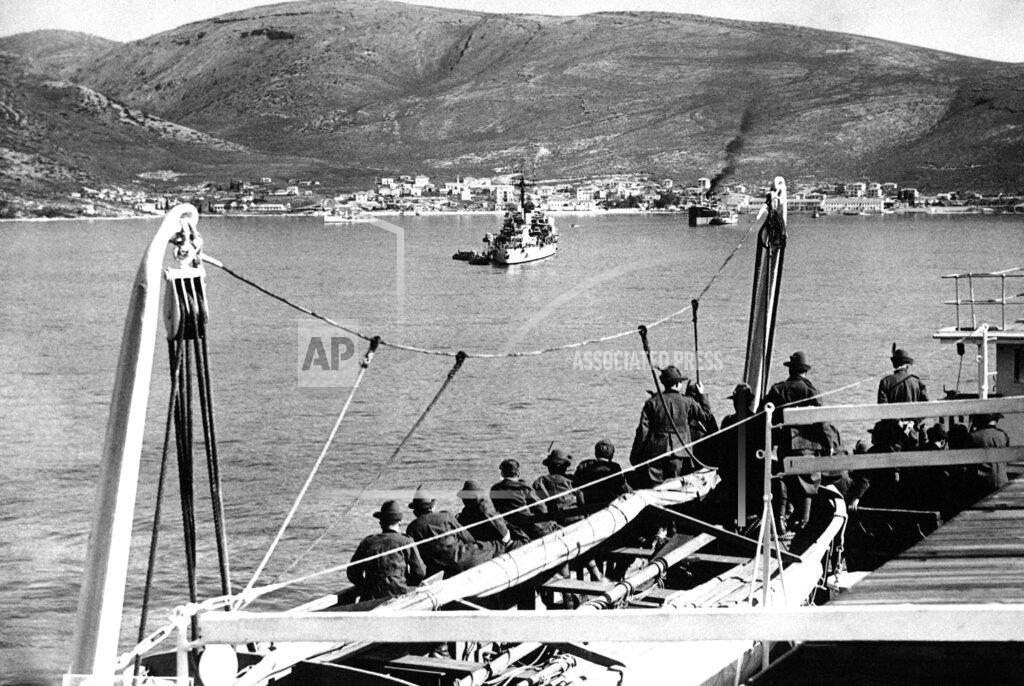
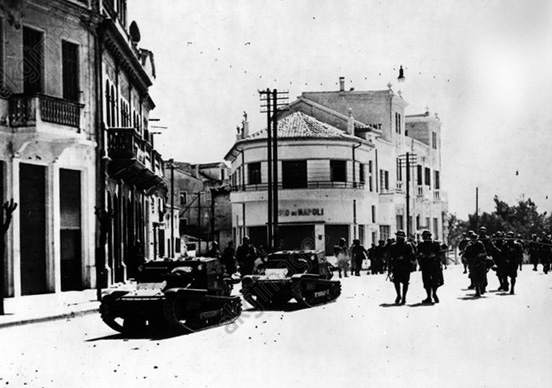
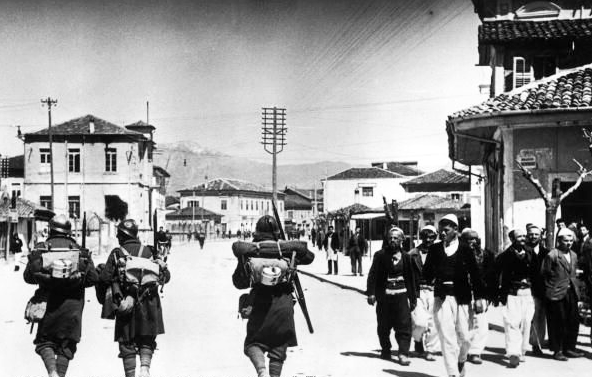
The Italian invasion of Albania began. The Albanians offered little resistance. Italy invades Albania, which offers only token resistance. The Italians bombarded several coastal towns and landed an army.
Italy’s expected invasion of Albania took place yesterday when troops, seizing four ports, advanced inland toward Tiranë (Tirana). They reported encountering little resistance, reaching a point ten miles from Tiranë and halting pending the outcome of negotiations. King Zog and his government fled to Elbasan, twenty-five miles southeast of the capital.
Albanian reports, however, declared that the outnumbered defenders were putting up fierce resistance to the invasion. They said that Vlorë (Valona) and Durrës (Durazzo) were in ruins after Italian naval and aerial bombardments.
In Durrës, a force of only 360 Albanians, mostly gendarmes and townspeople, led by Abaz Kupi, the commander of the gendarmerie in Durrës, and Mujo Ulqinaku, a marine official, tried to halt the Italian advance. Equipped only with small arms and three machine guns, they succeeded in keeping the Italians at bay for several hours. Then a large number of small tanks were unloaded from Italian ships and resistance crumbled. Within five hours Italian troops had captured the city. By 1:30 pm on the first day, all Albanian ports were in Italian hands.
The British Government, through its Ambassador in Rome, protested the Italian invasion, declaring that it violated the Anglo-Italian agreement of 1938, but no further British action in the matter was indicated.
Despite this clear violation of the Anglo-Italian Agreement of 1938, the British government did not intervene. On April 12, the Albanian parliament voted to unite the country with Italy. Victor Emmanuel III took the Albanian crown, and the Italians set up a fascist government under Shefqet Verlaci and soon absorbed Albania’s military and diplomatic service into Italy’s.
Queen Geraldine of Albania fled to Greece with two-day-old son Leka. King Zog remained in Albania briefly. Queen Geraldine fled with her 2-day-old son to a primitive Greek village on the frontier. The Queen, according to the Albanian Legation in Athens, is ill and suffered considerably as the result of her hurried flight. She and the child, accompanied by two ladies in waiting, are reported tonight to be in Florina, a small Greek provincial town on the Yugoslav frontier, where there is no inn that can boast of more than the most primitive comfort.
France was shocked by the Italian move but did not plan a protest. Paris heard reports of German troop movements.
Germany backed Rome’s action and viewed it as an enhancement of the prestige of the Axis. The news that Italy had landed troops in Albania was broadcast throughout Germany late this afternoon. The morning papers contained no mention of impending military action, although initiated circles were prepared for the event following the Italo-German general staff conversations of the last several days at Innsbruck.
Because of the Good Friday vacation official comment of an authoritative nature was lacking tonight. A perfunctory communiqué circulated by the official news bureau said that “Germany has a complete understanding for Italy’s vital interests in Albania.” Neutral military observers incline to view Italy’s invasion of the diminutive kingdom as representing a significant strategic move, which not only will insure her domination of the Adriatic but also “buttress” the Axis powers on the “Eastern front.”
The official Berlin communiqué states: “The landing of Italian troops in Durazzo conforms with the letter and spirit of the 1927 Italo-Albanian. friendship pact as well as with the deep Italian sympathy for the Albanian people. Germany understands that Italy could not permit the formation of a center of constant disturbance in a country on. the opposite side of the Adriatic and of decisive importance to her national interests, which would constitute a menace to the maintenance of order and security of Italian citizens domiciled there.”
Grave concern over fascist aggression was voiced in the Balkan countries. Outwardly Italy’s action in Albania is accepted with composure as unlikely to affect this country’s vital interests and it is stressed by official sources that “Rome kept Belgrade constantly informed of the march of events.” Under the surface, however, there is much heart searching and misgiving. For whatever may be the outcome of this Italian adventure, two facts stand out: First, Croatia has become the junction point of German and Italian thrusts eastward. Second, despite the late King Alexander’s change in the title of his kingdom, Yugoslavia still remains a conglomerate of Serbs, Croats and Slovenes. In a word, Yugoslavia today is not prepared to resist Italy.
The Yugoslav Cabinet had a long session today under Regent Paul’s presidency. It is understood that the chief concern was the protection of this country’s interests in the Adriatic, which are obviously vital. Foreign Minister Alexander Cincar Markovitch informed the Cabinet of the most recent developments, including the démarche by the Albanian Minister here, but it is stressed that no accords exist between Yugoslavia and Albania guaranteeing the latter any material aid. On the other hand, rumors are not lacking that Italy has offered Yugoslavia substantial compensation in order to insure her benevolent neutrality.
The Netherlands today reinforced its frontier defenses by canceling Easter leaves to troops and by ordering a speed-up in work on fortifications. Italy’s invasion of Albania, an official announcement said, did not “give ground for uneasiness.” The public reacted calmly to the day’s developments, although many people canceled Easter holiday trips outside the country. It was understood that troop reinforcements on the eastern frontier with Germany and with Belgium on the south numbered 25,000. The Netherlands has three defense lines running north and south to repel any invasion from the east. Behind the third line lies the famous Netherlands water line. Approximately 40,000 conscripts of the older classes now on furlough were informed officially they “may be called under arms.”
The Albanian Minister to Washington protested the invasion to Secretary of State Hull and announced that he would not relinquish his legation to the Italians. This country’s policy regarding Rome’s move was in abeyance pending the return of President Roosevelt from Warm Springs, Georgia.
The Franco government in Spain joins Germany, Italy and Japan in the Anti-Comintern Pact. General Francisco Franco’s government today announced its adhesion to the Anti-Comintern Pact. An official note issued by the Nationalist press service says: “With the definite defeat on the battlefield of communism, which kindled the civil war in Spain, the Spanish Government has given its adhesion to the Anti-Comintern Pact as a confirmation of its defensive attitude toward the perils which threaten it. “The protocol required for this adhesion was signed in Burgos by the Minister of Foreign Affairs, the German and Italian Ambassadors and the Japanese Minister, who were duly authorized by their respective governments.”
A DNB, official German news agency, dispatch from Burgos said tonight that it was officially announced that the Spanish Nationalist Government of General Francisco Franco had signed the Anti-Comintern Pact on March 27. Germany, Italy, Japan, Hungary and Manchukuo are signatories of the pact against the Communist International, with headquarters at Moscow.
The National Union of Journalists, with only one dissenting vote, adopted a resolution today criticizing Prime Minister Neville Chamberlain for attempting to suppress a speech on fleet air-raid precautions by Earl Stanhope, First Lord of the Admiralty. The resolution held that “the action of the Prime Minister, if not challenged by public opinion, would establish a principle which constitutes a grave inroad into the freedom of the press.”
Patrick Monkhouse of London, who sponsored the resolution. charged that the government tried to suppress the speech “because the censorship mind is dominant at Whitehall.” Lord Stanhope said last Tuesday that orders had been given “to man the anti-aircraft guns of the fleet so as to be ready for anything that might happen.” The government asked that it not be published, but relented the next day after Mr. Chamberlain told Parliament that Lord Stanhope’s words gave an incorrect impression.
The same diversity of opinion which has characterized U.S. Senate discussions of possible revision of the Neutrality Act is prevalent in the House, according to a check of the situation. Representative Martin of Massachusetts, minority floor leader, said there would be no effort to organize a Republican policy committee to study the proposed neutrality legislation, as was done in the case of the national defense program. “There are too many varieties of opinions on our side of the House,” Mr. Martin said. “Every man will have to speak for himself. We could not get anywhere trying to reconcile all the divergent views.”
Active consideration of the problem will start on the House side of the Capitol Tuesday, when the Foreign Affairs Committee, to which have been referred fifteen proposals bearing on the subject, will hold the first of a series of public hearings. The first witnesses will be the members who have introduced bills or resolutions and wish to speak for them.
Representative Wadsworth of New York also will appear as an early witness, it was understood, although he has introduced no plan of his own. Mr. Wadsworth feels that the existing act should be repealed and nothing passed to take its place, on the ground that foreign policy is not susceptible to legislative definition in advance of unforeseen contingencies. He also thinks that the present law has demonstrated its inefficacy in every emergency that has confronted it.
Mr. Wadsworth was chairman of the national defense policy committee appointed by the Republican conference of the House, but he will not attempt any such function on the neutrality question. Strongly as he feels on the subject, he has as yet been unable to awaken any great amount of interest among his minority colleagues for outright repeal of the law. Representative Bloom of New York, the acting chairman of the Foreign Affairs Committee during the illness of Representative McReynolds of Tennessee, said today that he hoped his committee’s hearings would be conducted on a business-like basis and that useful information would be brought out by the witnesses before it. He hoped that the hearing would not be turned into a circus.
Majority and minority leaders in the Senate cooperated tonight in forcing a session tomorrow on the “Pepper bloc” of advocates of a $150,000,000 additional appropriation for the WPA in opposition to the $100,000,000 agreed upon as a compromise by the leadership. The step was taken after the opposition group declined to permit a vote today. The call to assemble on Saturday, the first for the Senate at this session, followed on the heels of an unprecedented Good Friday meeting. The decision was reached on a motion by Senator Barkley, the majority leader, after the minority leader, Senator McNary, had blocked an effort by Mr. Barkley and Mr. Pepper to reach an agreement to vote at 3 PM Monday, with a recess over the weekend.
Senator Barkley, obviously out of patience with tactics designed to withhold a vote until the scheduled return of President Roosevelt to the capital on Monday, late today put a motion to recess until tomorrow. But when Senator Pepper attempted to make some acceptable agreement, Vice President Garner stopped him in mid-sentence, on the ground that a motion to recess was not debatable under Senate rules. He put the question, and banged his gavel in response to a chorus of “ayes.” The session tomorrow was not expected to make any difference in the final vote on the $100,000,000 compromise, which, it was held likely, would be carried by at least sixty votes. Nevertheless, it gave the group led by Senator Pepper more time than they bargained for in which to talk.
The Senate also heard Senator Ellender criticize Secretary Ickes for giving permission to Marian Anderson, African-American contralto, to sing at the Lincoln Memorial on Easter morning. The Senate Education and Labor Committee heard Administrator Straus ask for $854,000,000 to continue the housing program, and its Appropriation Committee approved the $148,580,364 second Deficiency Bill carrying $110,000,000 for national defense. The Senate recessed at 5:02 PM until noon tomorrow.
The House was in adjournment over the weekend. Its Ways and Means Committee concluded hearings on changes in the social security program, receiving testimony of Chairman Altmeyer that four major changes in State unemployment insurance laws were desirable.
Amid the new crisis in Europe President Roosevelt today joined many Americans in quiet observance of Good Friday. Alone in the living room of his Pine Mountain cottage, he refrained almost completely from official duties, although he communicated several times during the day with Secretary Hull on diplomatic reports about German and Italian military movements. In the morning Mr. Roosevelt talked with the State Department as soon as the newspapers brought European developments to his attention. He postponed his scheduled press conference until tomorrow.
Thomas J. Pendergast, the “big boss” of the Kansas City Democratic machine and a power in State and national politics, was indicted this morning by a Federal Grand Jury on income tax charges. The 66-year-old leader was charged with evading income taxes in 1935 and 1936 on a total of $315,000 which, the government alleged, he received during those two years out of a fund of $447,500 which changed hands in connection with a $9,500,000 settlement of Missouri’s fire insurance rate controversy.
At the same time, the jury indicted R. Emmet O’Malley, former State Superintendent of Insurance, who allegedly engineered the settlement and who was accused of receiving $62,500 in the insurance deal and not paying income taxes on that amount. Mr. O’Malley was ousted from office by Governor Lloyd C. Stark, bitter Democratic enemy of “Boss” Pendergast. When told about the action of the grand jury, which is still investigating the insurance case, Mr. Pendergast growled: “No comment.” Later, after having been finger-printed in the office of the United States Marshal and released on $10,000 bond, he said: “There’s nothing the matter with me.”
An amphibian (seaplane with wheels for landing on water or land) version of PBY Catalina flying boat is ordered by the Navy from Consolidated Aircraft of San Diego, California.
While Japanese troops and Chinese guerrillas battle almost every day and night for supremacy throughout Shantung Province, Japanese strategists are hoping partially to solve the problem of pacification by shipping an estimated 3,000 Shantung coolies and peasants to Manchukuo daily. Encouragement of mass migration by train from Tsinan and by boat from Tsingtao and Chefoo is expected to serve three purposes:
- Removing hungry Chinese who might become guerrilla recruits.
- Building up friendly feelings by providing employment.
- Providing the Japanese-sponsored State of Manchukuo with sorely needed agricultural laborers.
While the Japanese claim that they are achieving headway in their pacification of guerrillas in Shantung, they admit they face a serious problem southeast of Tsinan and that this is one area in North China that they are unable to pacify. A rail trip across the center of Shantung from the port of Tsingtao shows that extensive precautions have been taken against raiders. There are broken bridges, overturned cars, burned stations and other evidence of frequent guerrilla attacks.
Tsinan itself, capital of Shantung, is heavily guarded. The gates are closed at sundown and no after dark gatherings are permitted. Triple rows of high-tension electric wires are strung around the city. The foreign population, consisting of seventy-five Americans, twenty-seven Britons, three Canadians, ninety-two Germans and four Swedes, are restricted in their movements. All are missionaries except thirty-two of the Germans, who are businessmen.
Chinese military headquarters reported today that in the counteroffensive in Kwangtung Province their troops had recaptured Sunwei and Kongmoon on the West River south of Canton. Along the Canton-Hankow Railway, according to reports received in Chungking, Chinese forces, after occupying Hsinchieh, pressed on swiftly. toward Canton, taking Chiangtsun, only sixteen miles north of Canton, after bitter fighting.
Japan intensifies bombing using the captured Nanchang air field as a base.
Cooperating for the first time in a formation flight, Japanese army and navy bombers today raided a Chinese air field at Chihkiang, Western Hunan. They reported the destruction of six Chinese bombing planes.
Severe fighting continues along the Han River, 100 miles northwest of Hankow, where the Japanese have been blocked from a westward crossing toward Shasi and Ichang, Hupeh Province ports on the Yangtze River, despite a one-month offensive.
In South China the Japanese are trying to mop up areas between Canton and the Portuguese colony of Macao, south of Canton along the delta of the Canton River.
Along the east coast, south of Shanghai, there was sporadic but indecisive fighting in the Hangchow area.
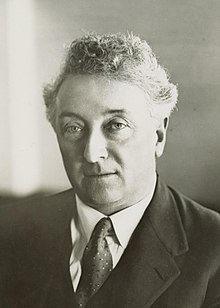
Australian Prime Minister Joseph A. Lyons died this morning after a two-day illness. Sir Earl Page, Deputy Prime Minister, was sworn in as Prime Minister. Mr. Lyons, who was 59 years old, had been Prime Minister of Australia since 1932 and was serving his third successive term. The Prime Minister was taken to a hospital yesterday suffering from a chill. Later it was announced that he had had a heart attack. His death occurred at 10:45 AM today. Lord Gowrie, the Governor General, this afternoon swore in Sir Earle C. G. Page as Prime Minister to succeed Lyons. Six other Ministers retain the portfolios they held under Mr. Lyons. Sir Earle is the leader of the Country party and was Deputy Prime Minister.
The Ministry will hold office until the United Australia party chooses a new leader. The Lyons Ministry was a composite Ministry representing two parties, of the larger of which Mr. Lyons was the leader. There is no deputy leader. Members of the Lyons party will elect a leader before the reassembling of the House of Representatives April 19. There will be a State funeral for Mr. Lyons Tuesday in Sydney.
Born:
Francis Ford Coppola, film director (“The Godfather”, “Apocalypse Now”), in Detroit, Michigan.
David Frost, journalist and media personality, in Tenterden, England, United Kingdom (d. 2013).
Gary Kellgren, American music producer who co-founded The Record Plant studios, in Shenandoah, Iowa (d. 1977).
Bob Suci, AFL safety (Houston Oilers, Boston Patriots), in Grand Blanc, Michigan (d. 2015).
Died:
Joseph Lyons, 59, 10th Prime Minister of Australia (1932–1939), of a heart attack.
Naval Construction:
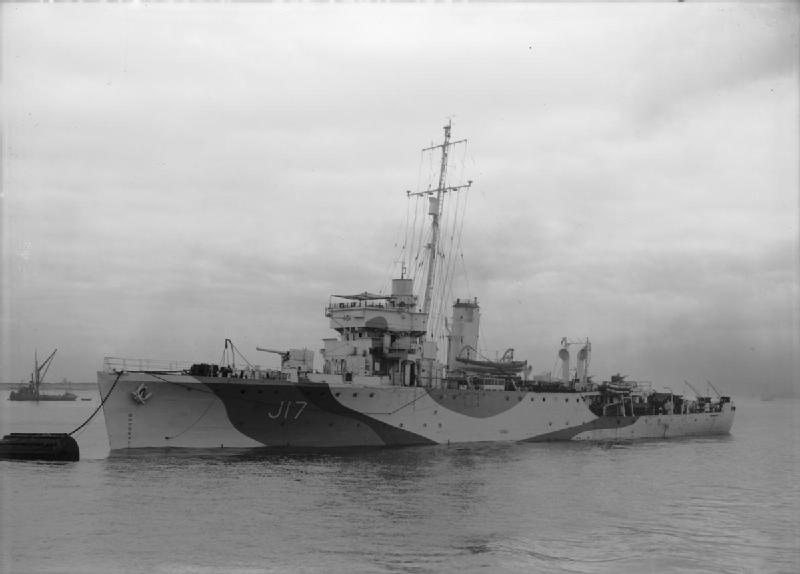
The Royal Navy Halcyon-class (Third Group) minesweeper HMS Speedy (J 17) is commissioned. Her first commanding officer is Lieutenant Commander John Curthoys Richards, RN.

 History Diaries