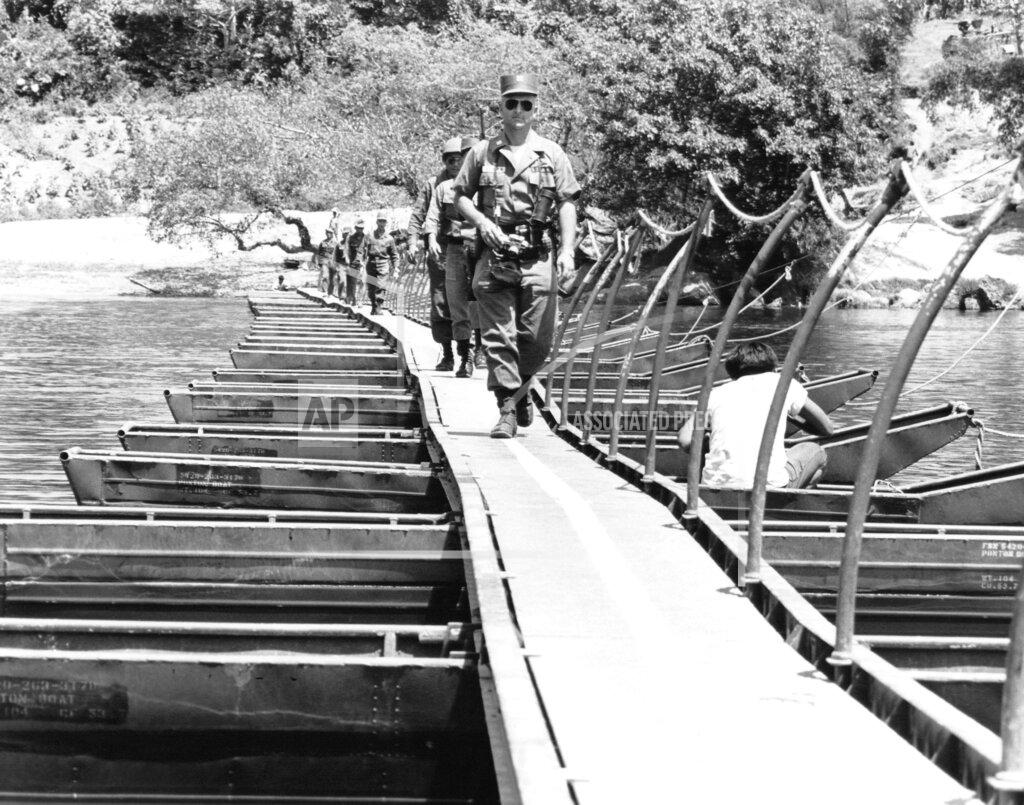
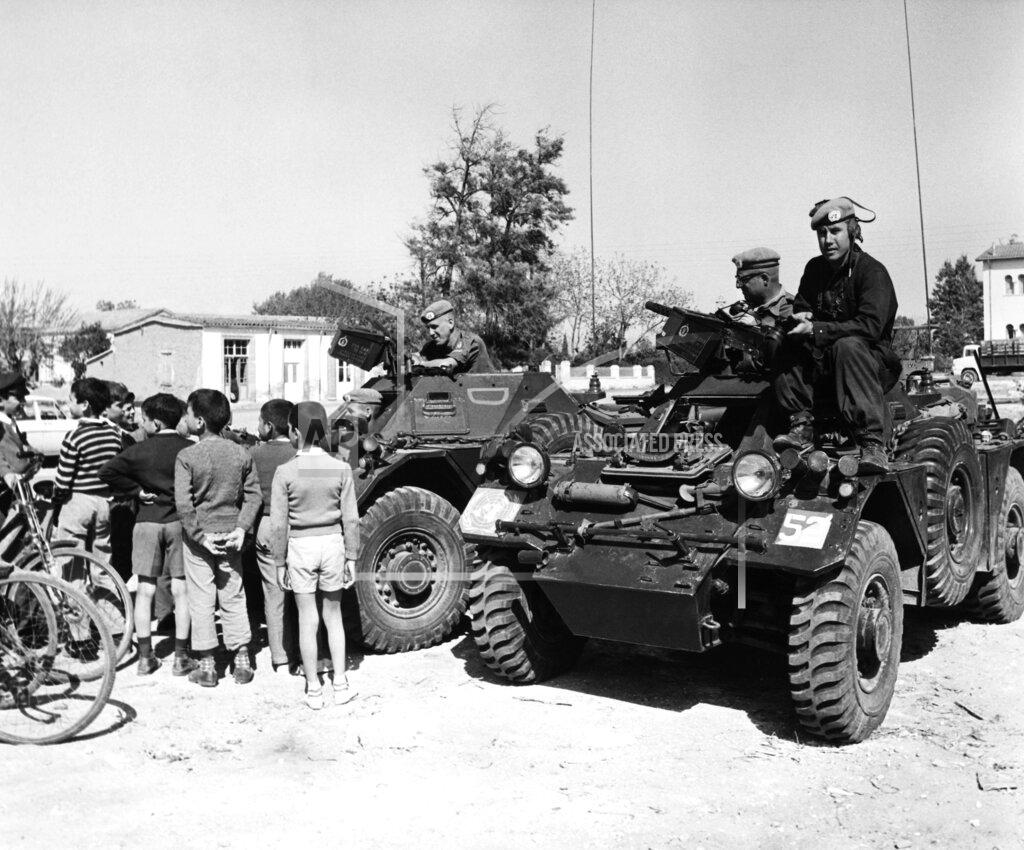
Archbishop Makarios, the President of Cyprus, said today that the key Nicosia‐Kyrenia Road, held by a Turkish Army contingent, should be opened by agreement. He did not, however, rule out the use of force to unblock the road. The Greek Cypriote leader’s observation followed reports that Turkey had warned that an attack on Turkish troops by Greek Cypriotes would be considered aggression against Turkey. The archbishop said he considered the opening of the Kyrenia Road “a matter of urgency.” Units of the 600‐man Turkish Army contingent in Cyprus straddle the road. They have effectively blocked it to Greek Cypriote movement since strife erupted last December between the Greek community and the Turkish Cypriote minority over the archbishop’s plans to revise the Constitution.
Archbishop Makarios, who is trying to force the withdrawal of the Turkish troops from the island, declared in an interview with the Cyprus news agency that he would take the matter to the United Nations Security Council if the troops were not withdrawn “eventually.” As a first step, he said, the Government will “stop granting to the Turkish military force the facilities provided for under the treaty of alliance.” The treaty, under which Greece and Turkey are permitted to have small military contingents on the island, was part of the agreement, also including a treaty of guarantee signed by Britain, Greece and Turkey and a Constitution, under which Cyprus was granted independence from Britain in 1960.
The President said last Saturday that he was abrogating the treaty of alliance. The halting of the facilities granted to the Turkish troops under the treaty of alliance is expected to affect their right to import military equipment and supplies. It will probably also cut off normal gasoline deliveries from local commercial suppliers. The contingent uses 2,000 to 3,000 gallons of gasoline a month. The Turkish Cypriote communities scattered along the Kyrenia Road may also be affected because, it is understood, the Government may decide to deprive the Turkish troops bivouacked there of water and electricity. It was announced that President Makarios would go to Athens Thursday for several days. The question of the Turkish contingent is expected to figure prominently in the discussions he will have with Greek leaders.
The military leaders of the revolution in Brazil asked Congress today for a special act to open the way for a sweeping “decommunization” program. The act would give great power to the President to oust members of Congress, Government officials, military officers and others found guilty of seditious and pro‐Communist activities. It would also permit seizure of their property and wealth.
Brazil is awaiting the election by Congress of the army chief of staff, General Humberto Castelo Branco, as interim President. The election is expected this week. In Brasilia today both houses of Congress acted to curb any obstructionist efforts of former President João Goulart’s Labor party in the naming of a new leader. Mr. Goulart was ousted last week by the military leader with the support of 10 state governors and apparently most of the people. He was accused of having tried to steer Brazil toward Communism and of seeking to set up a dictatorship. Mr. Goulart fled to Uruguay.
A nationwide roundup of many pro‐Communist leaders and agitators is under way throughout the country. The police made 30 raids on alleged Communist cells in the Rio de Janeiro area. They reported finding large quantities of arms, a mass of subversive propaganda, instructions for assassination of certain officials and a ledger listing payoffs to some Brazilian authorities. There was ample evidence of Chinese and Cuban participation, the police said. Evidence taken in the raids showed that a Communist uprising had been in preparation, according to police and military sources.
Congress has set up regulations for the election of an interim President, ruling out the need of a quorum. Mr. Goulart’s Labor party has 122 of the 426 seats in the Chamber of Deputies and is vigorously protesting the proposed act to give “clean sweep” powers to the executive. However, the military leaders who ousted Mr. Goulart are in no mood to be obstructed by pro‐Goulart forces.
President de Gaulle has won Indonesia’s support for his proposal that Vietnam be united and neutralized. Dr. Subandrio, the Indonesian Foreign Minister, who conferred with the French President Saturday, was quoted today as having said that although neutrality could not be considered a final solution, neutrality was the best solution for “a transitory period.” Asia does not want to be the center of explosive situations or the battlefield for great powers, Dr. Subandrio declared. The Foreign Minister’s views were made known by the French radio service whose programs are directed to Africa. General de Gaulle first proposed Vietnamese unification and neutrality last August. In January he extended the proposal to cover the neighboring states of Laos and Cambodia.
President de Gaulle has not amplified his proposal, but has quietly and effectively canvassed for support. His view is that the only sensible settlement is a ceasefire in the war between South Vietnam and the Việt Cộng guerrilla forces backed by North Vietnam. In the general’s view, a cease‐fire should be followed by an international conference to guarantee the area’s unity and neutrality. The French President’s unwillingness to set a time limit was regarded by diplomats as typical. He has seldom laid down a schedule for the accomplishment of his proposals. In the present case, General de Gaulle is believed to be waiting to assess the results of an intensification of South Vietnam’s military effort, with United States help, and reports from Prince Norodom Sihanouk of Cambodia and Prince Souvanna Phouma of Laos on Communist China’s attitude. Prince Souvanna Phouma, who recently returned from a visit to Communist China, evidently is encouraged by Peking’s support for his country’s continued neutrality.
Prince Souvanna Phouma, the neutralist Premier of Laos, declared today that he was confident of Chinese Communist help in restoring peace to his divided country. The prince said the Peking Government had informed him that it had no intention of linking the Laotian issue to the war in South Vietnam. The Laotian Premier made the statement in a speech before leaving Peking, where he had conferred with Chinese leaders on civil strife in Laos.
Princess Irene of the Netherlands defied the Dutch Government today and risked a break with her parents, Queen Juliana and Prince Bernhard, by deciding to take part in the political activities of the Spanish Carlist movement. The Carlists support her fiancé, Prince Carlos of Bourbon-Parma, in his contention that he should be Spain’s next monarch. Carlos will be 34 tomorrow; Irene is 24. Princess Irene was scheduled to leave for Mexico this afternoon on a 10‐day visit with Queen Juliana, Prince Bernhard and Crown Princess Beatrix. When the airliner left Amsterdam, Princess Irene had not appeared. Queen Juliana was in tears when she boarded.
Shortly after the royal party left, a court spokesman announced that Princess Irene and Prince Carlos would not marry in the Netherlands. Victor C. M. Marijnen, the Dutch Premier, had told the lower house of Parliament that they would. Jan van der Hoeven, private secretary of Queen Juliana, read a statement that said Juliana and Bernhard regretted their daughter’s decision. Prince Carlos and his father left for Paris late tonight. Princess Irene plans to go to Paris tomorrow morning. Circles close to the Dutch Cabinet indicated that Premier Marijnen had informed Juliana he could not accept the Princess’s involvement in Carlist politics. The Premier was reported to have said that under the circumstances it would be better if Princess Irene were married outside the Netherlands. Apparently, Juliana agreed.
The Ayatollah Ruhollah Khomeini, a Shi’ite Muslim cleric who would eventually be the leader of Iran was released from prison in Tehran and permitted to relocate within to the city of Qom.
Striking Belgian physicians warned today that further arrests of their colleagues would result in the cessation of all medical service in the country. The physicians, who began a nationwide strike last Wednesday in protest against the new health insurance law, have been providing for urgent cases through a reduced force of doctors at public hospitals. Government sources said that Premier Theo Lefevre had decided to order the doctors into the armed forces if their walkout continued much longer, according to an Associated Press dispatch.
A Republican policy group joined the rising national debate on foreign affairs today by proposing a seven‐point program for amending the Panama Canal Treaty pending the construction of a sea‐level waterway by 1989. The group called for a “wholly new treaty” covering a new canal in Panama. It also recommended several revisions in the existing pact. These included raising the Panamanian annuity from $1,930,000 to $15 million and revising the system of rotating United States employes in the zone.
A Federal grand jury yesterday indicted eight of the nation’s largest steel producers and two company officials for fixing prices in a basic consumer‐goods product, carbon steel sheet. As a result of the alleged price‐fixing, the government said, consumers paid unduly high prices for such items as washing machines, refrigerators, automobiles, kitchen cabinets and office furniture. The antitrust indictment, involving companies doing about $2 billion of business in a $36 billion market, is the most far-reaching of the seven antitrust indictments returned against the steel industry in a two‐year period. While relations between the steel industry and the government had improved since President Kennedy forced cancellation of a price rise in 1962, it remains to be seen whether the present case reflects a deterioration in such relations.
The indictment raises the question whether business confidence, which is being manifested in the longest peacetime business expansion in United States history, will be affected by the continued attack by the government on the pricing practices of a basic industry. The indictment also poses the question whether the inflation that followed the Korean War could be attributed in part to a criminal conspiracy rather than to so‐called administered pricing, that is, the ability of large producers to set or maintain prices regardless of market conditions. The corporate defendants are the United States Steel Corporation, Bethlehem Steel Corporation, National Steel Corporation and Great Lakes Steel Corporation, a division of National Steel, Jones Laughlin Steel Corporation, Armco Steel Corporation, Republic Steel Corporation and the Wheeling Steel Corporation.
The Republic Steel Corporation charged yesterday that the price‐fixing indictment returned by a Federal grand jury was a “step backward” that would force the major steel producers to “divert their energy from the serious problems at hand.” Most of the other companies named in the indictment had no comment.
The stock market, however, reacted sharply. As soon as word of the grand jury decision went over the news wires at 1 PM yesterday, stocks of the companies named in the indictment were engulfed in a wave of selling orders. The heavy selling spilled over into the rest of the market and produced the first general market decline in six trading sessions. Stock brokers here described the selling as “emotional.” By the close of trading, steel stock prices were sharply below their levels of the previous day. The heaviest loss was taken by Jones & Laughlin shares, which dropped $2.50. Republic Steel was off $2.12½ and United States Steel fell $1.62½.
Governor George C. Wallace of Alabama, who invaded Wisconsin to challenge the Johnson Administration’s civil rights legislation, rolled up more than 200,000 votes‐23 per cent of the total vote tonight in the State’s Presidential primary. This was about a third of the Democratic votes cast. Governor John W. Reynolds of Wisconsin, running as a favorite son pledged to President Johnson, won the election as expected, but the Alabama Governor piled up more than twice the total Mr. Reynolds had predicted he would get.
As 200 followers cheered at his headquarters at the Schroeder Hotel, Mr. Wallace declared: “We have won a victory and they know it, of course. We shall carry on this fight. The people of Wisconsin have done more to break the trend toward centralized government than they realize.”
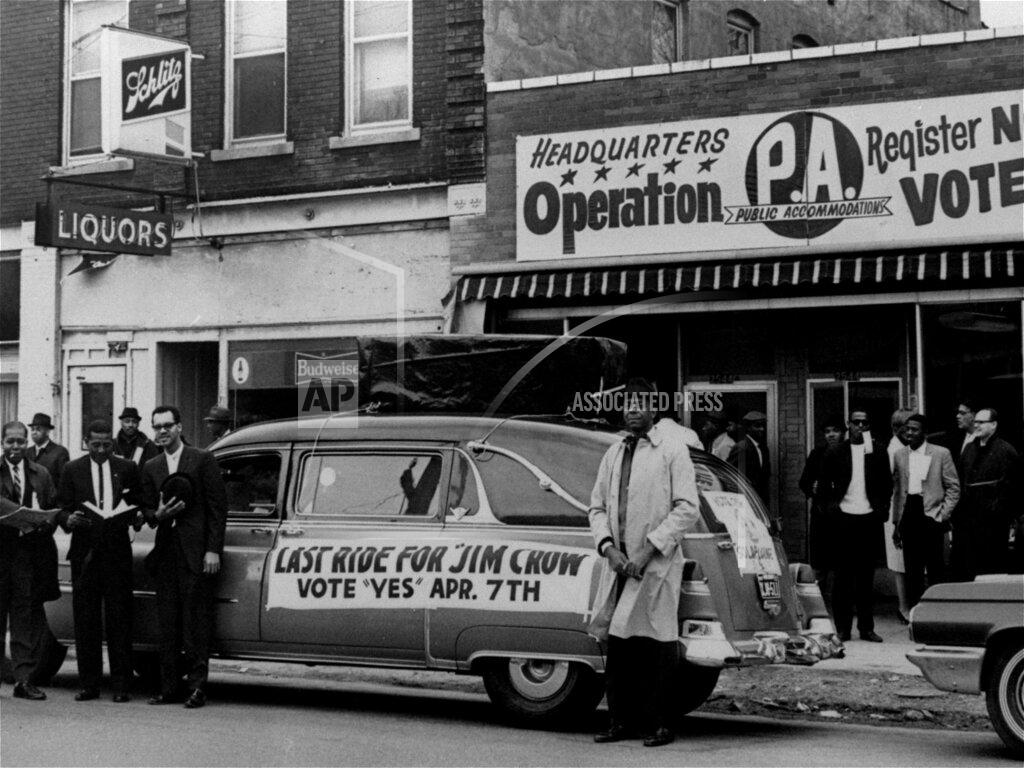
At the same time, voters in Kansas City approved by a narrow margin an ordinance barring racial discrimination in places of public accommodation.
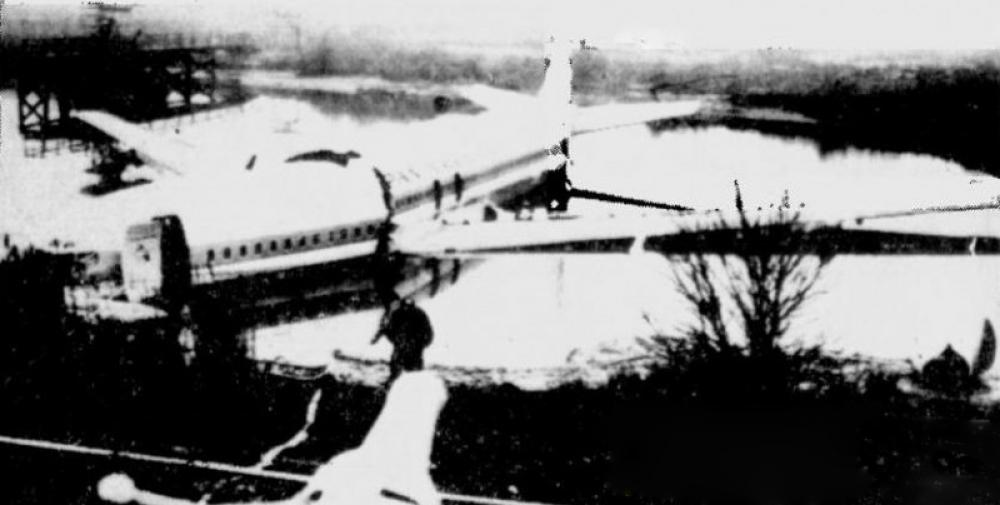
A Pan American World Airways jetliner, Pan Am Flight 212, carrying 136 passengers and nine crew members overran a runway at Kennedy Airport last night and plunged into an inlet off Jamaica Bay. There were no fatalities, but 46 persons were treated at the airport’s medical center for injuries and 10 of these were taken to local hospitals for further treatment. Some passengers and crew members were injured as they made their way out of the partly submerged plane and through water and mud to shore. Several climbed aboard rubber life rafts released by the plane’s crew, and paddled to dry land. The probable cause of the accident was determined to be the captain’s deviation from the glide slope during an ILS approach resulting in a touchdown on the runway at a point and speed which precluded stopping the aircraft on the remaining runway.
The big four‐engine Boeing 707 was coming from San Juan, Puerto Rico, after having been diverted to Dulles Airport in Washington because of poor weather. One witness said its fuselage “cracked in half like an egg” as it touched the fog‐shrouded runway and then hurtled into Thurston Basin, a long finger of water extending between the end of the runway and Rockaway Boulevard. The accident occurred on Runway 4‐R/22‐L, the same 8,700‐foot strip involved in the crash of an Eastern Air Lines DC-7 B on Nov. 30, 1962 In that crash, which occurred under similar weather conditions, 25 of 51 passengers were killed.
Immediately after the crash of the Pan American plane last night, passengers and crew members crawled out of the plane, plodding through mud as high as their thighs. Somme escaped front the plane by sliding down an emergency chute; others got out through the cockpit exit. Somme passengers were taken on stretchers to buses that had been rushed to the water’s edge. The plane, named the “Southern Cross,” jutted half out of the water; her nose sheared off and her cracked fuselage lit by the floodlights of emergency trucks.
New Yorkers by the thousands filed past the bier of General of the Army Douglas MacArthur today at the Seventh Regiment Armory, Park Avenue and 66th Street. They had come at the rate of nearly 3,000 an hour to pay their respects to the military leader who, after an eventful life on many battlefronts, lived here in the last 13 years of his life. They gazed for a moment on the chiseled features, which barely betrayed the suffering of the final illness that ended the life of the 84‐year‐old general at the Walter Reed Army Medical Center last Sunday. Tomorrow the general’s body will be taken to Washington, where it will lie in state in the Capitol Rotunda. President Johnson will participate in the ceremonies in the capital. At 11 o’clock last night the authorities said that 35,000 persons had filed past the bier in the armory here, Mourners were waiting for 40 minutes to get into the armory, until the doors closed at 11:15 PM. Earlier, mourners had to wait an hour to get in.
A young white minister was crushed to death today when he threw himself on the ground to stop a bulldozer in a civil rights demonstration held to protest the construction of a school building in Cleveland. The Rev. Bruce William Klunder, 26 years old, a well-known civil rights leader and adviser to college students, was killed during an afternoon of demonstrations in which policemen and about 1,000 demonstrators battled for more than an hour. The police said that Mr. Klunder, a Presbyterian minister, who decided yesterday that pressure to solve the school segregation problem here should be increased, was killed when four persons tried to immobilize a bulldozer. Three demonstrators fell to the ground in front of the bulldozer. The driver stopped, backed up and ran over Mr. Klumder, who had lain on the ground behind the bulldozer to keep it from changing course.
IBM announced the System/360 mainframe computer system, the first commercially available system to use micro-miniaturized logic circuits. The new machine, which IBM chairman Thomas J. Watson Jr. described as “the beginning of a new generation—not only of computers—but their application in business, science and government”, was shown off at meetings in 165 cities before a total of 100,000 customers. The system could “accept messages from remote locations, no matter what the distance” and could “communicate simultaneously with 248 terminals”. The most basic system had a storage of 8 kilobytes and the largest could accommodate 8 megabytes.
Hugh Martin and Timothy Gray’s musical “High Spirits”, based on Noel Coward’s “Blithe Spirit”, opens at Alvin Theater, NYC; runs for 375 performances.
Dow Jones Industrial Average: 822.77 (-1.99).
Born:
Russell Crowe, New Zealand-born film actor (“A Beautiful Mind”, “Gladiator”), in Wellington, New Zealand.
Joe Durant, American golfer (4 PGA Tour titles), in Pensacola, Florida.
Ron Francis, NFL cornerback (Dallas Cowboys), in La Marque, Texas.
Chuck Gorecki, NFL linebacker (Philadelphia Eagles), in Bryn Mawr, Pennsylvania.
Steve Graves, Canadian NHL left wing (Edmonton Oilers), in Trenton, Ontario, Canada.
Died:
John Alan West, 53, English crime victim was murdered during a burglary in his home in Workington. Gwynne Owen Evans and Peter Anthony Allen would be convicted of the murder and, on August 13, 1964, would become the last two people to be legally executed in the United Kingdom.
Bruce W. Klunder, 26, American Presbyterian minister, was accidentally killed in Cleveland, Ohio, while protesting the construction of a new school that would have reinforced the Ohio city’s pattern of racially segregated school districting. Klunder had and three other protesters attempted to block the path of a bulldozer by lying down in its path, and the machine backed over him.


 History Diaries