Polish Foreign Minister Beck signs a temporary mutual assistance pact in London, but since Beck fears the Soviets as much or more than the Nazis, it excludes any Soviet participation. Prime Minister Chamberlain announces the formal signing of the pact in the House of Commons.
The scope of the Anglo-Polish alliance was widened significantly today by Prime Minister Neville Chamberlain, in telling the House of Commons of Poland’s new pledge to come to Britain’s help immediately in case of an attack upon this country. Mr. Chamberlain announced that Britain’s present “temporary and unilateral” pledge to Poland would be replaced by an “agreement of a permanent and reciprocal character” as soon as the experts had settled certain matters, including a “more precise definition of the various ways in which the necessity for assistance might arise.” Chief among these “certain matters” are staff talks between the military, naval and air authorities of the two countries, which are expected to begin without delay.
The permanent Anglo-Polish agreement, Mr. Chamberlain went on, “would not be directed against any other country but would be designed to assure Britain and Poland of mutual assistance in the event of any threat, direct or indirect, to the independence of either.” This was an immensely important variation from the wording of the original British pledge, which, as Mr. Chamberlain announced it last week, would become operative in case of “any action which clearly threatened Polish independence and which, accordingly, the Polish Government would feel bound to resist with. their national forces.” The new definition of “any threat direct or indirect” was no verbal slip on Mr. Chamberlain’s part; the statement read to the Commons today was drafted by Colonel Beck and Mr. Chamberlain themselves. They had good reason to be careful in drafting it for their phrase, “direct or indirect,” made it still more probable that Germany would have to fight on two fronts in case of any further aggression upon her neighbors.
The British Government today made a preliminary move toward offering a military guarantee to Hungary, it became known tonight as Foreign Minister Josef Beck of Poland concluded his conversations in London. Instructions were flashed to the British Legation in Budapest to ask whether the Hungarian Government would welcome a British guarantee and under what conditions. The news was even more astonishing than the original British pledge to Poland, which for the first time placed the British defensive frontier in Eastern Europe. A little more than a week ago the British Ministers were writing Hungary off, as an inevitable victim of German expansion. Hungary was left out of all British calculations in an effort to build up a defensive ring against aggression among Germany’s neighbors.
But Colonel Beck apparently convinced the British they had underestimated Hungary’s will to resistance, and especially Regent Nicholas Horthy’s anti-German feelings. As a good friend of Hungary, Colonel Beck offered to try to bring both Hungary and Rumania into the British alignment if he could obtain British backing for his effort. So the tentative offer of a British guarantee was made today, and it should strengthen Colonel Beck’s hands in his coming dealings with Budapest. The British are none too hopeful, but in their new mood of resistance they are only too willing to help in keeping one more country from the clutches of the Nazi machine. In any case, the overture to Budapest from London today was a sign which way the wind is blowing.
Early reaction in German quarters to Prime Minister Neville Chamberlain’s House of Commons statement on the outcome of the Anglo-Polish talks purports to show complete indifference to any commitments that Foreign Minister Josef Beck of Poland may have entered into with the British statesman. It is noted here that apparently no clear limit as to Poland’s share in such commitments has been accepted by her so far, although the Polish Foreign Minister is spared no reproaches here for having permitted himself to be “drawn into the maelstrom of the aggressive British encirclement policy and all that such encirclement implies.” The situation as presented by the British Prime Minister contains several loopholes, in German opinion, which questions whether Colonel Beck is returning to Warsaw with his signature attached to a hard-and-fast agreement definitely committing him to an anti-German alliance.
Assumption for the present leaves the question in doubt. It is suggested the Polish Foreign Minister may have reserved his final decision. Germans do not, however, absolve him of the charge of violating the spirit of the 1934 German-Polish pact and of deliberately abandoning the policy laid down by his preceptor, the late Marshal Josef Pilsudski, who sought to come to an amicable agreement with the Reich over the entire complex of knotty problems in German-Polish relations. The amity accord concluded between the Reich and Poland in 1934 has been placed in jeopardy by Colonel Beck’s London trip, but it is not considered on the German side as abrogated. That was made clear in conversations in official quarters tonight. The resentment is directed more explicitly at British diplomacy rather than at the Polish statesman, who is believed to have fallen victim to the “ensnaring machinations” of Western powers.
Italy issues an ultimatum to King Zog I of Albania.
The Albanian government rejected Italy’s ultimatum.
An Italian cruiser and two destroyers arrived at Durrës (Durazzo) this morning as Albania feverishly discussed reports of an imminent Italian occupation. Many Albanian reservists have been mobilized. Twenty truckloads of arms were sent yesterday to Vlorë (Valona), the southern port of Albania.
Several demonstrations were staged in Albania’s main cities. That same afternoon, 100 Italian aircraft flew over Tiranë (Tirana), Durrës, and Vlorë, dropping leaflets which instructed the people to submit to Italian occupation. The people were infuriated by this demonstration of force and they called for the government to resist the Italian occupation and release all of the Albanians who were previously arrested on the suspicion that they were “communists”. The crowd shouted, “Give us arms! We are being sold out! We are being betrayed!” While a mobilization of the reserves was called, many high-ranking officers left the country. The government began to dissolve. The Minister of the Interior, Musa Juka, left the country and moved to Yugoslavia the same day. While King Zog announced that he would resist the Italian occupation of his country, his people felt that they were being abandoned by their government.
The Spanish Government tonight assured France there had been no recent landing of Italian troops at Cadiz, Spain. Formal assurances were given to Foreign Minister Georges Bonnet by the Spanish Ambassador, José Felix Lequerica, in response to French and British requests to Burgos for “clarification” of persistent rumors of fresh Italian troop movements to Spain. Señor Lequerica was called to the Foreign Office by M. Bonnet soon after reports circulated that 15,000 Italian troops, previously rumored to have landed at Cadiz, were Alpine soldiers trained for mountain fighting. In previous representations to Generalissimo Francisco Franco’s government, France obtained promises that Italian legionaries in Spain would be kept a reasonable distance from the Pyrenees, which divided Spain from France.
M. Bonnet was also understood to have discussed with the Spanish Ambassador the question of evacuating 4,000 Spanish Republican refugees from the neutral zone at Alicante. This neutral zone was created after the surrender of Madrid with the approval of Nationalist authorities. French authorities now are seeking permission for foreign ships to enter the port and take out the refugees.
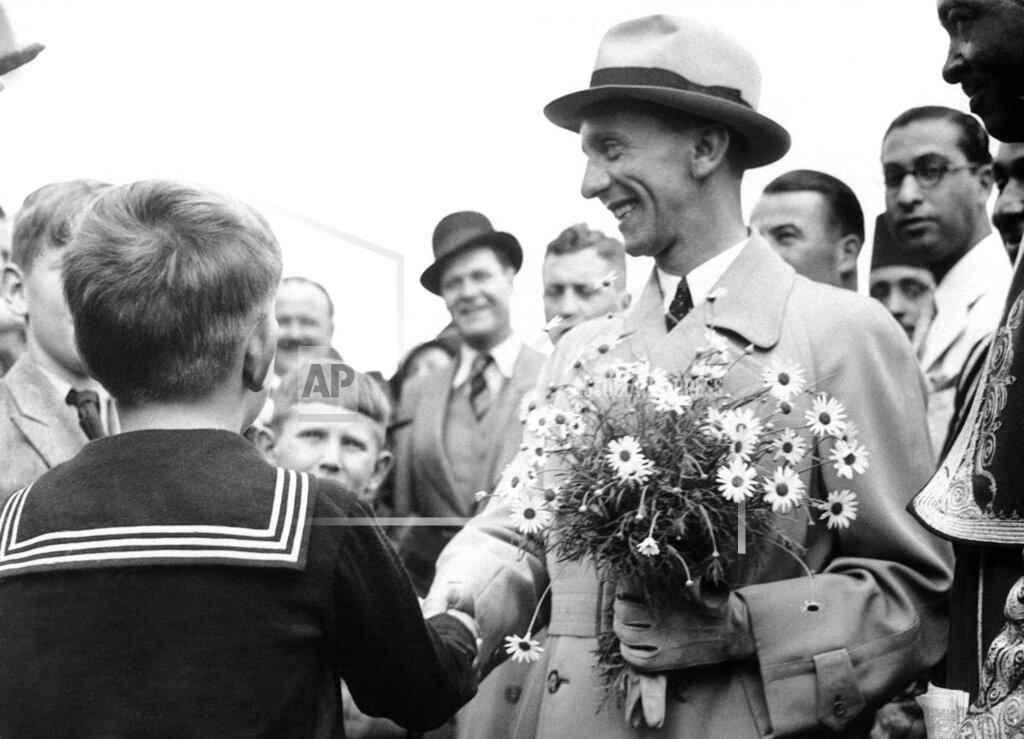
Dr. Joseph Goebbels, the German Propaganda Minister, arrived by air for a short visit to Cairo this morning, coming from Rhodes. He was accompanied by a suite of seven persons. Awaiting him at the Almaza Airdrome were the German Minister to Egypt, Herr von Henting, and a group of members of the German colony here. Dr. Goebbels spent the day entirely in the company of his own countrymen. In the afternoon he motored to Sakkara to visit the ruins there and tonight he dined at his hotel with his suite and Herr von Henting and other officials of the German Legation here. Since his visit is described as purely private, he has not met any Egyptian officials. On the request of the Egyptian Government, Dr. Goebbels is not making any statement for publication while in Egypt, and he will return to Rhodes after breakfasting tomorrow.
Declaring that neutrality legislation offered no guarantee that this country could avoid involvement in a general war, Bernard M. Baruch told the Senate Foreign Relations Committee today that the best way to keep America out of hostilities would be to make its goods and supplies of all kinds available to all belligerents under the “cash and carry” plan. In this he supported the theory put before Congress in the Pittman resolution. Testifying at the second of the committee’s hearings on proposals to revise the present neutrality legislation, Mr. Baruch warned that an embargo on sales of supplies to all belligerent nations would threaten disaster to the American economy.
Mr. Baruch, who was chairman under President Wilson of the War Industries Board, stressed in his prepared statement and in later informal discussions with various Senators the importance of impressing upon the public the idea that the “neutrality” law would not, of itself, keep the nation free of war. Senator Pittman, chairman of the committee, has attempted to meet this point by calling his resolution the “Peace Act of 1939” so that it would not necessarily imply a policy of strict neutrality as defined in international law.
The general tenor of Mr. Baruch’s testimony today was at direct variance with that given yesterday by Henry L. Stimson, former Secretary of State. Where Mr. Stimson advocated withholding American supplies from aggressors and supplying them to victims, Mr. Baruch held that any form of economic warfare, as he conceived such procedure to be, would lead inevitably to military warfare.
Asked by Mr. Pittman what would happen if the present law were repealed and no legislation were enacted in its place, Mr. Baruch said: “We would be right back where we were in 1917,” intimating as some Senators interpreted it, that the nation might soon be dragged into any European war.
Plans for the speedy passage by the Senate today of the House bill adding $100,000,000 to the WPA appropriation for the current fiscal year collapsed in the face of a fight waged by a handful of New Dealers, led by Senators Pepper and Mead. When the Senate recessed tonight there appeared little likelihood that this minority group could put through an amendment by Senator Pepper raising the appropriation to the $150,000,000 to complete the total thought necessary by President Roosevelt in January, when he requested $875,000,000 and Congress voted $725,000,000.
Senator Pepper, in a speech of about four hours, pricked alike his own New Deal associates and the conservative Democrats, led in this instance by Senator Adams, as he argued that not only relief but recovery demanded continuance of an ample spending program by the government. This aroused Senator Adams, who asserted that the $100,000,000 voted by the House was shown to be sufficient to carry out the Administration’s relief program on the basis of testimony given to an appropriations subcommittee by Colonel F. C. Harrington, WPA Administrator. Mr. Adams charged that speeches such as Senator Pepper’s were responsible for delaying a vote on the appropriation.
If Senator Pepper and his supporters would cease debating and permit a vote, Senator Adams said, the WPA would have sufficient funds to rescind orders by which 200,000 WPA workers were laid off on April 1. When Senator Pepper disputed this contention, Senator Adams asserted that the WPA had deliberately expanded relief rolls in an effort to “coerce” Congress. He cited testimony by Colonel Harrington showing that between February 11 and February 25, dates subsequent to action by the Congress cutting the relief appropriation requested by the President and indicating a need for economy in relief expenditures, the WPA had added 78,000 persons to its rolls. “It was a coercive increase,” Senator Adams added, “for the purpose of coercing Congress by inciting pressure from home.”
In subsequent debate, Senator Mead termed the projected lower appropriation a “tragic gesture” that would “augment the drive for a mistaken economy and result once again in disastrous deflation.” He read a telegram from Mayor La Guardia stating that unless the full $150,000,000 appropriation were voted, New York City would find 65,000 relief workers removed from the WPA rolls by June.
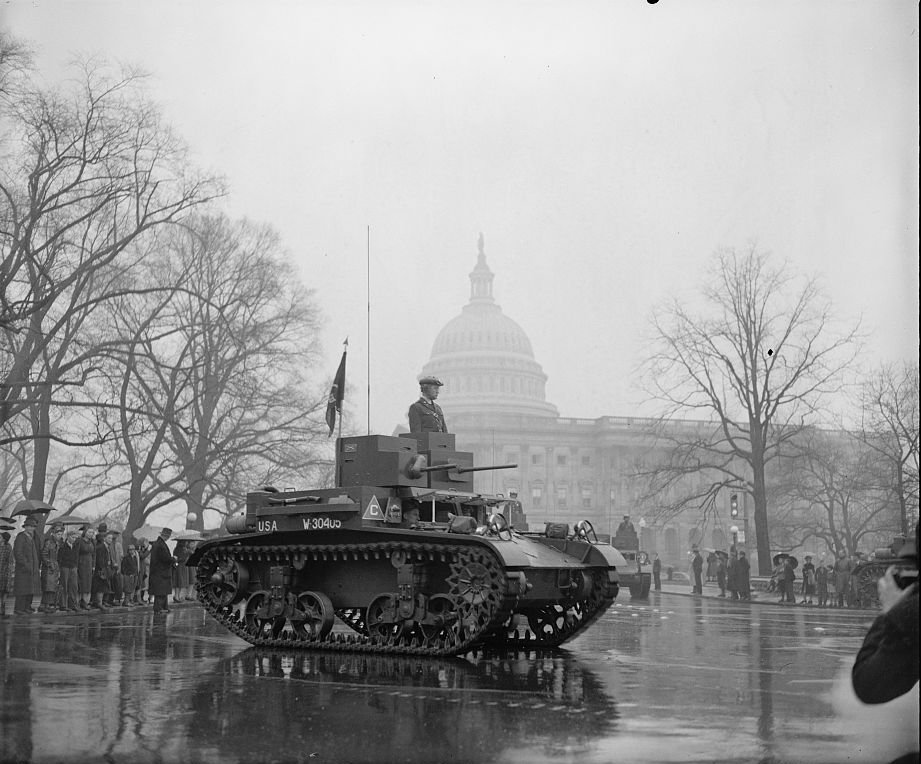
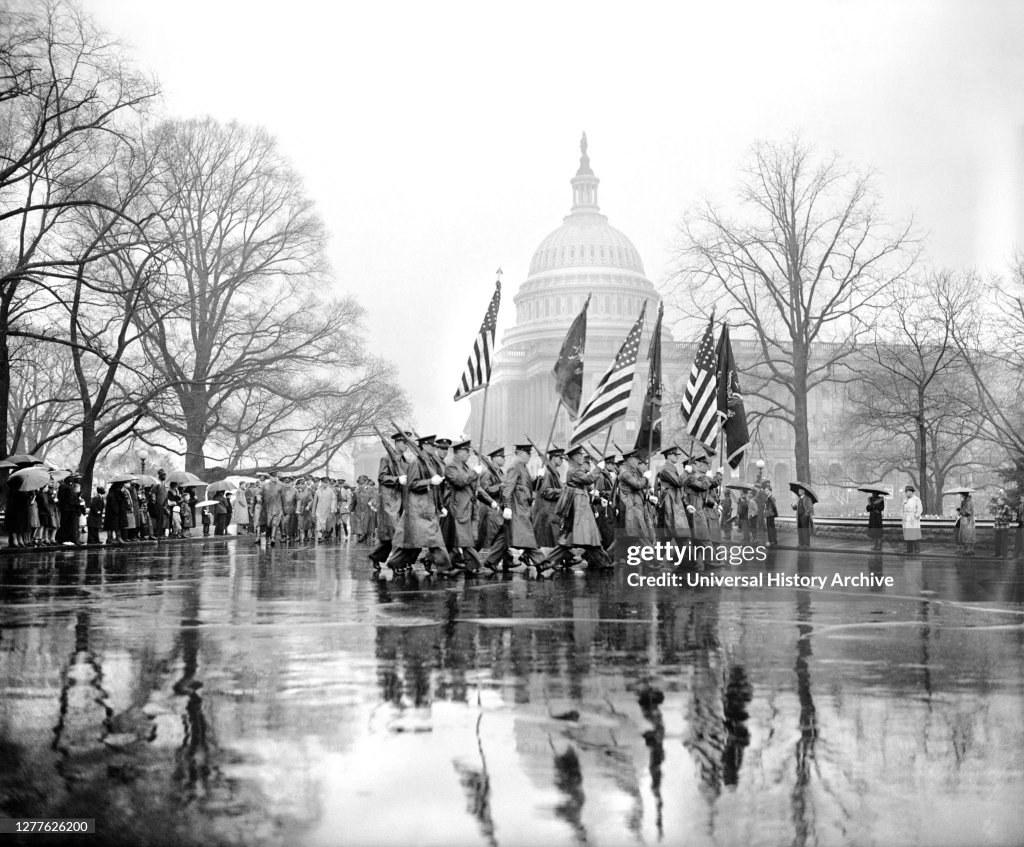
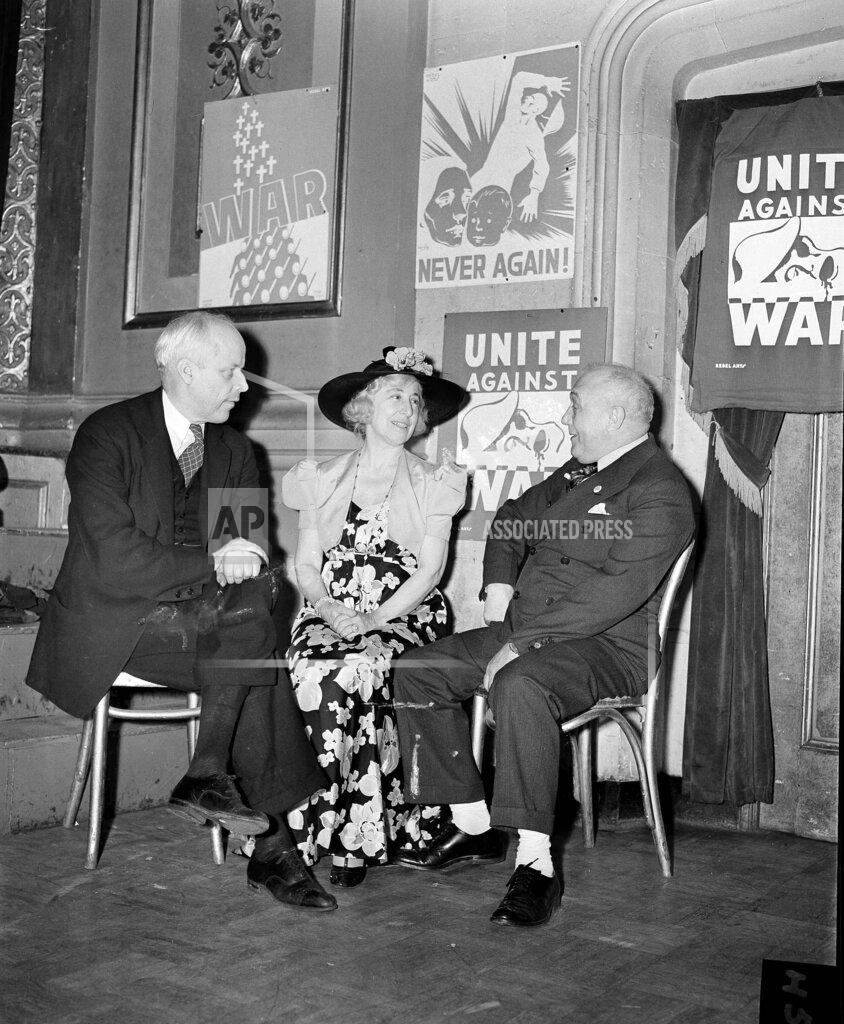
The United States observes the 22nd anniversary of its entry into World War I. Rain fails to mar Army Day parade in Capitol. Washington, D.C., April 6. With the United States rearming and rumors of war in the air thousands braved a heavy rain today to witness the Army Day parade pass the U.S. Capitol.
Ex-Secretary of State Henry Stimson demands that the U.S. reserve the right to name and boycott the aggressor in any foreign war.
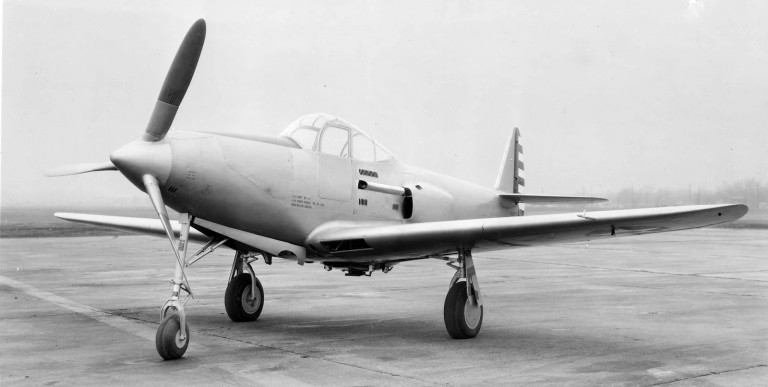
After being shipped by truck from the Bell Aircraft Company factory at Buffalo, New York, the XP-39 prototype, 38-326, (Bell Model 4) made its first flight at Wright Field, Ohio, with test pilot James Taylor in the cockpit. During the test flight, Taylor flew the XP-39 to 390 miles per hour (628 kilometers per hour) at 20,000 feet (6,096 meters). The service ceiling was 32,000 feet (9,754 meters). The XP-39 was designed by Bell’s chief engineer, Robert J. Woods, to meet a U.S. Army Air Corps requirement, X-609, issued in March 1937, for a high-altitude interceptor. A contract for the prototype was issued 7 October 1937. On 15 April 1939, Assistant Secretary of War Louis Johnson announced that the U.S. Army had purchased the experimental Bell XP-39 and the Seversky XP-41.
The Bell XP-39 Airacobra was a single-place, single-engine prototype fighter with a low wing and retractable tricycle landing gears. The airplane was primarily built of aluminum, though control surfaces were fabric covered. On 27 April 1939, the U.S. Army announced that a contract to Bell Aircraft had been issued in the amount of $1,073,445 for delivery of thirteen YP-39s. 9,584 Bell P-39 Airacobras were built during World War II. More than half were sent to the Soviet Union. Contrary to what many think, they were not primarily ground attack aircraft there. The P-39 was actually a decent medium-altitude fighter. Since most aerial combat over the USSR happened in poor weather at lower altitudes, it served quite well. But the Army Air Force’s decision to remove the turbosupercharger meant performance was unsatisfactory above about 15,000 feet, where the USAAF did most its fighting.
A howling windstorm of 50 mph does not deter the Red Sox and Reds from playing an exhibition game in Florence, South Carolina but the weather and the rock-hard infield results in the game being called in the 9th inning when all 54 baseballs have disappeared. “Grounders were actually blown off the ground and over the outfield fences,” observed Lou Smith in the Cincinnati Enquirer. The score is 18-18 when the game ends with both teams covered with grime.
The U.S. Embassy in Japan delivers its fifth written protest in two weeks, over aerial bombings of American property in China.
Anti-guerilla measures by Japanese troops in China are said to include the burning of villages and the killing of males between the ages of 12 and 40 years old.
Japanese headquarters at Hankow today issued an amended and greatly enlarged official estimate of Chinese losses in battles in the Nanchang and Siao River areas, declaring the Chinese had abandoned. 17,135 dead and that the Japanese had taken 7,979 prisoners, forty-eight field and mountain guns, thirteen other large guns, fourteen trench mortars, 134 machine guns and more than 4,000 rifles. The first official Japanese casualty figures on major engagements in many months, announced in Shanghai, listed 700 Japanese killed and wounded in the capture of Nanchang and 530 casualties on the Siao River front between March 19 and 29.
Reports indicate that the Japanese are making effective use of the recently captured Nanchang airdrome which, before the war, was one of the main Chinese air bases. In short-range attacks from Nanchang today Japanese planes bombed Liuchow in Kwangsi, Kian and Pingsiang in Kiangi and Henyang in Hunan. Information is meager as to the results of the raids. The damage at Hengyang is reported to be extensive.
The Chungking press continues fulminations against Wang Ching-wei, who is reported to be negotiating with the Japanese. The Communist New China Daily News demands a death decree for Mr. Wang and a purging from the government of all officials sympathetic toward Mr. Wang’s attitude. The China Times reports that Mr. Wang has changed his residence at Hanoi, French Indo-China, and that the guards around him have been strengthened.
Belated reports indicated tonight that Japanese air attacks had inflicted heavy damage on Chengchow, important Chinese-held Lunghai railroad center in Honan Province. The attacks typified the continuing aerial warfare of the Japanese, apparently checked in their westward offensive toward Changsha, capital of Hunan Province. The Chengchow raids, according to these reports, occurred on March 27, 29 and 31, causing 800 casualties among Chinese troops and undisclosed noncombatant casualties. The Chinese reported 200 casualties from raids today that the Japanese said were aimed at military establishments, particularly along the Chekiang-Kiangsi railway and the Kan River. An attack on Changsha itself, Chinese said, caused forty deaths.
The U.S. and UK agree on joint control of Canton & Enderbury Islands in the Pacific Ocean.
Dow Jones Industrial Average: 126.32 (-4.02).
Born:
John Sculley, American businessman (CEO of Apple, 1983-1993), in New York, New York.
Beverly “Guitar” Watkins, American blues guitarist, and singer, born in Atlanta, Georgia (d. 2019).
Frank Robotti, AFL linebacker (Boston Patriots), in Stamford, Connecticut (d. 1971, in a auto accident caused by a drunk driver).
Naval Construction:
The Вое́нно-морско́й флот СССР (ВМФ) (Soviet Navy) Project 7-class (Gnevny-class) destroyer Rekordny (Рекордный, “Record breaking”) is launched by Dalzavod (Vladivostok, U.S.S.R.) / Yard 202.
 History Diaries