
Israeli warplanes went into action to hit a Syrian force that crossed the cease-fire line in the Golan Heights, a military spokesman in Tel Aviv said. The air strikes were the first by Israel since the October war and indicated a further heightening of tension on the Golan Heights front, where artillery duels have been raging. Syrian military spokesmen in Damascus said that Israeli forces had shelled houses in two Syrian villages and that Israeli jets had twice attacked Syrian posts, causing no damage or casualties. Military sources said foggy weather prevented direct observation of the results of the strikes against the Syrian force, which crossed the line early today on the rocky slopes of Mount Hermon. But they said the Syrian force appeared to be small, less than a company.
Colonel Muammar Qaddafi, Libya’s intensely nationalistic and unpredictable leader, has been relieved of his “political administrative and traditional duties,” the official Egyptian press agency reported in Cairo. He remains Commander in Chief of the Libyan armed forces and will devote his time entirely to ideological matters and work involving mass organization, the agency said, citing a note sent by the Libyan government to foreign embassies in Tripoli, the capital. The decision to limit Colonel Qaddafi’s functions was made by the 11-man Revolutionary Command Council, the military junta that has ruled Libya since the Colonel and his fellow officers overthrew the monarchy four and a half years ago.
Recent fighting west of Saigon and northeast of Kon Tum has now subsided with the same kind of inconclusive results that have marked most of the “ceasefire war” since the Paris agreement was signed 14 months ago. Military analysts in Saigon believe that both battles had more to do with long‐term logistical objectives than with immediate military goals. Near the Central Highlands city of Kon Tum, for example, the fight has been over a five‐mile stretch of provincial road that could improve the Communists’ road system, thereby completing an encirclement of Kon Tum and facilitating transportation from the Hồ Chí Minh Trail along South Vietnam’s western border to the lowlands on the coast. The fighting in Hậu Nghĩa Province, west of Saigon, has been regarded as a struggle for control of a corridor between the capital and the Cambodian border. With firm control, the Communists could presumably send troops and weapons more freely to positions near Saigon.
This jockeying for position may be purely defensive or it may portend an upcoming offensive, depending on one’s theoretical bent. A week ago, a fresh prediction of an all-out North Vietnamese offensive was made by one of President Nguyễn Văn Thiệu’s advisers, Hoàng Đức Nhã, Minister of Information. Last fall, many American officials were making similar predictions. Some have reversed themselves by contending that Hanoi is too involved in its own economic problems to undertake an offensive. The Vietcong never seem to indulge in much public military analysis. At their weekly news conference this morning, for example, their officers simply termed the fighting “illegal land‐grabbing operations” by Saigon and added that their own military actions were “necessary and appropriate punishments.” The Kon Tum fighting began March 16 north of Highway 5B, which connects Kon Tum with the Communist-controlled Ba Tơ District to the northeast. According to the Saigon military command more than 400 troops were killed on both sides in two days, the heaviest losses in a single battle since the cease‐fire.
On March 27, as the South Vietnamese sent ammunition and other supplies from Quy Nhơn to Pleiku by way of Highway 19, a 66‐truck convoy was ambushed a few miles east of An Tức. The government reported one truck destroyed and 18 damaged. Fighting continued around the stretch of road. On April 2, two ranger battalions were reported to have taken heavy casualties. The Việt Cộng said today that their units killed, wounded or captured more than 400 government troops that day. The Communist position is that Route 5B has long been in their hands and that the government forces have recently staged bombing and artillery attacks. There were two battlefields in Hậu Nghĩa Province. One was an encircled government battalion at Đức Huệ, an outpost three miles from the Cambodian border, the other along the western edge of the Hố Bò woods, an old Vietcong base area 19 miles northwest of Saigon. The Đức Huệ outpost is located deep in a no man’s land devoid of population. It has been manned by the 83rd Ranger Battalion for many years, Government officers say. During the night of March 26, two battalions of the North Vietnamese Fifth Division attacked the outpost.
“I think the Communists want to get rid of the outpost because it is right in the middle of their infiltration route from the Parrot’s Beak in Cambodia to areas near Saigon,” said Lieutenant Colonel Lê Tất Biên, commander of the 33d Ranger Group stationed nearby. “The terrain is flat, so it is very easy for the outpost to observe and control any movement in a large area,” he added. “It is a big problem for the Communist infiltration troops.” The motives for the fighting near the Hố Bò woods, just northwest of Củ Chi, remained less clear. Officers say Government units in the area have stayed mobile to avoid shelling and to search out and attack Communist units. There seems to be no specific territorial objective by either side. As a result, Route 5B, northeast of Kon Tum, is still controlled by neither the Government nor the Communists, Đức Huệ is still in Government hands but so tightly encircled that incoming helicopters take heavy anti‐aircraft fire and the western edge of the Hố Bò woods is still heavily contested.
Gunfire from a passing car killed Ellen McDowell, 21, as she was walking home along a Belfast street with her boyfriend. Police at the scene in the Protestant Shankill Road area said they believed the intended target was her boyfriend, who escaped unharmed. His name was not disclosed.
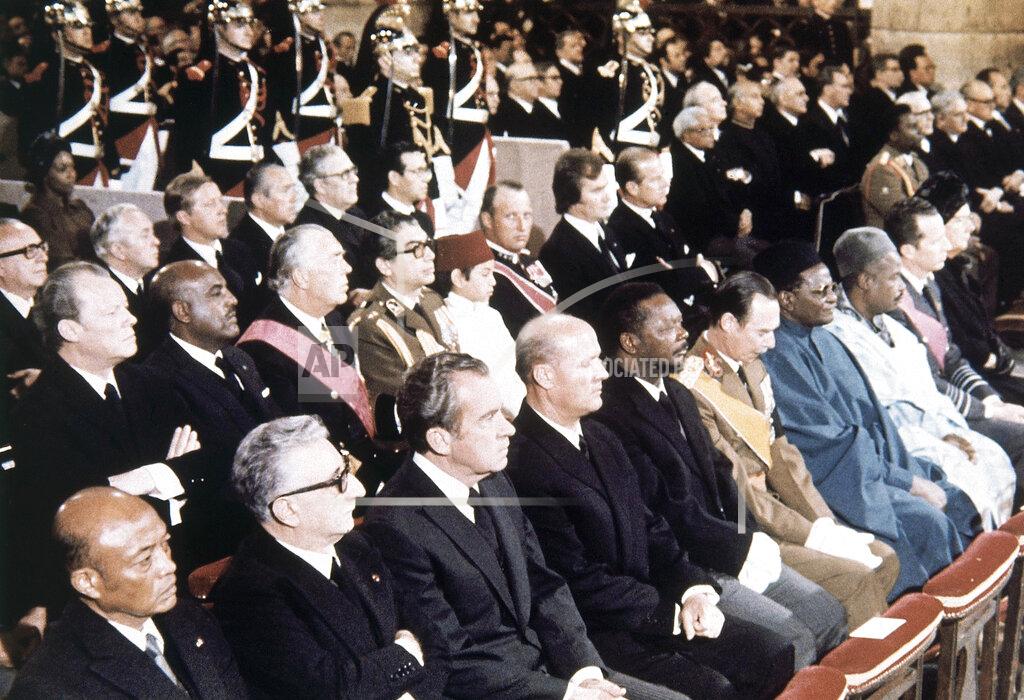
President Nixon conferred in Paris with four European leaders, reportedly on recent difficulties between the United States and Western Europe. After attending memorial Services for President Pompidou, Mr. Nixon, who extended his weekend visit, met successively with Alain Poher, the interim president of France, Prime Minister Wilson of Britain, Chancellor Willy Brandt of West Germany and Premier Poul Hartling of Denmark. He scheduled meetings tomorrow with President Nikolai Podgorny of the Soviet Union and Premier Kakuei Tanaka of Japan. He was scheduled to return to Washington Sunday afternoon.
More than 50 chiefs of state and government, including President Nixon, attended a requiem mass in the Cathedral of Notre Dame in Paris for Georges Pompidou, the late President of France. Francois Cardinal Marty, Archbishop of Paris, celebrated the mass.
Moderately high winds have forced the stricken luxury liner Queen Elizabeth 2 to lie off the coast of Bermuda until today before entering the harbor of Hamilton for repairs. The liner lost its power Monday and all 1,634 passengers were transferred to a rescue ship.
The liner France will resume its regular transatlantic service May 24, the French Line announced in Paris. It had been reported that the government had decided to take the liner out of service because it was too costly to operate. A spokesman for the French Line said that as far as the company was concerned, the government had made no decision to retire the ship.
An 18-year-old youth has been charged in Manchester, England, with raping and robbing a personal secretary to Princess Anne. The youth, Christopher Graham of Manchester, is being held pending a preliminary hearing. He is accused of raping Jan Walters, 23, in her London apartment.
The Spanish government named four more suspects in the assassination of Premier Luis Carrero Blanco, bringing to 10 the number sought in the slaying last December. The suspects, presumed to be members of the Basque separatist movement ETA, are thought to be hiding outside Spain.
Spain’s leading male ballet dancer, Antonio Ruiz Soler, who calls himself Antonio, was granted a pardon by General Francisco Franco after serving two weeks of a two-month sentence for blasphemy and public scandal. Antonio, 52, had been jailed near Cadiz by a local magistrate.
Acquittal of the “three Marias,” Portuguese feminist authors, was urged in Lisbon by the public prosecutor. Maria Isabel Barreno, 34; Maria Velho da Costa, 35, and Maria Teresa Horta, 35, who jointly wrote the feminist anthology, “New Portuguese Letters,” had been charged with offending public morality. The judge does not have to follow the public prosecutor’s recommendation when he rules on the case April 18. The prosecutor, Dr. Antonio Matias, said in making his unusual plea, that “one cannot prove the book is pornographic.”
Writer Alexander Solzhenitsyn made his first political statement since he was expelled from the Soviet Union in a telephoned talk on the British Broadcasting Corp.’s Russian-language program. The writer, speaking in Zurich where he is living with his family, declared that “the Soviet Union lives under the rule of serfdom. I have said so many times but people seem to take it for an artistic metaphor.”
Pope Paul VI said he felt deep concern for the suffering of the Chilean people and hoped for peace in Chile based on human rights for all. He appealed for an end to “all revenges, animosities and resentments” there. The Pope made the remarks in welcoming the new Chilean ambassador to the Vatican, Hector Riesle, who presented his credentials to the Pontiff.
Herbert Kalmbach, President Nixon’s former personal lawyer, told the Senate Watergate Committee last month that Charles Rebozo disclosed at a meeting with him a year ago that he had distributed portions of a secret $100,000 cash campaign contribution from Howard Hughes to the President’s two brothers, his personal secretary “and others,” well-placed sources said. Mr. Kalmbach’s testimony, considered a significant breakthrough by Senate investigators looking into the handling of the Hughes money, reportedly directly contradicted previous public statements by both the President and Mr. Rebozo. Mr. Rebozo has repeatedly said that he left the $100,000 in a safe deposit box for three years before returning it to the Hughes group.
A group of United States Attorneys asked by the Justice Department to evaluate the 17 independent organized crime strike forces now operating across the country has recommended that strike forces in large metropolitan areas such as New York be phased out and incorporated as separate units by the United States Attorneys’ offices in their own districts. The recommendation was made in a report prepared by the subcommittee of the United States Attorneys Advisory Committee to the Attorney General. The report emphasized that if the strike forces are continued as they are, their personnel practices and operations should be re-examined and that no new units should be set up.
In the last few weeks before she was kidnapped by the group that calls itself the Symbionese Liberation Army, Patricia Hearst selected chinaware and silver patterns at Tiffany’s for her forthcoming marriage. She augmented her minuscule wardrobe of blue jeans by buying a black “Gatsby style” strapless dress to wear to her sister’s coming-out party and made cinnamon rolls as a special treat for her parents. This is the 20-year-old girl who last week surprised the world — and certainly her family and friends — by saying in a tape recording that she had voluntarily chosen to abandon her old identity and become instead the revolutionary fighter “Tania.” Her friends and relatives say her statement was “false,” “weird” and “totally inconsistent” with their image of the girl they knew.
The Nixon administration’s determination to sound the death knell of the federal Office of Economic Opportunity at the end of June has prompted a growing number of governors, state officials and members of Congress, all Republicans, as well as some Democrats who formerly denounced the agency, to urge the continuation of its remaining programs in some form. This new band of enthusiasts for the long-embattled remnant of President Lyndon Johnson’s “war on poverty” is by no means in total agreement on just how to preserve what is left of the agency’s operations. According to current O.E.O. figures there are 973 community action agencies throughout the country.
Minutes before a strike deadline, United Air Lines and the Machinists Union reached a tentative agreement on a new labor contract, averting the walkout. Details of the pact were withheld pending a ratification vote by the union’s 16,000 members. Voting is expected within a few days. The contract with United, the nation’s largest airline, is expected to set the pattern in wage negotiations with other major airlines. United mechanics earned $6.60 an hour under their old contract.
A government official said that, despite a claim by President Nixon, the decline in welfare rolls accounted for only a small part of a $783 million surplus in this year’s federal welfare budget, Mr. Nixon announced recently that he was asking Congress to cut about $800 million from the fiscal 1974 welfare budget. He cited a drop of 255,000 persons receiving Aid to Families with Dependent Children. But James S. Dwight’ Jr., Department of Health, Education and Welfare public assistance administrator, said at least 60% of the surplus represented funds unspent by states for social services. The surplus, he said, bears no relationship to the declining relief rolls.
Cedars of Lebanon Hospital in Miami has filed for voluntary bankruptcy proceedings, less than two months after President Nixon dedicated a $75 million expansion project. Hospital spokesmen said voluntary bankruptcy would allow the private hospital to stay in business while arranging a schedule to pay its hundreds of creditors. The hospital’s board of directors said recently that the facility had defaulted on $13.8 million in federally insured mortgages.
Senator William Proxmire (D-Wisconsin) charged that the American Petroleum Institute had deliberately and grossly understated U.S. oil reserves with its March 29 estimate that they had declined by 1 billion barrels in 1973. “In fact, they rose, and probably by billions of barrels,” Proxmire said of domestic reserves. He said the institute’s estimate had been “based on the ridiculous assumption that prices will drop to half their present level.” An institute spokesman denied the charge and accused Proxmire of engaging in speculation.
The Mormon church formally sustained Spencer W. Kimball as the 12th president of the 3.3-million-member group in a solemn assembly attended by 8,000 at Salt Lake City. Kimball succeeded Harold B. Lee, who died last December, but the appointment was not ratified by church members until Saturday’s session of the semiannual conference of the Church of Jesus Christ of Latter-day Saints.
Overdue bills of $100,000 have caused the recall of 1,200 credit cards issued to the state of Massachusetts by a major oil company. Texaco, Inc., of Houston told the state by telegram that no further credit would be issued and the cards must be returned. But a spokesman for the state Motor Vehicle Management Bureau said the state’s credit was not in jeopardy and that the overdue bills stemmed from government red tape rather than a lack of funds.
A massive fire, started accidentally by “a 10-year-old boy playing with matches” swept through the Lincoln National Forest in the U.S. state of New Mexico and the small towns of Weed and Sacramento, New Mexico, causing $38 million worth of damage, including 21 homes and buildings, and scorching 14,469 acres (5,855 ha) of land.
The California Jam, a rock festival held at the Ontario Motor Speedway in the Los Angeles suburb of Ontario California, attracted 250,000 paying spectators who came to see headliners Deep Purple and Emerson Lake & Palmer, along with the Eagles, Earth, Wind & Fire, Black Sabbath, Seals and Crofts, Rare Earth and Black Oak Arkansas.
The Swedish pop group ABBA’s song “Waterloo” won the 1974 Eurovision Song Contest in Brighton, England.
The NFL San Francisco 49ers’ Ted Kwalick becomes the fifth NFL player to jump to the new WFL, signing with Hawaii.
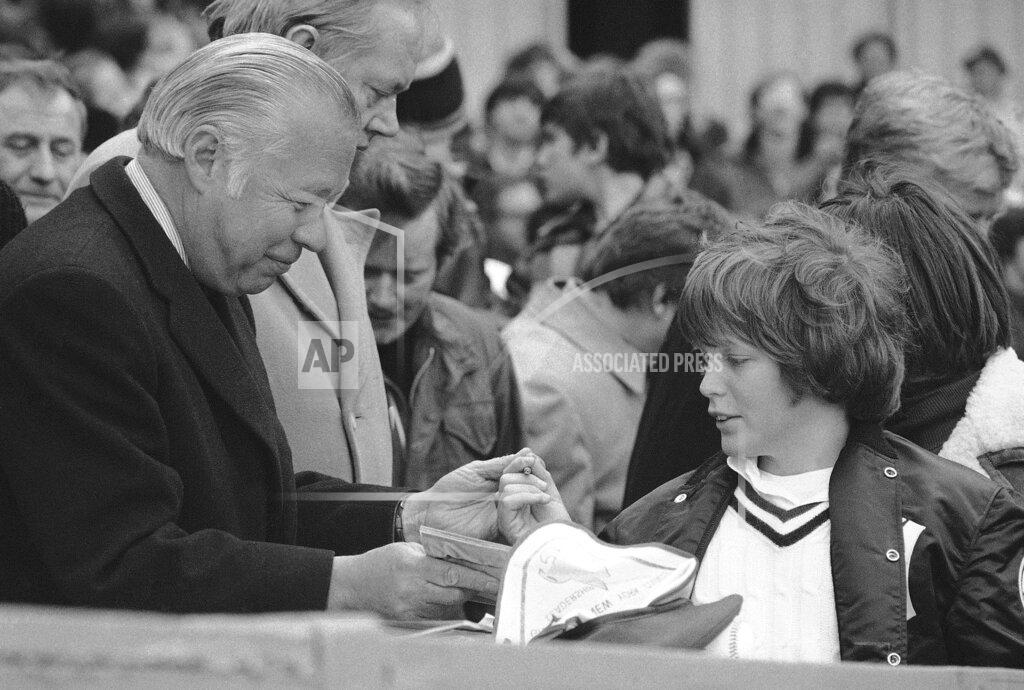
The Yankees open their two-year stay at Shea Stadium before a crowd of 20,744. 12-year-old Teddy Kennedy, Jr., flanked by his father and Mayor Abe Beame, tosses out the first ball. Missing from the ceremony is George Steinbrenner, indicted two days ago for illegal campaign contributions. Greg Nettle’s two-run homer in the 4th off the Indians Gaylord Perry opens the scoring and the Yanks score 4 more times to win, 6–1. Charlie Spikes scores the only Cleveland run in the 9th following a triple off starter and winner Mel Stottlemyre. Perry, who is warned once for an illegal pitch, is the loser today, but he will win his next 15 decisions.
The Kansas City Royals set a team record for runs‚ rolling over the Minnesota Twins‚ 23–6. The 20th Kansas City run comes on Frank White’s first major league homer. Twenty of the runs are earned.
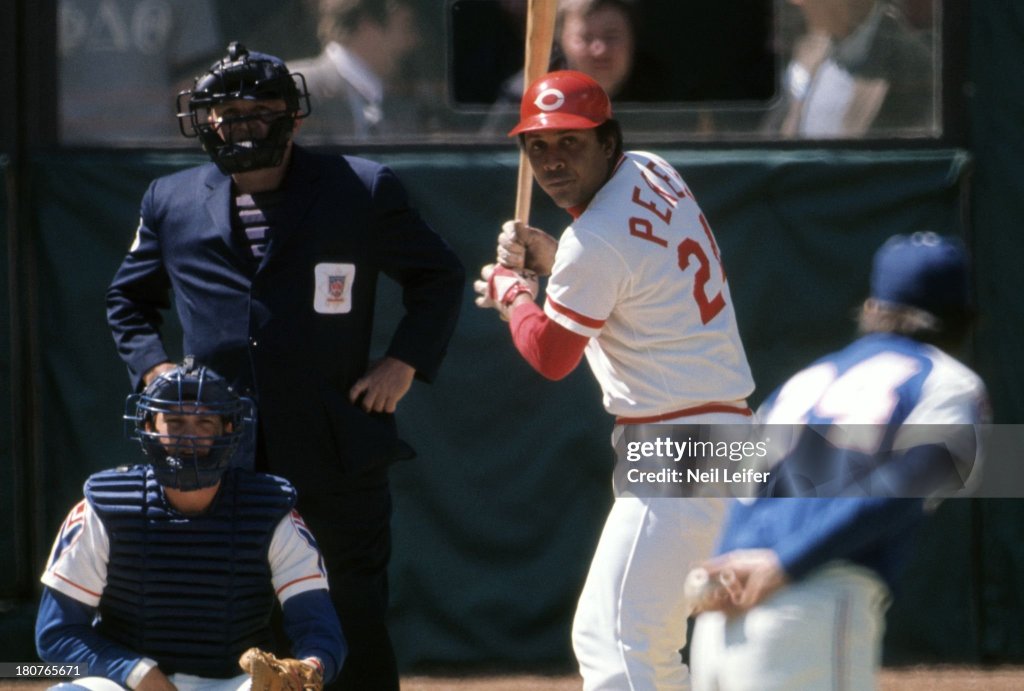
At Veterans Stadium, Phillies third baseman Mike Schmidt hits a ninth inning two-run home run off Tug McGraw to beat the Mets on Opening Day, 5–4. The walk-off homer is the first of the league-leading 36 dingers the third baseman will hit this season. It is the Mets’ only Opening Day loss of the 1970s.
Born:
Danny Clyburn, MLB outfielder (Baltimore Orioles, Tampa Bay Devil Rays), in Lancaster, South Carolina (d. 2012, murdered).
Died:
Sir Hudson Fysh, 79, Australian aviator and founder of the Australian airline Qantas.
Cardinal Štěpán Trochta, 69, the only Roman Catholic Cardinal for Czechoslovakia, died of a cerebral hemorrhage. Trochta, who had survived years in a Nazi concentration camp and later in a Czechoslovakian prison from 1953 to 1963 under Communist rule, had secretly been elevated to the cardinalate in 1969 by Pope Paul VI.
Willem Marinus Dudok, 89, Dutch modernist architect.



 History Diaries