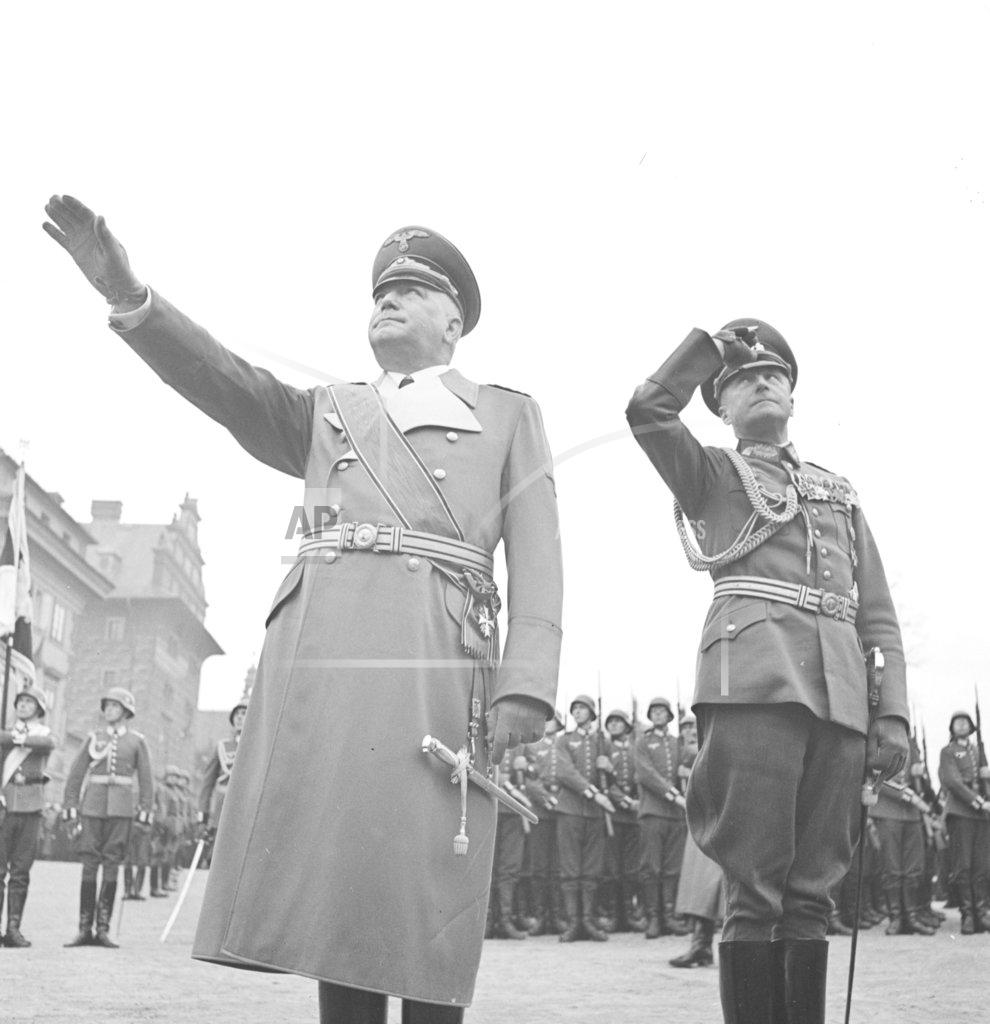
The spotlight of the European crisis swung to Albania last night. Reports were rife in Rome that Italy was ready to occupy that country at any moment. While negotiations with the Albanians went on in Rome the Italian Chief of Staff and the German Chief of the Supreme Command conferred at Innsbruck. German chief of armed forces General Wilhelm Keitel and Italian chief of armed forces General Pariani meet in Innsbruck to discuss division of operations in event of war with the West.
Across the Adriatic from Italy the Albanian Cabinet met late into the night and ordered military precautions. Italians were leaving the country in large numbers. Colonel Zef Sereggi, aide-de-camp of King Zog and newly appointed Albanian Minister to Rome, and Francesco Jacomoni, Italian Minister to Albania, arrived by plane from Tirana today and soon afterward were received by Foreign Minister Galeazzo Ciano. It is understood that Colonel Sereggi, who left Rome Sunday and was believed to have taken with him the Italian conditions for a new Italo-Albanian accord, brought Count Ciano King Zog’s reply. The Italo-Albanian negotiations for a new agreement were reported almost completed by Italian circles despite Tirana dispatches saying that the Albanian Government had ordered partial mobilization. The Albanian army numbers about 30,000 men, and it is believed that yesterday’s order affected approximately 15,000.
These reports added that a violent anti-Italian demonstration had taken place in Tirana yesterday. A crowd composed mostly of students marched through the streets and gathered before the City Hall, where it shouted, “Down with Italy!” Albanian dispatches tonight say that the Council of Ministers in Tirana sat until late this evening and that the situation is “very tense.”
Rome is buzzing with rumors, which cannot be confirmed at a late hour, according to which Italian transports with thousands of troops left Bari in the morning and are approaching the Albanian coast, while other rumors say they have already debarked at Valona and Durazzo. On the other hand, in Brindisi, where large contingents of troops have been reported concentrated during the last few days, it was denied that soldiers Had left for Albania.
In Rome it was announced that a communiqué would be issued soon on the Italo-Albanian situation. The press does not mention the strained relations between the two countries and its silence is believed attributable to the fact that no definitive solution of the controversy has yet been reached. No indication is available as to the character of the new reported accord. Should it be concluded, however, it is believed that it would permit Italy to send a number of troops to protect Italian interests in certain specified Albanian zones, including the district of Kucova, where the Italians have invested large sums for the exploitation of oil fields.
Albanian authorities said tonight that they had taken “suitable military precautions” to maintain the tiny kingdom’s independence. King Zog and his Cabinet sat up late studying Italian plans for strengthening the twenty-year defensive alliance that Italy and Albania signed in 1927. Foreigners here, learning that Italians were leaving Albania in large numbers, expressed considerable concern over the immediate situation. An heir to the throne was born this morning to Queen Geraldine, and this was accepted immediately by the country’s inhabitants as an occasion for a tremendous wave of intense nationalism. “We are a small country but proud of our independence,” was a representative comment. “We are determined to preserve it at all costs.”
French observers believed Chancellor Hitler was encouraging Premier Mussolini to establish a foothold in Albania as a first step toward domination of the Balkans and ultimately a joint hold on the Dardanelles.
In Geneva it was agreed that the Strait was the ultimate goal, and it was feared that Bulgaria would join in the venture.
Berlin reported that the coming weekend would see a demonstration by the Axis designed as a warning that “encirclement” would not be tolerated. Such a pronouncement, it is predicted, would be in the nature of a sharp warning to Western powers that any attempt to “encircle” Germany would find the Reich and Italy in complete unity in regard to retaliatory measures. Chancellor Adolf Hitler has been in active touch with Premier Benito Mussolini of Italy since the former’s Wilhelmshaven challenge to Britain Saturday — presumably through the medium of Field Marshal Hermann Göring, who is still on vacation in Italy. The expected pronouncement from Rome and Berlin will not only unmistakably reaffirm the unity of aims and the collaboration of the axis powers, it is believed, but will also inform Britain and France of their determination to combat any attempt to isolate Germany politically or economically.
At the same time Germany became further militarized by an order that all boys and girls between the ages of 10 and 18 would have to join the Hitler Youth for training.
Resolutely Britain pursued her “stop-Hitler” drive, aware of the risks entailed but seeking at all costs to widen the anti-aggression front.
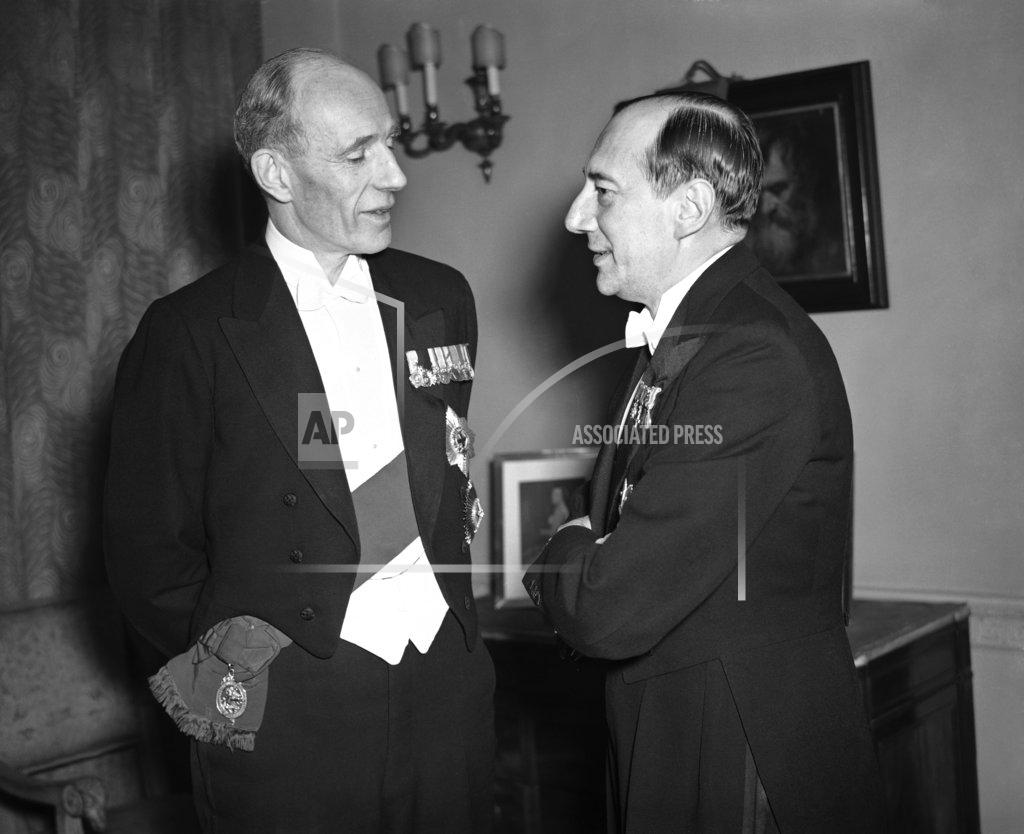
The defensive alliance with Poland is expected to be announced in the House of Commons tomorrow. Tonight, after a busy day of conferences and ceremonies, Viscount Halifax, the British Foreign Secretary, and Colonel Josef Beck, Polish Foreign Minister, put the finishing touches to the Anglo-Polish agreement which it is hoped will become the keystone of a defensive structure including many other nations. The agreement will not only reaffirm Britain’s pledge to Poland but also will include Poland’s promise to give immediate help with all her armed strength in case of an attack on Britain.
Colonel Beck also gave the British his assurance — and Mr. Chamberlain may communicate it to the House of Commons — that Poland would immediately honor her obligation to France in case of aggression. So the three-power alignment is already in existence, and Germany is confronted with the certain prospect of war on two fronts if she attacks Britain, France or Poland. How soon this alignment will be extended to include Rumania and Turkey and perhaps Russia is a problem for the diplomacy of the next few days and weeks.
Britain, moreover, was looking to her own defenses and it was confirmed that the navy’s anti-aircraft guns had been manned, although the disclosure of this fact by the First Lord of the Admiralty stirred up a tempest that Prime Minister Chamberlain did what he could to calm.
The British Government pushed forward today with all possible precautions against a war crisis, although the extreme jitters of twenty-four hours ago seemed to have subsided. All 13,000 teachers in the London County Council’s elementary schools were instructed today to register their addresses with the authorities before leaving for the Easter holidays. The purpose of this move, which was termed a “purely precautionary measure,” was to assure that the council’s scheme of evacuating school children from London could be carried out in the event of an emergency during the vacation period. At the same time parents were asked to send their children immediately to the usual schools if a state of emergency should interrupt the holidays. The government also announced that it would speedily place orders for 1,000,000 more of the portable steel shelters now being installed in back yards throughout the country as a protection against debris and blast damage from air raids.
Membership in Hitler Youth becomes obligatory.
Albert François Lebrun was re-elected by the French National Assembly to another seven-year term as President of France. The Independence in French character, which refuses to goose-step in any given direction, even though it may secretly approve, dominated the reelection of Albert Lebrun as President of France by the National Assembly at Versailles today. Nobody voted against M. Lebrun, but he received only 506 votes out of a possible 904. Nearly 400 Senators and Deputies preferred to give their votes to others, even though these had no chance of being elected. Thus, although no one had ever proposed him as a candidate Marshal Philippe Petain got nineteen votes.
It may seem contradictory and confusing, but those who think it so must remember that France is a democracy of a special kind. It is not a country where all the voting is like traffic under police orders to go one way. Nobody voted against M. Lebrun, for whom all parties have the highest respect. The votes that were not cast for him were not cast against him. They were given to a Socialist veteran, Albert Bedouce; to a Communist veteran, Marcel Cachin; to Edouard Herriot and to others in protest against the feeling that has developed during the past two days that M. Lebrun’s candidacy had been imposed on the National Assembly and on the President himself by Premier Edouard Daladier and his decree-power government, backed by what the Chamber majority regards as a reactionary Senate.
Those who voted for M. Lebrun were considered as voting for M. Daladier. Those who voted against his re-election considered that they were voting for the sovereign right of the National Assembly, representing the free people of France, to vote as they please and to accept no dictation. When the result was announced by the Assembly’s president, Jules Jeanneney, who, as president of the Senate, presided, the Right and Center arose cheering for M. Lebrun. On the Left, however, only Edouard Herriot and a few other sportsmen arose and clapped. All those who had taken the view that the President’s candidacy had been imposed on them preferred to see in his relatively small majority a check for the government and they started shouting, “Resign! Resign!” From the Right came the answering cry, directed at the Communists, who were leading the uproar: “Go to Moscow!”
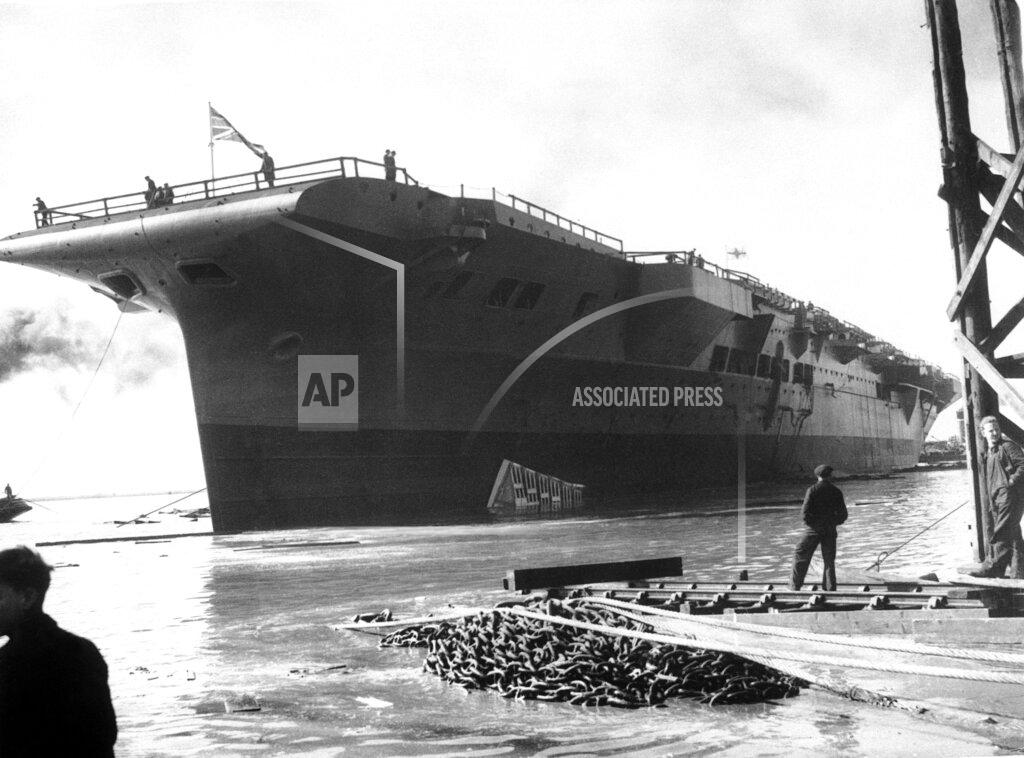
Britain’s largest aircraft carrier, HMS Illustrious, was launched at Barrow-in-Furness.
The funeral of King Ghazi in Iraq this morning was the occasion of a remarkable display of the people’s devotion to the throne. At least half of Baghdad’s population of 300,000 appeared to have gathered in the neighborhood of the royal mausoleum, and their numbers were swelled by deputations of mourners sent by Basra and other provincial towns. Women were prominent, wearing their usual black robes. They crowded in a solid phalanx at the roof of every house from which a view of the procession could be obtained. Their high-pitched lamentations — the characteristic wail of women in all parts of Arabia-gave a macabre note to the scene. The coffin was taken on a gun carriage from the royal court to the Mausoleum, where after a religious service it was carried on the shoulders of senior army officers to its final resting place followed by the Regent, Emir Abdullah, and Emir Zadid, the late King’s uncle. Buglers sounded the last post and a salute of ninety-nine guns was fired.
In Washington the Senate Foreign Relations Committee, opening hearings on the Neutrality Act, was urged by former Secretary of State Stimson to regard the revision problem as one of national defense, not foreign policy. Revision of the Neutrality Act should be approached as a problem of national defense rather than of foreign policy, Henry L. Stimson, former Secretary of State, told the Foreign Relations Committee today as it opened hearings on the seven proposals pending before it. He made the point repeatedly that the United States must consider its own vital interests in deciding whether it would throw its moral and material resources in the scales against the aggressors and treaty breakers of the contemporary world.
The conclusion he drew each time a member of the committee engaged him in a discussion was that this country would best serve its own national defense, as conditions were now, by discouraging the rulers of Germany, Italy and Japan. Although the colloquies often became involved in technicalities, Colonel Stimson stuck to his thesis that the United States could thrive unmolested only in a world where its neighbors lived up to treaty obligations and believed in mutual respect among sovereign nations.
Specifically, he urged the committee to report favorably the amendment to the existing neutrality statute which has been proposed by Senator Thomas of Utah and which would permit the President, with the assent of Congress, to name the aggressor in any foreign war (the aggressor would be the nation or nations which went to war in violation of a treaty with the United States, such as the Pact of Paris) and to apply against that nation or nations alone the prohibitions of the existing law.
The Senate Appropriations Committee voted unanimously today to give the Administration the $100,000,000 deficiency appropriation approved by the House to finance the Works Progress Administration funds for the rest of the year, ending June 30. The intent was to avoid possible bitter debate on the floor. The conservative group, headed by Senator Thomas of Colorado, chairman of the appropriations subcommittee designated to handle the House bill, gave up its demands for a further cut in the appropriation, in return for a pledge by the New Deal leaders that no organized effort would be made in the Senate to restore to the House bill the $150,000,000 requested by President Roosevelt, or any figure higher than that in the bill reported tonight.
The expectations were that the bill would be called up tomorrow and approved after very little debate. But it was reported that Senator Pepper, New Dealer, served notice on his leaders that he would not be bound by the compromise. The committee action followed consideration of the question during the day, first by the subcommittee and later by the Appropriations Committee itself. No parallel to the agreement reached was recalled by Senators since the World War. It was to the effect that testimony taken by the subcommittee should not be made public. The principal witness at the executive session was Colonel F. C. Harrington, Works Progress Administrator. Suppression of his testimony was interpreted at the Capitol as meaning that dissension in the subcommittee not only rose to such a high point that it was deemed inadvisable for the Democratic Senate leaders to open the testimony to debate, but that the feelings aroused were considered dangerous for party harmony.
A demand that the House receive an opportunity to amend the National Labor Relations Act was made today by Representative Cox, Democrat of Georgia, who intimated that if the House Labor Committee did not conduct hearings on the subject, a move would be made for a special Congressional investigation of the Labor Board.
Mr. Cox, ranking member of the Rules Committee, before which is pending a resolution for investigation of the Labor Board, called attention to bills before the Labor Committee providing for amendments to, or revision of, the Wagner Act, and added: “If the House Committee on Labor should promptly open hearings on the proposed amendments to the Wagner Act, in which full consideration is given to alleged defects in the law and maladministration by the board, the demand for investigation by a special committee would probably lighten up.” Representative Mary T. Norton of New Jersey, chairman of the Labor Committee, listened to Mr. Cox’s speech. She arose as if to ask him a question, but sat down without doing so. Afterward, she said there was no disposition on the part of the committee to “sidestep” the issue.
Mrs. Norton referred to the announcement that the Senate Committee on Education and Labor would begin hearings next Tuesday on the subject. She intimated that until hearings on amendments to the Wages and Hours Act and on a bill to make permanent the Civilian Conservation Corps were completed, the committee would have little time for anything else. Representative Anderson, Democrat of Missouri, introduced the investigation resolution, as well as a bill to abolish the Labor Board and set up a new quasi-judicial agency to handle labor problems. “The administration of the act by the National Labor Relations Board has not been satisfactory,” Mr. Cox asserted in his speech.
Southern and Western Senators organize a new group to push for $400,000,000 added farm aid.
Washington correspondents in a poll forecast the election of a Republican Dewey-Taft slate in the 1940 elections.
Andresen accuses President Roosevelt of splitting the nation by his appeal to the South to become “self-contained.”
Independent exhibitors back bill to curb blind selling and block booking of movies at hearing
A drug made from sulfanilamide and a fatty component kills tuberculosis germs, chemists say.
Alexander Gretchaninov’s 5th Symphony premieres at the Academy of Music in Philadelphia with Leopold Stowkowski conducting the Philadelphia Orchestra.
Mexico asks manufacturers to buy 8,840,000 pounds of Italian rayon to be obtained in oil barter.
Plants of capital newspapers accused of fascist leanings are stoned by Mexican unionists.
Governor of Bermuda resigns because Assembly denies him the use of an official automobile
Ta Kung Pao, the leading Chungking newspaper, published today details of alleged negotiations between Wang Ching-wei, fugitive former Premier of China, and the Japanese Premier, Baron Kiichiro Hiranuma, looking toward the assumption by Mr. Wang of the leadership of a Chinese regime cooperating with Japan. Mr. Wang was said to have urged the Japanese speedily to capture Nanning, in Kiangsi; Ichang and Siangyang, in Hupeh; and Fancheng in Honan before the reorganization of the Chinese Army is completed, and was reported to have promised to head an anti-Chiang Kai-shek government after these Japanese: successes.
The Japanese reported today that their forces had struck overland and through the air in a broadening campaign to extend the conquered area of central China. A column based on Wuning, in northwestern Kiangsi Province, was Isaid to have crossed the Siao River and driven ten miles along the 180-mile route to Changsha, Hunan Province capital 200 miles south of Hankow. Changsha also was subjected to an air raid.
One hundred miles northwest of Hankow, however, Chinese reported their troops had counter-attacked at Chungsiang and occupied part of that town on the Han River. The rest of Chungsiang was said to be under siege. Japanese planes bombed Sian, capital of Shensi Province, and reported severe damage to military establishments. The Japanese also bombed Suhsiang and Tsinhsien in Central Hopeh Province and Limchow in Kwangtung.
Chinese planes were reported to have raided Nanchang, Kiangsi Province capital recently lost to the Japanese, machine-gunning Japanese troops and bombing a munitions depot.
The American church mission at Changsha was slightly damaged yesterday in a Japanese air raid. The Rev. Walworth Wyng of Boston and his wife, missionaries at Changsha, reported they escaped injury.
Chinese officials closed the port of Ningpo, 100 miles south of Shanghai. Civilians are leaving that city because of reports that the Japanese might attempt to occupy it. During the last two weeks Japanese war vessels have shelled. Ningpo ports but apparently with little damage.
An anti-British campaign gained momentum in the Japanese-occupied Central China areas. At Kaifeng, on the Yellow River, 5,000 persons participated in a mass meeting at which twenty orators denounced Britain’s assistance to the Chinese Government.
Working against the coming of Spring floods of the Yellow River, Japanese military authorities have impressed thousands of Chinese laborers to repair dikes and fortify Kaifeng. Other impressed workers are building a railroad to link the Lung-Hai line with the Peiping-Hankow Railway at Sinsiang, forty miles north of Chengchow. Japanese engineers are making no effort to repair the major break in the Yellow River dike through which the river flooded a vast section of the countryside last Spring, blocking the Japanese drive on Chengchow, forty miles west of Kaifeng. They are concentrating repairs on two smaller breaks, planning to use the dike as part of the new railway’s roadbed. Throughout Japanese occupied zones of Honan and Shantung Provinces the Japanese are collecting new railway ties, charging each family with the task of supplying at least one. American and other foreign missions were said to have been compelled to furnish timber for ties.
Dow Jones Industrial Average: 130.34 (+0.54).
Born:
Crispian St. Peters [Robin Peter Smith], British pop singer (“The Pied Piper”; “No No No”), in Swanley, Kent, England, United Kingdom (d. 2010).
David Winters, American choreographer and director (“Steve Allen Comedy Hour”), in London, England, United Kingdom (d. 2019).
Ronald “Ronnie” White, American singer (The Miracles – “Shop Around”), in Detroit, Michigan (d. 1995).
Leka, Crown Prince of Albania (d. 2011), in Royal Palace of Tirana, Tirana, Kingdom of Albania.
Larry Vargo, NFL safety, linebacker, and split end (Detroit Lions, Minnesota Vikings, New York Giants), in Iron Mountain, Michigan.
Naval Construction:
The Royal Navy aircraft carrier HMS Illustrious (87), lead ship of her class of 3, is launched by Vickers Armstrong (Barrow-in-Furness, U.K.).

 History Diaries