
For the third time since 1957, a coalition government of neutralists, rightists and the pro-Communist Pathet Lao was established in Laos. A decree dissolving the neutralist-rightist Vientiane government of Premier Souvanna Phouma and establishing the coalition with the Pathet Lao was signed by King Savang Vatthana. This coalition, born of the Laotian cease-fire agreement signed on February 21, 1973, unites opponents from 20 years of civil war. In Vientiane, the capital of Laos, a new government was formed giving power to the Communist Pathet Lao, led by Prince Souphanouvong, chairman of the powerful new 48-person National Political Council, and his older half-brother, Prime Minister Souvanna Phouma. Souvanna Phouma and Souphanouvong were two of the 24 children of Chao Maha Oupahat Bounkhong, the late Uparaja of Luang Prabang. After having spent years in hiding during a fight against the Western-backed regime of Souvanna Phouma, Souphanouvong made his first public appearance in Laos, with his half-brother, at a ceremony at the Buddhist Ong Tu Temple, where both took a pledge to work together for the benefit of the Lao people.
Khmer Rouge insurgents besieging the Cambodian coastal town of Kampot blew up all 10 of the garrison’s artillery pieces with one shell, informed sources reported today. The reports said that the guns, 105‐mm howitzers, were bunched together and that one shell landed among the ammunition early yesterday. The ammunition exploded, destroying all the guns. Nevertheless, the government troops launched a counterattack on the northern edge of the town, the sources said. House‐to‐house fighting was reported, with three government soldiers killed and 23 wounded. Insurgent losses were not known.
About 700 Government troops were being sent to reinforce the defenders of the town, which is 85 miles southwest of Phnom Penh. Civilians were reported jamming aboard every available boat to escape to Kompong Som, 40 miles to the west. Foreign military observers, said that the weather over Kampot had turned bad, making it difficult for government warplanes to identify rebel positions. They said the lack of artillery and effective air support might cause the situation to become critical in the next few days. Meanwhile, Communist‐led insurgents kept up their attacks on government positions north and east of Phsar Oudong, the former royal capital 23 miles north of Phnom Penh. The Cambodian military command said that in sharp fighting around the government beachhead at Kompong Luong, three miles east of Phsar Oudong, four Government soldiers Were killed and 28 were wounded.
Two separate grenade explosions killed 11 people tonight and wounded 101, the South Vietnamese command reported. It blamed Việt Cộng terrorists in both incidents. No one was apprehended. Six civilians and two soldiers were killed and 56 wounded when a grenade exploded in temple near Trảng Bàng, a district capital 30 miles northwest of Saigon, the command said. Three civilians were killed and 45 wounded by a grenade hurled into a crowd watching a show near Đức Huệ, a district capital nine miles away, the command added. There has been heavy fighting near the towns for the past 11 days.
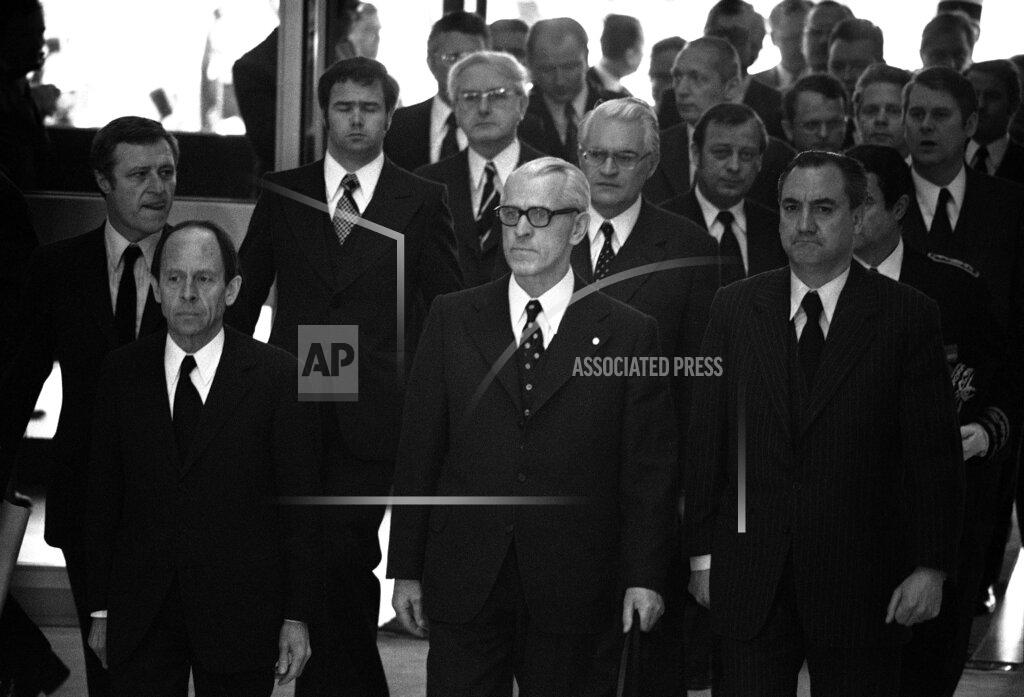
France will vote on May 5 for a President to succeed Georges Pompidou. The date was set at a meeting of the cabinet. More than 40 chiefs of state or government, including President Nixon, will attend a requiem mass for Mr. Pompidou in the Cathedral of Notre Dame in Paris tomorrow. Mr. Nixon arrived in Paris tonight. Mr. Pompidou was buried yesterday near his country home in Orvilliers, 31 miles west of Paris, in rites attended by only 17 family members and friends. In a handwritten note in August, 1972, President Pompidou stipulated that his funeral service be at the parish church near his private apartment on the Ile Saint‐Louis and that he be interred at Orvilliers with the simplest possible ceremonies.
A controversy involving property dealings of Prime Minister Wilson’s private secretary and an alleged forgery of Mr. Wilson’s signature has embarrassed and embittered the new Labor party Government. Scotland Yard has now opened an investigation into the signature, which appeared on a letter about the sale of industrial land. Members of Parliament, both Conservative and Labor, are demanding a full explanation of a series of transactions involving Mrs. Marcia Williams, Mr. Wilson’s secretary for 18 years, and two members of her family, both former associates of the Prime Minister. No allegations have been made that Mr. Wilson himself has been involved. There has been no evidence that any of the transactions were illegal.
The United States and Saudi Arabia announced that they have agreed to expand economic cooperation and to negotiate an American supply of weapons for Saudi defense requirements. King Faisal’s brother, Prince Fahd Ibn Abdel Aziz, is scheduled to meet President Nixon and Secretary of State Kissinger next week to codify the agreement, a United States official said.
A dispute between the Soviet Union and the United States forced the postponement today, of a Security Council session called to extend for six months the life of the 7,000‐man United Nations Emergency Force in the Middle East. The Council will make another effort Monday to act on continuing the force. The dispute was touched off by Soviet efforts to compel Israel to allow free movement inside, her lines for all United Nations troops, including the 824‐man Polish contingent.
Israel has balked at allowing entry to troops coming from countries that she regards as “Unfriendly.” Israeli authorities were said to fear that Moscow would next seek entry for its own 36 officers, who serve as members of the United Nations Truce Supervisory Organization. Israel maintains that these soldiers, who serve side‐by‐side with members of the United Nations, Emergency Force, would raise security risks. United Nations authorities are known to have been trying to resolve the issue of free movement for all military contingents in discussions with Israeli officials, but apparently without much progress. Secretary General Waldheim, in a report Tuesday to the Council urging extension of the life of the peace force, singled out the matter of free access as requiring “urgent solution.”
Yakov A. Malik, the Soviet delegate, moved to press the issue yesterday at a private meeting, insisting that a resolution on continuing the force be amended to ask the Secretary General to take steps to insure freedom of movement. John A Scali, the United States delegate, objected that the proposed Soviet changes introduced elements of controversy and blocked swift approval of the resolution. When further consultation failed to break the deadlock, the Council session was put off for the weekend.
Aleksandr I. Solzhenitsyn said today that the Soviet Union “lives under the rule of serfdom.” The Russian author, who was deported seven weeks ago and is, living in Zurich, made the accusation in a 300‐word statement telephoned to the British Broadcasting Corporation. It Was broadcast overt the B.B.C.’s Russian‐language service, to which Mr. Solzhenitsyn was a regular listener. He protested against the removal from Moscow of two dissident writers, Viktor Nexrasov, winner of several Soviet literary prizes, and Aleksandr Ginzburg, who was released from a labor camp two years ago after serving a five‐year term. “The Soviet Union lives under the rule of serfdom, the author asserted, “I have said so many times, but people seem to take it for, an artistic metaphor.”
“Free citizens are not at all free. They are free neither to choose their employment nor to fight for a fair wage for it, and even in their day‐by-day lives they are obliged to conform to the whims of the petty local party bosses. Soviet people cannot choose where to live in their own country. How much more intolerable is this oppression than the lack of freedom to emigrate, which has caused so much justified protest all over the world.”
A Perónist leader was shot dead in a shantytown early today in the third political killing in Argentina in less than 24 hours. The police said that 27‐year‐old Fernando Quinteros was dragged from his home and killed in the northwestern suburb of San Martin by two men claiming to be policemen. Mr. Quinteros was one of scores of Perónists sent into the shantytowns to organize politics when President Juan Domingo Perón’s Justicialist Movement came to power last May. Yesterday, Roberto Klecher, Fiat Motor Company executive, was shot dead in an ambush in the industrial city of Córdoba
Dwight Chapin, President Nixon’s former appointments secretary, was found guilty in Federal District Court in Washington of lying to a Watergate grand jury. The Watergate special prosecutor’s office thus won the first case it brought to trial. Mr. Chapin was convicted of making two false statements to a grand jury last April about his relationship with Donald Segretti, who has served a jail sentence for distributing bogus campaign literature about Democratic presidential campaign candidates. Mr. Chapin will be sentenced May 16.
George Steinbrenner, chairman of the American Shipbuilding Company and principal partner in the New York Yankees, was indicted on 14 felony charges growing from illegal campaign contributions to both Republicans and Democrats. He was indicted by a federal grand jury in Cleveland on charges that he consented to $51,000 in gifts by American Shipbuilding and had authorized $91,000 more paid through fake bonuses and expense accounts. He is 43 years old and a resident of Bay Village, Ohio.
Edward Nixon, the President’s youngest brother, became the first witness for the defense in the Mitchell-Stans trial and promptly contradicted the testimony of two of the government’s chief witnesses. He took the stand after Judge Lee Gagliardi in Federal District Court in New York dismissed one of three obstruction of justice counts against John Mitchell and Maurice Stans.
President Nixon neglected to pay Social Security taxes for a maid he employed at his San Clemente home in 1969, though he took one quarter of the wages he paid her as a “business deduction” on his own tax return, according to the Congressional study of Mr. Nixon’s taxes. This is reported in a brief passage and footnote in the 99‐page study of Mr. Nixon’s tax returns that was prepared by the staff of the Joint Committee on Internal Revenue Taxation and made public on Wednesday. The study also reports that Mr. Nixon failed to pay Social Security, taxes for the gardener at San Clemente, Calif for six months of 1970, though he also deducted one quarter of the gardener’s salary on his own return. The staff of the committee concluded that Social Security taxes should have been paid for both individuals.
Diane Sawyer, an assistant in the White House press office, would make no comment on the Social Security taxes, beyond stating, “The President did not handle any aspect of his tax returns. They were done entirely by the tax experts that he hired.” The amounts of Social Security tax were not included in the $444,022 that the Congressional investigators said Mr. Nixon owed in unpaid taxes for his first four years in the White House. The reason, the staff said, was that it had been assigned solely to deal with Mr. Nixon’s income taxes, not other types of taxes.
Frank DeMarco, Jr., President Nixon’s tax lawyer, says it is “ridiculous” to believe that the President did not know about his tax returns. The lawyer is worried that he may be made a “scapegoat.” When asked about a White House statement that he and the President had only chatted when the lawyer submitted the President’s, 1969 tax return to be signed. Mr. DeMarco said: “It is ridiculous.” “What we did was go over the return page by page,” Mr. DeMarco said in answering White House statement that controversial deductions had been made without Mr. Nixon’s knowledge and without his approval.
Mr. DeMarco said it would rote ridiculous to believe that he and the President’s tax accountant, Arthur Blech, had made the decisions they did without instructions from Mr. Nixon or his representatives. He said he still believed that the deductions that were claimed could be defended, but perhaps did not show “political astuteness” on the part of a President.
In the face of his Watergate and income tax troubles, President Nixon decided to campaign in Michigan next week in hopes of salvaging a Republican victory in a closely contested special election. The White House said that he would make a one-day trip on Wednesday to Michigan’s eighth Congressional District, where James Sperling, a Republican who worked briefly for Mr. Nixon last year, is running against Robert Traxler, a Democrat.
The nation’s unemployment rate took a slight dip in March, to 5.1 percent from 5.2 percent of the labor force, the Labor Department reported. The rate held basically steady for the second consecutive month, after rising in the late fall and early winter. It was 5.2 percent in both January and February.
The Labor Department, in devising a modernized version of the Consumer Price Index, has decided to use the “spending patterns” of a broader segment of the population than in the past because nearly 50 million people now have their incomes tied in whole or part to the new index. The new index will not be published until April, 1977. The broader coverage was attacked by Leonard Woodcock, president of the United Automobile Workers.
The Department of Interior, which for nine years has supported the construction of a huge hydroelectric station on the New River on the North Carolina‐Virginia border, has reversed itself. In a letter yesterday to Representative Wilmer Mizell, Republican of North Carolina, Secretary of the Interior Rogers C. B. Morton said the department would support a bill that would include a large portion of the New River in a list of other rivers that are under study for inclusion in the National Wild and Scenic Rivers System. The bill is sponsored by Mr. Mizell in the House and by Yorth, Carolina’s Senators Sam J. Ervin Jr., a Democrat and Jess A. Helms, a Republican. It is also supported, by North Carolina’s Governor James E. Holshouser Jr. and both houses of the state Legislature. Largely as a result of the reversal by the Interior Department, a subcommittee of the Senate Interior Committee recommended today a slight modification of the Ervin-Helms-Mizell bill. It would provide that the Department of Interior be given a full fiscal year to miles inclusion of about 70 miles of the New River in North Carolina and Virginia plus a stretch in West Virginia, in the Wild and Scenic Rivers System.
A major development in x-ray astronomy was achieved with discovery of “the first indication of strong coronal emission from stars” when astronomer Richard Catura detected x-ray luminosity from the star Capella (Alpha Aurigae), almost 43 light years from Earth, that was more than 10,000 times as much as the x-ray luminosity of the Sun. The detection was made by accident, in that the intended mission of a rocket-borne launch of instruments was simply to calibrate the directional accuracy of the stellar sensors.
“Carrie,” the debut novel by high school teacher Stephen King, was published by Doubleday, launching his career as the “King of Horror.”
Streakers and strippers highlight the Opening Day game at Chicago’s Comiskey Park. The Angels beat the White Sox 8–2. Despite handing out 10 walks, Nolan Ryan is the winner over Wilbur Wood, with help from Leron Stanton, who homers. For Wood, it is the first of his American League high 42 starts, the third of four years in a row the knuckler will lead in that category.
Dow Jones Industrial Average: 847.54 (-11.35, -1.32%).
Born:
Rick Terry, NFL defensive tackle (New York Jets, Carolina Panthers), in Lexington, North Carolina.
Sahaj [Daniel Ticotin], American alternative-metal singer, guitarist, and record producer (Ra; Meytal), in New York, New York.
Died:
Jennifer Vyvyan, 49, British opera soprano, died of a bronchial illness.
Richard Crossman, 66, British M.P. and Leader of the House of Commons, 1966 to 1968
Fred Snodgrass, 86, retired American MLB baseball outfielder, later known for being the mayor of Oxnard, California, remembered for his crucial error in the 1912 World Series that cost the New York Giants the championship.
A. Y. Jackson, 91, Canadian landscape painter and a founding member of the “Group of Seven”
S. P. Kodandapani, 42, Indian film score composer.



 History Diaries