Hitler gave a top secret directive to the military code-named CASE WHITE, ordering the preparation of military operations against Poland for any time from September 1 forward. Hitler issues a war directive marked “Most Secret” and has it delivered by hand to his senior war commanders. “Since the situation on Germany’s eastern frontier has become intolerable and all political possibilities have been exhausted,” it began, “I have decided upon a solution by force.” Preparations for the attack on Poland, “CASE WHITE” (Operation White), “must be made so that the operation can be carried out any time from September 1, 1939.
Reassured by Prime Minister Neville Chamberlain’s new statement that Britain’s pledge stands unequivocal and unconditional, Foreign Minister Josef Beck of Poland will begin tomorrow a series of talks that will be vital to his country’s future and to the peace of Europe.
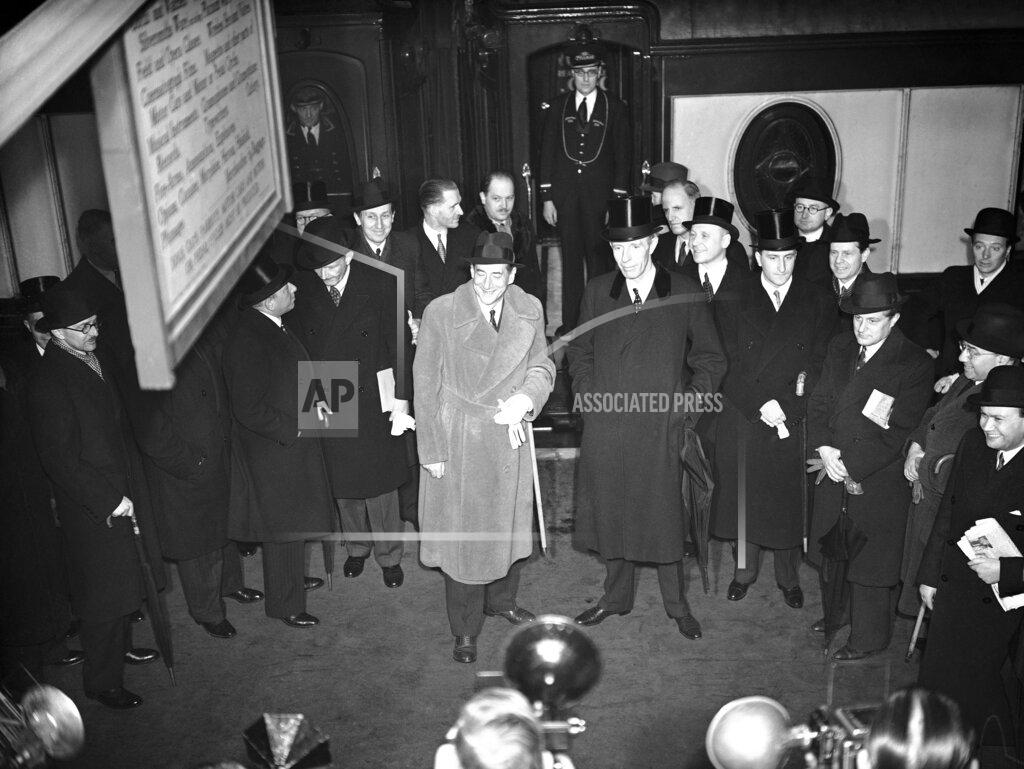
Colonel Beck arrived in London this afternoon and was met at Victoria Station by Viscount Halifax, Foreign Secretary, and a small crowd, which was kept back by the police, watchful against any incident. Colonel Beck spent a quiet evening at his hotel, studying the House of Commons foreign debate speeches. Mr. Chamberlain’s new statement favorably impressed the Poles, who arrived still suspicious of British intentions after the editorial in The Times, London, on Saturday. This statement will facilitate the “writing of a complete insurance” policy after the pledge made Friday.
In the background of the visit little has changed over the weekend. The British assurance to help Poland against a menace to her independence remains the basis of the proposed discussions. How far Poland will make it reciprocal, how much Britain is prepared to lend Poland to buy raw materials and munitions, what other countries will join in the security front; what demands, if any, Germany has presented — these matters will be discussed.
It seems the Poles do not yet know precisely what they will be asked to do or to sign — whether they will be asked to conclude a mutual assistance pact or give a reciprocal official pledge or just make a gentleman’s agreement for mutual aid. A “one-sided” British guarantee, they maintain, automatically pledges all the countries whose independence Britain is prepared to safeguard.
Colonel Beck will certainly insist that whatever is arranged in London shall not have the character of an encirclement of Germany. The Poles insist that their policy of equilibrium between Germany and Russia is unchanged and that Poland does not want to break with Germany.
Concentrations of troops and transports at the port of Brindisi are reported and there are other indications that Italy intends to take some action in Albania. It is possible that what is intended is merely a change in the relations between Italy and Albania — some form of a protectorate that would give Italy stronger control and enable her to develop Albanian resources more fully. The money that has been poured into Albania so far has benefited neither Italy nor Albania very much.
The economic position of Albania has been growing worse lately and there is believed to be great discontent among the people. Italy may have come to the conclusion that her best plan would be to take virtual possession. This has appeared to be her ultimate aim in the last fifteen years and if it were done now, it might be a timely addition to Premier Mussolini’s prestige. King Zog’s chief aide-de-camp, General Zef Sereggi, who is a well-known pro-Italian, was recently appointed Minister to Rome and since his arrival there has been great activity at the Albanian legation. King Zog may have agreed to accept a protectorate in his own interests.
In that case Italian troops may have been prepared only to be used as a last resort. They may be concentrated for this purpose at the island of Sasseno, the Italian naval base off Valona.
Warning signals of two impending changes in the shifting frontiers in the Mediterranean — from Albania and the Sanjak of Alexandretta — occupied the attention of the French Foreign Office today. Although it has been officially denied that Italy intends shortly to occupy Albania, the report is taken as having some foundation, especially in view of Premier Mussolini’s equivocal reference to the Adriatic in his recent speech. It is openly avowed that Italy demands some compensation in the Balkan region and Albania is considered the safest ground for attempted expansion.
To a House of Commons as impressively united as in August, 1914, British Prime Minister Neville Chamberlain hinted today that all of Germany’s neighbors that were “unhappy, anxious and uncertain about Germany’s future intentions” might find themselves included in the anti-aggression front now being built up by the British Government. Mr. Chamberlain did not enumerate all the countries he had in mind, but his words suggested that an attack on The Netherlands, Switzerland, Denmark or nations of Eastern Europe could equally put Britain and France into a war. Britain’s new commitments, he said, would apply against any German policy that attempted to “dominate the world by force.”
“What we are concerned with,” the Prime Minister said simply, “is to preserve our independence, and when I say ‘our independence’ I do not mean only this country. I mean the independence of all States which may be threatened by aggression in pursuit of such a policy as I have described. “Therefore, we welcome the cooperation of any country, whatever may be its internal system of government, not in aggression but in resistance to aggression.”
A new German press slogan, uniformly adopted by the Berlin press today, is “Encirclement.” Screaming headlines announce with renewed vigor: “Britain continues encirclement agitation. Rome warns against encirclement. Corridor question is British explosive and foundation of encirclement policy.” The new “encirclement” press campaign recalls 1914, when the same charges were hurled at the Triple Entente and the German nation was called to arms allegedly to prevent its being “ringed in.” Prime Minister Neville Chamberlain’s statement in the House of Commons today evoked, however, a thinly veiled threat from the semi-official news agency, which said: “The Führer’s speech obviously has not been adequately understood by the British Government. We once more must energetically emphasize that the Reich does not intend to wait until the encircling net has been closed and made fast.”
Mr. Chamberlain’s statement, the comment declares, presents no new viewpoint and definitely shows determination to perpetuate the spirit of the Versailles treaty. Regardless of “beautiful peace phrases” with which it is disguised, the comment continues, “there is only one conclusion for Germany: Britain intends to throw all her strength into an encirclement policy against the vital continental interests of Germany.” Other nations must decide, the comment adds, what conclusions they must draw “from these well-known methods of Britain, which likes to give others advice as to how they can best serve British interests.”
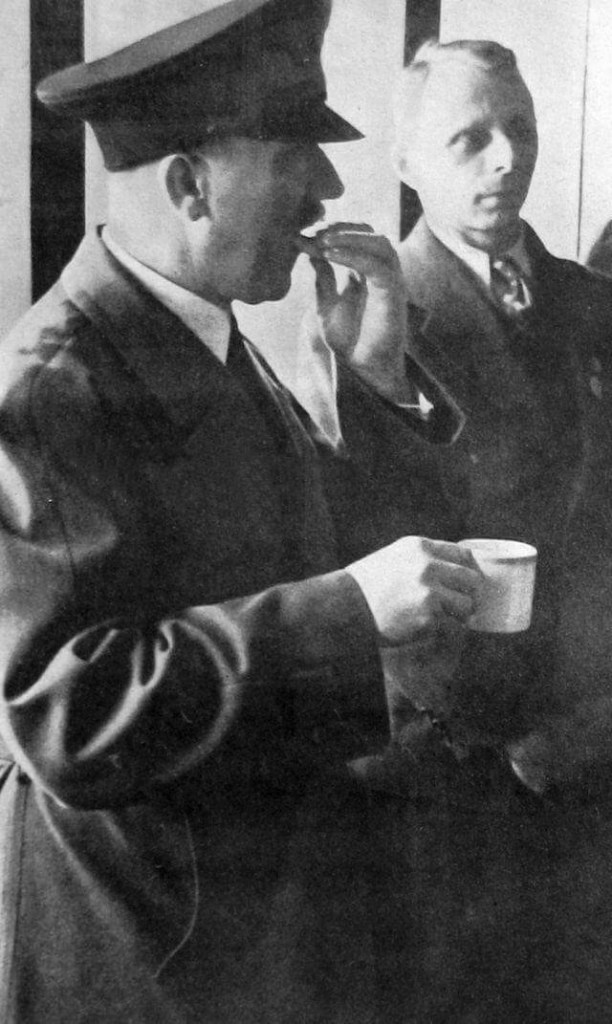
Official quarters in Berlin, however, await the outcome of Polish Foreign Minister Josef Beck’s conversations in London. Field Marshal Wilhelm Goering is still vacationing in Italy, and Dr. Joseph Goebbels, Propaganda Minister, is spending a holiday in Greece. Chancellor Adolf Hitler meanwhile is still fraternizing with some 1,500 German workers who are having a grand holiday aboard the Robert Ley in the North Sea. He is scheduled to return to Hamburg tomorrow. The Chancellor apparently is enjoying his three days at sea aboard the Labor Front’s spacious new excursion steamer. Herr Hitler is acquainting himself with the practical application of the “Strength through Joy” movement as applied to ocean voyages.
The Spanish Nationalist judicial mills — expected to grind fine and not slowly — began working away today on a great mass of “war guilt” trials. A summary court-martial started at near-by Colmenar Viejo, the accused being six individuals charged with slaying Rightists at the start of the civil war. At Valencia, Loreto Apellaniz Garcia, former Republican military police chief of the city, and twenty of his aides were executed after their conviction by a military tribunal on charges of committing murders during the civil war. It was stated in an official radio broadcast today that 35,000 persons were “known” to have been slain in Valencia during the war.
It was learned that Falangist military and civil investigators had taken 20,000 depositions from persons having knowledge of events in the Republican regime who either were located and questioned or appeared in response to the Army Advocate General’s summons last week. Evidence in 600 cases already has been prepared for hearing.
With more than 2,000 prisoners in Madrid jails alone, Eduardo Rozdan, Director General of Security, said today that Nationalist agents still were “effecting detentions among Red elements in Madrid.” Señor Rozdan added that the reorganization of police and administrative services was proceeding rapidly. White-helmeted policemen and civil guards took over policing the city, replacing Falangistas who had kept order since Madrid surrendered, last Tuesday.
Hungarian and Slovak negotiating commissions fixed a new Ruthenian-Slovak frontier in detail tonight. A protocol between Slovakia and Hungary on the frontier question will be signed tomorrow. The agreement gives Hungary, which annexed the old Czech province of Ruthenia (Carpatho-Ukraine), title to almost all the Slovak territory that Hungarian troops occupied in bitter frontier warfare March 23-25. Hungary gains as a result of annexation and tonight’s agreement about 386 square miles of territory and 45,000 new citizens. The new territory includes about forty villages, two of them health resorts.
Of greater importance is the fact that the land ceded includes mountain ledges that form a natural defensive frontier for the Ung Valley, through which run the main rail and highway connections between Hungary and Poland. The strip is on the western frontier of Ruthenia, about 36 miles long and 12 miles wide. It increases the length of the Hungarian-Polish frontier by about fifteen miles. This latest gain, the third made since last Fall, gives Hungary a total area of about 46,000 square miles and a total population of 10,335,000. Despite the gains, which have come as by-products of German inroads into Czecho-Slovakia, Hungary remains less important than before the World War. Then she was an integral kingdom within the Austro-Hungarian empire, with 25,000,000 population and an area of 125,000 square miles.
Folketing elections were held in Denmark. The Social Democrats lost 4 seats but maintained their majority.
The increased danger of military conflicts, possibly involving Finland, caused Finnish students representing the large Academic Karelian League to offer the services of 5,000 students to undertake two to four weeks’ voluntary work to strengthen the fortifications of the Karelian isthmus northward of Leningrad. This is both the most important and the most exposed section of the Finnish-Russian frontier, as behind it there are large industrial districts, power plants and strategic railways. The Ministry of Defense gratefully accepted the offer and the students will probably start work soon. The government is offering them food and lodging.
President Roosevelt signed the National Defense Act of 1940, authorizing 6,000 airplanes and increasing personnel of Army Air Corps to 3,203 officers and 45,000 enlisted men, and appropriating $300 million for the Air Corps. The army plane bill signed today by President Roosevelt appropriates $358,000,000 to be used principally in building up the Army Air Corps to a fighting strength of 6,000 airplanes. Of the total, $300,000,000 will go directly to the Air Corps, $23,750,000 will be used to bolster the defenses of the Panama Canal, and $34,500,000 will be expended on orders for war materials to “educate” industry, otherwise engaged in the production of civilian commercial products, in manufacturing specialty materials that would be needed in the event of war.
In view of world conditions, the U.S. Navy took unprecedented steps today to speed up destroyer and submarine construction. For the first time in history bids were asked on combatant ships before Congress had appropriated funds. Provision for the money is made in the Naval Appropriation Bill now pending in the House Committee on Appropriations. By the time the bids are to be opened, at noon of May 24, it is anticipated that the bill will have been passed and signed by the President. The United States is now third among the great naval powers in under-age destroyers and fifth in submarine strength. Bids were asked on four destroyers and four submarines, half of the total of such vessels which Congress is expected to vote into the pending bill.
The compromise Reorganization Bill vesting President Roosevelt with authority to reshuffle Federal agencies and departments became law with his signature almost a year from the day he issued his famous statement denying any inclination to become a “dictator,” a role he was charged with seeking in the heat of Congressional debate on the measure. Specifically exempting many quasi-judicial agencies and commissions, such as the I.C.C., the Communications Commission, Trade Commission and other arms of Congress, the reorganization plan was pressed by the Administration in the name of efficiency and adopted by both houses on the ground that it promised substantial economies. Bearing little resemblance to the far-reaching measure introduced in both houses a year ago, the bill was recently passed after a demonstration of Administration strength that defeated by a few votes mutilating amendments which would have required an affirmative vote of both houses before Presidential reorganization edicts became effective.
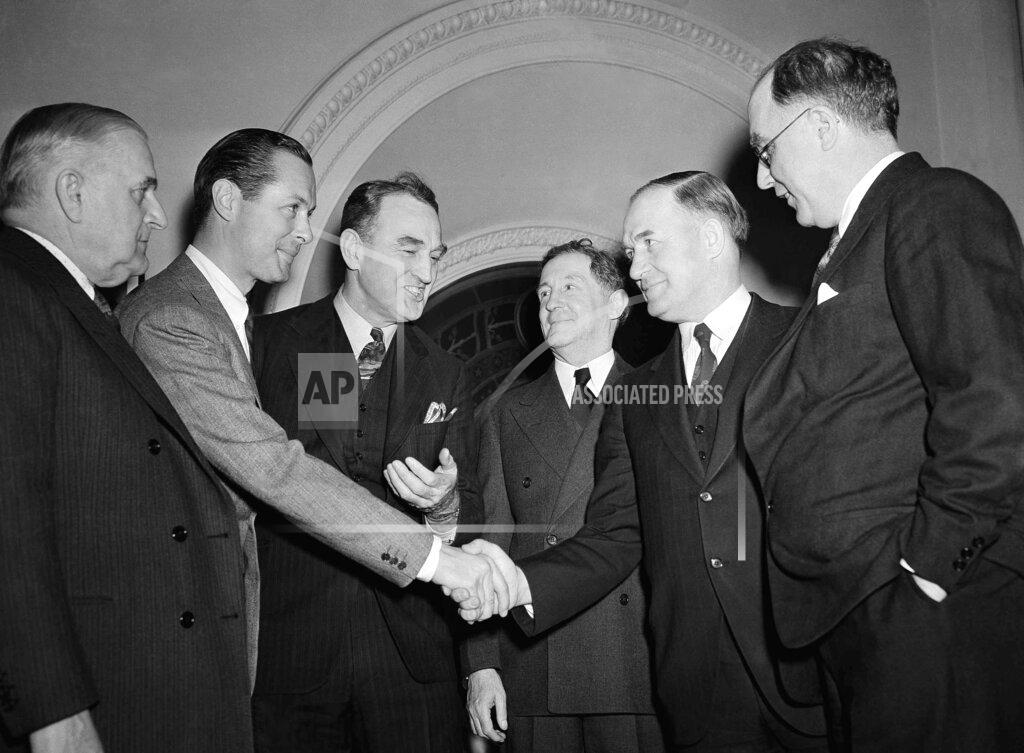
The Tennessee Valley Authority, its two remaining directors, its methods of operation and its ambitious program of navigation, flood control, electric power and fertilizer development in the Tennessee River basin received blanket and specific approval today from a majority of the Joint Congressional Committee which spent nine months and nearly $75,000 in investigating its activities.
The voluminous report, filed when the two houses convened at noon, declared that charges of dishonesty brought by Dr. Arthur E. Morgan, deposed chairman of the TVA board, against his two colleagues, Dr. Harcourt A. Morgan and David E. Lilienthal, were “without foundation, not supported by the evidence and made without due consideration of the available facts.” It held, furthermore, that the other two board members had “acted with forbearance and dignity” during the period of internal dissension before the former chairman was removed from office by President Roosevelt. “This cannot be said of Dr. A. E. Morgan,” the report added.
The majority report, which became the committee’s official finding, was signed by five Democrats, Senators Donahey (chairman), Mead, Schwartz, and Representatives Thomason of Texas and Barden of North Carolina, and one independent Republican, Senator Frazier of North Dakota.
A minority report, concurred in by Senator Davis and Representatives Jenkins of Ohio and Wolverton of New Jersey-all Republicans -attacked the TVA as shot through with “waste and inefficiency” and as being “arbitrary, dictatorial and unbusinesslike.” It recommended a sweeping reorganization of the agency, including transfer of its flood control and power generation activities from the TVA to the army engineers, and of its agricultural program to the Department of Agriculture.
In additional minority views of his own, Representative Jenkins told Congress that the majority report was a “whitewash.” He said it was “silent but unmistakable proof of a desire to withhold the true facts rather than bring them to light.”
The Senate adopted today a bill embodying part of a program to thaw out frozen export markets for cotton, by selling back to farmers at a low price, cotton pledged against loans made by the government. The bill, which represents half of a proposal sponsored by Senators Bankhead and Smith, would authorize farmers to buy at five cents a pound up to 3,000,000 bales of cotton, on which loans averaging a little under nine cents a pound have been made. The bill suggested a price of three cents, but this was raised to five cents by an amendment sponsored by Minority Leader McNary.
Majority Leader Barkley intervened to stop consideration until sometime later this week of a companion bill proposing to pay a subsidy of 3 cents a pound on new cotton grown this year by producers who cooperate in acreage-limitation proposals. The Bankhead-Smith program would cost an estimated $225,000,000 this year, but there was little expectation that it would prevail.
The Justice Department made public without official comment today a bulky report, accompanied by fourteen files of exhibits, of the investigation of the German-American Bund movement in this country which it conducted in the Fall of 1937. The report, which is purely factual and contains no conclusions, was submitted last year to the Dies committee investigating un-American activities, but was made public at this time because of the introduction recently of a resolution by Chairman Dies, which he later said. was the result of a misapprehension, asking that the report be made available to the committee.
The report, as compiled by agents of the Federal Bureau of Investigation, pictured the organization as of small size and generally restricted to some of the larger metropolitan areas in the Northeast, Middle West and the Pacific Coast. Although Fritz Kuhn, national führer, told one investigator it had 200,000 members, to another he gave the membership as 8,299, scattered among fifty locals, five of which were found not to exist. This figure tallied fairly well with those gathered from the local leaders, which gave a total of 6,617 in the forty-five posts then functioning. Both national and local officers, however, consistently refused to submit membership records to support their membership statements, it was stated.
The U.S. Supreme Court agrees to review a law taxing the salary of a Federal Circuit judge.
Senator Frazier attacks the nomination of William O. Douglas for the Supreme Court.
The reciprocal salary tax bill is amended by the Senate to make it non-retroactive up to this year.
A House committee speeds the WPA inquiry as a Senate group inclines to cut the deficiency grant.
Japan broadcasts a goodwill message at the U.S. World Fair and says relations between the two countries are growing closer.
The settlement of the Russo-Japanese fisheries dispute is expected here to result in early developments in the military situation on the Chinese fronts. It is believed that, with the tension on the Manchurian borders eased, large Japanese troop movements to the south will be made shortly with a resumption of extended activities in the late Spring.
[Ed: About that… Tension is about to explode with the Khalkhin Gol (Nomonhan) Incident.]
It is thought that the long-planned drive from Suiyuan down to Lanchow, capital of Kansu Province, will be the first major development with a simultaneous push against Sian that is designed to cut the motor route to Siberia. It is over this road that the Chinese are receiving important munitions shipments. Other drives are expected whose objectives will be to obtain control by the Japanese of the entire length of the Peiping-Hankow and Canton-Hankow railways. There may also be a westward offensive from Hankow as far as Ichang. It is understood also that South China is expecting the Japanese shortly to enlarge their scope. of operations there. These may include a push into Kwangsi Province.
A new Japanese offensive toward Changsha, Hunan Province capital, is threatening the great Chinese southwest, at present the principal reservoir of China’s war power. Generalissimo Chiang Kai-shek’s greatest defensive works lie in the southwestern provinces, and his greatest troop strength is deployed along the Hankow-Canton Railway guarding the fringe of this domain which includes the provisional seat of the Chinese Government. The Japanese west of Nanchang were advancing on a seventy-five-mile line, about fifty miles west of the Nanchang railway and within about 150 miles of Changsha and other objectives on the Hankow-Canton Railway. Chinese reports filled in a picture of bitter resistance to the Japanese Invasion. Chinese said fighting was still in progress on the outskirts of Kaoan and that several Japanese attacks in the Yochow sector had been repulsed.
The Chinese said they had destroyed tracks of the Chekiang-Kiangsi Railway, south of Nanchang, hampering the Japanese drive, and had captured two Hupeh-Honan provincial border towns, about 125 miles north of Hankow, in a campaign against Japanese communications over the Peiping-Hankow Railway. The Chinese also reported that Eighth Army units ambushed a Japanese convoy near Tatang, northern Shansi, killing or wounding 1,000 men and seizing twenty-eight loaded trucks. Other guerrillas were said to have attacked the Japanese garrison at Tacheng, central Hopeh Province, exacting 300 casualties. A campaign against foreign governments, especially the British, spread today to Hankow and Soochow, where newspaper editorials showed similarity to previous press comment in other Japanese-occupied cities. The anti-British drive started in Nanking on Thursday. when posters appeared attacking “British Imperialism” and “British support for (Generalissimo] Chiang Kaishek.”
Serious reverses for the Japanese in the Chungtiao Mountain area of southwestern Shansi are claimed by the Chinese. A series of counter-attacks, featured by swift flank assaults through the mountain passes is said to have forced the Japanese to abandon a number of recently hard-won positions at the eastern and western ends of the Chungtiao range. Five strategic villages are among the points reported to have been retaken by the Chinese at a cost to the Japanese of more than 1,000 men and a considerable amount of equipment.
In Honan the Chinese reported that they were continuing to besiege Sinyang and claimed to have routed Japanese units in the suburbs outside the wall. In Hupeh the Chinese are still counter-attacking along the Han River and no progress is reported. In Kiangsi the loss of Kaoan, fifty miles west of Nanchang, is admitted in Chungking. It is also stated that the Japanese are initiating an advance upon Changsha from Wuning.
Chinese forces in South China tonight were reliably reported to have defeated an invading Japanese army in a battle south of Canton, capturing or causing casualties among 3,000 Japanese. The Chinese attack, a surprise offensive made more effective by reinforcement by two newly arrived Kwangsi divisions, was reported to have broken the spearhead of a Japanese thrust into the Kwangtung province region. The Chinese were said to have recaptured the twice-lost city of Kongmoon, fifty miles south of Canton, and to have driven the invading Japanese back to their ships in the nearby West River.
The English Baptist Mission at Sian, Shensi Province, was reported today to have been damaged for the third time in a Japanese air raid. Two hundred houses, including the Baptist missionary residence. were said to have been destroyed in the noontime raid yesterday. Improved air-raid precautions and the previous withdrawal of many civilians restricted casualties to only a dozen. All foreigners were reported safe.
Dow Jones Industrial Average: 132.25 (-0.58).
Born:
Hawk Taylor, MLB pinch hitter, catcher, and outfielder (Milwaukee Braves, New York Mets, California Angels, Kansas City Royals), in Metropolis, Illinois (d. 2012).
Darryl Sly, Canadian NHL defenseman (Toronto Maple Leafs, Minnesota North Stars, Vancouver Canucks), in Collingwood, Ontario, Canada (d. 2007).
Catalino “Lino” Brocka, Filipino film director (Macho Dancer, Jaguar), born in Pilar, Sorsogon, Philippines (d. 1991).
Died:
Walery Sławek, 59, Polish military officer and politician (suicide).
Naval Construction:
The U.S. Navy Sargo-class submarine USS Saury (SS-189) is commissioned. Her first commanding officer is Lieutenant Commander George Warren Patterson, Jr., USN.




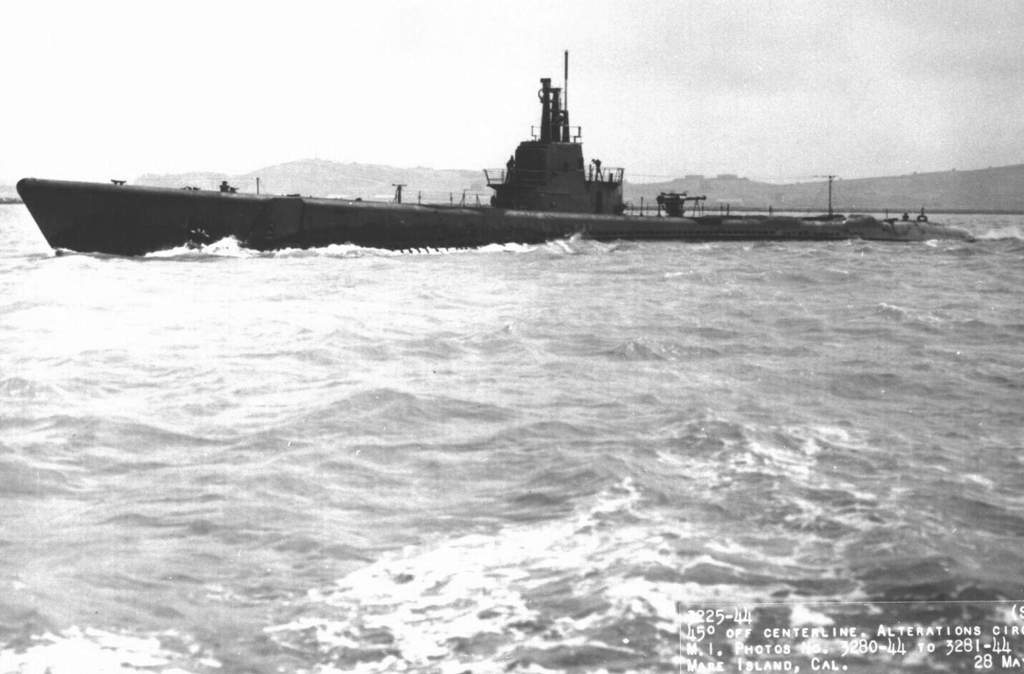
Saury was decommissioned on 22 June 1946, and her name was struck from the Navy list on 19 July. She was sold and delivered to the Learner Co., Oakland, Calif., in May 1947; and was scrapped the following October.
Saury conducted 11 war patrols and earned seven battle stars during World War II. The official JANAC credits Saury with 5 vessels sunk, for a total of 28,542 tons.
https://www.history.navy.mil/research/histories/ship-histories/danfs/s/saury.html
 History Diaries