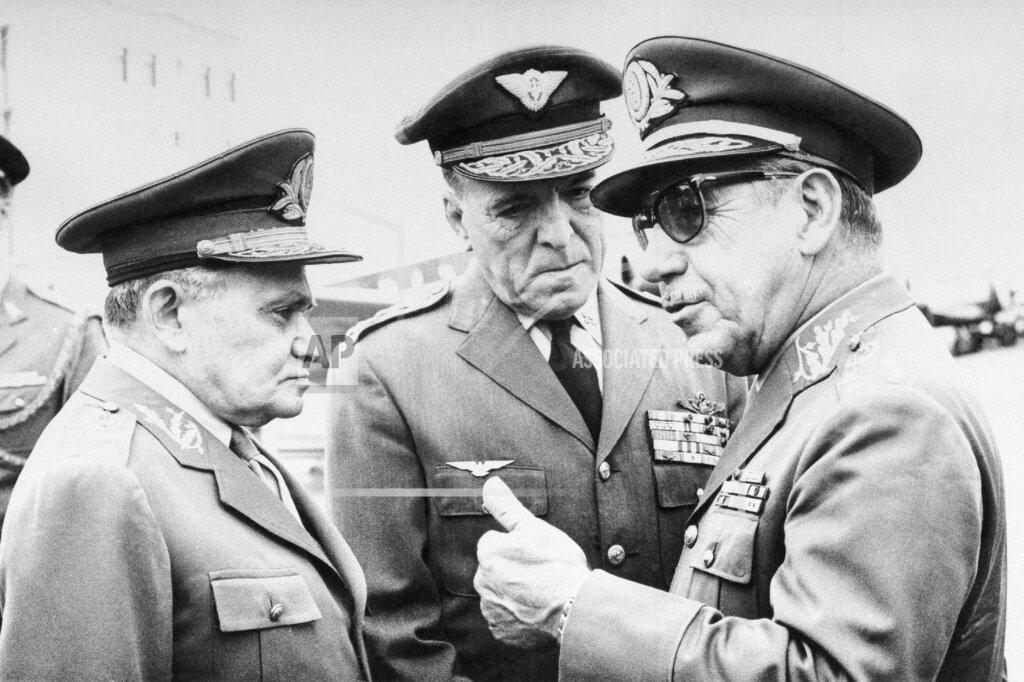
Brazil’s new President, Ranieri Mazzilli, announced today the choice of a Cabinet that he described as a “bridge between the old situation and the situation to come.” He made the announcement at his first presidential news conference after flying here from Brasilia to cope with Brazil’s ever‐perilous economic problems — with promised U.S. help — and the aftermath of the revolutionary upheaval that put him in office.
Mr. Mazzilli said that he had information that Mr. Goulart had left Brazilian territory. He declined to comment further, declaring that he was waiting for a full report on the deposed President and the situation surrounding his flight from Brazil. Police officials in Montevideo said early Saturday that Brazil’s deposed President, João Goulart, was in Uruguay, The Associated Press reported from the Uruguayan capital.
The Communist Party of the Soviet Union issued a statement calling the Communist Party of China “the main danger to the unity of the world communist movement”, and called for a summit of the leaders of the world’s communist parties. Printed in the party newspaper Pravda, the CPSU wrote that “Peking is steering a course toward a split among the communist parties, toward the setting up of factions and groups hostile to Marxism-Leninism.”
Mr. Khrushchev, who is here ostensibly to attend the celebration tomorrow of the 19th anniversary of Hungary’s “liberation,” accused the Chinese of “disruptive tactics” and a “disruptive policy.” As a result of this challenge, he said, “it can be taken for granted that the Communist parties will close their ranks more and more.” “We constantly strive for unity, especially now when there is open revision of the main line of Communist policy established in 1957,” he added.
The Soviet‐Chinese feud entered a new stage of bitterness with the publication in Moscow today of a statement by Mikhail A. Suslov, the party’s chief ideologist, condemning the position and tactics of China, and a Pravda editorial retorting to Peking’s attack on Mr. Khrushchev. In a vague proposal that is likely to arouse misgivings among some of the Eastern European countries that have begun to enjoy a measure of latitude, Mr. Khrushchev declared “new organization forms” must be found to enhance this unity. He suggested “some organization for the correlation of foreign policy between members of the Council for Mutual Economic Assistance [Comecon] and the Warsaw Pact.”
Adlai E. Stevenson, chief United States delegate to the United Nations, warned Americans today not to let the current Moscow‐Peking rift “lull us into a false sense of security.” Mr. Stevenson, in San Francisco to help plan for the 20th anniversary of the founding of the United Nations, said it would be “a tragic mistake for us to draw comfort” from the break between the Soviet Union and Communist China. “We must not look to this apparent break as a victory for our side,” he said. “Instead we must be even more vigilant and look to our own well‐being and security.” Mr. Stevenson refused to be drawn into any references to last week’s speech by Senator J. W. Fulbright, Democrat of Arkansas, who urged a reappraisal of United States foreign policy in the light of current world realities.
The Soviet Communist party disclosed today that Vyacheslav M. Molotov, Georgi M. Malenkov and Lazar M. Kaganovich had been expelled from the party. The three, once top Soviet leaders, formed the so-called anti‐party group. Mr. Molotov is a former Premier and Foreign Minister, Mr. Malenkov a former Premier and Mr. Kaganovich a former Deputy Premier. The disclosure of their expulsion from the party was made in a speech on the Soviet-Communist Chinese ideological dispute by Mikhail A. Suslov, one of the party’s secretaries. Mr. Suslov accused Mr. Molotov of having been “a better Catholic than the Pope,” an allusion to his zeal in the Stalinist purges. The text of Mr. Suslov’s speech attacking Mr. Molotov, Mr. Malenkov and Mr. Kaganovich, who were ousted from positions of leadership in 1957, appeared in Pravda, the party newspaper, today. The speech was delivered February 14 to the Central Committee of the party.
Additional charges against Mr. Molotov were contained in a section of Mr. Suslov’s speech attacking Communist China’s leaders on the ground that they were opposing Premier Khrushchev’s de‐Stalinization policy. Recalling past charges against Mr. Molotov, Mr. Malenkov and Mr. Kaganovich for their part in Stalinist purges of high‐ranking officials, Mr. Suslov said: “Not only that, but as it turned out, Molotov together with Stalin gave sanction for death sentences of wives of these officials.”
President Johnson told the nations of the North Atlantic Treaty Organization today that they must be “alive to the new spirit of diversity now abroad in Eastern Europe.” He said that NATO must also “be alert to any hope of stable settlement with those who have made vigilance essential.” “Our guard is up,” the President said, “but our hand is out.” Mr. Johnson spoke to more than 100 guests in the East Room of the White House at an observance of the 15th anniversary of the treaty organization. Included among the guests were three former commanders of the forces of the alliance.
Mr. Johnson said that “the first common task” of the nations was “to move onward to that closer partnership which is so plainly in our common interest.” He said the United States would “never turn back to separated insecurity.” The President recalled that the entry of the U. S. into NATO in 1949 had been a “historic departure.” Now, he said in remarks carried to the nation on live television, the treaty organization was “the tested and recognized foundation‐stone” of American foreign policy.
In his address, Mr. Johnson predicted a bright future for NATO. “We believe in the alliance because in our own interest we must,” he said; “because in the common interest it works; because in the world’s interest it is right.” But the President addressed himself obliquely several times to one of the major problems — the reservations of French President Charles de Gaulle about NATO’s future and about American leadership. The United States, Mr. Johnson said, found “no contradiction between national self‐respect and interdependent mutual reliance.” That was a reference to General de Gaulle’s reluctance to yield French sovereignty to a NATO role. The President also made it clear that the United States continued to believe that “the union of Europe is her manifest destiny,” although he conceded that building it would be “a long, hard job.”
Panama resumed diplomatic relations with the United States, after a split on January 17. An agreement between representatives of the two nations was signed at a meeting of the Council of the Organization of American States in Washington. The statement, worked out secretly last night, also calls for the adoption of procedures for “the prompt elimination of the causes of conflict between the two countries.” The declaration did not identify those causes, but the main issue was understood to be a review of the 1903 Canal Zone treaty, which Panama has been demanding. The vagueness of the language of the agreement was designed to avoid any impression that the United States was assuming any previous commitment that it would actually negotiate a new treaty. However, it left the door open for such negotiations by stating that the forthcoming talks would be held “without limitations or preconditions of any kind.”
The declaration said that the two Governments had agreed to designate special Ambassadors with sufficient powers to undertake “the necessary procedures with the objective of reaching a just and fair agreement, which would be subject to the constitutional processes of each country.” President Johnson, who hailed the agreement as truly a great day for the Western Hemisphere, announced at a hurriedly arranged White House ceremony following the signing of the declaration that Robert B. Anderson would be named special Ambassador for the United States.
The Chinese Communists asserted today that the Western alliance was disintegrating under the impact of a worldwide struggle for influence between France and the United States. Peking made the observation in its first commentary on the role of the de Gaulle Government in world politics since France established diplomatic relations with Communist China on January 27. Citing the extension of French interests in Asia, Latin America and other regions, the commentary said France was trying to “increase its influence so that it may be able to cope with the United States more effectively.” Both France and the United States were described in the commentary as “imperialist” powers, but the de Gaulle Government escaped the scathing criticisms directed against the Johnson Administration. The commentary was published in the authoritative weekly journal Peking Review, which is distributed in various languages throughout the world.
Peking has rejected a New Delhi protest against the alleged setting up of stone cairns by Chinese troops in the western sector of the Chinese‐Indian border area to mark the line of actual control, Hsinhua, the Chinese Communist press agency, said today.
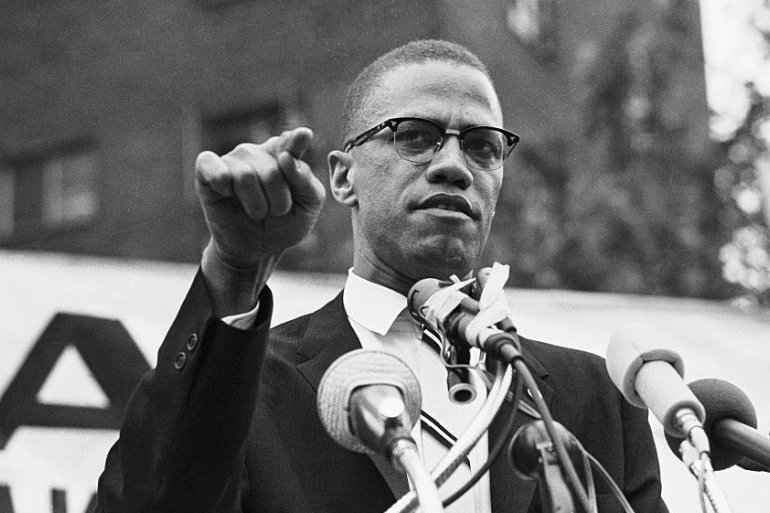
Malcolm X gave his speech, “The Ballot or the Bullet”, at the Cory Methodist Church in Cleveland, Ohio, calling on African-Americans to reconsider the policy of nonviolent resistance in pursuit of equal rights. “Don’t be throwing out any ballots,” he told the crowd; “A ballot is like a bullet. You don’t throw your ballots until you see a target, and if that target is not within your reach, keep your ballot in your pocket.” He closed by saying, “in areas where the government has proven itself either unwilling or unable to defend the lives and the property of Negroes, it’s time for Negroes to defend themselves. This doesn’t mean you’re going to get a rifle and form battalions and go looking for white folks, although you’d be within your rights… If the white man doesn’t want the black man buying rifles and shotguns, then let the government do its job. That’s all… In 1964, it’s the ballot or the bullet.”
Most of the Northern whites who came to assist St. Augustine, Florida’s Blacks in their civil rights struggle have now departed, and the 399‐year-old tourist center has regained its placid, segregated way of life. Mrs. Malcolm Peabody, the mother of Governor Endicott Peabody of Massachusetts, flew home to Boston this morning after posting a $450 bond on charges growing out of a racial demonstration. She had spent two nights in jail. Before she left, she told the Black community that its future depended on communications with white persons. “When you get together and begin to talk,” the 72‐year‐old grandmother said, “the walls really will come tumbling down.” There was little evidence today, though, that the white community had anything to say to the Blacks, and members of the civil rights movement indicated that they were preparing for a drawn‐out period of protests.
A sizable number of the city’s 15,000 residents are retired Northerners and Midwesterners who came here to absorb the bright sun. Interviews with several showed that, regardless of where they came from, they had little difficulty in adopting the prevailing Southern white’s attitude toward race relations.
Even visitors to St. Augustine who came here this week in automobiles from Illinois, Michigan and the New England states seemed to share this attitude. One elderly white woman who stepped out of an automobile with a Massachusetts license today told a motel’s employes: “We expected all sorts of trouble when we came to St. Augustine. We heard about it on the car radio all the way down. But you certainly have gotten them under control, haven’t you?” A desk clerk in another lodging place boasted, “I’m getting pretty good at telling the tourists from the troublemakers.” Asked if he worried about insulting tourists inadvertently when he questioned whether they were “outside agitators,” he said: “No. When I explain what we’re up against, they all seem to understand it.”
Black leaders in Little Rock, Arkansas called off today a school boycott planned for Monday. Parents had been asked to keep their children home that day to protest what Blacks have called a “painfully slow” pace in integrating classrooms. The boycott was put off this afternoon after the Little Rock school board reversed its previous position and agreed to several Black demands. Black leaders called the board’s action “a significant victory for justice.”
The most important concession was designation of a biracial committee to advise the board on racial matters. The first meeting of the committee was held less than an hour after the boycott was called off. In the 10 years since the Supreme Court decision calling for “all deliberate speed” in desegregating schools, only 118 of the city’s 7,000 Black pupils have been assigned to formerly all‐white schools. Black leaders have urged the board to assign each youngster to the school nearest his home regardless of race.
Two Senators argued today that the slow pace of school desegregation in the South would continue unless Congress gave the Attorney General the authority to initiate integration suits. This authority was withheld in the 1957 Civil Rights Act, but is the main provision of Title IV in the bill passed by the House of Representatives Feb. 10 and now before the Senate.
Senator Paul H. Douglas, Democrat of Illinois, contended that private litigation to force school desegregation had largely failed because Southern officials had used “every legal gimmick in the book” to evade the Supreme Court ruling of 1954 that segregation of the races in public schools violates the equal protection clause of the 14th Amendment. “It is the custom of many of our Southern friends,” Mr. Douglas said, “to ignore this amendment and to assume that it is either nonexistent or has ceased to operate.”
Senator John Sherman Cooper, Republican of Kentucky, said that since most Southern officials had refused to obey the 1954 decision as the law of the land, “the Congress must assume its responsibility under Section V of the 14th Amendment.” This section gives Congress the power to enforce by appropriate legislation equal protection of the law. Senators Douglas and Cooper are the bipartisan captains in charge of Title IV of the bill.
A solid gain in nonfarm employment and no change in the national unemployment rate were registered in March. A report today by the Labor Department also showed:
- A decline in unemployment among adult men and some rise, following a sharp drop, in teen‐age unemployment.
- A reduction of work time lost through involuntary parttime schedules.
- A drop of about 250,000 in unemployment for the first three months of 1964 as compared with the same period of 1963.
The closely watched, politically sensitive national unemployment rate held steady at 5.4 per cent. This meant that 54 of every 1,000 persons in the labor force in March were out of work and looking for a job. The labor force is made up of the employed and the jobless. Government officials were disappointed that March did not bring another drop in the unemployment rate, following February’s decline from the January level of 5.6 percent. There was, however, a sense of relief that the rate had not rebounded, as it has often done in the past.
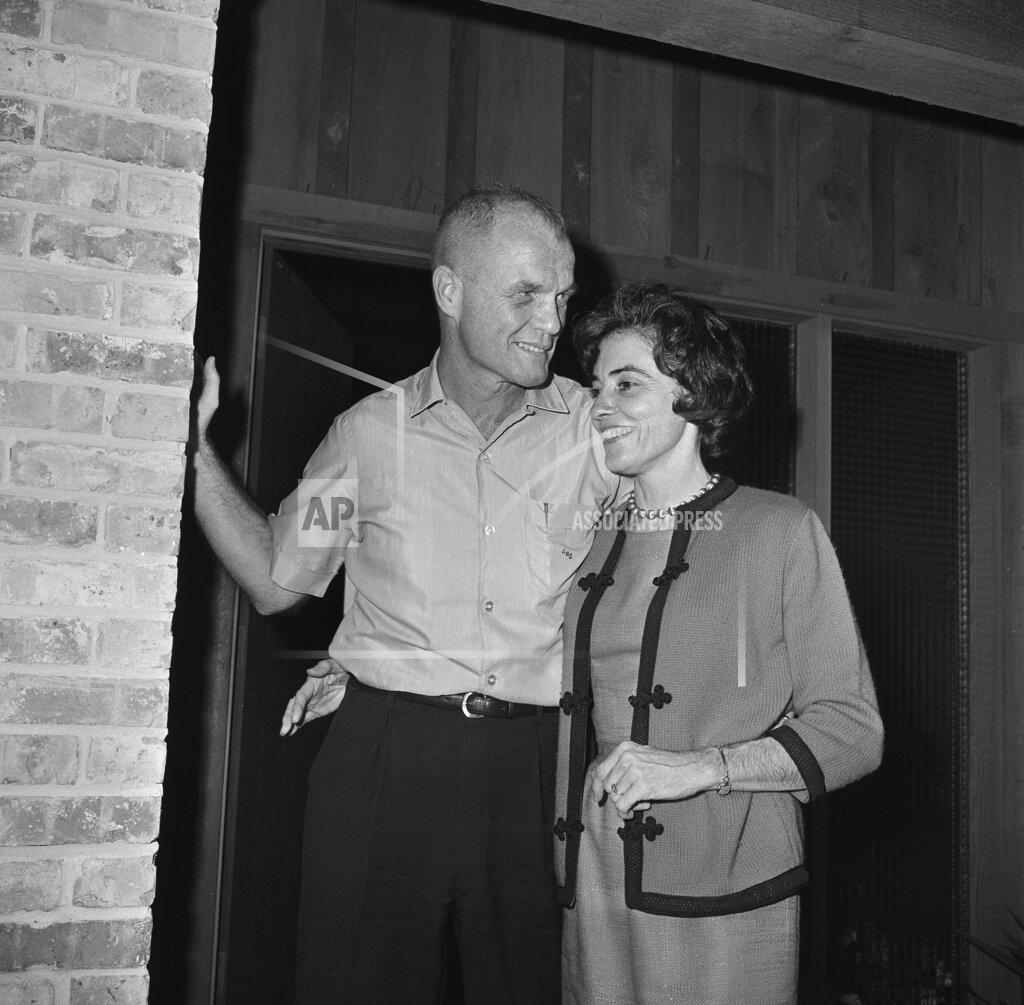
Lieutenant Colonel John H. Glenn Jr. left for his home in Seabrook, Texas, today to convalesce from the head injury that forced him out of the Ohio senatorial race. The former astronaut smiled as he left Wilford Hall Hospital at Lackland Air Force Base in San Antonio. But he walked with his feet about 12 inches apart, taking short steps in a shuffling gait. Colonel Glenn, 42 years old, fell in a bathroom in Columbus, Ohio, on February 26. The resulting head injury caused a swelling in his inner ear and disturbed his sense of balance. He withdrew Monday from the May 5 Democratic primary in Ohio.
The Glenns bought the home in Seabrook when he worked for the National Aeronautics and Space Administration. Colonel Glenn resigned from NASA when he announced for the senatorial nomination but is still a lieutenant colonel in the Marine Corps. His secretary, Nancy Lowe, drove him from the hospital today in her automobile. Hospital authorities said that Colonel Glenn would report periodically for checkups. They expect that it will take several months to recover though there seemed no question of his eventual recovery.
The Beatles hold the top 6 spots on Sydney, Australia record charts.
Pitcher Carl Willey of the Mets suffers a broken jaw when he is hit by a line drive off the bat of Detroit’s Gates Brown during a spring training loss. He will be out until June 6th but his career will be effectively ended.
Dow Jones Industrial Average: 822.99 (+2.12).
Born:
Nigel Farage, British politician, MP of the European Parliament, and co-founder of the right-wing UK Independence Party; in Farnborough, Kent, England, United Kingdom.
Shane Conlan, NFL linebacker (Pro Bowl, 1988-1990; Buffalo Bills, Los Angeles-St. Louis Rams), in Frewsburg, New York.
Andrei Lomakin, Russian Soviet National Team and NHL right wing (Olympics, Gold Medal, 1988; Philadelphia Flyers, Florida Panthers), in Voskresensk, Russian SFSR, Soviet Union (d. 2006).
Dom Campedelli, NHL defenseman (Montreal Canadiens), in Cohasset, Massachusetts.
Bjarne Riis, Danish professional bicycle racer; in Herning, Denmark.
Died:
John Haynes Holmes, 84, African-American activist and co-founder of the NAACP and the ACLU.

 History Diaries