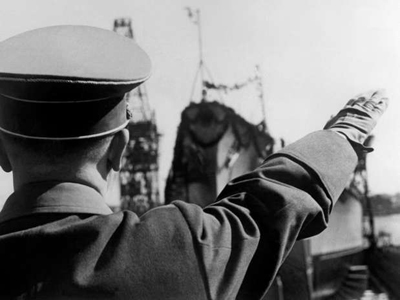
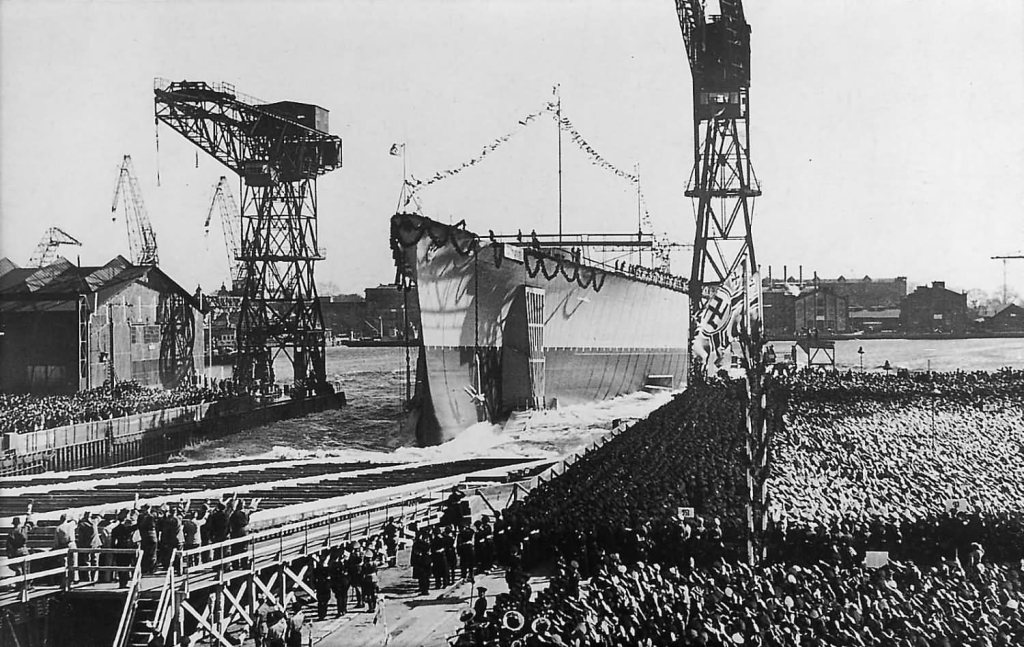
The German battleship Tirpitz was launched at the Kriegsmarinewerft shipyard in Wilhelmshaven, Germany. Grossadmiral Alfred von Tirpitz’s daughter Ilse von Hassel christened the battleship named after her father.
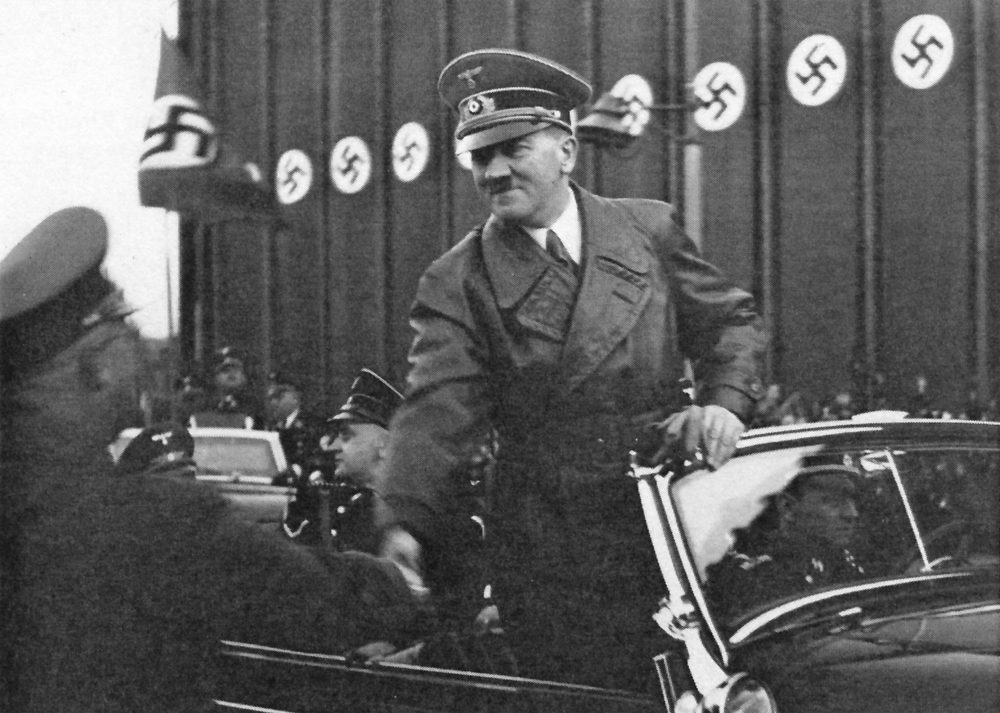
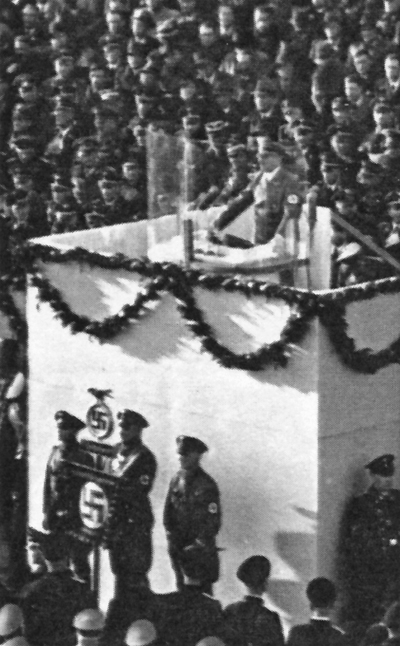
At the launching ceremony of German battleship Tirpitz, Adolf Hitler gave a fiery speech that was so extreme that it was decided at the last minute that it would not be broadcast to foreign nations in fear of talks of war provocation. The speech included a response to Neville Chamberlain’s pledge of the previous day to support Poland, saying “If they (the Western Allies) expect the Germany of today to sit patiently by until the very last day while they create satellite States and set them against Germany, then they are mistaking the Germany of today for the Germany of before the war.” The broadcast to the United States was cut off halfway, leading to false rumors that Adolf Hitler was assassinated amidst the speech.
Hitler tells General Keitel that it is a shame that “sly, old Marshal Pilsudski,” with whom he had signed a nonaggression pact, had died so prematurely, but the same could happen to him at any time, and that is why it is so important to resolve the problem of East Prussia as soon as possible
The Deutsche Werke Kiel AG operations in Kiel, Germany and the Kriegsmarinearsenal merged and became Kriegsmarinewerft Kiel.
Prime Minister Neville Chamberlain’s momentous pledge to Poland yesterday was made still more sweeping and unconditional today by official assurances that Sir Alexander Cadogan, permanent head of the Foreign Office, found it necessary to give to Count Edward Raczynski, the Polish Ambassador in London. The Poles had been disturbed by interpretations placed upon Mr. Chamberlain’s statement in several newspapers here, notably The Times, which said in an editorial this morning that the pledge “does not bind Britain to defend every inch of the present frontiers of Poland.” It had been suggested — and it is still being said — in some Conservative quarters in London that Britain would not regard the seizure of Danzig as a threat to Poland’s independence and that even Pomorze, the so-called Polish Corridor, was not intended to be covered by Mr. Chamberlain’s pledge.
This morning Count Raczynski hurriedly called at the Foreign Office to point out the deplorable effect that these suggestions would have upon Poland. Sir Alexander expressed surprise that any one should have tried to minimize Mr. Chamberlain’s statement, which, Sir Alexander said, was perfectly clear. And he promised his visitor to correct any contrary impressions without delay.
Russia and even possibly Italy may be brought into the mutual assistance pact to guarantee the independence of Poland and Rumania that Prime Minister Neville Chamberlain of Britain made public yesterday. Before the French Ministers in council at the Elysée Palace today Foreign Minister Georges Bonnet gave a confidential outline of what France hopes to do to consolidate this system of resistance to territorial changes by violence. The council devoted the major part of its deliberations to a discussion of the negotiations now in progress with Moscow, and members who were willing to talk expressed confidence that the Soviet will ultimately join France, Britain, Poland and Rumania with its full defensive strength.
Josef Beck, the Polish Foreign Minister, may be induced to come to Paris on his way home from London, and his attitude toward the Soviet may be decisive, since the Moscow government can cooperate only with the consent and collaboration of all parties to the accord. With regard to Italy, where both official and public opinion, it is believed here, is undergoing a reversal, the French Cabinet members remained more reticent. That Italy might volunteer to join in the Polish guarantee, however, is not considered impossible, and the feeling of the whole French Cabinet with regard to Italian relations is showing signs of optimism.
[Ed: Of course, this will not happen. The Poles distrust the Russians at least as much as the Germans, particularly after 1919. And without the Soviets, the “guarantee” is toothless; serving only to push Germany and the USSR into a marriage of convenience in the Fall.]
Francisco Franco announced final victory in the Spanish Civil War.
“After having made prisoner and disarmed the Red Army, the National troops have attained their final military objective. In consequence, the civil war is over.” – Communiqué‚ by General Franco.
The United States recognized Francoist Spain. The Roosevelt administration officially recognized the government of General Francisco Franco as the official government of Spain.
Pope Pius XII congratulated and blessed Franco’s victory.
On 1 April 1939, the day the war ended, the Soviet Union was the only major power that had not yet recognized Franco’s government. The new regime had signed a non-aggression pact with Portugal and a treaty of friendship with Nazi Germany on 31 March, and on 6 April, Franco made public Spain’s adherence to the Anti-Comintern Pact.
The Nationalists arrested hundreds of thousands of Republican soldiers and civilians, with 150,000 soldiers captured in the final offensive, and herded them into makeshift concentration camps. There were between 367,000 and 500,000 prisoners in 1939. In the first years after the war, 50,000 Republican prisoners were executed.
A reciprocal trade agreement was signed today between the United States and Turkey, marking the first extension of the program to the Near East. Apart from the stimulus it is expected to give to trade between the two countries, it is regarded as having more than usual political importance, inasmuch as it will make for better relations with Turkey, which stands at the farther end of the region toward which Germany has been driving in her efforts to expand her position and power in Europe. Moreover, it provides for the usual unconditional most-favored-nation principle of equal treatment for the commerce of all nations, and so strikes directly at German ambitions for economic expansion and leadership beyond the Black Sea.
A British newspaper raises Nazi ire by reporting that German troops near Poland.
Cambridge won the 91st Boat Race. The race would not be officially held again until 1946, although unofficial races were held during the war.
With some sentiment already expressed among members of the monopoly investigating committee for a new industry-by-industry approach to the regulation of competition in industry, considerable interest was expressed today in a supplemental report submitted to the committee by the Federal Trade Commission on its experience with antitrust law enforcement in various industries. The difficulties faced by the commission in trying to enforce the single standard of full competition in all non-public utility industries, as required by the present antitrust laws, was evidenced by a variety of situations arising from the commission’s enforcement efforts. In large measure, the commission blamed court interpretations of the antitrust laws and faulty draftsmanship of the laws in the first instance. The difficulties were illustrated in the commission’s summary of cases, filling about sixty pages of the official record of the committee’s hearings.
A non-partisan group of Senators started today an attempt to work out a unified farm program, the aim of which was described as being to strengthen the internal economy of the United States “against current uncertainties in world affairs.” Secretary Wallace, Edward A. O’Neal, president of the American Farm Bureau Federation, and Representative Hope of Kansas met with the Senators. The meeting, which was held in the office of Senator Lucas, attracted Senators Gillette, Herring, Norris, Burke, La Follette, Wiley, Minton, and Gurney. Mr. Lucas acted as spokesman after the meeting. “The impact of foreign affairs upon our national economy,” he said, “caused a group of us representing agricultural states of the Midwest to recognize the need for a strong, definite and unified approach to the entire farm program, realizing that the welfare of the nation is dependent upon a satisfactory solution of the problems which now confront us.” An effort will be made to get Southern Senators from the cotton States interested in the movement, Mr. Lucas said.
An undercover patronage fight has developed in the House of Representatives over a $1,046,000 appropriation for the New York World’s Fair. Some members predicted that it would take all the persuasive powers of Grover Whalen, president of the New York World’s Fair Corporation, to obtain the appropriation. Mr. Whalen asked for the money to reimburse the corporation for funds advanced to complete contracts with foreign exhibitors and to provide facilities for army and navy units at the Fair. Twice in the past few weeks action on the bill has been blocked by members on economy grounds. They contended that the Fair received $3,000,000 in Federal funds last year and protested against granting additional money. But the men who know what makes Congressional wheels go around said what has really jammed the legislative machinery is a lack of “patronage oil.” Some New Yorkers were reported “hopping mad” at what they described as “high handed” tactics adopted by Mr. Whalen in dispensing jobs.
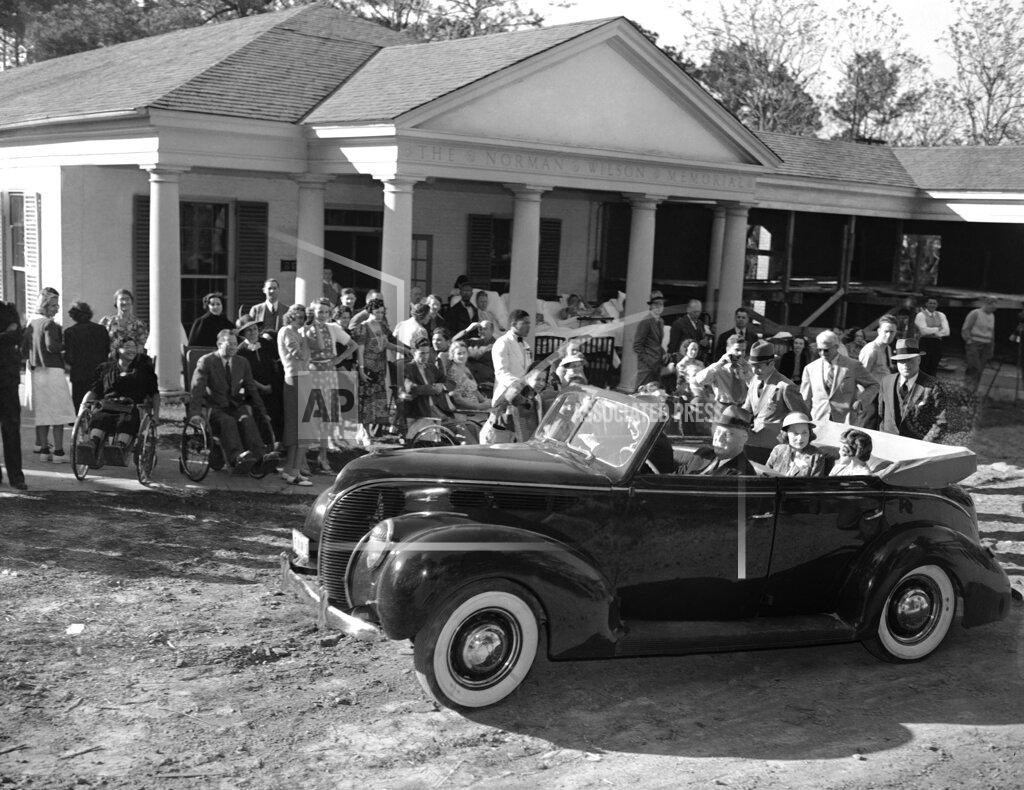
Apparently undisturbed after telephone conversations with the State Department in Washington on Chancellor Adolf Hitler’s latest statement of Nazi objectives, President Roosevelt turned his attention today to fellow-sufferers of infantile paralysis (polio). He dedicated two new buildings on the foundation here to “crippled boys and girls all over the United States and other countries for generations to come. A few hours after the Reich Chancellor had indicated his intention to remove treaty limitations on that country’s naval strength, Mr. Roosevelt was telling “the Warm Springs family” that surrounded him in wheelchairs and rolling beds how the added facilities would speed their recovery.
Secretary of Labor Frances Perkins asks the coal industry and its Appalachian miners to reach a labor accord promptly.
Charles Kimble, said to be the oldest living Union soldier, dies at age 101.
A pathologist and other specialists warn that fish gulpers may suffer from anemia. Boston College promises “drastic punishment” for those who continue with the activity.
The Western film “Dodge City” starring Errol Flynn, Olivia de Havilland and Ann Sheridan had a special premiere in Kansas.
The U.S. Navy holds the largest war games to date in the Hawaiian Island area.
Peruvian Withdrawal from the League: The government of Peru informed the League of Nations of its intention of withdrawing from the organization
Japanese planes attacked Chinese troop trains and stations today along the Chekiang-Kiangsi railway and attacked Chinese forces retreating west from Kiangsi Province into Hunan. Chinese headquarters here admitted the Japanese had occupied the town of Wuning after hard fighting in which both armies suffered extremely heavy casualties in Northwest Kiangsi, 105 miles south of Hankow and sixty-five miles northwest of Nanchang. Severe fighting raged around Kaoan, about one-fourth of the way from Nanchang to Changsha. There also were clashes elsewhere along the 100-mile battleline in North Kiangsi as the Japanese advanced slowly west and south along routes leading to Changsha.
Fengsin, forty miles west of Nanchang, was again in Chinese hands after a heavy assault had driven the Japanese out. Fengsin is astride the route to Changsha. The Japanese had captured Fengsin just before occupying Nanchang. The Chinese reported also that their troops had closed in upon Sinyang, north of Hankow, and had occupied a part of it and had cut off the Japanese garrison there.
Chungking reported that an unnamed Japanese warship sank yesterday “somewhere in the Yangtze River” when Chinese shore batteries shelled it.
Japanese at Canton reported a big drive had been launched against 10,000 Chinese troops and guerrillas west of Canton.
Japan’s motive for planting the Rising Sun flag on the Spratly Islands was to forestall a similar move by France. The French had foreshadowed such an intention and communications had passed between Paris and Tokyo on the matter. It is reported the French Government will contest the legality of the Japanese occupation on the ground that in 1934 France assumed responsibility for the islands and sent a warship there as a formal gesture of occupation.
Behind Japan’s immediate motive a wider significance is discernible. Strategically the islands are an outpost in the defense of Hainan and Japan’s action constitutes notice. that she is henceforth vitally interested in the defense of her gains in China and demands the right to suitable outposts that otherwise would be ownerless. From this angle the move may be When represented as defensive. China becomes a member of the new East Asian bloc, which is the goal of Japan’s policy. Japan will make herself responsible for China’s defense by sea as well as by land. So potential air outposts are important.
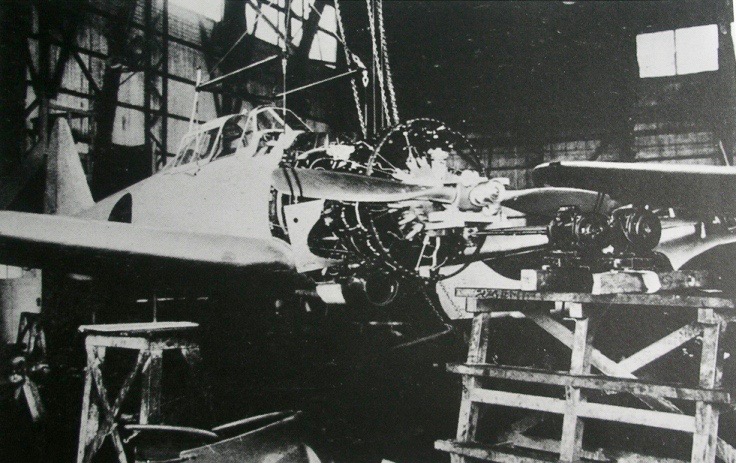
The prototype A6M Zero fighter took its maiden flight at Kagamigahara airfield, Japan. Mitsubishi Kokuki K.K. (Mitsubishi Aircraft Company) Chief Test Pilot Katsuzo Shima made the first flight of the prototype Mitsubishi A6M1 Navy Type 0 fighter at the Kagamigahara air field (now, Gifu Airbase). Completed about ten days earlier, at the Mitsubishi Aircraft Company factory at Nagoya on the island of Honshu, the prototype fighter had been disassembled so that it could be transported by road approximately 22 miles (36 kilometers) to the airfield. Beginning late in the afternoon with taxi tests and a brief “hop” to check control response, at 5:30 pm, Shima took off on what would be a successful test flight.
After the success of the A6M1’s initial flight tests, a second prototype, c/n 202, was built and testing continued. In September 1939 the Japanese Navy accepted the new fighter, the Rei Shiki Sento Ki, or “Rei-Sen,” and it was ordered into production with few changes.
Dow Jones Industrial Average: 132.83 (+0.99).
Born:
Ali MacGraw, American actress (“Love Story”, “Goodbye Columbus”), in Pound Ridge, New York.
Rudolph Isley, American rock singer (Isley Brothers, 1954-89 – “Shout”; “Twist and Shout”; “It’s Your Thing”), and minister, in Cincinnati, Ohio (d. 2023).
Phil Niekro, MLB pitcher (Hall of Fame, inducted 1997; knuckleballer; no-hitter 1973; All Star, 1969, 1975, 1978, 1982, 1984; Milwaukee-Atlanta Braves, New York Yankees, Cleveland Indians, Toronto Blue Jays), in Blaine, Ohio (d. 2020).
Vitali Davydov, Russian National Team ice hockey defenceman (Olympic gold medal, 1964, 1968, 1972; HC Dynamo Moscow), in Moscow, Russian SFSR, Soviet Union.
Nick Peters, American Baseball Hall of Fame writer (Oakland Tribune, Sacramento Bee, Berkeley Gazette, San Francisco Chronicle), in San Francisco, California (d. 2015).
Spider Martin, photographer, in Fairfield, Alabama (d. 2003).
Died:
Anton Makarenko, 51, Russian educator and writer.
Naval Construction:
The U.S. Navy South Dakota-class battleship USS Alabama (BB-60) is orderedfrom the Norfolk Navy Yard (Portsmouth, Virginia, U.S.A.).
The Kriegsmarine (German Navy) Type 1936A destroyer Z26 is laid down by AG Weser (Deschimag), Bremen (werk W960).
The U.S. civilian tanker Esso New Orleans is launched by Sun Shipbuilding & Drydock Co. (Chester, Pennsylvania, U.S.A.). She later becomes the U.S. Navy Sangamon-class oiler USS Chenango (AO-31), and then the escort carrier USS Chenango (CVE-28).
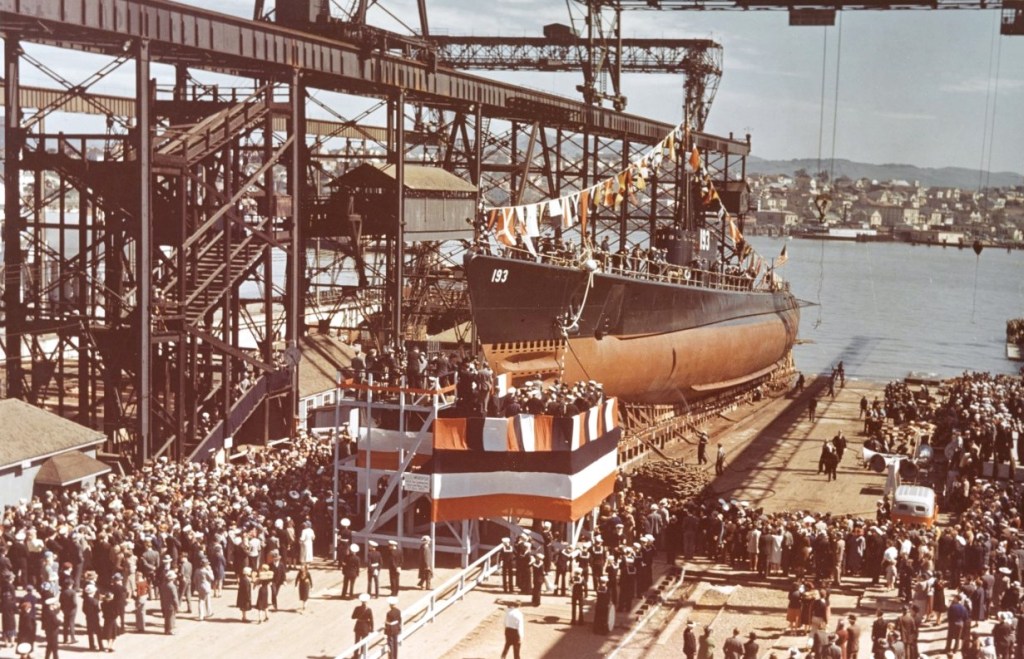
The U.S. Navy Sargo-class submarine USS Swordfish (SS-193) is launched by the Mare Island Navy Yard (Vallejo, California, U.S.A.).
The Kriegsmarine (German Navy) battleship Tirpitz is launched by Kriegsmarinewerft, Wilhelmshaven (werk S 128). Grossadmiral Tirpitz’s daughter Frau von Hassel christened the battleship named after her father.
The Regia Marina (Royal Italian Navy) Soldati-class (First Group) destroyer Bersagliere is commissioned.

 History Diaries